
Money Laundering
Money laundering is the process by which illegally obtained income (“dirty money”) is made to appear legitimate. The central objective is to conceal the true source and ownership of funds, so that they cannot be traced back to criminal activity. In the context of public finance and governance, money laundering is a serious threat to fiscal integrity, financial stability, and national security.
The Three Stages of Money Laundering
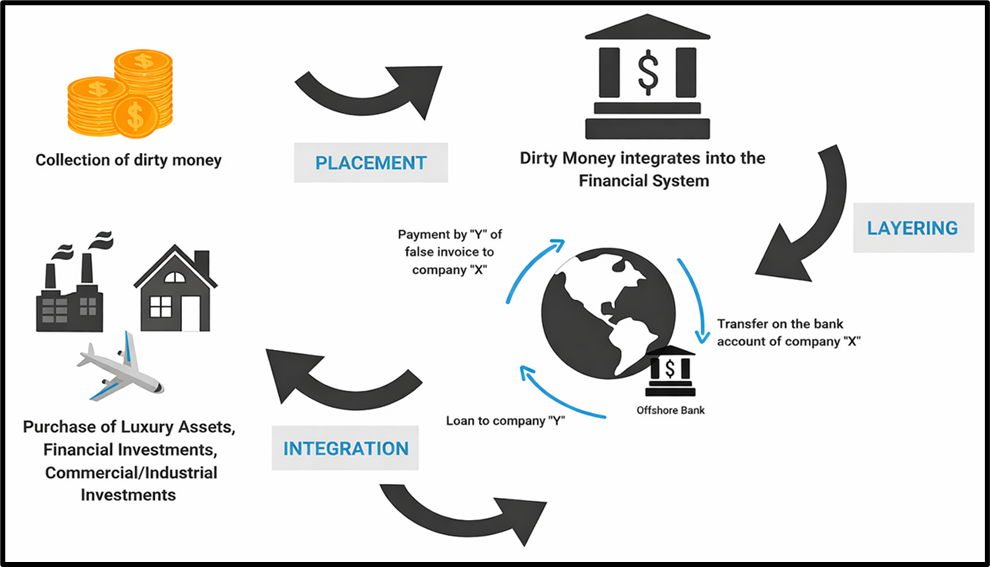
Money laundering typically unfolds in three sequential stages. Understanding these stages is crucial for conceptual clarity and answer enrichment.
1. Placement — Entry of Illicit Money into the Financial System
Placement is the first and most vulnerable stage.
What happens here?
- Illicit cash is introduced into the formal financial system
- Methods include:
- Depositing cash into bank accounts
- Purchasing real estate or luxury goods
- Using money transfer services
Example:
A person involved in drug trafficking deposits large amounts of cash into multiple bank accounts to mix it with legitimate funds.
➡️ Objective: Remove large cash holdings and reduce suspicion
2. Layering — Obscuring the Audit Trail
Layering involves creating complex chains of financial transactions to distance the money from its illegal source.
Techniques used:
- Multiple bank transfers
- Cross-border transactions
- Investments through shell companies
- Movement across jurisdictions
Example:
Funds are moved between various domestic and foreign accounts to confuse investigators.
➡️ Objective: Break the traceability of money
3. Integration — Re-entry as “Clean” Money
In the integration stage, laundered money is brought back into the economy as apparently legitimate income or assets.
Methods include:
- Investing in businesses
- Purchasing properties
- Funding legitimate enterprises
- High-value consumption
Example:
A launderer starts a lawful business using illicit funds and later earns “profits” that appear legitimate.
➡️ Objective: Enable unrestricted use of illegal wealth
Modern Methods of Money Laundering
With globalisation and technological advancement, money laundering techniques have become more sophisticated.
1. Cryptocurrencies
- Digital currencies like Bitcoin allow cross-border transfers with relative anonymity
- Criminals:
- Convert illicit funds into crypto
- Move them across wallets
- Convert back into fiat currency
➡️ Decentralisation and pseudonymity make tracking difficult.
2. Online Payment Systems
- Digital wallets and payment platforms can be misused by:
- Creating multiple accounts
- Circular transactions
- Rapid global transfers
➡️ Speed and volume complicate detection.
3. Money Mules
- Individuals recruited to:
- Receive illicit money
- Transfer it further (often abroad)
Key concern:
Many money mules are unaware participants, lured by fake job offers or commissions.
➡️ They create a buffer between crime and criminal.
4. Offshore Accounts and Tax Havens
- Use of jurisdictions with → Lax regulations, Strict secrecy laws
- Shell companies and offshore trusts disguise ownership
➡️ This severely hampers enforcement and asset recovery.
5. Online Gambling and Casinos
- Illicit funds used for betting
- “Winnings” withdrawn as clean money
➡️ High cash flows and complex transactions mask laundering.
Impact of Money Laundering (Link with Black Money)
Money laundering:
- Sustains the black money economy
- Fuels organised crime and terrorism
- Weakens financial institutions
- Distorts investment patterns
- Undermines rule of law
In effect, it legitimises illegality and corrodes economic governance.
India’s Institutional and Legal Response
India has adopted a multi-layered strategy combining legislation, institutions, technology, and global cooperation.
1. Prevention of Money Laundering Act (PMLA), 2002
- India’s primary anti-money laundering law
- Provides:
- Legal definition of money laundering
- Powers of attachment and confiscation
- Penal provisions
Obligations on financial institutions:
- Report suspicious transactions
- Maintain transaction records
- Ensure compliance
2. Financial Intelligence Unit – India (FIU-IND)
- Central nodal agency for → Collecting, Analysing, Disseminating information on suspicious transactions
Receives reports from → Banks, NBFCs, Insurance companies, Other financial intermediaries
➡️ Acts as the information backbone of AML efforts.
3. Know Your Customer (KYC) Norms
- Mandatory customer identification
- Continuous monitoring of transactions
- Maintenance of audit trails
➡️ KYC is the first line of defence against money laundering.
4. International Cooperation
Money laundering is a transnational crime, requiring global coordination.
India:
- Cooperates with other countries on → Information sharing, Asset freezing, Extradition
- Is an active member of the Financial Action Task Force
➡️ FATF standards guide India’s AML and counter-terror financing framework.
Concluding Insight
Money laundering is not merely a financial offence; it is a systemic threat to economic sovereignty and democratic governance. India’s challenge lies in staying ahead of evolving laundering techniques, while ensuring that enforcement remains fair, effective, and rights-respecting. A robust AML framework is essential for clean growth, financial stability, and national security.