
Multiple Nuclei Theory
– Understanding the Complex Urban Morphology
🔰 Context – Why a New Theory Was Needed?
“If we try to explain the structure of modern cities only through simple shapes like circles or sectors, we are oversimplifying reality.”
Earlier models like:
- Burgess’ Concentric Zone Model assumed a city grows outward in rings.
- Hoyt’s Sector Model believed development follows wedge-shaped sectors.
But Harris and Ullman argued in 1945 that urban growth is not so geometrically neat, especially in modern cities.
📌 Main Premise of the Theory
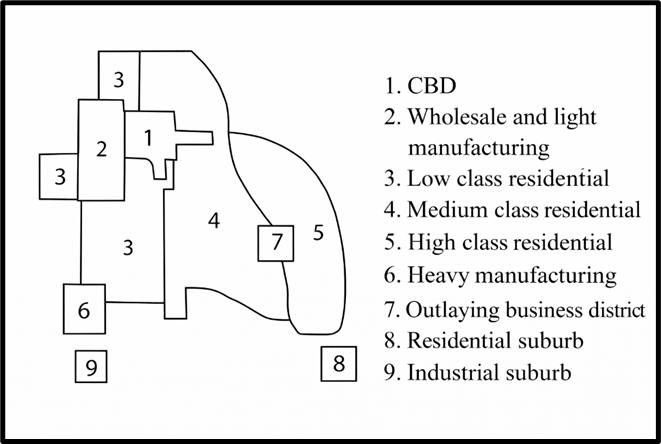
“A city doesn’t grow around just one centre — it has multiple centres or nuclei, each with its own logic and function.”
These nuclei are specialized zones, such as:
- A Central Business District (CBD)
- An industrial area
- A residential colony
- A wholesale market, and so on.
So, instead of being unicentric, modern cities are multicentric in structure.
🧱 Why Do These Multiple Nuclei Form?
The theory says urban growth results in different land uses, and these uses develop around different focal points, or “nuclei”, based on 4 major factors:
1. Functional Specialization: Certain activities need specific facilities
- For example, a Central Business District (CBD) must be located where maximum accessibility is available.
- Think of it as the economic nerve centre — offices, banks, malls, etc. — all located where transportation lines converge.
2. Functional Cohesion: Some activities benefit from being close together
- Clustering of similar industries happens due to shared benefits.
- Example: The clothing industry tends to concentrate in densely packed inner districts of a city.
- Why? Easy access to labour, suppliers, markets.
- This is known as agglomeration economies.
3. Functional Repulsion: Some activities repel each other
- Certain land uses cannot coexist.
- Example: Heavy industries and high-class residential zones.
- Pollution, noise, traffic – these don’t go well with elite lifestyles.
- Hence, they settle in different zones, forming separate nuclei.
4. Economic Constraints: Some cannot afford prime land
- Not all functions can pay the high rents near the city centre.
- So, low-income housing or bulk storage facilities are pushed to cheaper land at city margins.
- These then grow into independent zones or nuclei of their own.
🧭 Result: A City With Multiple Nodes of Growth
“So, what we get is not a neat city with one heart, but a city with many hearts — each pumping different kinds of economic and social life.”
This explains:
- Why cities develop sub-centres over time.
- Why functions are scattered and specialized in different parts of the urban landscape.
- Why land values, transport patterns, and demographics differ widely within the same city.
🗺️ Visual Representation
You can sketch a simple diagram for the exam:
🧠 Some useful Insights:
| Feature | Importance in Urban Geography |
|---|---|
| Multicentric City Concept | Reflects realistic urban growth in both developed and developing regions |
| Functional Differentiation | Shows how economic logic shapes space |
| Social Geography | Explains spatial segregation of classes, industries, services |
| Applicability | Useful to analyze megacities like Delhi, Mumbai, Bengaluru |
🚫 Criticism / Limitations
| Critique | Explanation |
|---|---|
| Too Theoretical | Does not always match ground realities of developing countries |
| Static Model | Doesn’t explain dynamic land use changes over time |
| No spatial precision | Unlike concentric circles or sectors, nuclei locations are not geometrically fixed |
✅ Conclusion
“The Multiple Nuclei Theory teaches us that a city is not a machine made of wheels and gears arranged in symmetry — it is an organic, evolving organism, with multiple centres of gravity.”
This theory is especially helpful for understanding:
- Modern urban complexity
- Polycentric urban growth
- Urban land use patterns in both Western and Indian cities