
Natural Gas Refining Industry
Imagine you get raw milk from a cow. Can you drink it directly? Technically, yes—but it’s not safe or usable in its best form. You first pasteurize it, remove impurities, and sometimes add things like vitamins. Similarly, natural gas that comes from the earth is not immediately usable. It contains a mixture of useful and non-useful components.
So, the Natural Gas Refining Industry takes raw natural gas—which is a mixture—and refines it to make it usable, clean, and marketable.
👉 Natural gas is considered a clean-burning and versatile fuel—which means it burns efficiently and produces less pollution compared to coal or oil.
Stages of Natural Gas Refining: How is Raw Gas Transformed?
Let’s understand this in three stages:
a) Separation: Sorting the Basket
Think of raw natural gas as a basket full of mixed fruits. You need to separate bananas, apples, and mangoes. Similarly, this stage separates:
- Heavier hydrocarbons: like propane, butane, ethane (these are more dense),
- From lighter components: like methane, water vapour, and impurities.
Techniques used:
- Fractionation: Sorting based on boiling points.
- Condensation: Cooling gas to turn some parts into liquid.
- Absorption: Using liquids to absorb specific gases.
👉 This stage prepares the gas stream for purification.
b) Purification: Cleaning the Gas
Now that the fruits are sorted, you need to wash them. Similarly, the next step is to remove unwanted or harmful components.
Processes involved:
- Acid gas removal: Removes hydrogen sulphide (H₂S) and carbon dioxide (CO₂), which are toxic or corrosive.
- Dehydration: Removes water to prevent corrosion and hydrate formation.
c) Processing and Finishing: Final Touches
Just like you sometimes cut and pack fruits for final sale, this stage prepares gas for specific uses:
- Liquefaction: Converts gas into Liquefied Natural Gas (LNG) for easier transport.
- Odorisation: Adds smell to methane (which is odorless) for safety.
- Blending: Mixing in certain proportions to meet market needs.
Products of Natural Gas Refining: What Do We Get?
Let’s now see what comes out of this entire process. We get multiple useful products, not just one:
a) Purified Methane
- The main component of natural gas.
- Used for electricity generation, cooking, heating, and industrial energy.
b) Heavier Hydrocarbons (Propane, Butane, Ethane)
- Used as cooking fuels, industrial feedstock, and in petrochemical industries.
- Ethane goes into plastic manufacturing.
c) CNG and LNG
- CNG (Compressed Natural Gas): Used in vehicles as an eco-friendly fuel.
- LNG (Liquefied Natural Gas): Cooled and transported over long distances—very useful for countries that import gas.
Global Distribution of Natural Gas Refining Industries
Let’s now take a geographical tour, understanding where these industries are located and why. The logic is mostly tied to natural gas reserves and infrastructure.
a) North America
- USA: Due to the shale gas boom, especially in regions like:
- Texas and Louisiana (Gulf Coast)
- Appalachian Basin (Pennsylvania)
- Canada: Alberta is the main hub.
➡ These areas have easy access to raw gas, advanced tech, and strong demand.
b) Russia
- Holds the largest gas reserves in the world.
- Key areas: Urengoyskoye and Novy Urengoy in Western Siberia.
- Russia is a major exporter, especially to Europe via pipelines.
c) Middle East
- Countries like Qatar, Iran, UAE, and Saudi Arabia are gas giants.
- Qatar is a global leader in LNG exports, thanks to vast reserves and strategic shipping access via the Persian Gulf.
d) Europe
- Europe has high energy demand but limited local gas.
- Refineries are located near import terminals.
- Key players: Germany, Netherlands, UK.
- Major pipeline: Nord Stream 1 and 2 (Russia to Germany via Baltic Sea).
- These pipelines also raise geopolitical tensions.
e) Asia-Pacific
- Australia: Projects like Gorgon and Wheatstone make it a top LNG exporter.
- China and Japan: Notable for high demand, leading to more refining and import terminals.
f) Africa
- North Africa: Algeria and Egypt have strong refining capacity.
- West Africa: Nigeria stands out with both production and refining infrastructure.
g) South America
- Argentina, Venezuela, Brazil: All have natural gas refining, primarily for domestic use.
Natural Gas Refining in India
Let’s begin with the context. India is a fast-growing economy with an ever-increasing energy demand. While coal and oil still dominate, natural gas is gaining ground because it is:
- Cleaner than coal,
- Cheaper to transport (via pipelines and LNG terminals),
- And versatile—used in cooking, vehicles, industries, and power generation.
Thus, India’s refining infrastructure is expanding in two directions:
- Where we produce natural gas, and
- Where we import it as LNG.
Distribution of Natural Gas Refining in India
Let’s explore this region-wise:
✅ West Coast: The Powerhouse of Refining
- Gujarat is the undisputed leader.
- Major refineries: Hazira, Dahej, and Gandhar.
- Why Gujarat?
- Proximity to Mumbai High and Hazira gas fields
- Strong industrial demand in western India
- Excellent coastal infrastructure for both domestic refining and LNG import.
📍Dahej LNG Terminal is among the largest in India.
✅ East Coast: Tapping Offshore Reserves
India’s east coast, though newer to the game, is rich in hydrocarbon basins.
- Krishna-Godavari Basin (off Andhra Pradesh and Odisha coast)
- Refineries: Kakinada (AP) and Dhamra (Odisha)
- This basin is considered one of India’s most promising offshore gas reserves.
- Cauvery Basin (Tamil Nadu):
- Still under exploration and development, but important for future prospects.
➡ These locations align with the offshore production strategy, where gas is piped inland to nearby refining sites.
✅ Landlocked Regions: Moving Inland with Pipelines
Gas refining is no longer restricted to the coast.
- Uttar Pradesh (Gautam Buddha Nagar)
- Rajasthan (Barmer)
Why here?
- Pipeline expansion has made it feasible.
- These refineries serve urban and industrial demand centers in northern and north-western India.
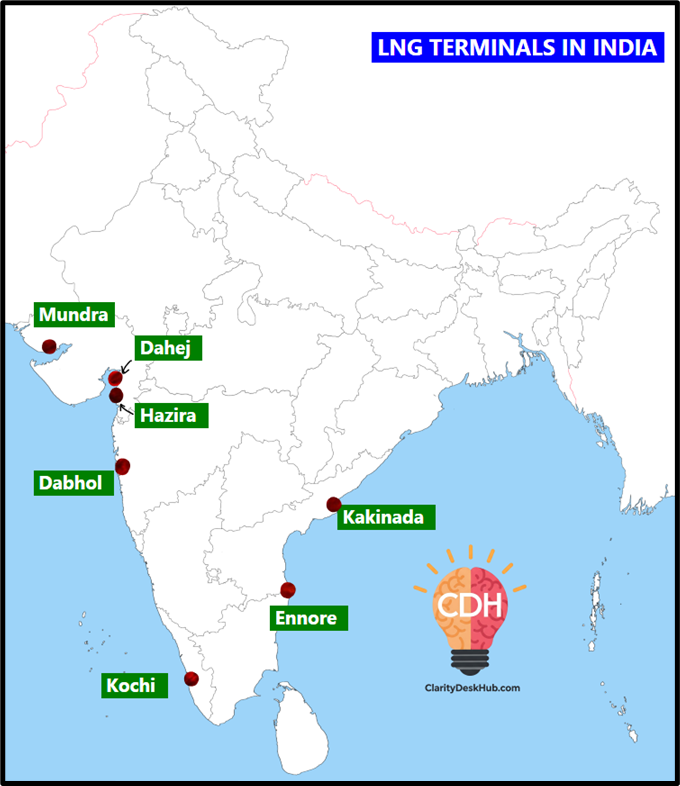
✅ Import Terminals: Gateways for LNG
Since India cannot meet all its gas needs through domestic production, LNG imports are crucial.
Key LNG terminals:
- Dahej LNG Terminal (Gujarat)
- Hazira LNG Terminal (Gujarat)
- Kochi LNG Terminal (Kerala)
➡ These terminals receive LNG from countries like Qatar, which is then regasified and transported to users inland.
Locational Factors Influencing Natural Gas Refining
Now let’s apply geographical logic. Why are some places chosen for gas refining while others are not?
We’ll understand this through key factors and examples.
(i) Resource Availability: First Logical Step
- Refineries are ideally set close to natural gas fields to save on transport and reduce losses.
- Example: Dahej is close to Mumbai High.
- Qatar places refining hubs near its North Field gas reserve.
- Type of gas matters:
- Dry gas (mostly methane) needs simpler setups.
- Wet gas (with propane, butane) needs complex fractionation.
- Water availability is also critical:
- Used in cooling systems.
- Ras Laffan (Qatar) is built near the sea for easy access.
(ii) Market Demand: Serving the Consumer Efficiently
- Refineries are placed near demand centers to save distribution costs.
- Example: Hazira Refinery (Gujarat) supplies fuel to western Indian industries.
- Cities and industrial zones with:
- Power plants
- Fertilizer factories
- Gas-based industries
… are magnet zones for refineries.
(iii) Infrastructure Factors: Roads, Rails, and Pipelines
- Refineries need:
- Access to pipelines, highways, ports, and railways.
- Example: North America’s refining hubs are aligned along interstate pipelines.
- They also require:
- Reliable electricity
- Stable gas supply
➡ Without infrastructure, even gas-rich areas become non-viable.
(iv) Government Policies and Regulation
- Incentives like:
- Tax holidays
- Subsidies
- Ease of land acquisition
- Single-window clearance
… can attract investment.
- Example: Many Middle Eastern countries offer lenient regulatory environments and state funding.
(v) Geopolitical Stability: Refining Needs Peace
- Refineries are long-term investments.
- So, companies avoid zones of:
- Civil unrest
- Terrorism
- War or sanctions
- Example: While Russia has large reserves, geopolitical tension around pipelines like Nord Stream creates uncertainty.
✅ So, we can say:
India’s natural gas refining is expanding due to:
- Rising demand
- Diversification of energy sources
- Improved infrastructure
- Strategic import terminals
However, like any industrial activity, it is shaped by geography, policy, infrastructure, and market logic.
India’s Natural Gas Pipeline Network: The Circulatory System of Energy
Just like blood vessels carry nutrients across the human body, pipelines carry natural gas across the country. This system ensures that production zones, import terminals, and consumption hubs remain interconnected.
🇮🇳 As of 2025:
India’s pipeline network has expanded significantly, reaching 24,945 km.
Let’s break this into types:
🛤️ Types of Pipelines
✅ Trunk Lines
- These are large-diameter, long-distance pipelines, like national highways for gas.
- They connect major gas fields or LNG terminals to the rest of the country.
✅ Regional Pipelines
- These act as feeder routes, distributing gas from trunk lines to smaller towns, cities, and industries.
✅ City Gas Distribution (CGD) Networks
- These are like last-mile delivery systems.
- They deliver gas directly to:
- Households (for cooking),
- Commercial units (restaurants, hospitals),
- Vehicles (CNG stations).
✅ Regional Cooperation Example
- Bangladesh-India Friendship Pipeline
- Carries gas from India to Bangladesh.
- Symbol of regional integration and energy diplomacy.
📍Major Gas Pipelines in India: With State-Wise Coverage
| Pipeline | States Covered |
|---|---|
| Hazira–Vijaipur–Jagdishpur (HVJ) | Bihar, UP, MP, Rajasthan, Gujarat |
| Kakinada–Hyderabad–Uran–Ahmedabad | AP, Telangana, Maharashtra, Gujarat |
| Dahej–Uran–Panvel–Dhabhol | Gujarat, Maharashtra |
| Krishna-Godavari Basin Pipelines | Andhra Pradesh, Puducherry |
| Dahej–Vijaipur–Dadri (DVPL) | Gujarat, MP, Rajasthan, UP |
| High-Pressure Gujarat Gas Grid | Gujarat only |
| Shahdol–Phulpur Pipeline | Madhya Pradesh, UP |
| Assam Regional Network | Assam |
Significance of Natural Gas Refinery Industries in India
Let us now understand the economic, environmental, and strategic importance of these industries.
(i) Diversification of Energy Mix
- Reduces dependency on coal and oil.
- Helps meet Paris Climate Goals and India’s Net Zero target.
- Natural gas acts as a transition fuel between fossil fuels and renewables.
(ii) Efficient & Versatile Fuel
- Used in:
- Power generation
- Fertilizer production
- Petrochemicals
- Household & CNG transport
- Flexible usage makes it a multi-sector enabler.
(iii) Environmental Benefits
“Natural gas is the cleanest of all fossil fuels.”
- Lowers carbon dioxide (CO₂) and sulphur dioxide (SO₂) emissions.
- Supports renewable energy by providing backup during intermittent supply (like when solar/wind is unavailable).
(iv) Economic Growth & Job Creation
- Building a refinery involves:
- Infrastructure
- Engineering
- Skilled workforce
- This creates Growth Poles and stimulates the local economy.
(v) Urbanization & Population Growth
- As India urbanizes, energy demand surges.
- Natural gas is a sustainable, scalable, and clean solution to meet this demand efficiently.
Global Snapshot of Natural Gas Industry
Let’s see how India fits into the global picture of gas refining.
🌐 Top Countries by Category (2023)
| Category | Countries |
|---|---|
| Top Producers | USA, Qatar, Russia, Australia, Iran |
| Top Consumers | USA, China, Russia, Japan, Iran |
| Top Exporters | Qatar, Australia, USA, Russia, Norway |
| Top Importers | Japan, China, South Korea, India, Taiwan |
India is a major importer, indicating both its dependency and market potential.
India’s Refining Capacity: Current Status
- Total Capacity (2023): ~250 MMTPA (Million Metric Tonnes Per Annum)
- Number of Operational Refineries: 23
- Target by 2030: 450 MMTPA
Challenges to Natural Gas Refining in India
Let’s now face the ground reality.
(i) Incomplete Pipeline Network
- Many landlocked and remote areas are still unconnected.
- Affects equitable access, especially in:
- Northeast India
- Rural hinterlands
(ii) Limited Storage Infrastructure
- India lacks strategic gas reserves.
- Can’t stockpile gas during low demand for future use.
- Risk of supply shocks during:
- Cold waves
- Industrial surges
- Global disruptions
(iii) Import Dependency
- Heavy reliance on imported LNG.
- Vulnerable to:
- Price volatility
- Geopolitical tensions (e.g., Russia-Ukraine, Middle East issues)
- Impacts energy security.
(iv) High Capital Requirement
- Setting up:
- Pipelines
- LNG terminals
- Processing units
- Requires huge investment and policy clarity.
- Also faces:
- Land acquisition delays
- Regulatory bottlenecks
✅ Conclusion: Where Is India Headed?
Natural gas refining is not just an industry; it is a strategic pillar of India’s future:
- Environmentally responsible
- Economically scalable
- Geopolitically significant
However, for it to reach its full potential, India must:
- Expand pipelines,
- Build storage,
- Reduce import dependency,
- And support domestic exploration and innovation.