
Newton’s Equilibrium Theory of Ocean Tides
Imagine the Earth, Moon, and Sun as three dancers performing a well-rehearsed ballet. Each exerts a pull on the others, maintaining a delicate balance of forces. This is the essence of Newton’s Equilibrium Theory of Tides, proposed in 1687 in his Principia, where he laid down the universal law of gravitation.
The Role of Gravitational Force in Tides
Newton’s theory states that every celestial body exerts gravitational attraction on every other body. In the case of the Earth-Moon-Sun system, this attraction creates an equilibrium, where:
- The Sun’s gravitational force is much stronger than the Moon’s, but because the Moon is much closer to Earth, its effect on tides is greater.
- The Earth and the Moon revolve around a common center of gravity, creating two opposing forces:
- Centripetal Force (pulling the Earth towards the Moon).
- Centrifugal Force (pulling the Earth away due to its own rotational motion).
The Formation of Tidal Bulges
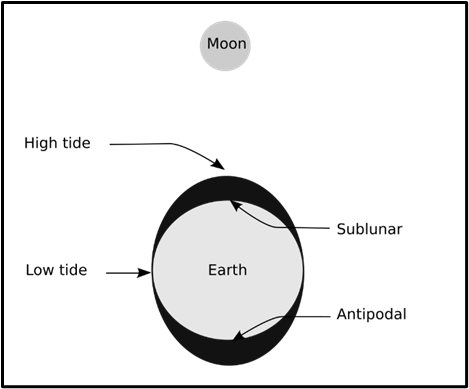
Since the Earth is not a rigid body, its water responds more flexibly to these forces. Two major tidal bulges form:
- The first bulge occurs on the side of the Earth directly facing the Moon due to the Moon’s gravitational pull.
- The second bulge forms on the opposite side because the centrifugal force of Earth’s rotation is stronger than the Moon’s gravitational pull there.
Now, visualize this: If you spin a water-filled bucket quickly, the water bulges outward on both sides due to the spinning force. Similarly, Earth’s rotation and the Moon’s pull create two simultaneous high tides.
In contrast, areas perpendicular to these bulges experience low tides, completing the two-high, two-low tide cycle every day.
Limitations of the Equilibrium Theory
While Newton’s theory explains the fundamental cause of tides, it assumes an ideal Earth covered entirely by water, which is not the reality.
- The presence of landmasses disrupts the uniform movement of tidal bulges.
- If Newton’s theory were perfect, all locations along the same meridian (longitude) should experience high tides simultaneously, but this never happens due to variations in ocean depth, coastline shape, and local geography.
Conclusion
The Equilibrium Theory provides a clear understanding of why tides occur, but it simplifies reality by assuming an Earth without continents or varying ocean depths. In reality, tides are influenced by ocean basins, local geography, and even atmospheric conditions.
To fully understand how tides work in specific locations, modern oceanography complements Newton’s theory with the Dynamic Theory of Tides, which accounts for real-world complexities.
So, while Newton gave us the foundation of tidal science, nature adds its own variations, making tides one of the most fascinating and complex oceanic phenomena!