
Rajput School of Miniature Painting
(16th–19th Century)
Background of Rajput Painting
Origin and Development
Rajput painting is a miniature painting tradition that developed in the Hindu kingdoms of Rajasthan roughly between the late 16th century and mid-19th century.
The term “Rajput painting” was formally coined in 1916 by Ananda Coomaraswamy, who identified it as a distinct indigenous tradition separate from Mughal court art.
Rajput painters were selective assimilators, not imitators. They absorbed and reworked:
- Gujarati palm-leaf painting traditions
- Persian and Mughal miniature techniques
- Limited European influence (via Mughal contact)
Yet, the emotional core remained Indian and devotional.
Purpose and Narrative Depth
Rajput paintings were created for multiple purposes:
- Religious devotion (especially Vaishnavism)
- Courtly life and historical events
- Personal and emotional expression
Unlike Mughal paintings that documented power, Rajput paintings narrated emotions.
Literary Foundations
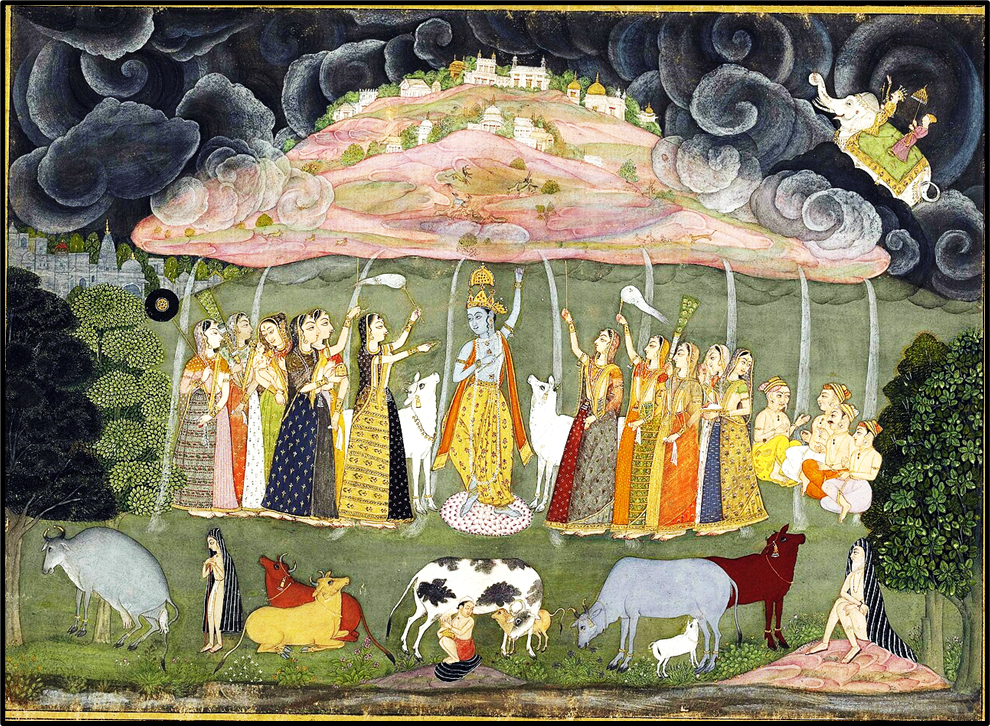
Rajput painting is inseparable from Indian literary traditions. Paintings visually interpret texts such as:
- Bhagavata Purana
- Rasikapriya
- Ragamala series (visualisation of musical modes)
These paintings were executed on waslis — layered handmade paper sheets glued together to provide thickness and durability.
Method of Production
- Painting was collaborative
- The master artist prepared the initial sketch
- Other artists filled colours, details, borders
Major Features of Rajput Painting
1. Emotional and Aesthetic Orientation
Rajput painting is → Dynamic, Romantic, Lyrical
👉 It is less intellectual and analytical than Mughal painting, and more emotive and symbolic.
2. Style and Technique
- Bright, flat colours
- Intricate surface ornamentation
- Delicate brushwork
- Emphasis on decorative beauty over realism
Rajput painters excelled in miniature precision, often illustrating manuscripts and religious texts.
3. Themes and Bhakti Influence
Themes are predominantly Hindu and devotional, deeply shaped by the Bhakti movement.
Frequently illustrated texts include:
- Git Govinda by Jayadeva
- Rasamanjari by Bhanu Datta
- Kavipriya and Rasikapriya by Keshav Das, court poet of Orchha
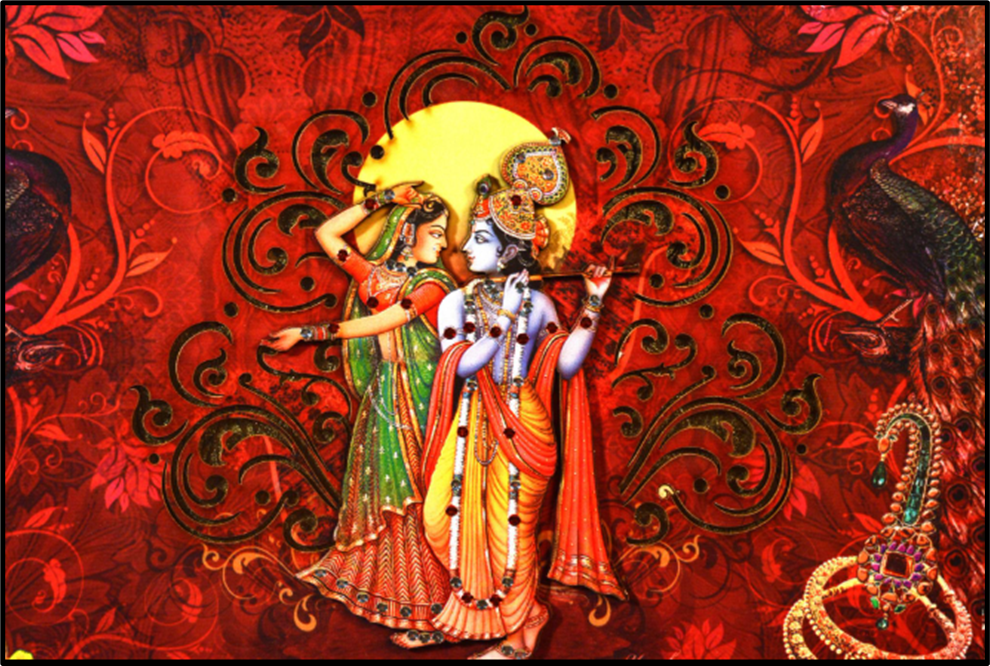
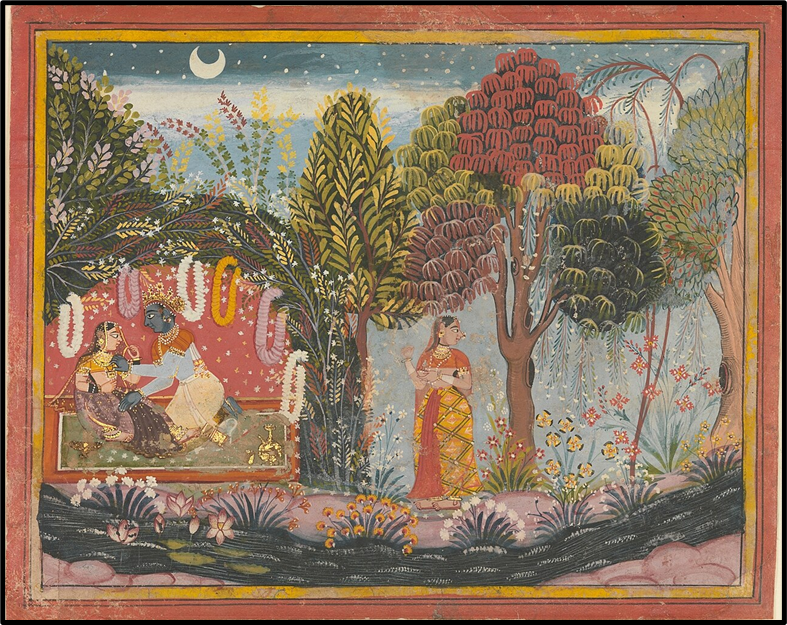
Krishna–Radha themes dominate and symbolise the soul’s longing for union with God.
4. Social Reflection and Regional Diversity
Rajput painting reflects a society that was → Feudal, Aristocratic, Clan-based, Warlike
Each Rajput kingdom had:
- Its own political culture
- Its own patron ruler
- Its own artistic temperament
👉 This explains the emergence of multiple Rajput schools (Mewar, Marwar, Bundi, Kota, Kishangarh, etc.).
5. Love as the Central Motif
Love in Rajput painting operates at two levels:
- Romantic love (nayika–nayaka)
- Spiritual love (jivatma–paramatma)
The Radha–Krishna relationship is both erotic and metaphysical.
Representation of Women
Women occupy a central and dignified place in Rajput paintings.
They are depicted as:
- Ideals of beauty
- Wearing transparent fabrics
- Stylised with → Slender faces, Elongated limbs, Revealed midriff
- Adorned with gold metallic ornamentation
Unlike Mughal art, women here are active emotional agents, not marginal figures.
Symbolism of Colour
Rajput painters used colour intentionally and symbolically:
- Yellow → passion, erotic energy
- White → purity and serenity
- Red → joy, prosperity, well-being (often used as background)
Colour is emotional language, not decoration.
Meaningful Environment and Nature
Nature in Rajput painting mirrors human emotion:
- Peacocks → romance and love (often with Krishna–Radha)
- Cloud-filled night skies → longing and separation
- Monsoon scenes → anticipation and desire
👉 Environment becomes a participant in the emotional narrative.
Schools of Rajput Painting
Rajput painting broadly developed under two major schools:
- Rajasthani School – Plains and desert regions of Rajasthan
- Pahari School – Himalayan foothills (Hill painting)
This division is geographical, stylistic, and emotional.
Rajasthani School of Painting
The Rajasthani School flourished in the Rajput kingdoms of Rajasthan from the 17th to 19th centuries.
It is further divided into four major streams, each reflecting the regional ecology, court culture, and ruler’s personality.
1. Mewar School
Centres → Nathdwara, Devgarh, Chavand, Udaipur, Shahpura
Characteristics
- Developed mainly in the 17th–18th centuries
- Simple compositions
- Bright, vivid colours
- Straightforward and emotionally direct appeal
- Minimal ornamentation compared to later styles
Themes → Ragamala series (most important), Vaishnava themes
Artists →Sahibdin (most famous), Manohar, Jagannath
Special Styles
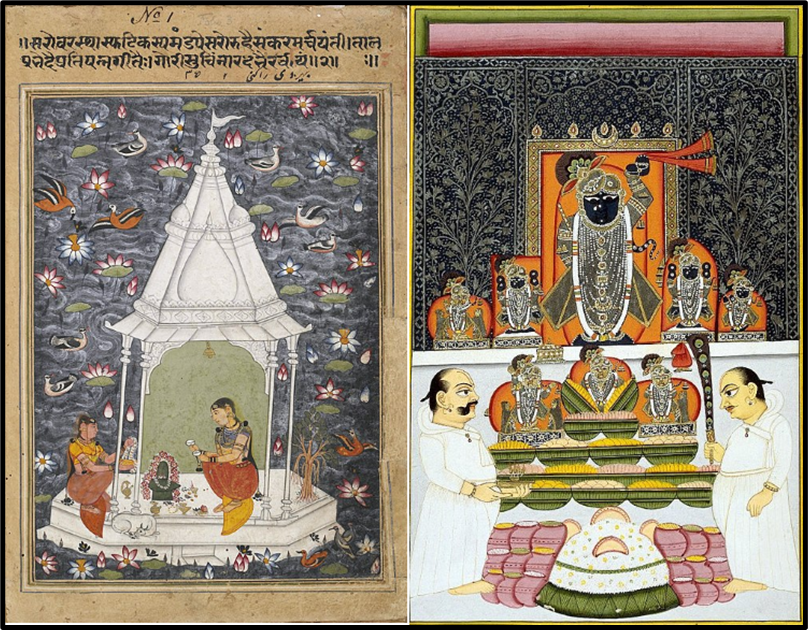
- Nathdwara:
- Famous for Pichhwai paintings
- Strong devotional focus on Shrinathji
- Influenced by Thanjavur painting traditions
- Chavand Ragamala (1605):
- Painted by Nisardin
- Earliest dated Rajasthani Ragamala
- Earliest documented Mewar painting
UPSC hook:
Mewar = simplicity + devotion + Ragamala
2. Marwar School
Centres → Jodhpur, Kishangarh, Bikaner, Nagaur, Pali, Ghanerao
General Features
- Originated in Jodhpur
- Bold lines
- Dominant primary colours (red, yellow)
- Clear Mughal influence in costume and ornamentation
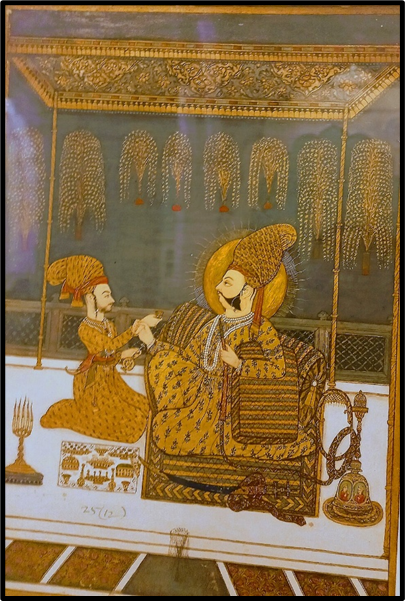
(a) Kishangarh School (Most Stylised)
- Emerged in the 18th century
- Most stylised of all Rajasthani schools
Facial Features (VERY IMPORTANT) → Pointed nose and chin, Arched eyebrows, Lotus-petal shaped eyes, Serpentine hair locks, Intense spiritual–romantic expression
Patron & Muse
- Raja Savant Singh → Poet with pen name Nagari Das
- Inspired by Bani Thani
- Master artist: Nihal Chand
UPSC hook:
Kishangarh = Bani Thani + extreme stylisation
(b) Bikaner School
- Strong Mughal elegance
- Subdued colour palette
- Many Mughal artists worked here in the 17th century
- Unique feature:
- Artists signed their portraits
- Makes Bikaner one of the best-documented schools
3. Hadoti School
Centres → Bundi, Kota, Jhalawar
Patron → Rao Chattar Shal
(a) Bundi School
- Emerged in 17th century, peaked in early 18th century
- Influences → Mughal, Deccan
Key Characteristics → Lush vegetation, Dramatic night skies, Water shown as light swirls on dark background, Strong sense of movement
Themes → Royal tiger hunts, Court life, Baramasa (twelve months), inspired by Kavipriya of Keshav Das
(b) Kota School
- Specialised in → Hunting scenes, Animal chases, Combat
- Artists were masters in → Rendering animals, Dynamic action
UPSC hook:
Bundi = romance + landscape | Kota = hunt + action
4. Dhundar School
Centres → Amber, Jaipur, Shekhawati, Uniara
Characteristics
- Graceful women → Large eyes, Round faces, Long necks, Pointed noses
(a) Amber
- Strong Mughal influence
- Ornamented costumes
- Blend of Mughal elegance and Rajasthani folk elements
(b) Jaipur
- Excelled in → Life-size portraits, Mythological scenes, Ragamala, Astrology, Erotic themes
- Large canvas
- Ornate backgrounds
- Bright decorative borders
Prominent artists → Sahib Ram, Chandras, Lall Chittara
(c) Shekhawati
- Famous for painted Havelis and temples
- Distinct features:
- Elephants and horses in bold relief on brackets
- Gods and goddesses painted on main gates
Mughal Influence on Rajasthani Schools
A strong Mughal connection began when → Raja Bharmal married his daughter Jodha Bai to Akbar (1562)
This political alliance intensified artistic exchange.
Pahari School (Hill Painting)
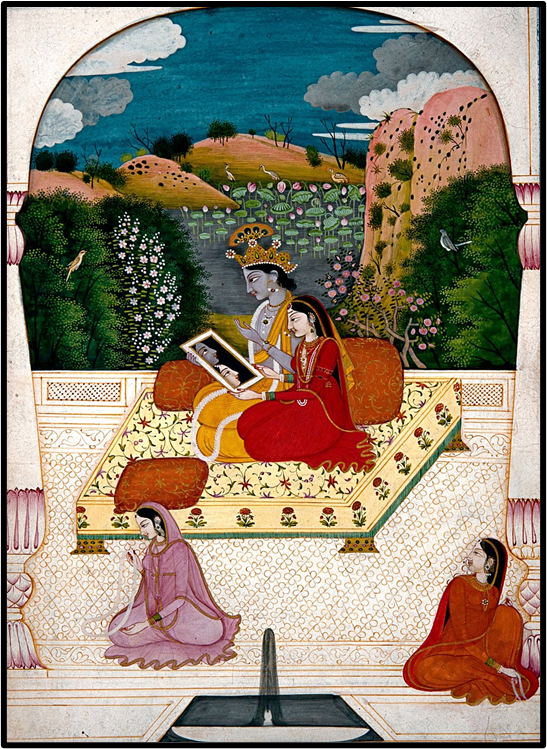
Region and Centres
- Himalayan foothills
- Centres → Basohli, Jammu, Guler, Kangra
Common Themes
- Ashta Nayikas (eight emotional states of women)
- Love, devotion, separation, longing
Basohli School
- Bold, intense colours
- Strong, vigorous lines
- Unique jewellery depiction:
- Thick raised white paint
- Green beetle wings used to represent emeralds
Kangra School (Most Poetic)
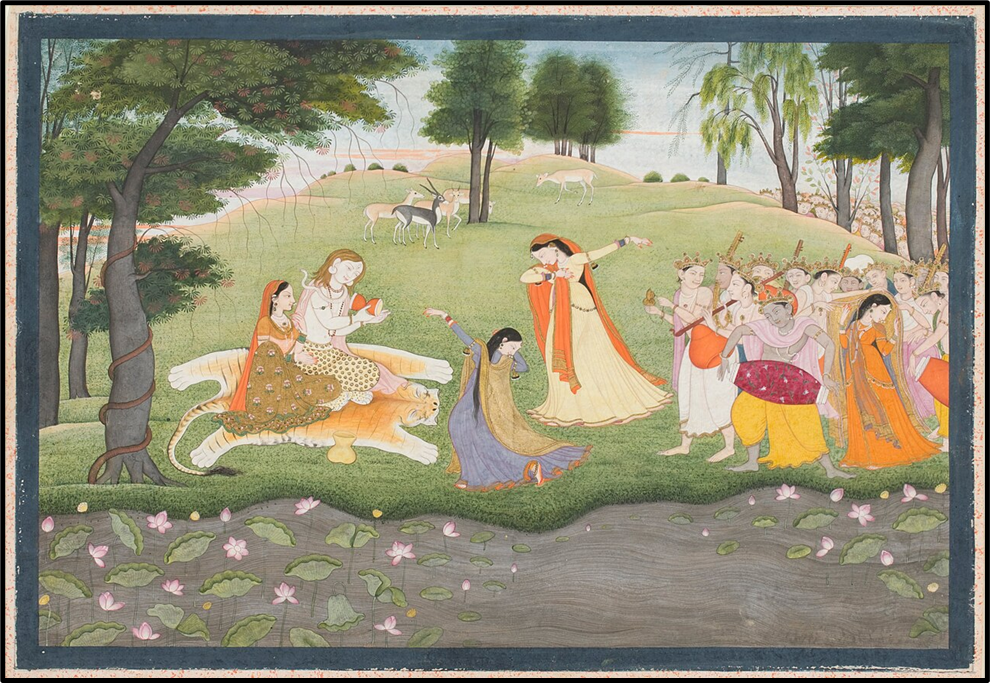
- Originated in early 18th century
- Emerged when Kashmiri artists trained in Mughal style migrated to Guler
- Blossomed under Raja Sansar Chand (1775–1823)
Features
- Extremely delicate lines
- Brilliant but soft colours
- Minute decorative details
- Serene beauty and emotional depth
Kangra painting is regarded as the most lyrical and poetic of all Indian miniature styles.
Rajasthani and Pahari Paintings: A Conceptual Comparison
1. Geographical Origin
- Rajasthani School
Originated in the princely states of Rajasthan — Mewar, Marwar, Bundi, Jaipur, Kishangarh, etc.
The geography is arid and semi-arid, which explains → Flat backgrounds, Decorative surfaces, Architectural emphasis - Pahari School
Emerged in the hilly regions of North India, especially → Himachal Pradesh, Jammu, Parts of Punjab
The Himalayan landscape deeply shaped its visual language.
2. Subject Matter
- Rajasthani Paintings → Episodes from Ramayana and Mahabharata, Court scenes and royal portraits, Local legends and daily life, Ragamala themes
- Pahari Paintings → Predominantly romantic and devotional, Radha–Krishna love episodes, Lives of Hindu deities, strongly spiritual and emotive
👉 Key difference:
Rajasthani = narrative + courtly
Pahari = lyrical + devotional
3. Style and Technique
- Rajasthani School → Bold, vibrant colours; Strong outlines; Flat, stylised figures, Heavy ornamentation
- Pahari School → Soft, delicate colour palette; Flowing, graceful lines, Greater naturalism, Emphasis on facial expressions and emotions
4. Landscape and Background
- Rajasthani Backgrounds → Ornamental and flat, Floral motifs, Architectural frames, Frequent use of gold leaf
- Pahari Backgrounds → Naturalistic landscapes; Mountains, rivers, trees, Lush greenery; Calm, serene atmosphere reflecting hill ecology
5. Influence and Patronage
- Rajasthani School
- Rooted in local Rajput culture
- Strong Mughal influence due to political alliances and court interactions
- Pahari School
- Deeply influenced by the Bhakti movement
- Vaishnavism (Krishna devotion) dominant
- Patronised by hill Rajput rulers who were devout Krishna worshippers
Comparison Snapshot
| Aspect | Rajasthani | Pahari |
| Region | Rajasthan plains | Himalayan foothills |
| Mood | Bold, narrative | Soft, lyrical |
| Themes | Epics, courts | Radha–Krishna |
| Figures | Stylised, flat | Graceful, expressive |
| Landscape | Decorative | Naturalistic |
Ragamala Paintings
Meaning and Essence
Ragamala literally means “Garland of Ragas.”
It is a unique miniature painting tradition that visually represents Indian classical music, translating sound and emotion into form and colour.
- Flourished between 16th and 19th centuries
- Represents the fusion of music, poetry, and painting
- Practised across multiple schools → Rajput, Pahari, Deccan, Mughal
Structure of a Classical Ragamala Set
1. Standard Composition
A complete Ragamala set generally consists of:
- 36 paintings
- Depicting male–female relationships
- Linked to → Different times of the day, Different seasons, Different emotional states (rasa)
2. Personification of Music
In Ragamala paintings:
- Each raga is personified as → A deity, A hero or heroine
- Each raga has a feminine counterpart called Ragini
Examples:
- Bhairava / Bhairavi → Associated with Shiva
- Sri → Associated with Devi
Thus, music becomes mythological and emotional, not abstract.
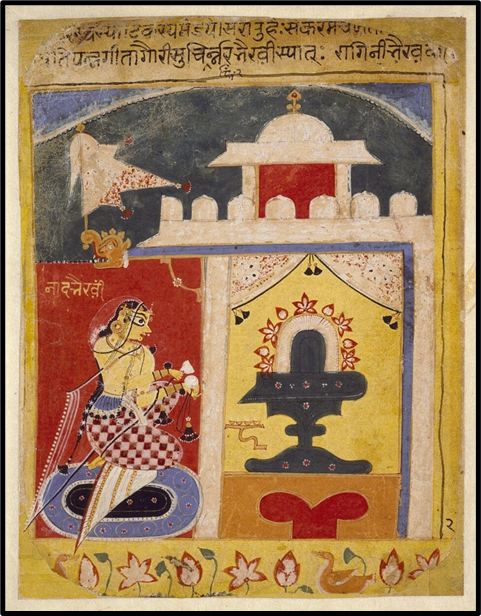
3. The Six Principal Ragas
The six main ragas in Ragamala tradition are → Bhairava, Deepak, Sri, Malkaunsa, Megha, Hindola
These correspond symbolically to the six seasons → Summer, Monsoon, Autumn, Early winter, Winter, Spring
Often, the poetic mood (rasa) is written on the margins of the painting.
4. Symbolic and Emotional Imagery
Ragamala paintings use → Romantic couples, Moonlight and night skies, Animals and birds, Palaces and gardens
Each element visually conveys the emotional tone of the raga, such as longing, joy, separation, or devotion.
5. Ornamentation and Detail
- Rich costumes
- Intricate jewellery
- Elaborate architectural settings
- Fine detailing enhances emotional depth and elegance
6. Regional Variations
Ragamala paintings were created in multiple traditions → Rajput Ragamala, Pahari Ragamala, Deccan Ragamala, Mughal Ragamala
A notable patron of Deccan Ragamala was Ibrahim Adil Shah II
→ Ruler of Bijapur
→ A connoisseur of music and painting