Ramsar Sites in India
Background
Wetlands in India are not random dots on a map — they are living classrooms of geography 😊. Some lie quietly in the Himalayas, fed by glacial melt; others stretch along the coasts where rivers meet the sea; some are oxbow lakes of the Ganga plains; and many are community-managed tanks and reservoirs of peninsular India.
After joining the Ramsar Convention in 1982, India began identifying these ecologically precious landscapes as Ramsar Sites. With 90+ sites today, India stands among the top wetland-protecting nations in the world. For an aspirant, studying these sites is not just about knowing names — it is about understanding India’s hydrology, climate zones, biodiversity corridors, and human–nature relationships.
When we talk of India’s Ramsar Sites, we are not simply memorizing lakes and marshes — we are looking at a geographical mosaic of how India’s physiography, climate zones, biodiversity corridors, river systems, and community traditions have shaped wetland conservation. Ramsar Sites reveal the ecological signature of each region, and that’s exactly what you should be aware of
Spatial Variation — Why Some States Have Many Sites, Others Have Few
Tamil Nadu: “The Tank & Lagoon Culture”
The highest number of Ramsar Sites. Why? Because TN has:
- Thousands of traditional irrigation tanks
- Long coastline + lagoons + mangroves
- Strong community conservation traditions
- High IBA (Important Bird Area) density
TN’s Ramsar profile = man-made tanks + coastal wetlands + mangroves.
UPSC angle: Tank irrigation, deltaic evolution, community-managed wetlands.
Uttar Pradesh: “The Oxbow Belt of India”
Most UP wetlands are:
- Oxbow lakes on the Ganga floodplain
- Barrage-created wetlands
- Bird sanctuaries on migratory routes
UPSC angle: Oxbow formation → Fluvial geomorphology + floodplain ecology.
Odisha & West Bengal: “The Delta Powerhouses”
The eastern coast wetlands reflect:
- Lagoon systems (Chilika)
- Estuaries and backwaters
- World’s largest mangrove delta (Sundarbans)
UPSC angle: Coastal geomorphology → lagoons, deltas, mangroves.
Himalayan States: “Altitude Creates Rarity”
Himachal, Ladakh, J&K have:
- High-altitude saline and freshwater lakes
- Snow-fed marshes
- Glacial systems → pristine but fragile
These sites are few but ecologically exceptional.
UPSC angle: Altitude → endemism → climate sensitivity.
Ecological Patterns — What Makes Indian Ramsar Sites Unique
The Central Asian Flyway Backbone
Most Ramsar Sites fall on the Central Asian Flyway, making India a global bird-migration hub.
UPSC angle: Flyways + migratory species protection + IBA network.
Oxbow Lakes & Floodplain Wetlands Dominate the Indo-Gangetic Plain
Bihar, UP, Bengal wetlands revolve around:
- River migration
- Meander cutoff
- Seasonal flooding
Oxbow lakes = geomorphology + ecology + livelihoods.
Mangroves, Lagoons & Estuaries Rule the Coasts
Sundarbans, Pichavaram, Bhitarkanika, Gulf of Mannar — all are climate buffers:
- Cyclone protection
- Nursery for fish/prawns
- High productivity zones
Man-made Wetlands Are Equally Important
Many Indian Ramsar Sites are:
- Tank systems (TN)
- Reservoirs (MP, Karnataka, Odisha)
- Barrage-created lakes (UP)
India’s Ramsar profile blends natural + cultural hydrology.
Species Patterns — What Species Keep Reappearing?
Across states, these species repeatedly appear as flagship or threatened indicators:
Birds
- Sarus Crane (VU) → Wet grasslands of UP & MP
- Pallas’s Fish Eagle (EN) → North & NW India
- Common Pochard (VU) → Wintering grounds
- Indian Skimmer (EN) → Ganga & coastal sites
- Baer’s Pochard (CR) → Bihar, UP, North India
Reptiles
- Gharial (CR) → UP River Systems
- Olive Ridley Turtle (VU) → Odisha
- Roofed turtles → Indo-Gangetic oxbow wetlands
Mammals
- Fishing Cat (VU) → Eastern wetlands
- Indus River Dolphin (EN) → Beas
- Red Panda (EN) → Khecheopalri (Sikkim)
- Saltwater Crocodile (LC) → Bhitarkanika
Hydrological Logic — Wetlands Are Climate Infrastructure
Ramsar Sites perform India’s most crucial ecosystem services:
- Flood buffering (Ganga plains, Odisha, Assam)
- Groundwater recharge (UP, Bihar, TN tanks)
- Salinity regulation (Sundarbans, Vembanad)
- River-flow maintenance (Asan, Wullar, Hirakud)
- Disaster mitigation in cyclonic/coastal regions
Each site is a hydrological safety valve.
Threat Patterns
Across the sites, threats fall into five repeating categories:
- Siltation & sedimentation (Ganga basin, Kashmir valley)
- Invasive species (Prosopis, hyacinth, African catfish)
- Urbanisation & sewage (Pallikaranai, East Kolkata)
- Hydrological alteration (dams, barrages)
- Climate stress (drying of oxbow lakes, salinity shifts in lagoons)
These threats are deeply geographical — tied to terrain, rivers, climate, and human pressure.
The “Geography Connection” – Why Wetlands Appear Where They Do
Each physiographic region contributes a signature wetland type:
| Region | Dominant Wetland Types | Why? |
|---|---|---|
| Himalayan region | Glacial lakes, snowmelt marshes | High altitude hydrology |
| Indo-Gangetic Plain | Oxbow lakes, floodplain marshes | River migration, flooding |
| Peninsular Plateau | Reservoirs, tanks, crater lakes | Hard rock geology + irrigation |
| Eastern coast | Lagoons, estuaries, mangroves | Deltas + tidal action |
| Western coast | Backwaters, estuaries | Narrow coastal plains + monsoon |
| Desert/Arid zone | Salt lakes, ephemeral wetlands | Interior drainage + high evaporation |
High-Value Prelims Pointers
- Largest Ramsar Site → Sundarbans (4230 km²)
- Smallest → Renuka Lake, Vembannur (0.2 km²)
- Oldest → Chilika & Keoladeo (1981)
- Highest Ramsar State → Tamil Nadu
- Only floating national park → Keibul Lamjao (Loktak)
- CR species hotspots → Bihar oxbow lakes & UP floodplains
Now after going through the analysis upto now, I believe you are ready for the comprehensive list of Ramsar Sites and their map locations. Here you go!
List of Ramsar Sites in India
The following is the most recent and comprehensive list of India’s Ramsar Sites. Each site is hyperlinked for easy access to detailed information:
| S. No. | Ramsar Site | Year | State / UT | Wetland Type | Key Feature | Area (ha) |
|---|---|---|---|---|---|---|
| 1 | Kolleru Lake | 2002 | Andhra Pradesh | Freshwater natural lake | Between Godavari–Krishna deltas; natural flood-balancing lake | 90,100 |
| 2 | Deepor Beel | 2002 | Assam | Freshwater lake | Only major storm-water basinof Guwahati; large stork populations | 4,000 |
| 3 | Kabartal Wetland (Kanwar Jheel) | 2020 | Bihar | Floodplain wetland | Major monsoon flood absorber; habitat for 3 critically endangered vultures | 2,620 |
| 4 | Nagi Bird Sanctuary | 2023 | Bihar | Reservoir (damming of Nagi River) | One of India’s largest bar-headed goosecongregations | 206 |
| 5 | Nakti Bird Sanctuary | 2023 | Bihar | Man-made reservoir | Hosts one of the largest red-crested pochardcongregations | 333 |
| 6 | Gokul Jalashay | 2025 | Bihar | Oxbow lake (Ganga floodplain) | >50 bird species; important buffer during monsoon floods; supports fishing, farming & traditional weed-removal festival. | 448 |
| 7 | Udaipur Jheel | 2025 | Bihar | Freshwater lake (oxbow) | Surrounded by Udaipur Wildlife Sanctuary; >280 plant species; important wintering site for ~35 migratory birds; includes endemic plant Alysicarpus roxburghianus. | 319 |
| 8 | Gogabeel Lake | 2025 | Bihar | Oxbow wetland between Ganga & Mahananda | Bihar’s first Community Reserve; major wintering ground on Central Asian Flyway; supports vulnerable speciesincl. common pochard & Wallago attu; community-managed. | 87 |
| 9 | Kopra Jalashay | 2025 | Chhattisgarh | Freshwater source | A nutrient-rich reservoir in the Mahanadi catchment that supports 60+ migratory bird species, including vulnerable and endangered raptors. | 210 |
| 10 | Nanda Lake | 2022 | Goa | Freshwater marsh | Linked to Zuari River; supports diverse migratory waterbirds | 42 |
| 11 | Nalsarovar Bird Sanctuary | 2012 | Gujarat | Freshwater lake (relict sea) | Largest natural wetland in Thar Desert; stopover for Sociable Lapwing | 12,000 |
| 12 | Thol Lake Wildlife Sanctuary | 2021 | Gujarat | Shallow reservoir | Central Asian Flyway site with 320+ bird species | 699 |
| 13 | Wadhvana Wetland | 2021 | Gujarat | Irrigation reservoir | Important wintering ground; Dalmatian pelican & Pallas’s fish-eagle | 630 |
| 14 | Khijadia Wildlife Sanctuary | 2021 | Gujarat | Freshwater–coastal wetland | Supports 310+ bird species; >20% of regional common cranepopulation | 512 |
| 15 | Chhari Dhand | 2025 | Gujarat (Kutch) | Seasonal saline wetland | Located between Banni grasslands and salt flats of Kachchh; key habitat for migratory birds | 22,700 |
| 16 | Bhindawas Wildlife Sanctuary | 2021 | Haryana | Man-made freshwater wetland | Largest wetland in Haryana; 1.7% of global greylag goose popn | 412 |
| 17 | Sultanpur National Park | 2021 | Haryana | Shallow lake system | >220 bird species; >7% global bar-headed goosepopulation | 143 |
| 18 | Pong Dam Lake | 2002 | Himachal Pradesh | Reservoir | Key trans-Himalayan flywaysite; major hydropower reservoir | 15,662 |
| 19 | Renuka Wetland | 2005 | Himachal Pradesh | Freshwater lake | Sacred lake; karst springs; diverse 103 bird species | 20 |
| 20 | Chandertal Wetland | 2005 | Himachal Pradesh | High-altitude lake | 4,300+ m glacial lake; snow leopard habitat | 49 |
| 21 | Wular Lake | 1990 | Jammu & Kashmir | Freshwater lake | Largest freshwater lake in India; key fishery & wintering birds | 18,900 |
| 22 | Hokera Wetland | 2005 | Jammu & Kashmir | Freshwater marsh | Only remaining reedbeds of Kashmir; important migratory pathway | 1,375 |
| 23 | Surinsar–Mansar Lakes | 2005 | Jammu & Kashmir | Twin freshwater lakes | Hindu sacred lakes; nutrient-rich migratory waterfowl nursery | 350 |
| 24 | Hygam Wetland Conservation Reserve | 2022 | Jammu & Kashmir | Marsh on Jhelum floodplain | Connected to Wular; >40,000 birds; key flood-controlwetland | 802 |
| 25 | Shallbugh Wetland Conservation Reserve | 2022 | Jammu & Kashmir | Freshwater marsh | Extensive reedbeds; habitat for steppe eagle & Pallas’s fish eagle | 1,675 |
| 26 | Udhwa Lake Bird Sanctuary | 2024 | Jharkhand | Two connected lakes (Pataura & Barhel) | Habitat of band-tailed fish eagle; linked to Ganga River | 936 |
| 27 | Ranganathittu Bird Sanctuary | 2022 | Karnataka | Riverine islands (Cauvery) | Breeding site for painted stork & pelican; mugger crocodile | 518 |
| 28 | Magadi Kere Conservation Reserve | 2023 | Karnataka | Human-made alkaline lake | One of South India’s largest bar-headed goosewintering sites | 54 |
| 29 | Aghanashini Estuary | 2023 | Karnataka | Estuary + mangroves | Habitat of halavi guitarfish; major Black-headed Ibispopulation | 4,801 |
| 30 | Ankasamudra Bird Conservation Reserve | 2023 | Karnataka | Reservoir wetland | 20% of regional glossy ibispopulation; major nesting colonies | 99 |
| 31 | Sasthamkotta Lake | 2002 | Kerala | Freshwater lake | Largest freshwater lake in Kerala; spring-fed drinking water source | 373 |
| 32 | Vembanad–Kol Wetland | 2002 | Kerala | Brackish estuary & backwaters | Largest wetland in SW India; fed by 10 rivers; major clam fisheries | 1,51,250 |
| 33 | Ashtamudi Wetland | 2002 | Kerala | Estuarine system | Second-largest estuary in Kerala; supports 100+ fish species | 6,140 |
| 34 | Tsomoriri Lake | 2002 | Ladakh | High-altitude freshwater–brackish | Only Indian breeding site of Black-necked crane; 4,595 m altitude | 12,000 |
| 35 | Tso Kar Wetland Complex | 2020 | Ladakh | High-altitude freshwater + hypersaline lakes | Major breeding site of Black-necked crane; 4,500 m elevation | 9,577 |
| 36 | Bhoj Wetland | 2002 | Madhya Pradesh | Human-made lake system | Historic Upper & Lower Lakesof Bhopal; rich urban biodiversity | 3,201 |
| 37 | Sakhya Sagar | 2022 | Madhya Pradesh | Human-made reservoir | Within Madhav NP; supports mugger crocodile, migratory waterfowl | 248 |
| 38 | Sirpur Wetland (Pakshi Vihar) | 2022 | Madhya Pradesh | Human-made shallow lake | Supports 130 bird species; buffer against floods; alkaline wetland | 161 |
| 39 | Yashwant Sagar | 2022 | Madhya Pradesh | Freshwater reservoir | Key IBA; habitat for Sarus crane; major birdwatching site | 823 |
| 40 | Tawa Reservoir | 2024 | Madhya Pradesh | Man-made reservoir | Inside Satpura Tiger Reserve; major fish spawning ground incl. tor mahseer | 20,050 |
| 41 | Nandur Madhameshwar | 2019 | Maharashtra | Lake–marsh–riparian mosaic | Weir-created wetland at Godavari–Kadwa confluence; vulture species | 1,437 |
| 42 | Lonar Lake | 2020 | Maharashtra | Crater lake (alkaline) | Only meteorite-impact lakein India; high salinity & microbial diversity | 427 |
| 43 | Thane Creek | 2022 | Maharashtra | Brackish creek + mangroves | Flamingo sanctuary; major MEOW mangroveecosystem | 6,521 |
| 44 | Loktak Lake | 1990 | Manipur | Freshwater lake (phumdis) | Only lake with phumdis; in Montreux Record; crucial for flood control | 26,600 |
| 45 | Pala Wetland | 2021 | Mizoram | Deep natural lake | Largest natural wetland in Mizoram; habitat for Hoolock gibbon & Phayre’s leaf monkey | 1,850 |
| 46 | Chilika Lake | 1981 | Odisha | Brackish lagoon | Asia’s largest brackish lagoon; Irrawaddy dolphins; Montreux (removed) | 1,16,500 |
| 47 | Bhitarkanika Mangroves | 2002 | Odisha | Mangrove & coastal | World’s largest Olive Ridley rookery; highest saltwater crocodile density | 65,000 |
| 48 | Satkosia Gorge | 2021 | Odisha | River + marsh + forest mosaic | Ecotone of Deccan Peninsula & Eastern Ghats; red-crowned roofed turtle | 98,197 |
| 49 | Ansupa Lake | 2021 | Odisha | Freshwater oxbow lake | Known for scenic beauty; supports Indian skimmer & black-bellied tern | 231 |
| 50 | Hirakud Reservoir | 2021 | Odisha | Large reservoir | Major hydropower source; 436,000 ha irrigated; 54 fish species | 65,400 |
| 51 | Tampara Lake | 2021 | Odisha | Freshwater lake | Battle-created depression (1766); connected to Rushikulya; supports 60 bird species | 300 |
| 52 | Harike Lake | 1990 | Punjab | Freshwater reservoir | Confluence of Beas–Sutlej; supports 200,000+ migratory Anatidae | 4,100 |
| 53 | Kanjli Wetland | 2002 | Punjab | Stream + barrage wetland | Kali Bein sacred stream; key groundwater recharge regulator | 183 |
| 54 | Ropar Wetland | 2002 | Punjab | Man-made lake + river wetland | Sutlej Barrage wetland; smooth-coated otter & pangolin | 1,365 |
| 55 | Beas Conservation Reserve | 2019 | Punjab | Riverine wetland (Beas stretch) | Only Indian population of Indus River Dolphin; braided river channels | 6,429 |
| 56 | Keshopur–Miani Community Reserve | 2019 | Punjab | Marsh + aquaculture ponds | India’s first community-managedwetland; high floral diversity | 344 |
| 57 | Nangal Wildlife Sanctuary | 2019 | Punjab | Human-made reservoir | Bhakra-Nangal reservoir; habitat of Indian pangolin & Egyptian vulture | 116 |
| 58 | Keoladeo National Park | 1981 | Rajasthan | Man-made seasonal lagoons | UNESCO WHS; famous for Siberian crane(historically) | 2,873 |
| 59 | Sambhar Lake | 1990 | Rajasthan | Saline lake | Largest inland salt lake; major flamingo habitat | 24,000 |
| 60 | Menar Wetland Complex | 2025 | Rajasthan | Freshwater monsoon wetland | Community-led conservation; wintering site for white-rumped & long-billed vultures | 463 |
| 61 | Khichan Wetland | 2025 | Rajasthan | Desert wetland (pond + river) | Famous for 22,000+ demoiselle craneswintering annually | 54 |
| 62 | Siliserh Lake | 2025 | Rajasthan | Man made freshwater lake | Human-made wetland in Sariska buffer, key water source, supports tiger, river tern & black stork. | 316 |
| 63 | Khachoedpalri Wetland | 2024 | Sikkim | High-altitude lake + peatland | Sacred Himalayan lake; habitat for red pandaand Baer’s pochard | 172 |
| 64 | Point Calimere Wildlife & Bird Sanctuary | 2002 | Tamil Nadu | Coastal & mangrove wetland | Flamingo site; mangroves; nursery for fish & prawn species | 38,500 |
| 65 | Koonthankulam Bird Sanctuary | 2021 | Tamil Nadu | Irrigation-tank wetland | Largest waterbird breeding reservein South India; key CAF site | 72 |
| 66 | Chitrangudi Bird Sanctuary | 2021 | Tamil Nadu | Freshwater wetland | Important heronry; breeding site for pelican & painted stork | 260 |
| 67 | Gulf of Mannar Marine Biosphere Reserve | 2022 | Tamil Nadu | Marine & coral–mangrove seascape | India’s first Marine Biosphere Reserve; dugong + 117 coral species | 52,672 |
| 68 | Vellode Bird Sanctuary | 2022 | Tamil Nadu | Man-made tank | Staging/breeding ground for river tern, darter, painted stork | 77 |
| 69 | Vedanthangal Bird Sanctuary | 2022 | Tamil Nadu | Irrigation tank | Oldest bird sanctuary; habitat for spoonbill, ibis, night heron | 40 |
| 70 | Karikili Bird Sanctuary | 2022 | Tamil Nadu | Twin rain-fed irrigation tanks | Breeding of oriental darter & spot-billed pelican | 58 |
| 71 | Kanjirankulam Bird Sanctuary | 2022 | Tamil Nadu | Freshwater wetland | Important heronry with painted stork & pelicannesting | 97 |
| 72 | Pallikaranai Marsh | 2022 | Tamil Nadu | Freshwater + partly saline marsh | Chennai’s major flood-buffer; habitat for glossy ibis & jacana | 1,248 |
| 73 | Pichavaram Mangrove | 2022 | Tamil Nadu | Mangrove forest | One of India’s largest mangroves; home to Rhizophora hybrid species | 1,479 |
| 74 | Vaduvur Bird Sanctuary | 2022 | Tamil Nadu | Man-made reservoirs | 118+ bird species; buffering flood-control wetland system | 113 |
| 75 | Udhayamarthandapuram Bird Sanctuary | 2022 | Tamil Nadu | Irrigation-tank network | Staging/breeding site for oriental darter & ibis; Koraiyar canal fed | 44 |
| 76 | Suchindram–Theroors Wetland Complex | 2022 | Tamil Nadu | Twin man-made reservoirs | 250 bird species; ancient irrigation network; key CAF staging site | 94 |
| 77 | Vembannur Wetland Complex | 2022 | Tamil Nadu | Irrigation tank | Key breeding site for Indian river tern; supports 2,000+ ha agriculture | 20 |
| 78 | Karaivetti Bird Sanctuary | 2023 | Tamil Nadu | Inland freshwater lake | One of TN’s biggest inland lakes; breeding site for 14 colonial waterbirds | 454 |
| 79 | Longwood Shola Reserve Forest | 2023 | Tamil Nadu | Shola forest + marsh | Only natural shola near Kotagiri; high endemism; Nilgiri laughing thrush habitat | 116 |
| 80 | Kazhuveli Bird Sanctuary | 2024 | Tamil Nadu | Brackish lake (estuarine gradient) | Peninsular India’s 2nd largest brackish lake; habitat for spot-billed pelican | 5,152 |
| 81 | Nanjarayan Bird Sanctuary | 2024 | Tamil Nadu | Freshwater lake | Historic 400-year-old reservoir; supports 191 bird species | 126 |
| 82 | Sakkarakottai Bird Sanctuary | 2024 | Tamil Nadu | Peri-urban freshwater wetland | Flood-buffer wetland; nesting site for spot-billed pelican | 230 |
| 83 | Therthangal Bird Sanctuary | 2024 | Tamil Nadu | Marshy lake | Habitat for Egyptian vulture& Indian spotted eagle; babul-tree nesting | 29 |
| 84 | Rudrasagar Lake | 2005 | Tripura | Lowland sedimentation reservoir | Fed by 3 streams; habitat of Three-striped Roof Turtle | 240 |
| 85 | Upper Ganga River (Brijghat–Narora Stretch) | 2005 | Uttar Pradesh | Riverine stretch | Habitat of Ganga River Dolphin, gharial, turtles; holy pilgrimage stretch | 26,590 |
| 86 | Saman Bird Sanctuary | 2019 | Uttar Pradesh | Seasonal oxbow lake | Wintering ground for >50,000 waterbirds, incl. greylag goose | 526 |
| 87 | Sandi Bird Sanctuary | 2019 | Uttar Pradesh | Freshwater marsh | >40,000 waterbirds; >1% population of common teal & ferruginous duck | 309 |
| 88 | Samaspur Bird Sanctuary | 2019 | Uttar Pradesh | Perennial marsh (6 connected lakes) | >75,000 birds annually; key site for Egyptian vulture & common pochard | 799 |
| 89 | Parvati Arga Bird Sanctuary | 2019 | Uttar Pradesh | Two permanent oxbow lakes | Refuge for critically endangered vultures; >100,000 birds recorded | 722 |
| 90 | Sarsai Nawar Jheel | 2019 | Uttar Pradesh | Permanent marsh | Largest population of Sarus crane(~400); significant religious site | 161 |
| 91 | Nawabganj Bird Sanctuary | 2019 | Uttar Pradesh | Freshwater marsh | >25,000 waterbirds; habitat for Pallas’s fish eagle & woolly-necked stork | 225 |
| 92 | Sur Sarovar (Keetham Lake) | 2020 | Uttar Pradesh | Man-made reservoir | >30,000 waterbirds; site for greylag goose; tourism hotspot | 431 |
| 93 | Bakhira Wildlife Sanctuary | 2021 | Uttar Pradesh | Freshwater floodplain marsh | Largest natural wetland in Eastern UP; diverse migratory birds | 2,894 |
| 94 | Haiderpur Wetland | 2021 | Uttar Pradesh | Barrage-created wetland | Important site for gharial, swamp deer, Indian skimmer | 6,908 |
| 95 | Patna Bird Sanctuary | 2025 | Uttar Pradesh | Freshwater marshes, woodlands, grasslands | Supports 178 bird species and 252 plant species; surrounded by agricultural landscape | 108.9 |
| 96 | Asan Conservation Reserve | 2020 | Uttarakhand | River stretch + barrage | 330 bird species; important for red-headed vulture & ruddy shelduck | 444 |
| 97 | East Calcutta Wetlands | 2002 | West Bengal | Brackish & sewage-fed wetlands | World’s largest natural wastewater-fed aquaculturesystem | 12,500 |
| 98 | Sundarban Wetland | 2019 | West Bengal | Mangrove delta | Largest mangrove forest; only mangrove habitat of Royal Bengal Tiger | 4,23,000 |
Map location of Ramsar Sites in India
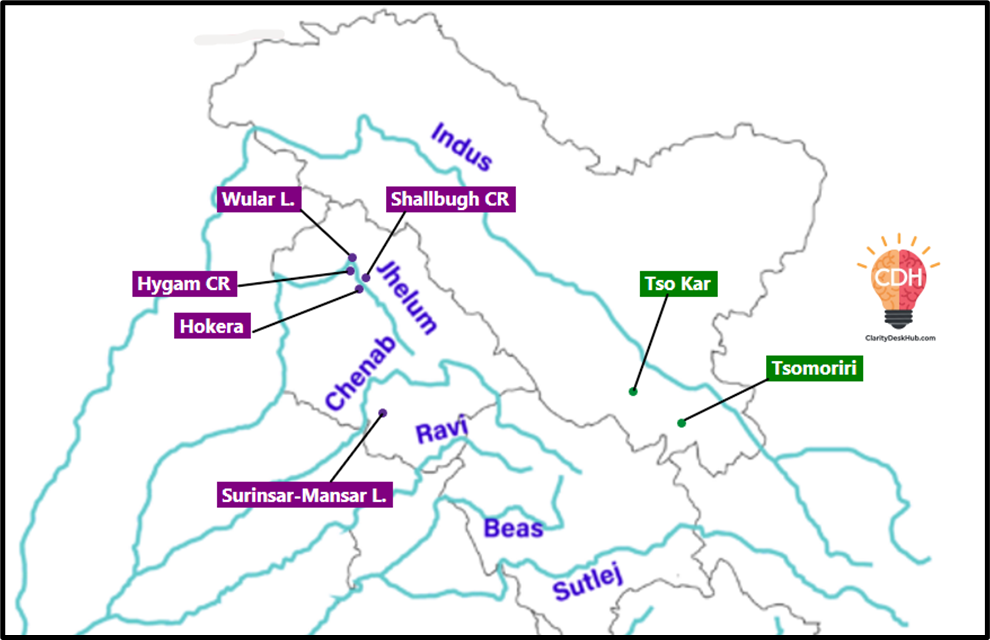
Jammu and Kashmir and Ladakh
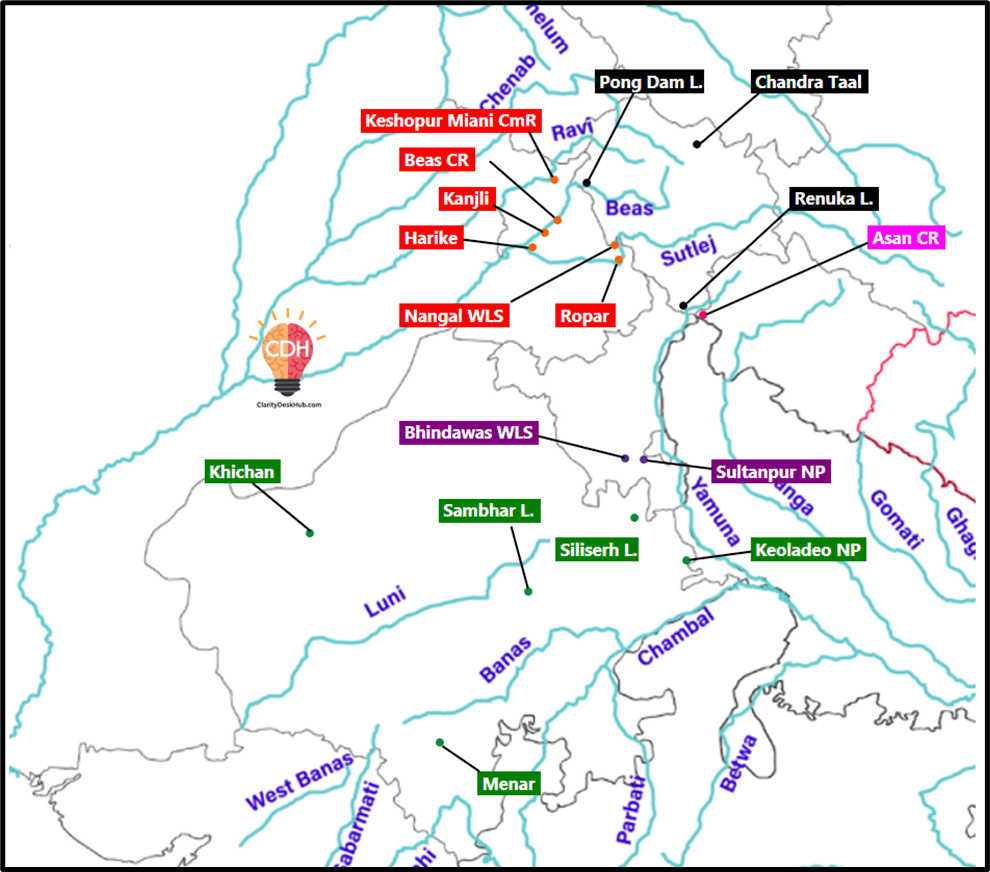
Rajasthan, Punjab, Haryana and Himachal Pradesh
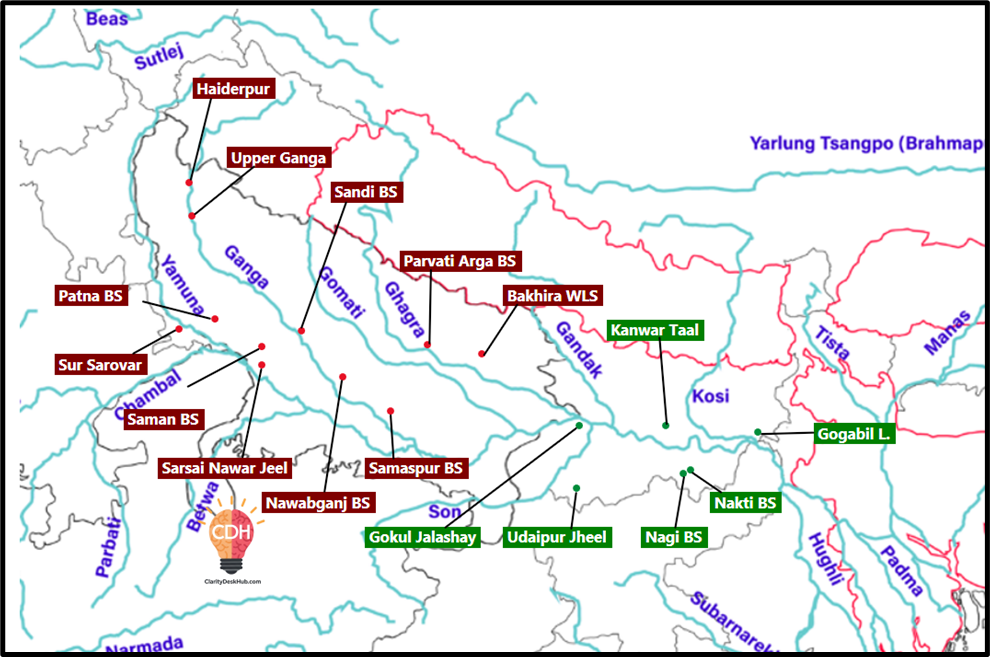
Bihar and Uttar Pradesh
Jharkhand, West Bengal, Odisha, North East
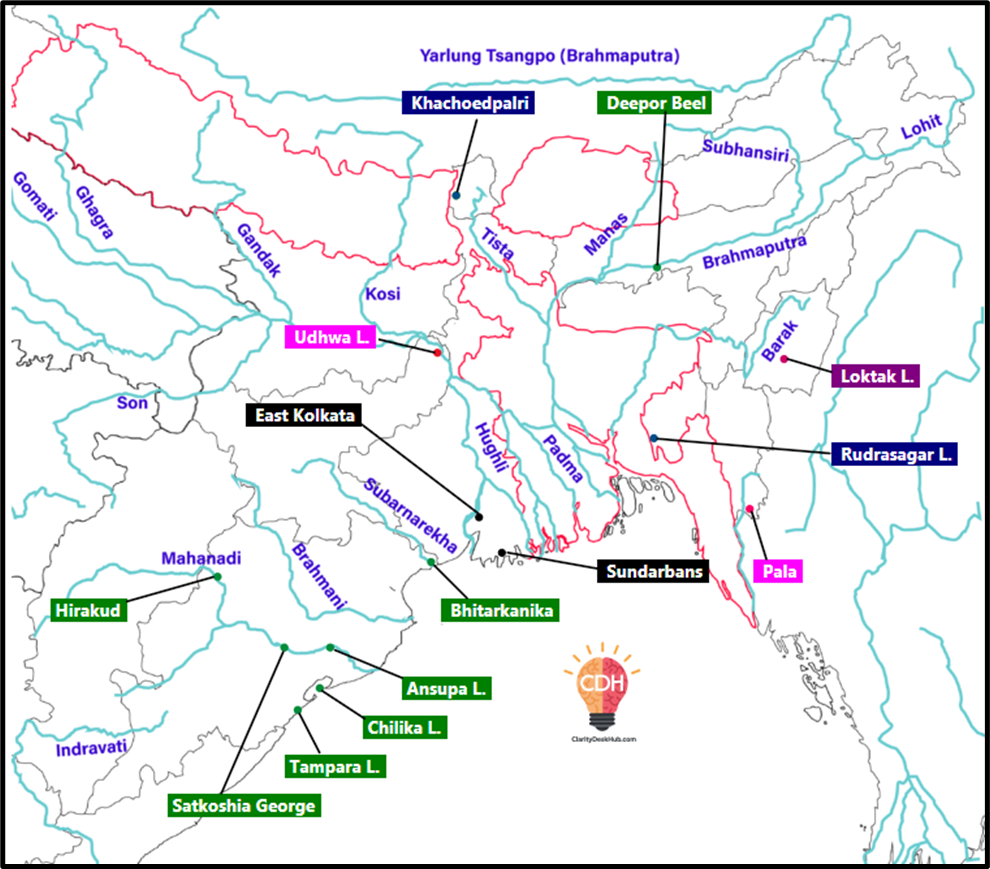
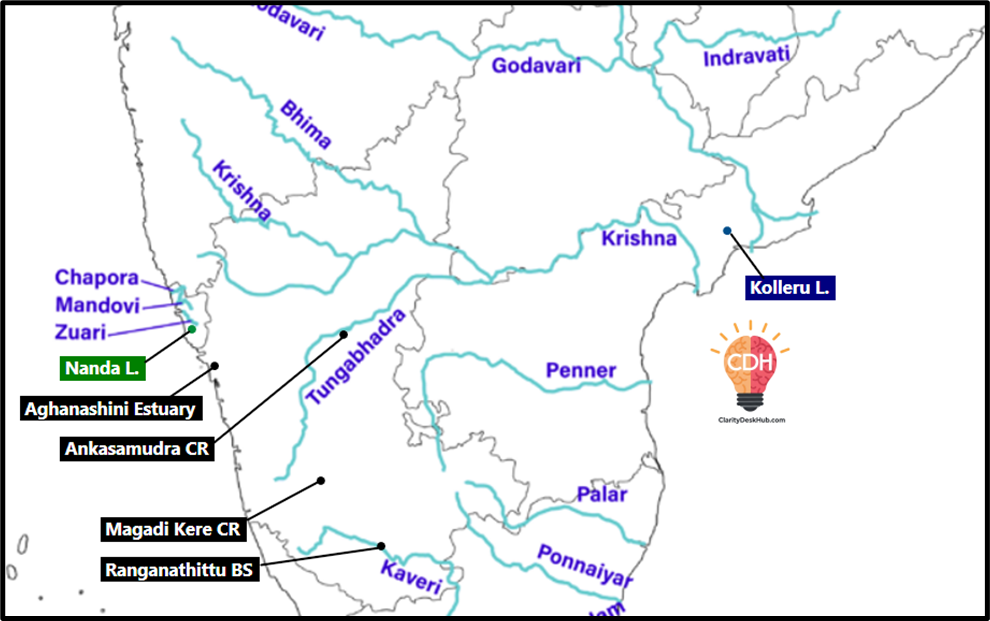
Karnatka, Andhra Pradesh, Telangana and Goa
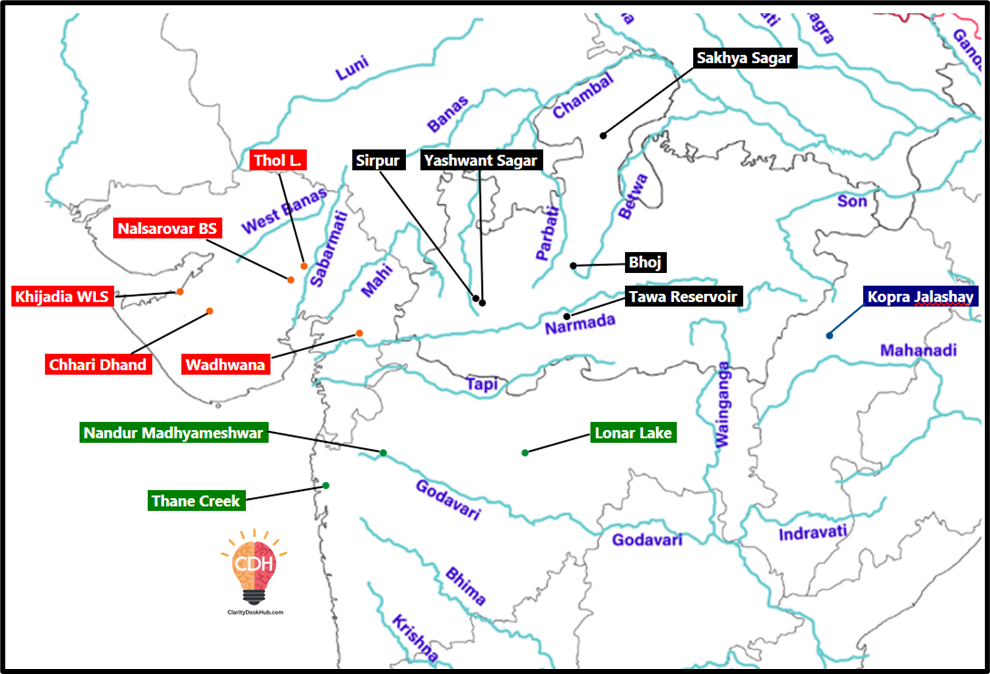
Gujarat, Maharashtra, Chhattisgarh and Madhya Pradesh
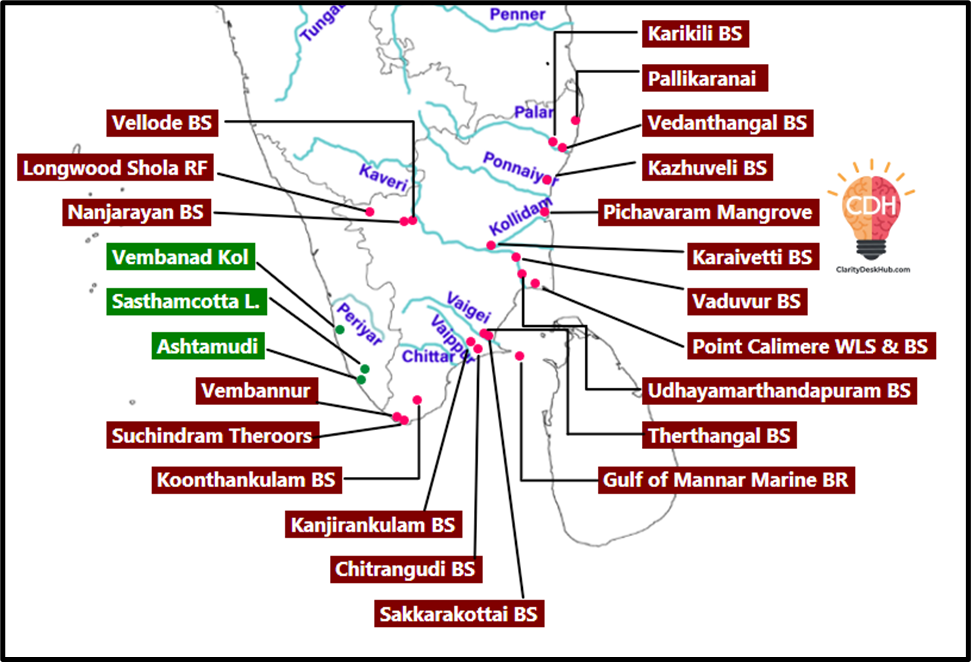
Kerala and Tamil Nadu