
Rare Earth Elements (REEs)
Imagine you’re assembling a modern gadget—your smartphone, electric car, or a wind turbine. Behind these high-tech marvels are some lesser-known but super-crucial heroes—Rare Earth Elements.
- REEs are a group of 17 chemical elements that are chemically and physically similar.
- This group includes:
- 15 Lanthanides from the Periodic Table (like Neodymium, Cerium, etc.)
- Plus Yttrium and Scandium, which behave like Lanthanides.
- Though they’re not exactly “rare,” they are classified as critical minerals in India due to their strategic importance and economic value.
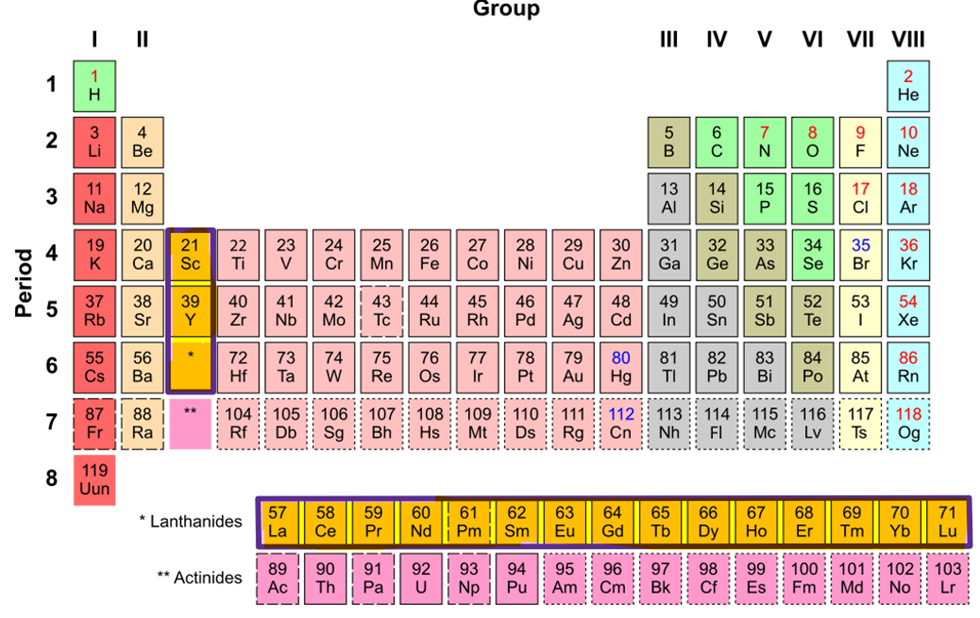
List of Rare Earth Elements (REEs)
| Rare Earth Name | Discovery Year | Atomic Name & Number | Light/Heavy REE | Critical/Uncritical |
|---|---|---|---|---|
| Yttrium | 1788 | Y-39 | Heavy | Critical |
| Cerium | 1803 | Ce-58 | Light | Excessive |
| Lanthanum | 1839 | La-57 | Light | Uncritical |
| Erbium | 1842 | Er-68 | Heavy | Critical |
| Terbium | 1843 | Tb-65 | Heavy | Critical |
| Ytterbium | 1878 | Yb-70 | Heavy | Excessive |
| Holmium | 1878 | Ho-67 | Heavy | Excessive |
| Scandium | 1879 | Sc-21 | Heavy | Critical |
| Samarium | 1879 | Sm-62 | Light | Uncritical |
| Thulium | 1879 | Tm-69 | Heavy | Excessive |
| Praseodymium | 1885 | Pr-59 | Light | Uncritical |
| Neodymium | 1885 | Nd-60 | Light | Critical |
| Dysprosium | 1886 | Dy-66 | Heavy | Critical |
| Europium | 1886 | Eu-63 | Heavy | Critical |
| Gadolinium | 1886 | Gd-64 | Heavy | Uncritical |
| Lutetium | 1907 | Lu-71 | Heavy | Excessive |
| Promethium | 1947 | Pm-61 | — | — |
🧪 Types of REEs: LREEs vs HREEs
| Type | Availability | Importance |
| LREEs | More common | Economically valuable (e.g. Neodymium) |
| HREEs | Less common | Even more crucial, harder to find |
- Neodymium: A critical LREE (light REE), used in mobiles, electric vehicles, and medical equipment.
- HREEs (Heavy REE) like Dysprosium, Yttrium, and Cerium are essential for clean energy tech but suffer from supply constraints.
🪨 Sources of REEs (Geological Deposits)
| Source Mineral | Where it’s Found |
|---|---|
| Bastnaesite | In carbonatites and igneous rocks |
| Xenotime | In mineral sand deposits |
| Loparite | In alkaline igneous rocks & monazite |
| Phosphate Rocks | As by-products through leaching |
❓ Why are they called “Rare” if they’re not Rare?
This is like a trick in the name. REEs are not rare in quantity—they’re just rare to extract:
- These elements occur together, making isolation hard.
- They’re often bonded with thorium or uranium, making radioactive contamination a risk.
- Found in low concentrations, widely dispersed.
- Extraction is costly, requires high-tech refinement, and is environmentally damaging.
- Only a few locations worldwide are geologically and economically viable for mining.
⚙️ Significance of REEs
These elements may be invisible to the eye, but they’re the backbone of modern technology:
- Vital for green energy: electric cars, solar panels, wind turbines.
- Key in defense and aerospace: aircraft, missiles, satellites.
- Unique properties:
- Magnetic
- Luminescent
- Electrochemical
- They are recyclable—unlike fossil fuels.
Urban Mining: Instead of digging the Earth, why not dig into e-waste? This concept involves extracting REEs from discarded electronics, promoting sustainability.
🔁 Recycling of REEs
Why Recycling is Important
- Reduces environmental damage from mining.
- Minimizes conflicts and human rights issues (e.g., Myanmar–China border REE mining issues).
- Helps establish a conflict-free, ethical supply chain.
- By 2050, 60% demand for Neodymium and Dysprosium (used in wind turbines) can be met through recycling.
Challenges in REE Recycling
- Sadly, only 1% of REEs from discarded products are recycled.
- Why?
- REEs are often mixed with other metals.
- Separation is technically complex and costly.
- Some recycling methods use toxic chemicals, raising environmental and health concerns.
🌐 Global Distribution (2024)
- China dominates REE reserves, followed by Brazil, India and Australia
- China dominates in production capacity too (69% of world production)
- India also has REEs like Lanthanum, Cerium, Neodymium, Praseodymium, and Samarium—mostly found in beach sands and some igneous rocks.
Now let’s revise what we read upto now: See Guys,REEs may not be as rare in nature, but they are rare in terms of accessibility, extraction, and ethical sourcing. Their role in powering green energy and digital economies makes them strategically vital. But with supply constraints and geopolitical tensions, the future may belong to urban mining and sustainable recycling.
So, if we are to move toward a greener and self-reliant future, India must focus not just on mining more, but also on mining smarter—through technology, recycling, and policy innovation. Well, let’s continue with other concepts related to REEs.
🌟 Applications of Rare Earth Elements (REEs)
You might ask—what makes these rare earths so special?
Their unique properties—electronic, optical, and magnetic—are irreplaceable. No other metal or synthetic material can perform quite like them. Hence, they have become the unsung heroes of modern technology.
📱 Where Are REEs Used?
Let’s understand their applications—element by element:
| REE | Applications |
|---|---|
| Scandium | Used in TVs and fluorescent lamps |
| Cerium | Key role in NASA’s Space Shuttle Programme |
| Yttrium | Used in cancer and arthritis drugs, also in superconductors |
| Lanthanum | Crucial for night-vision goggles |
| Neodymium | Found in laser rangefinders, guidance systems, and communication devices |
| Europium | Used in fluorescent lights and monitor screens |
| Erbium | Powers amplifiers in fibre-optic communication |
| Samarium | Used in high-temperature magnets, precision-guided weapons, and cancer treatment |
| Praseodymium + Neodymium | Together form the strongest permanent magnets |
| Dysprosium & Holmium | Known for their exceptional magnetic properties |
| Thulium | Enables portable X-ray machines and efficient lasers for medicine and defence |
🔑 So, from medical tech to defence, from smartphones to satellites—REEs are everywhere, yet most people don’t even know they exist.
🇮🇳 India & Rare Earth Elements
📊 What is India’s Status?
India ranks 3rd globally in REE resources, but surprisingly contributes less than 1% to global REE production as of 2024
Why this gap?
Let’s understand:
- In India, Monazite is the principal source of REEs. It’s found mainly in placer deposits—these are sand-based mineral deposits formed by river or ocean movement.
- However, India’s REE resources mostly contain LREEs, not HREEs.
- Only Neodymium and Praseodymium are currently extracted in high purity (up to 99.9%).
🚫 Why Can’t We Extract More?
There are environmental and regulatory barriers:
- CRZ (Coastal Regulation Zone) norms
- Mangroves, forests, and human settlements
- Extraction from beach sands is limited due to ecological sensitivity
🏢 Institutional Framework
Who Extracts REEs in India?
- IREL (Indian Rare Earths Limited): A Mini Ratna under Department of Atomic Energy, is the only processor of monazite for REE compounds.
- KMML (Kerala Minerals and Metals Ltd.): A Kerala state PSU working on beach sand mining.
🌐 India’s Dependency on Imports
Despite having deposits, India relies heavily on imports for:
- REEs
- Other strategic elements like selenium, germanium, rhenium
- Over 90% of imports comes from China
So, finally Let’s understand the bigger picture:
- Rare Earth Elements are not just minerals—they are the foundation of 21st-century technology.
- While India has the potential, it needs a clear path forward:
- Technological advancement
- Environmental safeguards
- Strategic planning to reduce dependency
- Urban mining and sustainable extraction policies can help India emerge as a global player in this field.
Current Affairs 2025
May 2025: How India Is Reducing Dependence on China for Rare Earth Minerals
Rare Earth Elements (REEs)—vital for green technologies like wind turbines, EVs, and solar panels—are globally critical but geopolitically concentrated. China dominates the REE supply chain, accounting for over 60% of global production and exports. India, heavily dependent on Chinese REEs (81% of its imports by value), faces energy security risks due to this monopolization.
The 2010 China-Japan maritime dispute underscored the vulnerability of over-reliance on Chinese REEs, sparking global efforts toward diversification.
🔍 India’s Strategy to Reduce Dependence:
1. Diversification of Imports
- Kazakhstan: Rich in 15 out of 17 REEs; India seeks strategic partnerships for supply diversification.
- India-Central Asia Rare Earths Forum (ICAREF): Exploring joint mining and regional REE market development.
2. Recycling Initiatives
- Ministry of Mines designing a PLI scheme for REE recycling.
- Recognizes challenges such as high water/energy use and logistical complexity.
3. Research and Development
- R&D to improve REE usage and develop substitutes is underway, though time- and cost-intensive.
4. Institutional and Industrial Developments
- IREL: Set up in 1950, now out of the U.S. export control list, boosting its global trade potential.
- New REPM plant in Visakhapatnam: To produce samarium-cobalt magnets indigenously.
- KABIL: Formed to secure overseas mineral assets.
- MMDR Act amendments: Meant to ease critical mineral extraction and trade.