
Rostov’s Model of Stages of Growth
📚 Introduction to Rostow’s Model
In Human Geography, particularly when we study development, we often classify countries as:
- Developed vs Developing
- First World vs Third World
- Core vs Periphery
But then a crucial question arises:
What does it really mean for a country to be ‘developed’? And why do some nations reach that stage while others lag behind?
To address this, several scholars have proposed development models. One of the most influential among them is Walt Whitman Rostow’s model.
Rostow’s theory, published in 1960 as “The Stages of Economic Growth: A Non-Communist Manifesto,” lays out a linear pathway through which all societies must pass to achieve economic development — much like a ladder with five rungs.
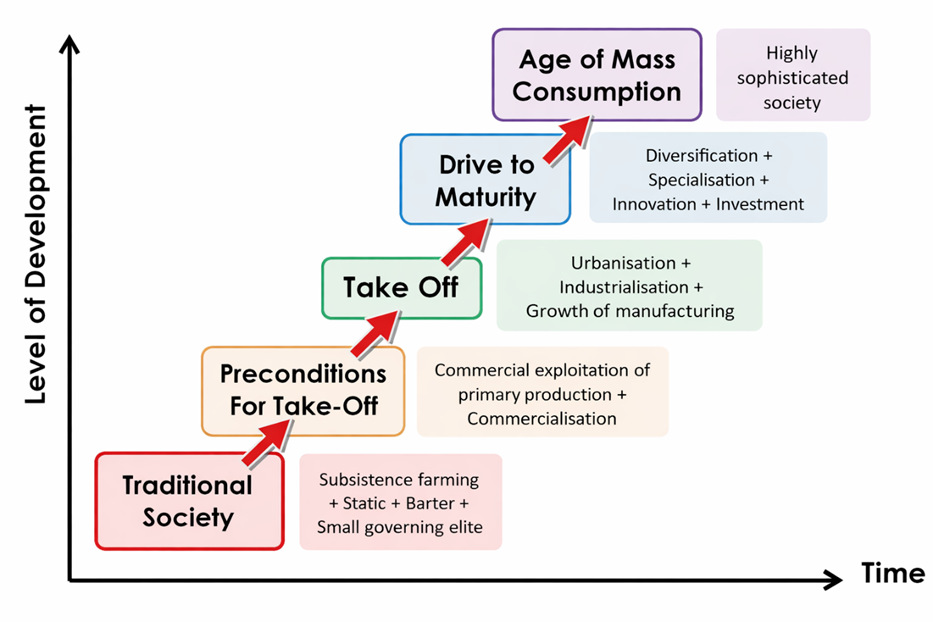
The Five Stages of Growth: Rostow’s Model
Rostow believed every society progresses through five sequential stages. Let’s understand each, step-by-step:
Stage 1: Traditional Society
- Think of this as a pre-modern stage.
- Technology is primitive, agriculture is subsistence-based, and society is structured hierarchically — typically ruled by kings or landlords.
- People’s behavior is driven by customs and traditions, not logic or rational planning.
- There’s minimal acceptance of innovation or new ideas.
- Per capita production is very low.
- Raw materials are exported, and finished goods are imported — showing dependence on other countries.
📝 Example: Medieval European societies or tribal communities today.
Stage 2: Precondition to Take-off
- This is a transitional stage, often triggered by external influences — like colonization, foreign investments, or cultural contact.
- Infrastructure begins to develop — roads, ports, electricity, etc.
- There is some growth in agriculture and industry.
- Investment in the economy rises modestly, but not enough to spark sustained growth.
- Despite having potential, private capital may ignore opportunities, delaying take-off.
📝 Example: India under British rule or Egypt in the 19th century.
Stage 3: Take-off
- This is the turning point — a short, intense phase of transformation.
- Investment rises rapidly, savings increase, and industrial sectors boom.
- New industries grow, especially in manufacturing and primary sectors.
- We see urbanization, industrialization, and a rise in literacy, life expectancy, and per capita income.
📝 Example: Britain during the Industrial Revolution or Japan in the early 20th century.
Stage 4: Drive to Maturity
- Now, the economy diversifies — different sectors (manufacturing, services, agriculture) all grow.
- Imports reduce, and the country produces more of what it consumes.
- Productive investment is now between 10%–20% of national income.
- Society sees the emergence of consumer goods and welfare services.
- The economy becomes self-sustaining.
📝 Example: South Korea in the late 20th century.
Stage 5: Age of High Mass Consumption
- The economy has now reached maturity and abundance.
- Every citizen has access to comforts and luxuries.
- There’s a huge market for recreational services and consumer durables.
- Paradoxically, although leisure options are many, people work more to afford the latest trends.
- Literacy approaches 100%, life expectancy is high, and per capita income is very high.
📝 Example: The USA in the post-World War II era or modern-day Germany.
❗ Criticism of Rostow’s Model
As influential as Rostow’s model is, it’s not without its flaws:
1. Western Bias
- Rostow’s model assumes the Western capitalist path is the only road to development.
- It sees Western modernity as the ideal.
2. Linear Progression Fallacy
- The model is too simplistic — it assumes all countries will pass through the same five stages in the same order.
- But in reality, some countries skip stages, regress, or take non-linear paths.
3. Top-down Approach
- Rostow emphasizes urban industry and elite-driven change.
- Critics argue for a bottom-up model, where development starts from rural areas and grassroots initiatives.
4. Single-End Goal Assumption
- Rostow assumes that all countries want to reach mass consumption.
- But not every society values consumption over cultural or ecological sustainability.
- Hence, development goals vary across societies.
🧠 Conclusion
Rostow’s model is like a ladder of development, describing how a nation could climb from being a traditional society to a modern industrial one. It provides a clear, structured framework and was among the first attempts to systematically explain economic development.
However, like any model, it must be understood in context. Not all societies fit into its neat, sequential boxes — and development is as much about social justice, environment, and culture as it is about economic growth.