SDG Related Reports and Indices
UN Sustainable Development Report
According to the UN Sustainable Development Solutions Network‘s 10th Sustainable Development Report (SDR) 2025, India ranks 99th in the Sustainable Development Goals (SDG) Index, marking its first time in the top 100 out of 167 countries with a score of 67.
- The score measures progress on a scale of 0 to 100 where 100 indicates a country has achieved all 17 goals and 0 means no progress has been made.
- This shows a significant improvement from its previous rankings (e.g.,109th in 2024, 112th in 2023) in the Sustainable Development Goals (SDG) Index.
Key Findings of the 10th Sustainable Development Report (SDR) 2025
- Global SDG Progress Status: Projections show that only 17% of SDG targets are on track to be met by 2030, highlighting a significant slowdown in global progress.
- This stagnation is driven by conflicts, structural vulnerabilities, and limited fiscal space, which continue to hinder effective SDG implementation.
- Top Performers: Nordic countries lead the SDGs rankings, with Finland (1st), Sweden (2nd), and Denmark (3rd); notably, 19 out of the top 20 countries are European.
- East and South Asia have shown the fastest regional progress since 2015—India ranks ahead of Bangladesh (114th) and Pakistan (140th) but trails Bhutan (74th), Nepal (85th), Sri Lanka (93rd), and Maldives (53rd).
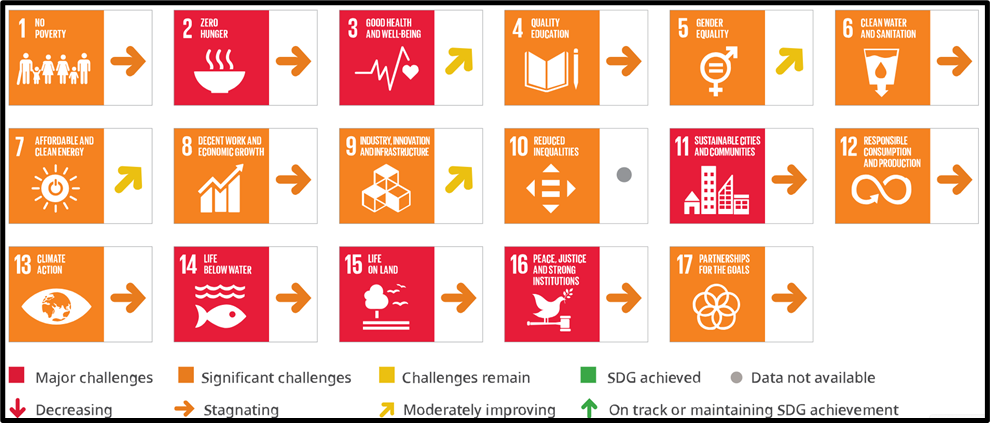
- Successes & Setbacks in SDGs: Most countries have made strong progress on basic services and infrastructure—notably in mobile broadband and internet use (SDG 9), electricity access (SDG 7), and reducing under-five and neonatal mortality (SDG 3).
- However, five targets have seen significant reversals since 2015: obesity rate (SDG 2), press freedom (SDG 16), nitrogen management (SDG 2), Red List Index (SDG 15), and corruption perception (SDG 16).
- Ranking on Multilateralism: Barbados, Jamaica, and Trinidad & Tobago are the top 3 countries most committed to UN multilateralism.
- Brazil ranks highest among G20 nations (25th), and Chile leads Organisation for Economic Co-operation and Development (OECD) countries (7th), while the United States ranks last (193rd) for the second consecutive year due to its opposition to the SDGs and withdrawal from the Paris Agreement and World Health Organization (WHO).
- Strong Commitment to SDGs: A decade into Agenda 2030 (2015-25), 190 of 193 UN member states have participated in the Voluntary National Review (VNR) process, sharing their SDG progress and priorities.
- Only Haiti, Myanmar, and the United States have not participated.
- Global Financial Architecture: The report criticizes the broken Global Financial Architecture (GFA), highlighting that capital disproportionately flows to rich nations, neglecting emerging and developing economies (EMDEs).
SDG India Index
- About: The SDG India Index is a tool developed by NITI Aayog to measure and track India’s progress towards the SDGs set by the United Nations.
- The Index supports the localization of SDGs, encouraging states to integrate these goals into their development plans.
- It serves as a benchmark for policymakers to identify gaps and prioritise actions towards achieving sustainable development by 2030.
- Methodology: The Index assesses the performance of states and union territories (UTs) across 16 SDGs using a set of indicators aligned with national priorities.
- The SDG India Index measures national progress using 113 indicators aligned to the National Indicator Framework.
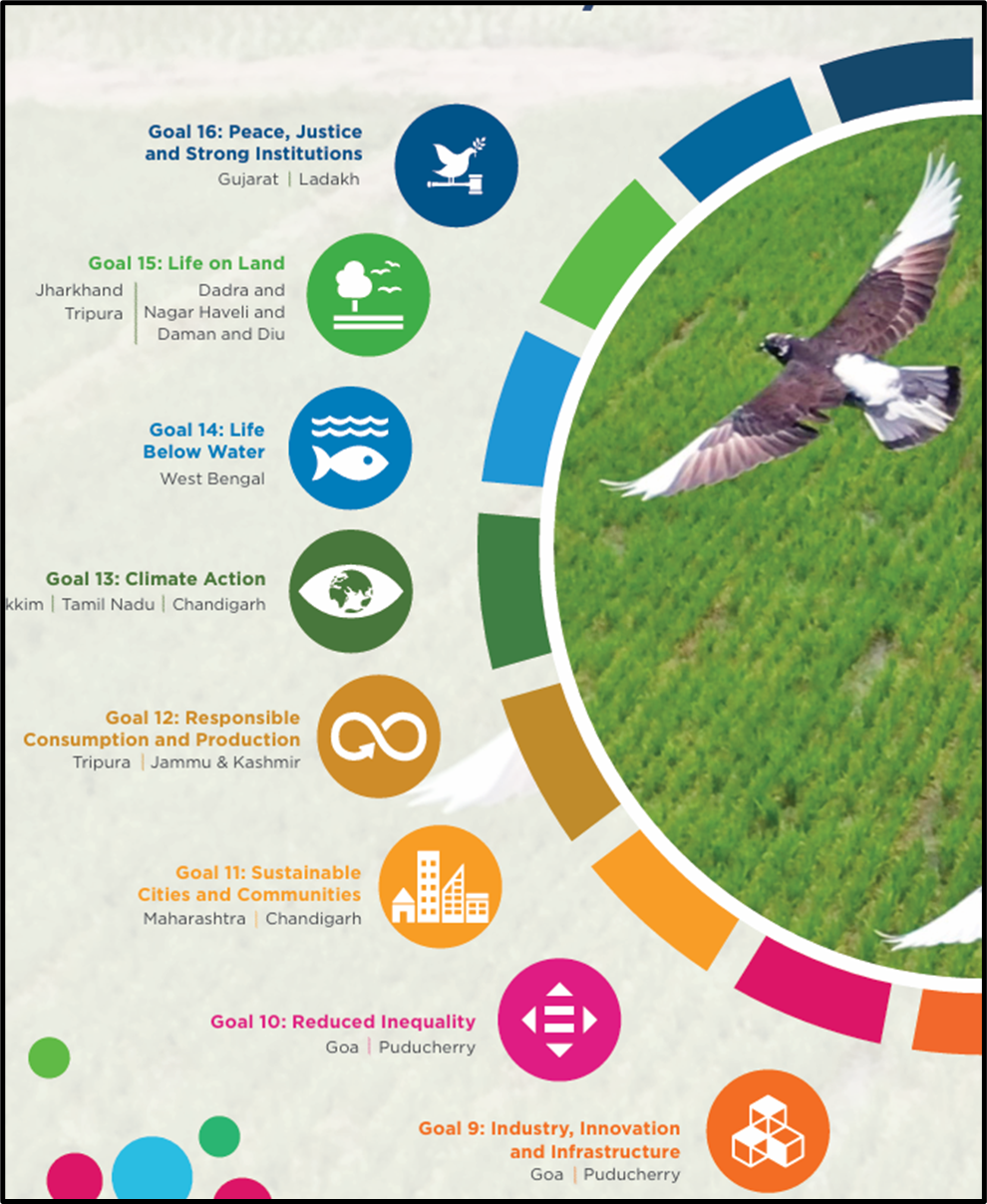
- Goal-wise scores are computed for the 16 SDGs, and overall composite scores are derived for each State/UT. Goal 14 (Life Below Water) has not been included in the calculation of the Composite Score for the Index as it solely pertains to the nine coastal States.
- Scores range from 0-100, with higher scores indicating greater progress toward SDG targets.
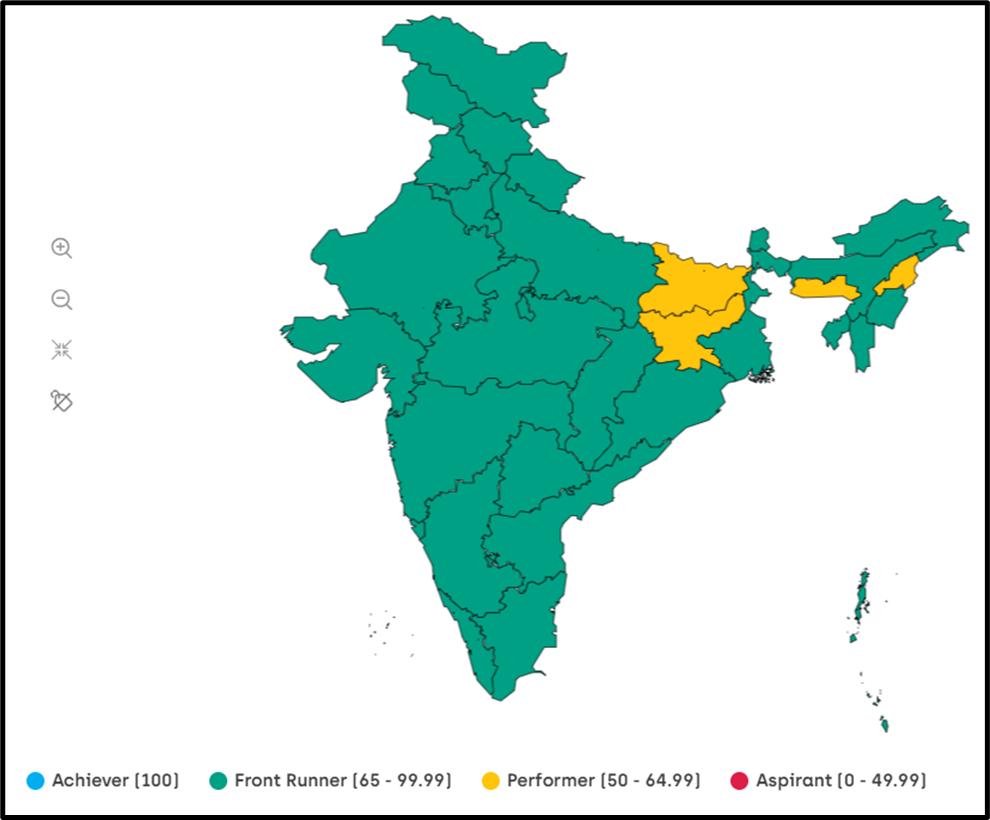
- State/UTs are categorised based on their SDG India Index score as follows: Aspirant: 0–49, Performer: 50–64, Front-Runner: 65–99, and Achiever: 100.
- Impact on Development: The Index promotes competitive and cooperative federalism, encouraging States and UTs to learn from each other and close outcome-based gaps.
- It provides a comprehensive analysis of progress, highlighting achievements and areas needing improvement.
- India fully integrated the SDGs into its national development strategies and is proud of its SDG localisation model based on institutional ownership, collaborative competition, capacity building, and a whole-of-society approach.
- The Index serves as a barometer for measuring progress towards Viksit Bharat @ 2047 and informs national and subnational development strategies.
Key Highlights of the SDG India Index for 2023-24
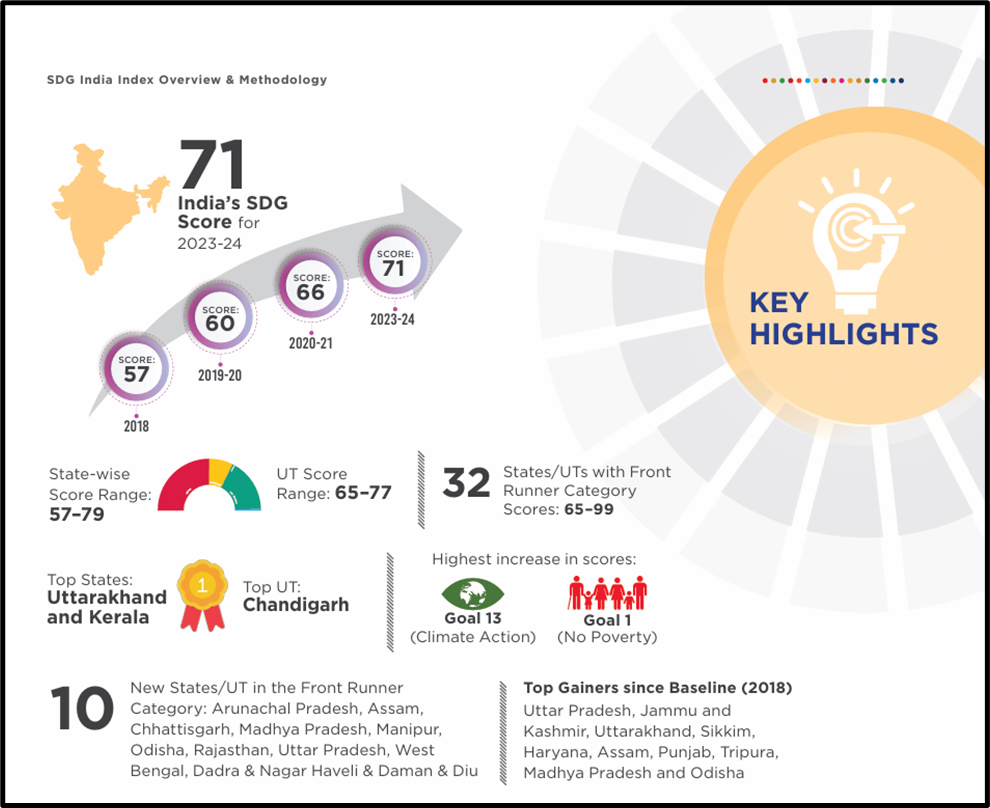
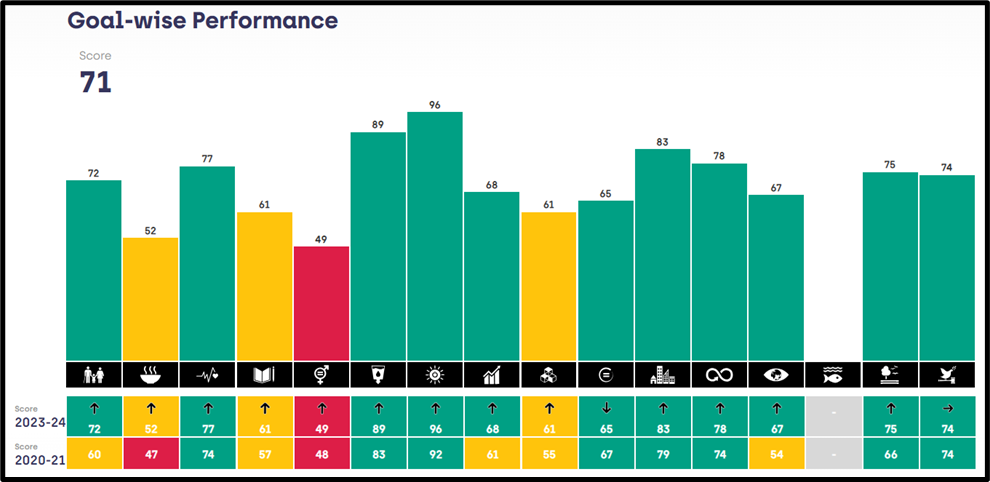
- Overall Progress: India’s overall SDG score improved to 71 in 2023-24 from 66 in 2020-21 and 57 in 2018. All states have shown improvement in overall scores. Progress has been largely driven by targeted government interventions in poverty reduction, economic growth, and climate action.
- Top Performers: Kerala and Uttarakhand emerged as the best-performing states, each scoring 79 points.
- Lowest Performer: Bihar lagged behind with a score of 57 points, followed by Jharkhand at 62 points.
- Front-Runner States: 32 states and union territories (UTs) are in the front-runner category, with 10 new entrants including Arunachal Pradesh, Assam, Chhattisgarh, and Uttar Pradesh.