
Subsidence Theory of Darwin: on Origin of Coral Reefs and Atolls
Let’s imagine ourselves on a voyage with Charles Darwin aboard the HMS Beagle in the early 19th century 😊. As we sail across the warm waters of the Pacific, we come across various coral formations—some hugging the coastline, others forming large offshore walls, and some appearing as perfect circular rings in the middle of the ocean. Darwin, observing these formations, proposes an idea that would shape our understanding of coral reef evolution: The Subsidence Theory (1837, modified in 1842).
The Core Idea: Coral Growth and Land Subsidence
Darwin noticed that coral polyps could only thrive in shallow, sunlit waters. But the presence of deep-sea atolls (ring-shaped reefs enclosing a lagoon) puzzled him—how could corals survive and form reefs in such deep waters? His answer: subsidence of land.
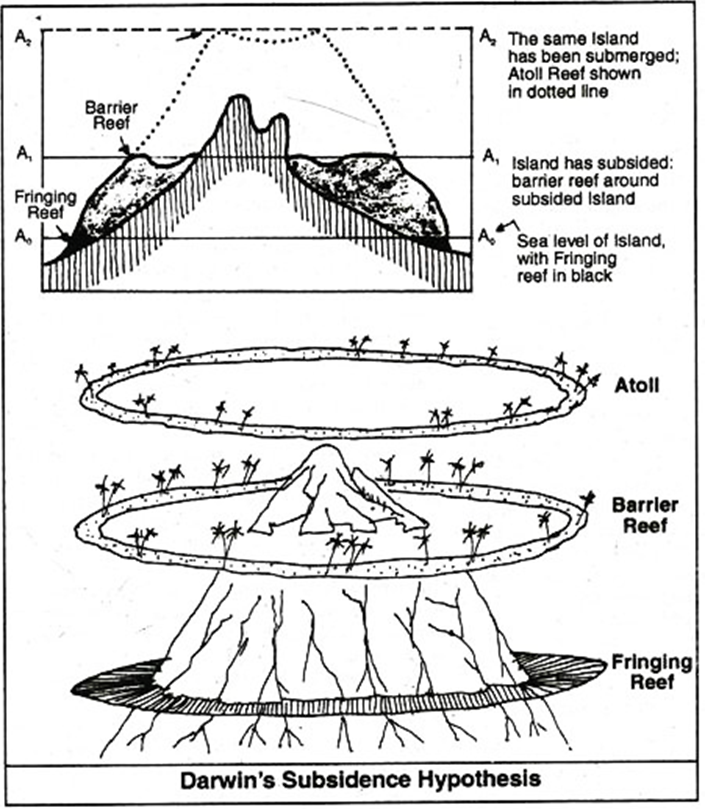
Step-by-Step Evolution of Coral Reefs
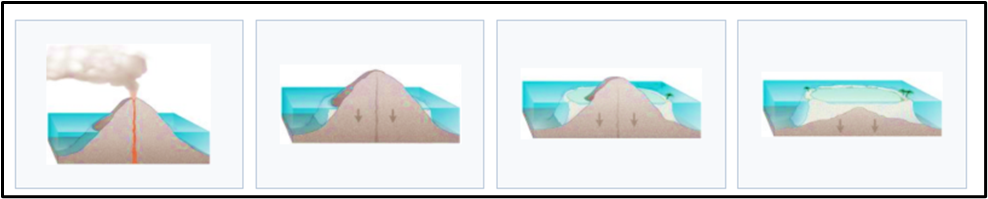
According to Darwin, the formation of reefs follows a natural progression based on land subsidence (sinking) and coral growth:
- Fringing Reef Formation (Initial Stage)
- Coral polyps settle and grow along the edges of an island or a continental platform, forming a fringing reef—the simplest type of reef.
- This reef extends outward but remains attached to the land.
- Barrier Reef Formation (Intermediate Stage)
- Over time, the sea floor and the island start sinking (subsidence).
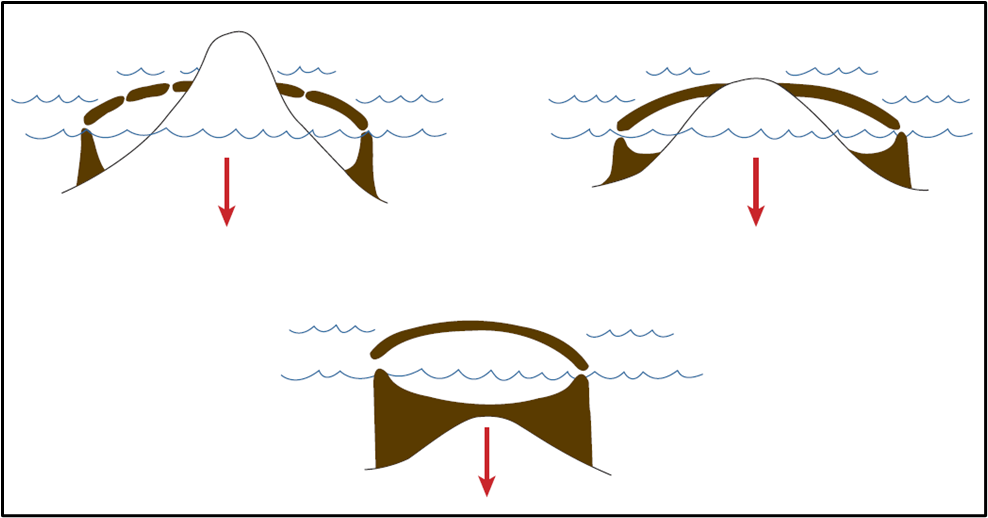
- Corals, needing sunlight, continue growing upward and outward, keeping pace with the sinking land.
- As the land further submerges, a wider and deeper lagoon forms between the reef and the land, transforming the fringing reef into a barrier reef.
- The reef expands in width due to outward coral growth and accumulation of coral debris.
- Atoll Formation (Final Stage)
- Eventually, the island completely submerges, leaving behind only a circular reef surrounding a lagoon—an atoll.
- Despite continued subsidence, the lagoon remains shallow due to constant sediment deposition from the surrounding land.
Thus, Darwin concluded that fringing reefs, barrier reefs, and atolls are simply different stages of coral reef evolution caused by land sinking and coral adaptation.
Supporting Evidence for Darwin’s Theory
Darwin’s theory is backed by several observations:
- Shallowness of Lagoons
- If the island is sinking, the lagoon should be very deep, but it remains shallow due to continuous sediment deposition.
- Absence of Cliffs on Coral Islands
- Subsidence explains why coral islands lack steep cliffs, as the land sinks gradually instead of breaking off suddenly.
- Raised Beaches Lack Barrier Reefs or Atolls
- If a landmass rises instead of sinking, coral reefs do not form—proving that downward motion is crucial for barrier reef and atoll development.
- Thickness of Coral Reefs Increases Downward
- Deep drilling in atolls revealed that coral deposits extend downward for thousands of feet, which supports the idea of continuous subsidence and coral growth over time.
You may draw the following simple diagram to Illustrate the subsidence theory of Atoll formation:
Criticism & Limitations of the Theory
Despite its elegance, the Subsidence Theory has some weaknesses:
- Different Reef Types Coexist
- If reefs evolve in stages, fringing reefs, barrier reefs, and atolls should not exist together—but they do.
- Some islands have all three types of reefs simultaneously, which contradicts the idea of a strict evolutionary sequence.
- Pacific Ocean Islands Are Still Above Water
- If subsidence were the only factor, most Pacific islands would have already disappeared beneath the ocean—but they haven’t.
- Coral Reefs Exist on Emerging Landforms
- Some reefs are found around rising land masses, proving that subsidence is not the only process involved in reef formation.
Final Thoughts
Darwin’s Subsidence Theory was revolutionary—it laid the foundation for modern coral reef studies and explained how reefs form and adapt to environmental changes. While later scientists introduced additional factors like sea-level changes, tectonic uplift, and carbonate accumulation, Darwin’s idea of corals keeping pace with sinking land remains a fundamental concept in geology and marine science.