
Uranium
Uranium is a silvery-grey metallic radioactive element, found naturally in the Earth’s crust. It is one of the most crucial atomic minerals due to its role in nuclear energy production and defence technology.
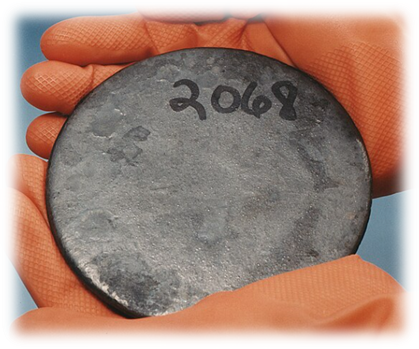
But what makes uranium so important?
Uranium Isotopes and Fissility
Uranium exists in nature in the form of two main isotopes:
- Uranium-238 (²³⁸U) – constitutes about 99.27%
- Uranium-235 (²³⁵U) – only about 0.72%
Here comes the most important point:
➡️ Of the two, only Uranium-235 is fissile, meaning it can sustain a nuclear chain reaction when bombarded with neutrons.
That’s why ²³⁵U is the fuel used in most nuclear reactors and atomic bombs.
Origin and Formation
Uranium is a primordial element—formed in the cataclysmic supernova explosions that predate the formation of the solar system. But how does it end up in the Earth’s crust?
Its concentration in mineable form is a result of complex geological processes:
- Magmatic and hydrothermal activity
- Geochemical reactions
- Groundwater movement over millions of years
These processes slowly accumulate uranium in specific rock types and formations, making commercial extraction viable only where uranium concentration is high.
Global Uranium Scenario
Let us understand the global distribution first in terms of two metrics:
A. Uranium Resources (as of 2023)
| Rank | Country | Resources (in thousand tonnes – TT) | % of World |
| 1 | Australia | 1671 | 28% |
| 2 | Kazakhstan | 814 | 13% |
| 3 | Canada | 582 | 10% |
| 4 | Russia | 477 | 8% |
👉 Australia has the largest reserves of uranium, but interestingly, it’s Kazakhstan that leads in production.
As of the latest official update from the Department of Atomic Energy (DAE) in December 2024, India’s total uranium oxide (U₃O₈) resources stand at 425,570 tonnes
B. Uranium Production (2022)
| Rank | Country | Production (in thousand tonnes) | % of World |
| 1 | Kazakhstan | 21.2 | 43% |
| 2 | Canada | 7.3 | 15% |
| 3 | Namibia | 5.6 | 11% |
| 4 | Australia | 4.5 | 7.1% |
| — | India | 0.6 | 0.7% |
This clearly shows a mismatch between resources and production, largely due to policy, investment, and export controls.
Key Global Uranium Mines
Let’s look at some of the prominent uranium mines across the world:
- Australia:
- Olympic Dam
- Ranger Mine
- Kazakhstan:
- Chu-Sarysu Basin
- South Inkai, Tortkuduk, Budenovskoye
- Canada:
- McArthur River Mine (world’s largest, high-grade ore)
- Athabasca Basin (noted for highest-grade deposits globally)
- Others:
- Arlit Mine – Niger
- Rossing Mine – Namibia
- Kraznokamensk Mine – Russia
🔸 Nearly two-thirds of the global uranium output comes from Kazakhstan, Canada, and Australia.
Uranium in India: Reserves & Production
Despite limited reserves, India has made considerable efforts to become self-reliant in uranium supply.
1. Major Uranium Provinces in India
A. Singhbhum Shear Zone / Copper Belt – Jharkhand
- This is India’s largest uranium-bearing belt.
- Major mines:
- Jaduguda – India’s *first commercial uranium mine
- Bhatin, Turamdih, Narwapahar
B. Pranhita-Godavari Valley
- Spread across Andhra Pradesh, Telangana, and Karnataka.
- Key deposits:
- Tummalapalle, Gogi, Lambapur
C. Cuddapah Basin – Andhra Pradesh
- Major sites:
- Lambapur-Peddagattu, Chitrial, Kuppunuru, Rachakuntapalle, Tumallapalle
- Tumallapalle is particularly promising with a large low-grade uranium reserve.
D. Mahadek Basin – Meghalaya
- Hosts sandstone-type uranium deposits.
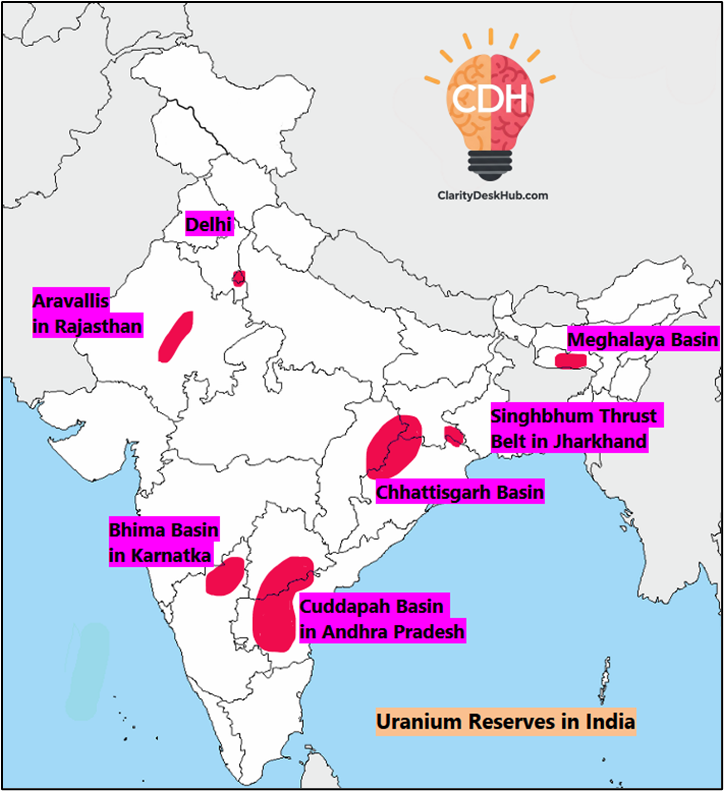
2. Other Locations
- Monazite sands on the Kerala coast (and parts of Tamil Nadu and Odisha) contain significant uranium along with thorium and REEs.
- Copper mines of Udaipur – Rajasthan (trace uranium).
- Emerging sites in Chhattisgarh, Karnataka, and Rajasthan also show potential.
India’s Uranium Dependency and Imports
Despite having deposits, India’s production is not sufficient for its nuclear energy program.
Hence, India imports uranium from:
- Russia
- Kazakhstan
- France
- Uzbekistan
Negotiations are ongoing with Australia and Canada, but strategic concerns like nuclear proliferation, NSG restrictions, and non-signature of NPT by India create diplomatic hurdles.
Nuclear Power Plants in India
| S. No. | State | Nuclear Power Plant(s) |
| 1 | Andhra Pradesh | Kovvada |
| 2 | Gujarat | Kakrapar, Mithi Viradi |
| 3 | Haryana | Gorakhpur |
| 4 | Karnataka | Kaiga |
| 5 | Madhya Pradesh | Chutka |
| 6 | Maharashtra | Tarapur, Jaitapur |
| 7 | Rajasthan | Rawatbhata, Mahi Banswara |
| 8 | Tamil Nadu | Kalpakkam, Kudankulam |
| 9 | Uttar Pradesh | Narora |
| 10 | West Bengal | Haripur |
Conclusion
Uranium is at the nexus of geography, energy, and geopolitics.
While India’s geological constraints limit large-scale uranium production, the country is pursuing exploration, imports, and strategic partnerships to meet its growing nuclear energy needs.
Understanding uranium’s global patterns, geological occurrence, and institutional frameworks is essential to grasp its economic and strategic significance—both in UPSC Geography and India’s national development roadmap.