
World Distribution of Petroleum
Oil Reserves ≠ Oil Production
Let’s begin with a very interesting observation:
👉 Just because a country has the largest oil reserves doesn’t mean it produces the most oil.
Think of it like this—someone might own a massive gold vault but may choose to sell only a portion of it each year, while another person with a smaller vault sells aggressively and appears richer in cash flow.
Similarly:
- Middle East holds over 50% of the world’s oil reserves, yet it produces only about 30% of the world’s oil.
- USA, on the other hand, holds less than 2% of reserves but produces nearly 10% of global oil.
This happens due to:
- Different extraction policies
- Technological capabilities
- Strategic conservation or commercial priorities
Petroleum is Unevenly Distributed: Supergiants vs Small Fields
Although oil is found in many countries, the bulk of it lies in a few gigantic fields. These are categorized as:
1. Supergiants
- These are the true titans—fields with 5 billion+ barrels of recoverable oil.
- Fewer than 40 such fields exist globally.
- About two-thirds are in the Arabian-Iranian basin—think Persian Gulf region (mainly Saudi Arabia, Iran, Iraq, Kuwait).
- The rest are scattered across Russia, USA, Venezuela, Mexico, Libya, Algeria, and China.
2. World-class Giants
- These have 500 million to 5 billion barrels.
- They are fewer in number but still form an important part of global supply.
🧠 Analogy: If oil fields were cities, supergiants would be like megacities (e.g., Tokyo or Delhi), while world-class giants are tier-1 cities (like Bangalore or Los Angeles).
Top Countries by Proven Oil Reserves (2023: Provisional)
Here’s a quick snapshot of the top 10 countries by reserves:
| Country | OPEC | Reserves (Billion Barrels) | % Share |
|---|---|---|---|
| Venezuela | Yes | 303.0 | 19.3% |
| Saudi Arabia | Yes | 267.2 | 17.0% |
| Iran | Yes | 208.6 | 13.3% |
| Iraq | Yes | 145.0 | 9.2% |
| UAE | Yes | 113.0 | 7.2% |
| Kuwait | Yes | 101.5 | 6.5% |
| Russia | No | 80.0 | 5.1% |
| Libya | Yes | 48.4 | 3.1% |
🌍 Together, these countries account for the majority of global oil reserves.
Country-wise Details: Petroleum Giants Explained
Saudi Arabia
- Home to the Al-Ghawār field—the largest onshore oil field in the world.
- Also has the Saffaniyah field—the largest offshore oil field globally.
- Forms the backbone of global oil supply and OPEC leadership.
Russia
- Possesses two supergiant fields: Western Siberia and Yenisey-Khatanga.
- Additional reserves in:
- Kamchatka Peninsula
- Sakhalin Island
- Volga-Caspian region
- Rich in both onshore and offshore petroleum.
North America
- Rich in sedimentary basins:
- Alaska’s North Slope
- East Texas
- Rocky Mountains
- Canada stands out for:
- Vast oil sands in Athabasca
- Largest field: Hibernia, discovered in the Jeanne d’Arc Basin off Newfoundland (1979)
Africa
- Major oil producers: Libya, Algeria, Nigeria, Egypt
- Niger Delta (Nigeria) is a highly productive oil-rich zone.
- Algeria depends heavily on oil exports.
- Libya remains a consistent oil producer.
- Egypt is notable for being self-sufficient in oil.
West Asia
- Iraq, Kuwait, Iran host multiple supergiant oil fields.
- Kuwait’s Al-Burqan field is the second-largest oil field in the world.
Venezuela
- Holds the largest proven oil reserves globally.
- Major exporter in the Western Hemisphere.
- Most reserves lie in the Orinoco Belt—rich in heavy crude oil.
Western Europe
- Key reserves in the North Sea—shared by UK and Norway.
- Recent exploration interest in the Barents Sea (Arctic region).
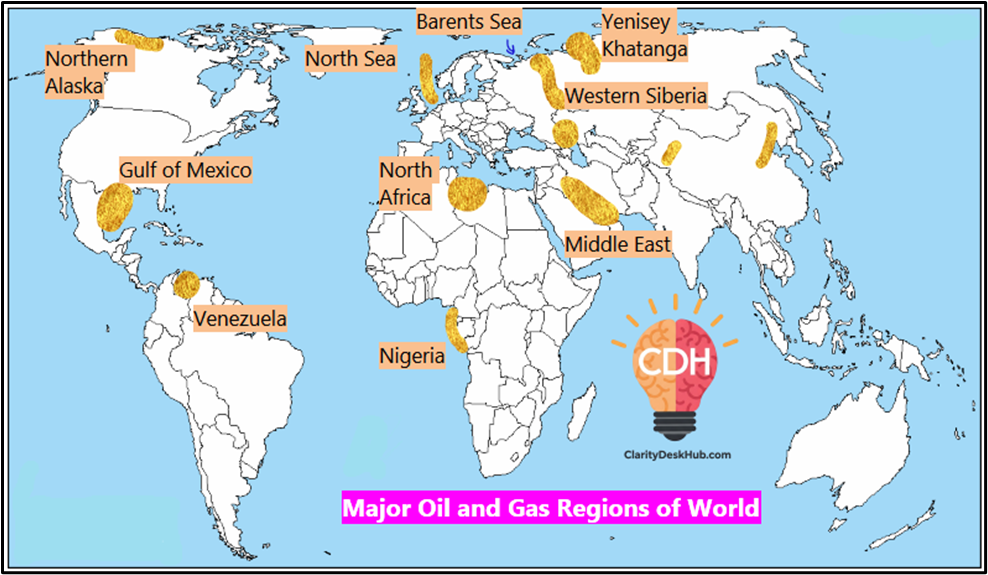
✅ Now, let’s summarise a bit what we have read:
- Petroleum distribution is highly uneven, concentrated in a few large oil fields.
- Reserves do not directly translate to production levels due to geopolitical, technological, and strategic factors.
- Supergiant and world-class giant fields dominate global petroleum supply.
- Middle East, Russia, North America, and Venezuela are the main players in the oil game.
- Africa and Western Europe also contribute significantly, though to a lesser extent.
World’s Top Producers, Consumers, and Exporters of Oil (2023)
Let’s look at the global petroleum scene like a marketplace—some nations extract more, some consume more, and others serve as middlemen through exports. Here’s how the key players stack up:
🛢 Top Crude Oil Producers (2023)
(Measured in thousand barrels/day)
| Rank | Country | Production | Global Share |
|---|---|---|---|
| 1 | USA | 19358 | 21% |
| 2 | Saudi Arabia | 11389 | 11.8% |
| 3 | Russia | 11075 | 11.5% |
| 4 | Canada | 5653 | 5.9% |
| 5 | China | 4198 | 4.4% |
| India | 728 | 0.8% |
🔍 Insight:
- USA leads globally, thanks to advanced tech like shale oil extraction and fracking.
- Saudi Arabia and Russia follow as traditional giants.
- India is a modest producer but a significant consumer, which we’ll see next.
⛽ Top Crude Oil Consumers (2023)
(Measured in thousand barrels/day)
| Rank | Country | Consumption | Global Share |
|---|---|---|---|
| 1 | USA | 18984 | 18.9% |
| 2 | China | 16577 | 16.5% |
| 3 | India | 5446 | 5.4% |
| 4 | Russia | 3635 | 3.6% |
| 5 | Japan | 3366 | 3.4% |
🔍 Insight:
- USA and China alone account for over 1/3rd of global consumption.
- India ranks 3rd, showcasing rapid industrial growth and rising energy demand.
🌍 Top Crude Oil Exporters (by share of global exports-2023)
(Measured in thousand barrels/day)
| Rank | Country | Export | Export Share |
|---|---|---|---|
| 1 | USA | 9108 | 13.4% |
| 2 | Saudi Arabia | 8282 | 12.2% |
| 3 | Russia | 6736 | 9.9% |
| 4 | Canada | 4836 | 7.1% |
🔍 Insight:
- Saudi Arabia tops exports—its economy heavily depends on oil.
- Other middle East countries excluding Saudi Arabia exports about 22% of Oil.
🛢️ OPEC: The Global Oil Cartel
Let’s now understand the Organisation of Petroleum Exporting Countries (OPEC)—the “oil union” of major producers.
🔑 Key Facts about OPEC:
- Founded in 1960 by Iran, Iraq, Kuwait, Saudi Arabia, and Venezuela.
- Headquarters: Vienna, Austria.
- Operates as a 12-member cartel (with fluctuating membership) to control:
- Oil production quotas
- Global supply levels
- Price stabilization in member nations’ favor
🧱 Core Principles:
- Unanimity in decisions – one member, one vote.
- Works collectively to maintain prices by reducing or increasing supply.
🌍 Global Significance:
- Holds about 80% of the world’s proven crude oil reserves.
- Exerts enormous influence on global oil prices and trade routes.
🇮🇳 India’s Dependence on OPEC:
India is heavily reliant on OPEC for its energy security:
- 70% of crude oil
- 60% of LPG
- 30% of LNG
- 45% of petroleum products
🔍 Insight: Any fluctuation in OPEC production decisions directly affects India’s economy—especially inflation, trade deficit, and rupee-dollar exchange rate.
✅ After this overwhelming data-driven analysis let’ summarise a bit:
- The USA is the largest producer and consumer of oil, but not the largest exporter.
- Saudi Arabia remains the top oil exporter, with Russia and Iraq closely behind.
- India, though a small producer, is the 3rd largest consumer—making its energy imports critical.
- OPEC plays a pivotal role in regulating oil supply and prices, affecting global economics, especially for import-dependent nations like India.