
Western Moral Thinkers
A Comprehensive Journey through 2,500 Years of Ethics
Before We Begin
Look, before we dive into Socrates and his merry band of philosophical troublemakers, let me ask you a very simple question.
Why should you, sitting in this 21st century, preparing for the UPSC examination, care about a barefoot Greek man who was executed 2,400 years ago for asking too many questions?
The answer is beautiful, and once you understand it, the entire syllabus of Ethics opens up like a flower.
You see, every time you watch a news debate about freedom of speech versus national security, you are unknowingly participating in a conversation that Socrates started.
Every time the Supreme Court strikes down a law because it violates the dignity of an individual, the ghost of Immanuel Kant is smiling somewhere.
Every time a government decides to launch a welfare scheme that maximises benefit for the largest number of people, Jeremy Bentham is being summoned from the grave.
These thinkers are not dead — they are quietly running our world.
The mistake most students make is treating Ethics as a subject to be memorised.
Ethics is not a subject — it is a way of thinking.
The names — Socrates, Plato, Aristotle — are just signposts. Behind each name lies a worldview, an argument, a question that humanity has been struggling with for millennia. Our job in this subject is not to make you remember names. Our job is to make you think like these thinkers, even if only for a few hours.
A Map of the Journey
Before we begin, here is a simple map of where we are going. Western moral philosophy moves in distinct waves — and each wave is essentially a reaction to the wave before it. Look at this flow carefully:
| Ancient Greek (Socrates → Plato → Aristotle) | Hellenistic Period (Epicureanism, Stoicism) | Enlightenment (Utilitarianism, Kantianism) | 20th Century (Virtue revival, Meta-ethics) |
Notice the rhythm: a great burst of creativity in Greece, then a long period of consolidation, then a re-awakening in modern Europe, and finally a sophisticated, almost technical analysis in our own century. The dialectic of philosophy is the dialectic of civilisation itself.
Socrates — The Man Who Taught Athens How to Think
The setting: Athens in the Fifth Century B.C.
Imagine the city of Athens in the year 450 B.C. It is one of the most vibrant places in the world. Trade is booming, ships are arriving from Egypt and Persia, the dramatists Aeschylus, Sophocles and Euripides are writing plays that the world will read for the next 2,500 years.
Athens is a democracy — not perfect, not inclusive (women and slaves are excluded), but a democracy nonetheless. People vote, juries decide, citizens debate in the marketplace.
But there is a tension in this golden city. The Greeks have started travelling. They are meeting Persians, Egyptians, Phoenicians. And they realise something disturbing — other cultures have different morals. What is sacred in Egypt is forbidden in Greece. What is virtuous in Persia is contemptible in Athens.
Earlier, the Greeks believed their morals were rooted in nature itself — that justice and honour were universal truths written into the fabric of the cosmos. Now, slowly, a doubt creeps in: are morals universal, or are they merely conventions of a particular society?
This is the question on which Western ethics is born. And it is into this confused, doubting Athens that a man called Socrates walks.
Enter the Sophists — The Original Spin Doctors
Before we meet Socrates, we must meet his opponents. Just as a hero needs a villain, Socrates had the Sophists. The Sophists were itinerant teachers — travelling professors, if you like — who went from city to city teaching young men three things: grammar, rhetoric, and the art of winning arguments. For a fee, of course.
Athens was a democracy. To get ahead in politics, you needed to speak well. To win a lawsuit, you needed to argue better than your opponent. The Sophists taught these skills. And in doing so, they developed a philosophy: moral relativism. Their most famous figure, Protagoras, declared:
“Man is the measure of all things — of those that are, that they are, and of those that are not, that they are not.” — Protagoras
What does this mean? Simply: truth is what appears true to you; morality is what your society approves. There is no objective standard. If Athens permits something, it is right for Athens. If Sparta permits the opposite, it is right for Sparta. Each man, each society, is its own measure.
Sophists earned a bad name because their critics accused them of teaching how to “make the unjust cause appear just” — basically, how to win arguments regardless of truth. Today, we might call them political consultants or PR experts. Their job was not truth; their job was persuasion.
Socrates — The Counter-Movement
Now Socrates (469–399 B.C.) walked the same streets, but he stood for the exact opposite. He was a stonemason’s son, lived in modest poverty, fought bravely in the Athenian army, and then spent the rest of his life doing one strange thing: asking questions in the marketplace.
He took no fees. He wrote no books. He simply walked up to people — generals, politicians, craftsmen, philosophers — and asked them questions until they realised they did not know what they thought they knew.
Socrates believed something the Sophists denied: that moral judgments are objective and universal. Justice is justice, courage is courage — not opinions, but real things that we can investigate. He brought philosophy down ‘from heaven to earth’ — from speculation about stars and atoms to questions about how a human being should live.
The Moral Concerns of Socrates — His Core Doctrines
1. Virtue is the Highest Good
Socrates believed that the only thing truly worth pursuing in life is virtue (aretē) — excellence of character, the noble and the praiseworthy. Wealth, fame, political power — all of these are secondary. In his famous defence speech (The Apology), he reproaches the Athenians for pursuing money and reputation more than wisdom and goodness.
He uses a beautiful idea here: the soul can be perfected by acquiring virtues, just as the body can be perfected by exercise. Wrongdoing corrodes the soul.
And — read this carefully — Socrates says that life is not worth living if the soul is destroyed. In modern terms: virtue is the highest psychological good, always to be preferred to material good.
2. Moral Intellectualism — “No One Knowingly Does Wrong”
This is Socrates’s most famous and most controversial doctrine. He argues: no one knowingly does what is bad. If a person commits an evil act, it is because of ignorance. They did not truly know that it was bad. If they had really, deeply understood the wrongness of the act, they would never have done it.
This view is called Moral Intellectualism. Its implication is striking: virtue is knowledge. And from this it follows — virtue can be taught! Just as you can teach mathematics, you can teach goodness.
The corrupt politician, the cruel husband, the dishonest trader — they are not evil, they are merely ignorant of what is truly good.
| The Problem with Moral Intellectualism Common experience tells us this is too simplistic. People often know perfectly well that smoking is harmful, that drugs destroy lives, that infidelity wounds families — and they do these things anyway. The saying ‘the spirit is willing but the flesh is weak’ captures this perfectly. Aristotle later criticised Socrates harshly on this point: virtue is not just knowledge, it is also habit. Knowing the right is not enough — one must cultivate the habit of doing the right. Even saints succumb to temptation. Socrates, in his nobility, may have overlooked the messy complexity of moral psychology. |
3. Mild Asceticism — Master the Body, Cultivate the Soul
Socrates was not a wild ascetic like a Hindu sadhu in a forest. He drank wine, attended parties, had friends. But he insisted: a philosopher must not be a slave to bodily pleasures.
The body is a hindrance — it gets hungry, falls sick, fills the mind with lusts and fears. True knowledge comes through thought, not sense. Mental purity means freedom from slavery to the body’s needs.
Notice the seed of a doctrine that will dominate Christianity later — the suspicion of the body, the privileging of the soul. This is the bridge between Greek philosophy and the religious traditions that will follow.
The Socratic Method — Teaching by Asking
How did Socrates actually teach? Not by lecturing. He had a famous technique now called the Socratic Method or elenchus. It worked like this: he would meet an expert — a general, a priest, a politician — and ask him a simple question: “What is courage?” or “What is justice?” The expert would give a confident answer. Socrates would then ask follow-up questions, exposing contradictions, until the expert realised — to his great embarrassment — that he did not truly understand the very thing he claimed to be expert in.
Socrates’s punchline was always the same:
“I know nothing — and that is why I am wiser than these people, because at least I know that I know nothing.”
| Bertrand Russell’s Anecdote Socrates would ask: ‘If I want a shoe mended, whom should I employ?’ Answer: ‘A shoemaker, O Socrates.’ He would go on to carpenters, coppersmiths, etc., and finally ask: ‘And who should mend the Ship of State?’ The implication was obvious — the State needed expertise, not popular vote. When Socrates fell foul of the ruling Thirty Tyrants, their leader Critias — who had been Socrates’s own pupil — angrily forbade him to continue teaching the young, adding: ‘You had better be done with your shoemakers, carpenters and coppersmiths. They must be pretty well trodden out at heel by now.’ |
The Trial and Death — When Philosophy Met the State
Athens lost a long war to Sparta in 404 B.C. A puppet oligarchy — the Thirty Tyrants — was installed. Some of these tyrants had been Socrates’s students. When democracy was restored after a year, the city was paranoid, suspicious, looking for scapegoats. Socrates, the gadfly who annoyed everyone with his questions, was a perfect target.
He was charged with two things: corrupting the youth and impiety towards the gods. He was tried, found guilty, and sentenced to death by drinking hemlock. His friends arranged an escape. He refused. He said it would be unjust to break the law of the city that had raised him, even when that law was being used unjustly against him. He drank the poison. He died.
Plato, his greatest student, gives us a heart-breaking account of this trial in the dialogue The Apology. John Stuart Mill, two thousand years later, would write in On Liberty:
‘Mankind can hardly be too often reminded that there was once a man named Socrates between whom and the legal authorities of his time there took place a memorable collision.’
Socrates today is placed in the same league as Jesus, Galileo, and Sir Thomas More — a moral hero who chose principle over life.
“The Unexamined Life Is Not Worth Living”
Of all Socrates’s sayings, this one has echoed loudest through history. What does it mean? Simply: a life that is not subjected to constant self-reflection, that does not question its own assumptions, that does not remove contradictions in its own thinking — such a life is not really being lived at all. It is mere existence, vegetative survival. To be a human being, in the Socratic sense, is to perpetually examine oneself.
This is a high, even severe, conception. It may not be applicable to every common person grinding through daily life. But notice how it elevates the human being.
Socrates is not interested in citizenship that is loyal, obedient, traditional — the citizenship of the warrior in Homer’s epics.
The Socratic citizen is the citizen who reasons, who questions, who refuses to defer to custom, authority, and tradition.
This is the seed from which modern democratic individualism will eventually grow — though it will take 2,000 years.
Critical Assessment — Where Socrates Falls Short
Let us be fair. Socrates’s moral intellectualism — the idea that knowledge alone makes one virtuous — is too neat. As Aristotle pointed out, virtue requires both knowledge and habit. You can know everything about honesty and still tell lies, unless you have cultivated the habit of truth-telling over many years.
The Christian and Hindu traditions go further: they say a pure heart (not necessarily knowledge) leads to virtuous action — and such a heart can be found in the most illiterate village woman as much as in the greatest scholar.
Also, Socrates wrote nothing. Everything we know about him comes from Plato — and many scholars suspect that the Socrates in Plato’s dialogues is partly fictional, a literary character through whom Plato expresses his own ideas. So, when we speak of Socrates’s doctrines, we may sometimes be speaking of Plato’s doctrines in disguise 😊.
Summary Table — Socrates at a Glance
| Concept | Socrates’s Position |
| Source of Morality | Objective, universal — not relative to society |
| Highest Pursuit | Virtue (aretē) — excellence of soul |
| Theory of Wrongdoing | Moral Intellectualism — no one knowingly does wrong; vice arises from ignorance |
| View of the Body | Mild asceticism; body is hindrance to knowledge of truth |
| Method | Dialectical questioning (Socratic Method / elenchus) |
| Famous Saying | “The unexamined life is not worth living.” |
| Citizenship Model | Reasoning, questioning individual — not loyal traditionalist |
| Death | Executed by Athens, 399 B.C., for impiety and corrupting youth |
| Modern Influence | Inspired Thoreau, Gandhi, Martin Luther King Jr. |
| UPSC Connect Socrates is the perfect entry point for any question on civil disobedience, conscience versus law, or whistleblowing. When an officer refuses an illegal order from a superior — that is the Socratic spirit. When an activist accepts imprisonment rather than abandon principle — that is Socratic. Remember: Socrates did not break the law to save himself. He suffered it, because principle mattered more than survival. This distinction — between dissent grounded in conscience and rebellion grounded in self-interest — is a recurring theme in Indian ethics, especially in Gandhian satyagraha. |
Plato — The Philosopher Who Saw Two Worlds
From Student to Master
If Socrates was the gadfly, Plato (429–347 B.C.) was the architect. Born to one of the noblest families of Athens, he was a young man of about 28 when he watched his teacher Socrates drink the hemlock. That trauma marked him forever.
He left Athens, wandered for ten years across the ancient world — meeting Euclid the mathematician, learning the mystical mathematics of the Pythagoreans — and returned to found his own school, the Academy. The word ‘academic’ comes from this very institution. It was the first university in the Western world, and it lasted for 900 years.
Plato was not just a philosopher; he was a literary genius. His works are written as dialogues — plays of ideas, where Socrates is usually the main character. The most famous ones are Apology, Republic, Phaedo, Protagoras, Meno, and Gorgias. Read any one of them, and you will see why he was called ‘divine Plato’ by his admirers — and why critics complained that his logic is often overtaken by his poetry.
The Theory of Forms — The Hidden World Behind the Visible World
To understand Plato’s ethics, we must first understand his most famous metaphysical doctrine: the Theory of Forms (or Ideas). Now stay with me, because this is genuinely beautiful.
The Greek philosophers were troubled by one fact about the world. Everything changes. Heraclitus famously said: ‘You cannot step into the same river twice’ — by the time you step in the second time, both you and the river have changed. So, if everything is constantly becoming and never simply being, how can we have reliable knowledge of anything? Today’s truth is tomorrow’s falsity.
Plato’s answer was breathtaking. He said: the world we see — the world of changing objects, the world of sense-experience — is not the real world at all. It is only an appearance, a shadow, a copy. The real world is a separate realm of eternal, unchanging Forms or Ideas.
Every chair we see is an imperfect copy of the Form ‘Chair-ness’. Every horse we see is a poor reproduction of the Form ‘Horse-ness’. And — here is the crucial step — every just act in the world is a faint reflection of the Form of Justice itself.
Plato called the Forms ‘archetypes’ and the objects of the material world their ‘copies’ or ‘adumbrations’. Philosophers, he believed, can gain knowledge of these Forms through the intellectual perceptions of the soul — through pure thought, not the senses.
| Physical World (Appearance, Change) | → | Forms / Ideas (Reality, Eternal) |
The Idea of the Good — Plato’s God
At the very top of the world of Forms sits the highest Form of all: the Form of the Good. Plato describes it almost mystically:
‘It is the ultimate ground at the same time of knowing and of being, of the perceiver and the perceived, of the subjective and the objective, of the ideal and the real.’
Plato essentially equates the Form of the Good with God.
Plato considers the good from three angles:
- The Good in itself — the supreme Form, the source of all worth.
- The Good as individual virtue — what makes a human being good.
- The Good in the political State — what makes a society good.
Plato rejects hedonism — the idea that pleasure is the highest good — because pleasures are momentary, relative, often followed by pain. But he is not anti-pleasure. He admits pleasure as an ingredient of the good — particularly the higher pleasures of reason, truth, and beauty.
The good life is virtuous life largely made of intellectual study and rational action, accompanied by some pure aesthetic pleasures. Plato’s conception of pleasure is spiritual and intellectual, not gross.
Plato’s Theory of Virtue — A Soul with Three Parts
Following his teacher Socrates, Plato also identifies virtue with knowledge. From this, two consequences follow:
- Virtue is teachable — morality is not an innate gift; moral beings are not born, they are made through education.
- Knowledge of the Good is sufficient to produce good action.
But Plato goes further than Socrates. He divides the human soul into three parts, and assigns a virtue to each. This is the famous tripartite division of the soul:
| Part of the Soul | Function | Cardinal Virtue |
| Rational (Logistikon) | Thinking, reasoning, deliberating | Wisdom / Prudence |
| Spirited (Thumos) | Courage, ambition, emotional drive | Valour / Courage |
| Appetitive (Epithumetikon) | Bodily desires, hunger, lust | Temperance (controlled desire) |
Now — and this is the crucial move — Plato adds a fourth, overarching virtue: Justice.
But Plato’s Justice is not what you and I understand by the word today. For Plato, Justice is the harmonious functioning of all three parts of the soul, with each performing its proper role.
When reason rules, spirit supports reason, and appetites are kept in check — the soul is just. The individual is just when his soul is in this balance. Justice is, simply put, the sense of duty — doing what is one’s own function, and not interfering with others’ functions.
Plato’s Republic — The Earliest Political Utopia
Now we come to the most controversial and influential book in the history of Western political thought: The Republic. Plato’s argument is this: individual virtue is only possible for citizens of a virtuous State. You cannot be a good person in a rotten society. So if you want individual ethics, you must first design a perfect society.
What sort of society does Plato design? Brace yourself. He proposes a constitution in which philosophers will be the rulers — philosopher-kings. He says:
‘Until philosophers become kings, or kings become philosophers, there will be no end to the political ills of States.’
Why such a radical proposal? Three reasons:
- Reaction against Athenian failure — Athens had just lost the Peloponnesian War. The democracy had become a mob rule. It had executed Socrates.
- Aristocratic temperament — Plato was a born aristocrat with a natural distrust of the common people.
- The myth of Sparta — Plutarch’s romantic, fictional account of Sparta in Life of Lycurgus had impressed Plato deeply. Sparta was a militaristic oligarchy.
Structure of the Ideal Republic
| Guardians (Philosopher-Rulers) | Auxiliaries (Soldiers) | Producers (Farmers, Artisans, Traders) |
Only the Guardians exercise political power. The first generation is chosen by the founding legislator; thereafter, Guardianship becomes hereditary.
Now — and pay close attention — Plato builds in a series of remarkable, even shocking, features to keep this aristocracy uncorrupted:
- No private property for Guardians — wealth corrupts.
- No family for Guardians — family ties create favouritism. There will be community of wives and community of children. Children will be taken from parents at birth and raised by the State.
- Weak and infirm children will be exposed to die at birth (eugenics!).
- Common meals, common living quarters — almost a monastic communism.
- Strict, rigorous military education for both boys and girls. Girls trained equally in military arts.
- Strict censorship of literature, drama, and music. Even Homer is banned, because he portrays gods doing immoral things. Tragic dramas are banned because pathos undermines courage. Cheap comedy is banned. Only military music is encouraged.
- The ‘Royal Lie’ — to make citizens accept the class system, Plato proposes a foundational myth: that God created three kinds of men — Guardians (with gold in their souls), Soldiers (silver), and common people (bronze). If people believe this, they will accept inequality as divinely ordained.
| Plato’s Concept of Justice — The State Mirror Just as the just individual has wisdom in his rational part, courage in his spirited part, and temperance in his appetites — so the just State has wisdom in the Guardians, courage in the soldiers, and temperance in the obedience of the common people to their rulers. Justice in the State is: every class minding its own business. As Bertrand Russell observed humorously, ‘that everyone should mind his own business is an admirable dictum, but it hardly fits into the modern concept of justice based on equity, impartiality and fair play.’ |
Why Modern Thinkers Attack Plato
For centuries, philosophers praised the Republic as a sublime vision. But in the 20th century, after the horrors of fascism and communism, attitudes shifted sharply.
Bertrand Russell traced the ancestry of fascism to Plato.
Karl Popper, in The Open Society and Its Enemies, included Plato among the three great intellectual enemies of open society — the other two being Hegel and Marx.
Let us examine why:
- Hereditary military oligarchy — It is not democratic but aristocratic. Power is permanently denied to farmers, artisans, traders. There is no possibility of social mobility.
- Totalitarian features — Strict censorship, abolition of family, eugenics, the ‘royal lie’ to deceive the population — these are the hallmarks of every modern dictatorship.
- False analogy on expertise — Plato argues that just as we need expert doctors and navigators, we need expert rulers. But political leadership is not a technical skill like surgery. The common denominator of citizenship is sufficient qualification — political legitimacy comes from consent, not expertise.
- Confusion of facts and values — Plato thinks Guardians know moral truths just as scientists know physical truths. But moral judgments are not factual statements that can be verified — they involve ideals, preferences, ends. As we say today: you cannot derive ‘ought’ from ‘is’.
- Justice without equality — For Plato, justice means accepting your assigned role. This permits massive inequality of power and privilege without injustice. Modern democratic theory rejects this completely.
- Submersion of the individual — The individual virtually disappears into the State. He has no private moral space.
| An Important Nuance Despite all these criticisms of Plato’s POLITICAL philosophy, his account of INDIVIDUAL virtue — the tripartite soul, the harmony of reason and emotion, the cultivation of wisdom — remains an inspiring ideal even today. We can reject the Republic and still admire Platonic ethics. Plato the political thinker is dangerous; Plato the moral psychologist is profound. |
Summary Table — Plato at a Glance
| Concept | Plato’s Position |
| Metaphysics | Two-world theory — sensible world (appearance) and world of Forms (reality) |
| Highest Form | The Form of the Good — identical with God |
| Hedonism | Rejected — pleasures are relative and indeterminate |
| Parts of Soul | Rational, Spirited, Appetitive |
| Cardinal Virtues | Wisdom, Courage, Temperance, Justice |
| Justice (Individual) | Harmony of soul’s parts; each doing its proper function |
| Justice (State) | Each class doing its proper function; no interference |
| Ideal Polity | Republic — rule of philosopher-kings, hereditary Guardians |
| Key Critics | Russell (fascist ancestry), Popper (enemy of open society) |
Aristotle — The Practical Philosopher
The Third Giant
If Socrates was the questioner and Plato the visionary, Aristotle (384–322 B.C.) was the systematic scientist of philosophy. He was Plato’s most brilliant student. He studied at the Academy for twenty years.
After Plato’s death, he was invited to Macedonia by King Philip to tutor a thirteen-year-old prince — a boy who would later be known as Alexander the Great. Imagine that: the greatest philosopher of antiquity, teaching the greatest conqueror of antiquity. Aristotle then returned to Athens and founded his own school — the Lyceum.
His temperament was radically different from Plato’s. Plato soared upward into a world of pure Forms and mathematical mysticism; Aristotle stayed on the ground. He was a biologist before he was a philosopher — he dissected animals, classified plants, observed how things actually behave.
He famously said: ‘Plato is my friend, but truth is a greater friend.’ His ethics, accordingly, are not visionary like Plato’s — they are practical, balanced, and rooted in actual human experience.
His great work on ethics is the Nicomachean Ethics — named after his son Nicomachus. In this treatise, Aristotle discusses two great themes: happiness and virtue. Notice what is absent: the idea of duty. That will only emerge later, with Christianity and Kant.
Summum Bonum — The Final End of Life
Aristotle begins with a brilliant question: why do we do anything? Every action has an end. But many of our ends are themselves means to further ends. There must be, finally, some ultimate end — an end that we pursue for its own sake, not as a means to anything else. This is Summum Bonum — the highest good.
Let me illustrate with Aristotle’s own kind of example. Suppose Mr. X wants to become a trader:
| Buy a store | Stock it | Sell wares | Make profit | Amass money | Satisfy wants | Be happy |
Notice how each action serves the next. But at the end of the chain stands happiness — something we pursue for itself, not as a means to anything further. So happiness is the Summum Bonum. Everyone agrees on this — but the disagreement is on what happiness consists in. Some say wealth, some say honour, some say pleasure.
Aristotle’s Concept of Happiness — Eudaimonia
Aristotle gives a profound argument. Every being in nature has a proper function (telos).
The function of a knife is to cut. The function of an eye is to see. What is the proper function of a human being? Not mere life — plants share that. Not sensation — animals share that. The unique function of human beings is rational activity. Therefore, true human happiness — eudaimonia — is found in the exercise of reason. It is not a feeling; it is a way of living.
But Aristotle is too practical to be a complete intellectualist. He admits that even a perfectly virtuous person cannot be happy in extreme poverty, disease or misfortune. Outward conditions matter. Wealth, health, friendships, good fortune — these are not the same as happiness, but they contribute to it. This is what makes Aristotle’s ethics so realistic, so human.
Two Kinds of Virtue — Intellectual and Ethical
Aristotle makes a fundamental distinction:
| Type of Virtue | What It Is | How It Is Acquired | Example |
| Intellectual (Dianoetic) | Excellence of reason — wisdom, contemplation | Through teaching and learning | Mathematics, philosophy, science |
| Ethical (Moral) | Excellence of character — control of passions by reason | Through habit and practice | Courage, temperance, justice |
Intellectual virtues rank higher because they belong to reason — man’s unique faculty, the faculty that resembles God’s life of pure thought.
But — and this is what makes Aristotle so wise — we cannot eliminate passions. We are not pure intellects; we are also creatures of appetite and emotion.
Aristotle calls passions the matter of virtue and reason its form. If you extirpate passions completely (as ascetics propose), virtue has nothing to act upon — it becomes an empty shell.
Where Aristotle Disagrees with Socrates — The Crucial Move
| The Famous Disagreement Socrates said knowledge alone makes a person virtuous. Aristotle disagrees sharply. Why? Because of one simple, devastating fact: people often know what is right and still do what is wrong. They know smoking is harmful, yet they smoke. They know infidelity destroys families, yet they cheat. ‘The spirit is willing, but the flesh is weak.’ Knowing the right is necessary, but not sufficient. What is needed is HABIT. By constant practice of self-control, virtuous behaviour becomes second nature. As Aristotle says — VIRTUE RENDERS VIRTUE EASY. Once you have practiced honesty long enough, telling the truth becomes effortless. |
The Doctrine of the Golden Mean
Now we come to Aristotle’s most famous contribution to ethics: the doctrine of the Golden Mean. Aristotle observed that every virtue lies between two vices — one of excess, one of deficiency. The virtuous person finds the mean.
Look at this beautiful table:
| Vice (Deficiency) | Virtue (the Mean) | Vice (Excess) |
| Cowardice (कायरता) | Courage (साहस) | Rashness / Foolhardiness (अविवेकपूर्ण दुस्साहस) |
| Pettiness (तुच्छता / क्षुद्रता) | Munificence (Generosity) (उदारता) | Vulgar Profusion (फिजूलखर्ची / अपव्यय) |
| Spiritlessness (उत्साहहीनता / निर्बल मनोवृत्ति) | Good Temper (सौम्यता / संतुलित स्वभाव) | Irascibility (क्रोधशीलता) |
| Rudeness (असभ्यता) | Politeness (विनम्रता / शिष्टाचार) | Obsequiousness (चापलूसी) |
| Shamelessness (निर्लज्जता) | Modesty (लज्जाशीलता / मर्यादा) | Bashfulness (अत्यधिक संकोच) |
| Insensibility (संवेदनहीनता) | Temperance (संयम) | Intemperance (असंयम) |
| Meanness (कृपणता) | Liberality (दानशीलता / उदारता) | Prodigality (अपव्ययिता / उड़ाऊपन) |
| Humility (निम्रता) | Proper Pride (उचित आत्मगौरव) | Vanity (अहंकार / दम्भ) |
| Buffoonery (भद्दा हास्य / मसखरापन) | Ready Wit (विनोदी चातुर्य) | Boorishness (रूखापन / गंवारपन) |
Now — and this is critical — Aristotle does NOT mean that we should mathematically split the difference. The mean is not bisecting a line or averaging two numbers. It depends on the individual, the situation, and circumstance.
In acts of charity, the mean for a rich man is far higher than for a poor man. A ten-rupee donation may be generous for a beggar; for Mukesh Ambani, it would be miserly. The mean is found by practical wisdom (phronesis) — good judgement applied to particular situations. General rules cannot cover the infinite variety of life.
The Magnanimous Man — Aristotle’s Hero
Aristotle paints a portrait of his ideal — the ‘high-souled’ or magnanimous man. He is good in the highest degree, great in valour, generosity, loyalty and dignity. He is principally concerned with maintaining his honour. He is — let us be honest — a portrait of the aristocratic Greek gentleman.
Bertrand Russell observes: ‘the virtues of the magnanimous man depend upon his having an exceptional social position. In the modern mind, these virtues get associated with hereditary privilege and inequality.’ It is an aristocratic ideal, increasingly alien to democratic times.
Aristotle on Justice
For Aristotle, justice is primarily a virtue of the State, not the individual. He distinguishes two kinds:
- Distributive Justice — rewarding people according to their merit. Note: this is NOT the modern egalitarian sense of reducing inequalities. It is about giving honours and rewards based on worth. Aristotle’s advice to rulers: reward meritorious citizens, not sycophants and time-servers.
- Corrective Justice — punishing wrong-doers. Anyone who gains unfair profit must be made to suffer a corresponding loss through fine or penalty.
Aristotle also introduces an important supplementary concept: Equity — the adaptation of general legal rules to particular circumstances.
General principles cannot foresee every case. The wise judge bends the rule to fit the situation. This idea has profoundly influenced modern jurisprudence — Indian Supreme Court judgments invoking ‘equity, justice and good conscience’ are direct descendants of this Aristotelian principle.
Freedom of Will — A Crucial Departure from Socrates
Socrates said: knowledge necessarily produces virtue. This implies that right action is not really a choice — it is a compulsion flowing from knowledge. Aristotle rejects this. He upholds the freedom of human will.
Men can choose between good and evil. Virtue requires choice, and choice requires freedom. Without freedom, there is no morality — only mechanism. This idea will resonate through 2,000 years of philosophy and theology.
Politics — The Ethics of the State
For Aristotle, politics is a division of ethics — politics is the ethics of the State. The famous saying ‘Man is a political animal’ comes from him. Individual morality finds its end in the State. People can be happy and virtuous only in a State. The State exists to provide opportunities for virtue.
The State, says Aristotle, is an organism — not a mere mechanical aggregation of individuals like a heap of stones. The whole has a life and reality of its own. But — and this is crucial — so do the parts. Aristotle rejects both extremes:
- Pure individualism (later called Social Contract Theory) — denies the reality of the whole; only individuals are real.
- Pure collectivism (Plato’s position) — denies the reality of the individual; only the State is real.
Aristotle takes a balanced view. The family has absolute rights and cannot be abolished (against Plato). But the individual finds his fulfilment in the larger community. This balance largely corresponds to modern liberal democratic thinking.
Critical Assessment of Aristotle
Aristotle is not above criticism. Modern thinkers raise several objections:
- Aristocratic bias — Benefits and privileges of the State are confined to a chosen few magnanimous men. The bulk of the population becomes a means for producing a few rulers and sages.
- Acceptance of slavery — Aristotle calmly accepts slavery as natural. He takes for granted that husbands are superior to wives and fathers to children. Anathema to modern feminist and democratic sentiment.
- Conventionality — Bertrand Russell accuses Aristotle of ‘petty bourgeois morality’ — emotional poverty, smugness. Russell’s words sting: ‘There is something unduly smug and comfortable about Aristotle’s speculations on human affairs. … He has nothing to say to those who are possessed by a god or a devil, or whom outward misfortune drives to despair.’
- The defence of Aristotle — Aristotle’s ethics may seem tepid compared to Dostoyevsky’s tortured characters or Camus’s existential rebels. But for the practical work of administration, governance, and ordinary moral life, Aristotle’s coolness, composure and balance are precisely the qualities required. A civil servant trained in Aristotelian moderation is preferable to one driven by ideological passion.
Summary Table — Aristotle at a Glance
| Concept | Aristotle’s Position |
| Highest Good | Eudaimonia — happiness through rational activity |
| Outward Conditions | Not happiness itself, but contribute to it |
| Two Kinds of Virtue | Intellectual (taught) and Ethical (habituated) |
| Key Departure from Socrates | Virtue requires habit, not just knowledge |
| Doctrine of Virtue | Golden Mean between two extremes |
| How to Find the Mean | Practical wisdom (phronesis), not arithmetic |
| Free Will | Affirmed — virtue requires choice |
| Justice | Distributive (merit-based) + Corrective (punitive); plus Equity |
| State | Organism; politics is ethics of the State |
| View of Man | ‘Man is a political animal’ |
| UPSC Connect Aristotle is the philosopher most useful for the everyday civil servant. The Golden Mean is the perfect framework for case studies — never the extreme, always the balanced middle. When you face a conflict between strict rule-following and compassionate flexibility, remember Aristotelian EQUITY — bending the rule to fit the situation. When a question asks about cultivating integrity in young officers, remember: virtue is built by HABIT, not knowledge alone. Repeated practice of honesty makes honesty automatic. This is why character-building in the LBSNAA training matters more than reading textbooks. |
Post-Aristotelian Philosophy — Living through Decay
A Civilisation in Decline
After Aristotle, something curious happens to Greek philosophy. The fire goes out. The grand metaphysical systems of Plato and Aristotle give way to small, defensive, inward-looking philosophies. Why?
Because the world around them changed. Greek city-states, except Sparta, came under the rule of Macedonia. Later, Greece became a province of Rome. The ‘delicate and beautiful Greek civilisation’ had lost its internal moral and social vitality.
Philosophy in this period is no longer about understanding the cosmos or designing the ideal State. It becomes personal therapy. A source of consolation for troubled minds.
A safe mooring for men trying to escape the storms of life. Two great schools dominate: Epicureanism and Stoicism. Both founded around the same time. Both deeply ethical. Both very, very different.
Epicureanism — The Pursuit of Tranquillity
Founder and Background
Founded by Epicurus (342–270 B.C.), this school survived for six centuries. The Roman poet Lucretius later expressed Epicureanism in verse form in De Natura. Despite its long survival, the school made almost no significant changes to Epicurus’s original doctrines — a sign of a closed, ideological system.
The Diagnosis — What Makes Men Unhappy
Epicurus asks a simple question: why are people unhappy? Our first instinct today would be: lack of material comforts. House, car, mobile phone. But Epicurus locates the root of unhappiness elsewhere.
He says: popular religion is the chief obstacle to human happiness. Religion haunts the human mind with fears of gods, death, retribution, and hell. People live in constant psychological trepidation.
The Cure — Materialist Philosophy
To rid men of these fears, Epicurus proposes a materialist philosophy (borrowed from Democritus). The universe is composed of atoms in motion. There is no divine plan, no supernatural intervention. The human soul is also made of atoms — at death, the atoms simply scatter. No paradise, no hell. As Epicurus says in his famous formula:
“If death is, we are not; if we are, death is not.” — Epicurus
Brilliant, isn’t it? Death is the end of all feeling and consciousness. There is no future state to fear. Curiously, Epicurus does not become an atheist — he accepts the existence of gods, but pictures them as living in serene bliss in the outer space, completely unconcerned with human affairs. So you need not fear them either.
The Goal — Happiness, but Refined
Epicurus declares pursuit of happiness as the chief aim of life. But — and this is crucial — happiness is NOT gross pleasure. Modern people often misuse the word ‘epicurean’ to mean someone who loves food and wine and indulgence. This is a complete misunderstanding.
The earlier Cyrenaic school pursued gross pleasures; Epicureans adopted a pure and noble conception of happiness.
| Bertrand Russell’s Famous Description It was a valetudinarian’s [sick man’s] philosophy, designed to suit a world in which adventurous happiness had become scarcely possible. Eat little, for fear of indigestion; drink little, for fear of next morning; eschew politics and love and all violently passionate activities; do not give hostages to fortune by marrying and having children; in your mental life, teach yourself to contemplate pleasures rather than pains. |
Mental Pleasures Above Physical
Epicurus distinguishes physical pleasures (ephemeral, lasting only as long as the sensation) from mental pleasures (arising from memory and anticipation). Recollection of past joy is present delight. Anticipation of future pain is present anxiety. Therefore, the secret of happiness is mental serenity (ataraxia).
Epicureans even claimed — extravagantly — that ‘a man on the rack [a medieval torture device] can be happy.’ If we leave aside the hyperbole, the kernel is profound: happiness is an inner mental state. Its link with outward circumstances is slender. Cultivate serenity. Avoid multiplying wants. Live simply. Epicurus reputedly lived most of his life on bread and water.
The Distinctive Feature — Negative Happiness
Here is the key idea. The Epicurean conception of happiness is negative — not active joy or tingling excitement, but the absence of pain, mental serenity, calm spirit untroubled by fears and anxieties. As they said:
‘Absence of pain is in itself pleasure — indeed, in the ultimate analysis, the truest pleasure.’
Evaluation
Epicureanism is a beautiful philosophy — but for whom? Only for those withdrawn from the world. It is hardly suited to energetic, dynamic, self-confident societies. It advises men to seek peace and quiet, detach from the world, discourage marriage, avoid political engagement.
It is a recipe for individual survival in a troubled age — not for building civilisations. Historically, Epicureanism was overtaken by Roman ideals of duty and heroic virtue, and finally by Christianity, which preached strenuous work and posthumous redemption.
Stoicism — Living According to Nature
Founders and Spread
Founded by Zeno (342–270 B.C.), Stoicism flourished not only in Greece but in Rome. The most famous Roman Stoics were Marcus Aurelius (the philosopher-emperor), Seneca (the statesman), and Epictetus (the slave who became a teacher). Stoicism deeply influenced early Christianity and continues to inspire people today — there is a thriving ‘modern Stoicism’ movement in the West.
Philosophical Underpinnings
Stoicism rejected Plato’s idealism. It is empiricist and materialist:
- Knowledge comes from sense impressions imprinted on the mind.
- Concepts are mental creations, not real existing Forms.
- The universe is governed by absolute laws — strict cause and effect.
- Freedom of will cannot exist in such a deterministic universe. Men only imagine they act voluntarily.
- God is identified with absolute reason governing the universe — a kind of pantheism.
The Core Ethical Exhortation
| The Stoic Motto ‘Live according to nature.’ This single phrase sums up Stoicism. It has two meanings: (1) Live according to the laws of the universe — accept what cannot be changed. (2) Live according to YOUR nature — which is rational. Therefore: follow reason, not impulse. The wise man subordinates his life to the life of the whole universe of which he is an infinitesimally small part. |
The Stoic Extreme — Indifference to Externals
Where Aristotle had allowed external goods (wealth, health, friends) to contribute to happiness, Stoics are uncompromising.
In their doctrine: virtue alone is good, only vice is evil, everything else is a matter of absolute indifference. Poverty, illness, suffering, even death — not evils. Wealth, health, joy, life — not goods. Pleasure must be shunned. Even suicide is permitted, since life itself has no intrinsic value.
This is asceticism pushed to extreme. Virtue must be practised not as a means to happiness, but as a duty. From the chief virtue of wisdom flow the four cardinal virtues: bravery, insight, self-control and justice. The wise man possesses all virtues; the fool has none. There are no shades of grey — only black and white.
The Stoic Compromise
Even Stoics had to soften their extremism somewhat. Total extirpation of passions is impossible and would lead to inactivity. So they permitted mild rational emotions.
Among things classified as ‘indifferent’, they allowed for preference — a wise man may prefer health to sickness, even if neither is truly good. They conceded that heroes and statesmen are ‘touched by evil’ to a lesser degree than common men.
The Stoic Glory — Cosmopolitanism
Despite their extremism, Stoics had one truly remarkable virtue: they were cosmopolitans — centuries ahead of their time. They believed all humans share the same nature in being rational, and the world is governed by one God.
Therefore all human beings are essentially brothers and sisters — Greeks and barbarians, free men and slaves. This insight would profoundly influence Roman law, Christianity, the Enlightenment, and modern ideas of universal human rights.
“In an age of ruin, they held fast to the moral idea.” — Schwegler on the Stoics
Comparison: Epicureanism vs. Stoicism
| Aspect | Epicureanism | Stoicism |
| Founder | Epicurus (342–270 B.C.) | Zeno (342–270 B.C.) |
| Goal of Life | Pleasure (pure, refined) — happiness | Virtue alone — living by reason |
| View of the Universe | Mechanical, atomic, no design | Rational, ordered, providential |
| Free Will | Affirmed — men can pursue happiness | Denied — universe is deterministic |
| View of Death | Nothing to fear — atoms scatter | A natural event, sometimes preferable |
| Approach to Passions | Calm them, seek mental serenity | Extirpate them — apatheia |
| Role of External Goods | Minor — happiness is inner | Absolutely indifferent |
| Political Engagement | Avoid — leads to anxiety | Often embraced — civic duty |
| Famous Followers | Lucretius | Marcus Aurelius, Seneca, Epictetus |
Utilitarianism — The Greatest Happiness Principle
The Birth of a Modern Ethical Theory
We now leap forward two thousand years. The world has changed beyond recognition. The Industrial Revolution is transforming Europe. Democracy is rising. Science is replacing religion as the ultimate authority. And in this new world, a new kind of ethics is born — practical, mathematical, modern.
In 1789, the English jurist Jeremy Bentham (1748–1832) published An Introduction to the Principles of Morals and Legislation. Out of this came a deceptively simple formula that would change the world:
‘The greatest happiness of the greatest number is the foundation of morals and legislation.’
Later, John Stuart Mill (1806–1873) refined and humanised the doctrine in his classic Utilitarianism. Henry Sidgwick added further sophistication.
The Core Principle
Bentham’s foundational statement:
“Nature has placed mankind under the governance of two sovereign masters — pain and pleasure. It is for them alone to point out what we ought to do, as well as to determine what we shall do.” — Jeremy Bentham
The utilitarian rule is brutally simple. When facing alternative courses of action A₁, A₂, A₃ — choose the one that maximises pleasure and minimises pain for everyone affected by it, including oneself. In Mill’s elegant formulation:
“Actions are right in proportion as they tend to promote happiness; wrong as they tend to produce the reverse of happiness.” — J. S. Mill
Bentham’s Hedonic Calculus — Mathematics of Pleasure
Bentham believed pleasures could actually be measured and compared. He identified seven aspects:
- Intensity — how strong is the pleasure?
- Duration — how long does it last?
- Certainty — how sure is it to occur?
- Propinquity — how soon will it occur?
- Fecundity — will it lead to further pleasures?
- Purity — will it be free from accompanying pain?
- Extent — how many people will it cover?
Utilitarians use ‘happiness’, ‘pleasure’, ‘utility’ and ‘welfare’ interchangeably.
Utilitarianism is NOT Selfishness
| A Common Misunderstanding Many think utilitarianism is just glorified egoism. Wrong. Bentham was very clear: ‘Each individual is to count for one and no one for more than one.’ My pleasure has the same weight as anyone else’s. Utilitarianism is therefore NOT egoism (which privileges the self). But it is also NOT altruism (which privileges others over self). It is what we may call ‘generalised benevolence’ — everyone counts equally. |
Mill’s Refinement — Higher and Lower Pleasures
Critics attacked Bentham’s utilitarianism as ‘a doctrine worthy only of swine’ — because if we are just maximising pleasure, then a contented pig living in luxury would be morally superior to Socrates suffering injustice. Mill, who was deeply educated and sensitive to this charge, introduced a crucial distinction:
“It is better to be a human being dissatisfied than a pig satisfied; better to be Socrates dissatisfied than a fool satisfied.” — J. S. Mill
Mill argued that pleasures differ not just in quantity but in quality. Higher pleasures — mental, aesthetic, moral — are intrinsically more valuable than lower pleasures of mere bodily satisfaction. A small amount of higher pleasure is worth more than a large amount of lower pleasure.
Two Major Problems with Utilitarianism
Problem 1: Measuring Happiness
How exactly do we measure happiness? There are no grams or kilograms of pleasure. Happiness is a subjective state of mind. The pleasure that Hari gets from a cup of coffee cannot be objectively compared to the pleasure Giri gets from an identical cup.
In economics, this is called the problem of interpersonal comparability of utility. Utilitarians answer that we have an intuitive sense — but this answer is unsatisfying.
Problem 2: The Famous Surgeon Example
| The Counter-Example That Breaks Act Utilitarianism Three eminent Nobel laureates — in physics, medicine, and genetics — are critically ill. One needs a kidney, one a heart, one a pancreas. No organs are available. Suddenly, an unconscious drunken tramp without family or friends is wheeled into the hospital. Assume the surgeons have legal immunity. By PURE utilitarian calculation, killing the tramp and giving his organs to the three laureates would produce far greater happiness than letting him walk away. Three brilliant lives saved against one worthless tramp. The numbers are clear. But — NO civilised society would accept this. The utilitarian calculus produces a monstrous result. |
Act Utilitarianism vs. Rule Utilitarianism
To avoid such monstrous conclusions, philosophers distinguish two versions:
| Type | Principle | Example |
| Act Utilitarianism (Bentham) | Every individual ACTION must maximise happiness | Each case judged separately — kill the tramp if it produces more good |
| Rule Utilitarianism (Mill) | Follow RULES that, if generally followed, maximise happiness | The rule ‘do not kill innocents’ produces more happiness if universally followed — never break it |
Rule utilitarianism is immune to the surgeon counter-example. Even though killing the tramp might maximise happiness in that single case, the rule ‘do not kill innocents to save others’ is a rule whose general adoption produces more happiness than its alternative. So, the rule wins, even when a particular act would seem to break the principle.
Teleological vs. Deontological — A Crucial Distinction
| Teleological Ethics (Consequentialism) | Deontological Ethics (Duty-based) |
| Aspect | Teleological (e.g., Utilitarianism) | Deontological (e.g., Kantianism) |
| Moral judgement based on | Consequences of the action | Nature of the action itself / duty |
| Greek root | telos = end, goal | deon = duty |
| Famous example | Hiroshima bomb saved lives — therefore good | Lying is wrong even if it would save lives |
| Strength | Practical, focused on real outcomes | Respects rights, dignity, principle |
| Weakness | Justifies horrific means for good ends | Rigid, ignores real consequences |
Other Problems — Foreseeing Consequences
Utilitarianism asks moral agents to foresee consequences. But consequences are notoriously hard to predict. Consider the example given by Gordon Graham in Eight Theories of Ethics:
Archduke Franz Ferdinand was the heir to the Austro-Hungarian throne whose assassination in Sarajevo in 1914 triggered the chain of events leading to World War I. Let’s see what happened:
The Archduke Ferdinand’s driver, in Sarajevo in 1914, took a wrong turn and drove into a dead end. He stopped to turn around. In that moment, assassins shot the Archduke. The chain of consequences:
| Wrong Turn | Assassination | WWI | Russian Revolution | Treaty of Versailles | Hitler | Holocaust + WWII | Atomic Bombs |
Did the driver commit the greatest moral error in history? Of course not. We cannot blame him for consequences that were unforeseen and unforeseeable.
Utilitarianism therefore distinguishes between expected and actual consequences. Moral agents must diligently consider likely outcomes — but they are not responsible for what no reasonable person could have foreseen. This is the principle of bona fide error.
Egalitarian Justice and Political Rights
Two further criticisms remain:
- Distribution matters, not just total — Utilitarianism cares about total happiness, not how it is distributed. A society where 1% live in luxury and 99% in misery could theoretically have the same ‘total happiness’ as a more egalitarian society. Mill took a more egalitarian view; John Rawls later challenged utilitarianism on this exact point in A Theory of Justice.
- Individual rights can be violated — Under utilitarianism, if violating one person’s rights produces more happiness, it would seem justified. But rights are supposed to be protections AGAINST majority preference. Rawls argued that utilitarianism dangerously subordinates individual rights to aggregate welfare.
Summary Table — Utilitarianism
| Concept | Position |
| Core Principle | Greatest happiness of the greatest number |
| Founder | Jeremy Bentham; refined by J. S. Mill |
| Hedonic Calculus | Pleasure measurable in 7 dimensions |
| Mill’s Addition | Higher (mental) and lower (bodily) pleasures |
| Relation to Egoism | Neither egoism nor altruism — generalised benevolence |
| Act vs. Rule | Rule utilitarianism avoids monstrous results |
| Ethical Type | Teleological / Consequentialist |
| Key Critic | John Rawls — individual rights, distribution |
| UPSC Connect Utilitarianism is the philosophy of practical governance. Whenever a government conducts cost-benefit analysis before launching a policy — that is utilitarian. The Land Acquisition Act’s ‘public purpose’ clause, the calculation of project benefits in MGNREGA, the displacement-vs-development debate on big dams — all are utilitarian dilemmas. In case studies, when you have to balance the rights of a few against the welfare of many, frame the issue as: ACT utilitarianism would suggest X, but RULE utilitarianism would suggest Y. Then take the rule-based, rights-respecting position. |
Kantianism — The Philosophy of Duty
The Quiet Giant of Königsberg
Immanuel Kant (1724–1804) was a German philosopher who lived such a regular life that the citizens of Königsberg reportedly set their watches by his daily afternoon walk. He never married.
He rarely travelled more than a few miles from his birthplace. And from this quiet, disciplined life emerged one of the most powerful, austere and influential ethical systems in human history.
Kant’s ethics is fundamentally different from utilitarianism. While the utilitarian asks ‘What will produce the best consequences?’, Kant asks ‘What is my duty?’
His theory is deontological — from the Greek roots deon (duty) + logos (reason). An action is moral not because of its consequences, but because it is performed from a sense of duty arising from rational thought.
Kant’s Fundamental Insight
| The Heart of Kantian Ethics An action may lead to good or bad consequences — but this does NOT determine its moral worth. An action that leads to bad consequences may still be moral. An action that produces good outcomes may still be immoral. Consequences have nothing to do with moral obligation. An action is moral if it is the outcome of a moral agent’s SENSE OF DUTY. |
But where does this sense of duty come from? Not from a holy book. Not from a king’s command. Not from social custom. Kant says it comes from human rationality itself. This is what makes Kant so radically modern. He calls it the autonomy of human reason — man’s self-legislating capacity.
The Categorical Imperative — Kant’s Supreme Moral Law
Now we come to Kant’s most famous formula. Suppose I am about to act. My action is based on some underlying rule or principle — Kant calls it a maxim.
When I act on a maxim, I am implicitly saying: ‘This is the rule I follow.’ But if I am acting rationally, I must be willing for everyone to follow this rule. Otherwise, I am giving myself a special exception — which is irrational.
From this comes Kant’s Categorical Imperative (First Formulation, the Universal Law version):
“Act only according to that maxim by which you can at the same time will that it should become a universal law.” — Immanuel Kant
Let me show you with an example how this works. Suppose Mr. X borrows ₹50,000 from Mr. Y, promising to repay in six months. Six months later, X has the money but considers not repaying. The maxim of his action would be: ‘One should evade loan repayment whenever possible.’ Now apply the test:
| X considers breaking promise | Universalise: Everyone breaks promises | All trust collapses | Promising itself becomes meaningless | Maxim is irrational |
The maxim self-destructs. If everyone evaded loan repayment, the very institution of lending and promising would collapse — and X could not have borrowed in the first place. So X’s maxim cannot be universalised. It is therefore irrational. It is therefore immoral.
Categorical vs. Hypothetical Imperatives
| Type | Form | Example |
| Hypothetical Imperative | If you want X, do Y | If you want to be a doctor, study medicine |
| Categorical Imperative | Do Y — unconditionally | Do not lie |
Hypothetical imperatives are technical or prudential — they depend on what you want. Categorical imperatives command absolutely, regardless of your desires. Only categorical imperatives are properly moral.
Categorical Imperative vs. Rule Utilitarianism
On the surface, Kant’s universal law looks similar to rule utilitarianism. Both rely on universalisable rules. But the difference is fundamental:
| Aspect | Rule Utilitarianism | Categorical Imperative |
| Test of the rule | Empirical — what consequences does it produce? | A priori — can it be rationally universalised? |
| Foundation | Likely happiness | Logical consistency, rationality |
| Reference to world | Required — must observe outcomes | Not required — purely rational |
| Compares to | Mathematical induction | Mathematical proof |
The Second Formulation — Humanity as End in Itself
Kant gave the Categorical Imperative a second, equally famous formulation:
“So act as always to treat man, both in your person and that of another, as an end and never solely as a means.” — Immanuel Kant
This is one of the most beautiful sentences in the history of philosophy. Treat every human being as an end in themselves, never merely as a means. This single principle condemns:
- Slavery — using human beings as instruments
- The Holocaust — exterminating millions for ideological ends
- Human trafficking — selling humans as commodities
- Stalin’s Kulaks — sacrificing peasants for collectivisation
- Deceiving people — manipulating others without their consent
| Kant and Human Rights This single doctrine is the philosophical foundation of the modern human rights movement. Article 1 of the Universal Declaration of Human Rights, the dignity clauses in modern constitutions, the Indian Supreme Court’s repeated invocation of ‘human dignity’ — all trace back to Kant. When the Supreme Court struck down Section 377 in Navtej Singh Johar, citing the inviolable dignity of the individual, it was channelling Kant. |
The Austere Morality of Kant
“Duty! Word sublime and strong that implies nothing that pleases or charms … nothing that threatens or inspires fear; your power is merely to establish a law before which all desires fall silent.” — Immanuel Kant
Kant sees a constant struggle between human inclinations and moral duty. Nature does not endow us with ‘pure spirits’. We must actively choose duty over impulse. Acting from feelings (even good feelings) is not moral — only acting from a clear sense of duty is moral. This is a severe, demanding ethics.
Where Kant Goes Too Far
Kant’s emphasis on absolute principles leads him to extreme positions. He famously argued that one must never tell a lie — even to save an innocent life.
Imagine: a murderer at your door asks where his intended victim is hiding. Kant says you cannot lie. You must either tell the truth or remain silent — but never lie.
Most of us recoil from this conclusion. Karl Jaspers responds powerfully:
“Where men wield total terrorist power, am I not justified in treating them as wild beasts? Is the categorical imperative not blunted, if it is translated into abstract injunctions such as ‘Never lie’ — even when to do so involves the certainty that those I love will perish as a result?” — Karl Jaspers
Critique of Kant
- Formalism — Kant’s ethics resembles an abstract formula. It contains few concrete moral guidelines. It tells you to test maxims for universalisability, but does not give you a list of duties.
- Ignores material values — Kant ignores the realm of experienced values that create moral motivation:
| Type | Material Value |
| Sensuous | Pleasant — Unpleasant |
| Vital | Noble — Base |
| Spiritual | Beautiful, Right — Ugly, Wrong |
| Summit | Holy — Unholy |
- Principles versus results — Kant says ‘do what is right and leave the consequences to God.’ But morality operates in the social world. Moral laws cannot be conceived in a Platonic vacuum — they must be linked to human existence and its consequences.
- Asymmetry of obligation — Kant says one must follow moral law even if others disobey. But this creates a difficult situation. Should I keep faith with those who systematically break faith with me? Should I extend reason to those who serve total terrorist power?
Summary Table — Kantianism
| Concept | Kantian Position |
| Foundation of Morality | Sense of duty arising from rational thought |
| Type of Ethics | Deontological (duty-based) |
| Role of Consequences | Irrelevant to moral worth |
| Categorical Imperative (1st) | Act on maxims that can be universal laws |
| Categorical Imperative (2nd) | Treat humanity as end, never merely as means |
| Source of Moral Law | Human rationality itself — autonomy |
| Hypothetical Imperatives | Prudential rules; not properly moral |
| Famous Hard Cases | Refusing to lie, even to save lives |
| Modern Influence | Human rights, human dignity, constitutional jurisprudence |
| UPSC Connect Kantian ethics is the gold standard for case studies involving INTEGRITY, HONESTY, and RIGHTS. When asked about a civil servant under pressure to falsify records, the Kantian answer is unambiguous: do not lie, even at personal cost. When a question asks whether torture is justified to extract life-saving information from a suspected terrorist — the Kantian says NO, because torture treats a human being merely as a means. When evaluating policies that displace tribal communities for ‘development’, remember: people are ends in themselves; their dignity cannot be reduced to a number in a cost-benefit calculation. |
Virtue Ethics — Be Good, Not Just Do Good
A Different Question
We have so far seen two great approaches to ethics.
- Utilitarianism asks: what action produces the most good?
- Kantianism asks: what action is my duty?
Both are focused on actions. But there is a third approach, much older, that asks a different question entirely: not what should I DO, but what kind of PERSON should I BE? This is Virtue Ethics — and it traces back to Aristotle, falling out of fashion for centuries, and then dramatically reviving in the late 20th century.
Virtue and Vice
Aristotle is regarded as the first systematic proponent of virtue ethics. He defines virtue as an excellence of character that leads one to act in a morally praiseworthy manner.
The kind person acts kindly — not because they calculate utility, not because duty commands it, but because they have internalised the virtue of kindness. Kindness has become part of who they are.
Vice is the opposite — an acquired weakness of character that produces blameworthy action. Bad acts arise from moral weakness, not just from mistaken thinking.
| Type | Definition | Examples |
| Moral Virtues | Promote a moral life | Kindness, honesty, compassion, gratitude, benevolence |
| Non-moral Virtues | Can be used for good or bad | Self-control, patience, courage, perseverance |
Notice that courage is a non-moral virtue. A bank robber may need great courage. So virtue alone is not enough — it must be moral virtue, oriented towards good ends.
The Aristotelian Foundations
Let us briefly recall Aristotle’s framework:
- Telos: Men should aim at eudaimonia — happiness, flourishing.
- Community: As social creatures, men achieve this in communities.
- Reason: As rational beings, they must lead a life of reason.
- Practice: This requires continuous practice — cultivating moral and intellectual virtues.
- Golden Mean: Virtue is the golden mean between extremes, found through practical wisdom.
Aristotle’s profound insight: developing a moral character is more important than knowing moral principles. Mere intellectual knowledge of ethics — being able to recite Kant’s categorical imperative — does not make a person moral. The truly moral person observes good rules voluntarily and without effort, because virtues have become second nature.
Virtue Ethics vs. Rule-Based Ethics
| The Crucial Contrast In rule-based ethics (utilitarianism or Kantianism), the moral agent appears as someone mechanically APPLYING rules. He may follow them grudgingly, out of fear or duty. Virtue ethics paints a far more attractive picture. The virtuous person GENUINELY TAKES PLEASURE in doing right things. They are not unwillingly propelled into good acts by grim duty. Such acts flow naturally from their character. While following moral rules matters, it matters MORE to be a genuinely moral person. |
Weaknesses of Virtue Ethics
Despite its attractive features, virtue ethics has been criticised:
- Assumption of natural goodness — Virtue ethics assumes humans are naturally good or at least morally neutral, so they can develop virtuous character. But many traditions (Christianity, for instance) hold that humans are inherently sinful and need divine grace for redemption. This challenges virtue ethics.
- Historical conditioning — Even ancient masters had blind spots. Socrates, Plato and Aristotle produced profound systems but accepted slavery. Their virtues were conditioned by the times. So, virtue alone may not prevent moral blindness.
- Ambiguity in application — Even after cultivating virtue, one may not know what virtue requires in a specific situation. A kindly person may show misplaced generosity to undeserving recipients. Some rules are still necessary.
- Cultural variation — What is a virtue in one tradition is a vice in another. Aristotle considered pride a virtue (for his aristocratic class); Christianity considers pride the deadliest of the seven deadly sins. So virtues are not as universal as they seem.
Yet, in spite of these weaknesses, virtue ethics provides a necessary corrective to rule-based ethics. It reminds us that character matters as much as conduct.
Natural Law Ethics — Following the Order of Nature
Origins
Natural law ethics goes back to Aristotle and the Stoics, but was fully developed by the medieval Catholic philosopher St. Thomas Aquinas (1225–1274).
The core idea: every natural object has a natural purpose or function, and morality consists in respecting and promoting these natural purposes.
The Core Doctrine
Aquinas observes: the purpose of the heart is to circulate blood; the purpose of the eye is to see. When natural objects perform their proper purpose, the result is wholesome and valuable. When they cannot, the result is undesirable. This logic extends to ethics.
All living things share one natural value: preserving life. Living things die, but as long as they live, their parts serve the purpose of maintaining life. Therefore:
| The Cardinal Tenet of Natural Law The DUTY OF PRESERVING LIFE — and indeed all life — is basic to natural law ethics. This sets it apart from other approaches. Morality imposes an obligation to preserve the lives of others and of the human species. It opposes practices that prevent procreation — such as abortion and sterilisation. This is the philosophical foundation of the Roman Catholic Church’s opposition to artificial birth control. |
Aquinas also propounds: human beings, as rational creatures, have a natural purpose of leading a life of reason. They must distinguish the rational from the irrational. Rational actions that promote life and reason are morally right. Irrational actions are wrong.
What Follows from These Principles
- Promote human flourishing — since humans flourish in well-ordered society, morality requires promoting social order.
- Truth-telling, promise-keeping — are moral duties because they sustain mutual trust.
- Support social institutions — marriage and civil government promote stability, hence support them.
- Resistance to tyranny — Aquinas argued that people need not support a government that fails to maintain social order and harmony. This idea would later fuel theories of legitimate revolution.
- Respect property and welfare — natural law supports property rights and helping those in desperate need.
Where Natural Law Differs from Other Theories
Natural law arrives at similar conclusions as utilitarianism and deontology — but by a different route. It does not appeal to utility or duty. It appeals to the natural value of life and the need for stable social order. This gives it a religious-philosophical flavour absent from secular ethics.
Exception — The Principle of Forfeiture
Natural law allows for taking life in certain circumstances. If a mad killer is on a rampage, police can shoot him. By going on a killing spree, the killer forfeits his natural right to life.
War, too, is justified in certain circumstances — the concept of Just War developed by St. Augustine. Just war is essentially defensive, taken to protect the nation against aggressors.
Criticisms of Natural Law Ethics
- Promoting natural function is not always desirable. Mosquitoes naturally sting and spread malaria. We destroy their habitats — violating their ‘natural purpose’. Should this be considered immoral? Obviously not. So natural function alone cannot be a moral guide.
- Nature is often cruel. Animal kingdoms run on predation. Tennyson called it ‘nature red in tooth and claw’. Darwin showed that natural selection involves brutal struggle for survival. Nature’s processes do not always yield morally acceptable principles.
- Selective use of ‘natural’. Natural law theorists pick and choose what they call natural. Death is natural — but they oppose euthanasia. They invoke nature when it suits their conclusions and ignore it when it doesn’t.
Comparison: Three Approaches to Ethics
| Approach | Central Question | Key Thinker | Strength | Weakness |
| Consequentialism | What outcome maximises good? | Bentham, Mill | Practical, focused on welfare | Justifies bad means for good ends |
| Deontology | What does duty require? | Kant | Respects rights and dignity | Rigid, ignores results |
| Virtue Ethics | What kind of person to be? | Aristotle | Holistic, character-based | Vague in specific cases |
| Natural Law | What is the natural purpose? | Aquinas | Grounded, stable | Selective, can be cruel |
Moral Thinkers of the Twentieth Century
The Linguistic Turn
Something curious happens to moral philosophy in the 20th century. The grand normative systems of the past — telling us what we should do, how we should live — largely disappear. Instead, philosophers begin to ask meta-questions:
What does the word ‘good’ actually mean? What is the logical status of a moral statement? Can moral arguments be valid in the same way scientific arguments are valid? This is called meta-ethics — discussions about moral discussions, rather than moral discussions themselves.
This shift produced great clarity in moral language, but also a kind of barren formalism. Let us survey the major figures.
G. E. Moore — Ideal Utilitarianism and the Naturalistic Fallacy
In his classic Principia Ethica (1903), G. E. Moore propounded three doctrines:
(i) Ideal Utilitarianism
Moore accepted utilitarianism but refined it. ‘Right’ means ’cause of a good result’ — hence ‘useful’. But what is the good? Moore identified three types of intrinsically desirable conduct:
(1) impersonal aesthetic and intellectual pursuits,
(2) warm human friendships, and
(3) benevolent actions towards others.
Critics complained Moore was thinking only about a small group of well-off English intellectuals — ignoring class divisions, social conflicts, and the lives of ordinary people.
(ii) Goodness Through Intuition
How do we know what is good? Moore says: through moral intuition. Goodness is a simple, unanalysable, indefinable quality — like the colour yellow. You cannot define yellow in terms of anything else; you simply perceive it. Similarly, you simply perceive that something is good. Yet this perception is real and accurate.
(iii) The Naturalistic Fallacy
| Moore’s Most Famous Contribution The naturalistic fallacy consists in identifying goodness (or other moral qualities) with natural properties of things. For instance, identifying ‘the good’ with ‘the pleasurable’ commits this fallacy. Moore argues: no description of natural properties can EVER logically commit one to an ethical judgment. Even if ‘X is pleasurable’ is true, one can always ask: ‘But is it good?’ Its goodness does not logically follow. This is the famous IS-OUGHT GAP — you cannot derive what OUGHT to be from what IS. |
Sir David Ross — Prima Facie Duties
In The Right and the Good (1930), Ross criticised Moore’s idealism. He argued that moral agents have certain duties not because of their consequences but because of their inherent rightness. Crucially, Ross introduced the famous concept of prima facie duties — duties that hold ‘all things being equal’.
All things being equal, we ought to keep promises. All things being equal, we ought not to lie. All things being equal, we ought to help those in distress. But moral situations are complex.
Sometimes prima facie duties conflict. What then? Ross gives the example of breaking a trivial promise (e.g., meeting a friend for tea) in order to prevent a serious accident:
“Besides the duty of fulfilling promises I have and recognise a duty of relieving distress, and when I think it right to do the latter at the cost of not doing the former, it is not because I think I shall produce more good thereby, but because I think it the duty which is in the circumstances more of a duty.” — Sir David Ross
Ross’s framework is extraordinarily useful for ethical dilemmas — exactly the kind that fill UPSC case studies. You don’t need to calculate utility; you weigh the relative stringency of competing duties in the specific context.
A. J. Ayer — Logical Positivism and Moral Emotivism
In Language, Truth and Logic (1936), A. J. Ayer applied the philosophy of logical positivism to ethics. The core idea: a statement is meaningful only if it can be verified — either empirically or through logical/mathematical proof. Look at this classification:
| Type of Proposition | Broad Meaning | Example |
| Empirical / Factual | About the physical, biological, social world | Moon is a satellite of Earth |
| Logical | About logical relations | If a=b and b=c, then a=c |
| Mathematical | Derived from proofs | (a+b)² = a² + 2ab + b² |
| Ethical | About ideal conduct | Be respectful to elders |
According to Ayer, only the first three types are genuinely meaningful. Ethical statements cannot be verified — there is no scientific test for whether ‘lying is wrong’.
So ethical statements are pseudo-propositions. They are not true or false. They are merely expressions of emotion. When you say ‘stealing is wrong’, you are not stating a fact — you are essentially saying ‘Boo to stealing!’ This doctrine is called Emotivism.
C. L. Stevenson — Persuasive Definition
Stevenson developed emotivism in more detail. Moral judgments do not state any sort of fact; they express the moral emotions of the speaker and attempt to influence others. Saying ‘dowry-taking is wrong’ is essentially saying: ‘I disapprove of dowry-taking — please disapprove of it too.’
Stevenson’s most famous contribution is the concept of persuasive definition. It involves using expressions that have two features:
- Strong emotive overtones (positive or negative)
- Vague descriptive content
Words like “democracy,” “freedom,” “terrorism,” “repression” fit this pattern. Each side defines these terms to suit their position.
Terrorism, for instance, may be defined as ‘heinous violence against innocents’ by one side, and as ‘legitimate resistance against intolerable oppression’ by the other. The vagueness allows for clever use of emotionally-charged language. Watch any prime-time debate on Indian television — you will see persuasive definition in action.
R. M. Hare — Prescriptivism
Hare rejected emotivism. In The Language of Morals (1952), he argued that moral statements are not mere expressions of emotion — they are prescriptions. They guide conduct. And they are universalisable — they apply to everyone in similar circumstances.
If I say ‘A ought to do X to B’, I am logically committed to also saying ‘B ought to do X to A’ in similar circumstances. The moral judgment binds regardless of who plays which role. This is essentially Kant’s universalisability translated into linguistic philosophy.
Hare’s Two-Level Utilitarianism
Hare’s most useful contribution is a synthesis. He proposes two levels of moral thinking:
| Level | Mode | When Used |
| Intuitive Level | Rule Utilitarianism — follow general prima facie principles | Daily life, time pressure, when not trusting one’s reasoning |
| Critical Level | Act Utilitarianism — analyse specific consequences | Unusual cases, conflicts between rules, complex situations |
This is a brilliant model. In everyday life, follow rules (‘don’t lie, keep promises, help those in need’). When rules conflict or unusual situations arise, switch to critical reasoning. This combines the strengths of both rule and act utilitarianism.
John Rawls — Justice as Fairness
Now we come to perhaps the most influential moral philosopher of the late 20th century. John Rawls (1921–2002), in his monumental A Theory of Justice (1971), revived large-scale moral philosophy at a time when it had been reduced to linguistic analysis. He focused on a specific question: what makes a society just?
The Veil of Ignorance — Rawls’s Most Famous Concept
| Rawls’s Thought Experiment Imagine you are about to be born into society — but you do not yet know who you will be. You don’t know your gender, race, caste, intelligence, talents, family wealth, or even your basic preferences. You are behind a ‘VEIL OF IGNORANCE’. This is what Rawls calls the ‘ORIGINAL POSITION’. Now: what principles of justice would YOU rationally choose for this society, knowing you could end up as anyone — a Brahmin or a Dalit, a man or a woman, rich or poor, healthy or disabled? |
Rawls argues that rational, self-interested people behind the veil of ignorance would unanimously choose two principles:
- First Principle (Liberty Principle): Each person is to have an equal right to the most extensive total system of equal basic liberties compatible with a similar system of liberty for all.
- Second Principle: Social and economic inequalities are to be arranged so that they are both:
- (a) Difference Principle — to the greatest benefit of the least advantaged members of society
- (b) Equal Opportunity Principle — attached to positions open to all under conditions of fair equality of opportunity
Notice the brilliance of this. Inequality is permitted only if it benefits the worst-off. A society can have rich CEOs and poor labourers — but only if having such inequality makes the labourers better off than they would be in a perfectly equal society. This is the philosophical foundation of:
- Affirmative action / reservation policies — positive discrimination to help those disadvantaged through no fault of their own.
- Progressive taxation — redistributing from rich to poor.
- Welfare state — guaranteed minimums for the least advantaged.
- Right to education, right to food — basic capabilities for all citizens.
| Rawls and the Indian Constitution Rawls’s ideas resonate powerfully with the Indian constitutional vision. The Preamble‘s ‘Justice — social, economic, and political’ is essentially Rawlsian. The Directive Principles of State Policy embody the Difference Principle. The reservation system for SC/ST/OBC, when justified philosophically, draws on Rawls’s idea that inequalities must serve the least advantaged. Many landmark Supreme Court judgments — from Indra Sawhney to the Right to Food cases — implicitly invoke Rawlsian reasoning. |
A Summary of 20th Century Moral Philosophy
| Thinker | Key Contribution | Significance |
| G. E. Moore | Ideal Utilitarianism + Naturalistic Fallacy | Good is unanalysable; cannot derive ‘ought’ from ‘is’ |
| W. D. Ross | Prima Facie Duties | Framework for resolving moral dilemmas |
| A. J. Ayer | Logical Positivism + Emotivism | Moral statements as expressions of emotion |
| C. L. Stevenson | Persuasive Definition | Moral language as influence and persuasion |
| R. M. Hare | Prescriptivism + Two-Level Utilitarianism | Moral statements as universal prescriptions |
| John Rawls | Theory of Justice — Veil of Ignorance | Justice as fairness; foundation of modern liberalism |
Synthesis — Putting It All Together
The Grand Map of Western Ethics
After this long journey, let us step back and see the entire landscape at one glance. Western moral philosophy can be understood as a sequence of great conversations — each new thinker responding to the limitations of the previous one.
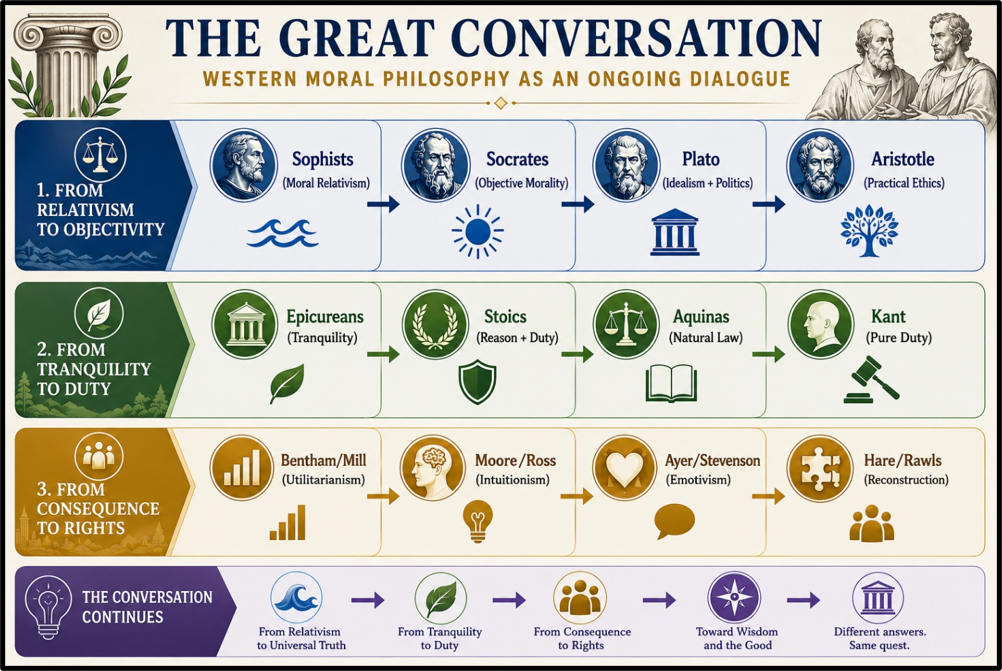
The Master Comparison Table
| Thinker / School | Core Idea | Type | Key Concept |
| Socrates | Virtue is knowledge | Virtue-based | Moral Intellectualism |
| Plato | Justice is harmony of soul | Idealist | Theory of Forms; Philosopher-King |
| Aristotle | Virtue is habit; mean between extremes | Virtue-based | Golden Mean; Eudaimonia |
| Epicurus | Happiness = absence of pain | Hedonistic | Mental serenity (ataraxia) |
| Stoics | Live according to nature/reason | Rationalist | Apatheia; Cosmopolitanism |
| Aquinas | Follow natural purpose | Natural Law | Preservation of life |
| Bentham / Mill | Greatest happiness of greatest number | Consequentialist | Utility principle |
| Kant | Act on universalisable maxim | Deontological | Categorical Imperative |
| Moore | Good is indefinable, intuited | Intuitionist | Naturalistic Fallacy |
| Ross | Weigh prima facie duties | Deontological | Prima facie duties |
| Ayer / Stevenson | Moral statements express emotion | Meta-ethical | Emotivism |
| Hare | Moral statements are universal prescriptions | Meta-ethical | Prescriptivism |
| Rawls | Justice as fairness | Contractarian | Veil of Ignorance |
The Three Great Schools — At a Glance
| Approach | Question | Focus | Best Suited For |
| Consequentialism (Utilitarianism) | What will produce the most good? | Outcomes / Results | Public policy, cost-benefit analysis |
| Deontology (Kantianism) | What is my duty? | Action itself / Rules | Rights, dignity, integrity, professional ethics |
| Virtue Ethics (Aristotle) | What kind of person should I be? | Character / Habits | Moral education, leadership development |
How to Use These Theories in UPSC Case Studies
Here is a practical framework. When you encounter an ethical dilemma in the Mains paper, do not blindly apply one theory. Use all three lenses:
- First, the Consequentialist Lens — What are the likely outcomes of each option? Who benefits, who suffers, what is the aggregate effect?
- Second, the Deontological Lens — Are any fundamental rights or duties being violated? Is any person being treated merely as a means? Can my action be universalised?
- Third, the Virtue Ethics Lens — What would a person of good character — honest, compassionate, courageous, just — do in this situation? What kind of officer do I want to become?
The best ethical decision is usually the one that survives all three tests — produces good consequences, respects duty and rights, and reflects virtuous character. When the three lenses conflict, you must explicitly weigh them and justify your choice. This is the structure of a high-scoring ethics answer.
Closing Thoughts
| Why This Matters Two and a half millennia ago, a barefoot Athenian stonemason started asking simple questions in the marketplace. What is justice? What is courage? How should one live? He was killed for it. But the questions he asked — and the conversation he started — continue today, in the chambers of the Supreme Court, in the corridors of Parliament, in the classrooms of LBSNAA, and in the silent moments when a young civil servant must decide whether to sign an unjust file. Ethics is not a chapter in your textbook. Ethics is the operating system of civilisation itself. Master it, and you do not merely pass an examination — you take your place in a 2,500-year-old conversation about what it means to be human. |
“The unexamined life is not worth living.”
— Socrates