
India and Bangladesh
Introduction: A Relationship Born of Liberation
Among all of India’s neighbours, Bangladesh is unique: it is the one country India helped to bring into existence. The two share a 4,096 km border—India’s longest with any nation—along with a common language, culture and the shared memory of the 1971 Liberation War (‘Muktijuddho’).
At its best, the relationship has been described as the ‘Sonali Adhyay’ (Golden Chapter), capable of transforming the geo-economics of the entire region. Yet it has always oscillated with Bangladesh’s domestic politics, and the dramatic political transition of 2024–26 has opened a new and uncertain phase that India must now navigate with fresh pragmatism.
| The Defining Rhythm of the Relationship India-Bangladesh ties swing with Dhaka’s politics: warm and cooperative under the Awami League (secular, India-friendly), cooler and more nationalist under the BNP (tilted toward Pakistan and China). The 2024 fall of Sheikh Hasina has ended an era of predictable alignment. |
Historical Background: A Land of Three Partitions
The land that is Bangladesh has been partitioned three times.
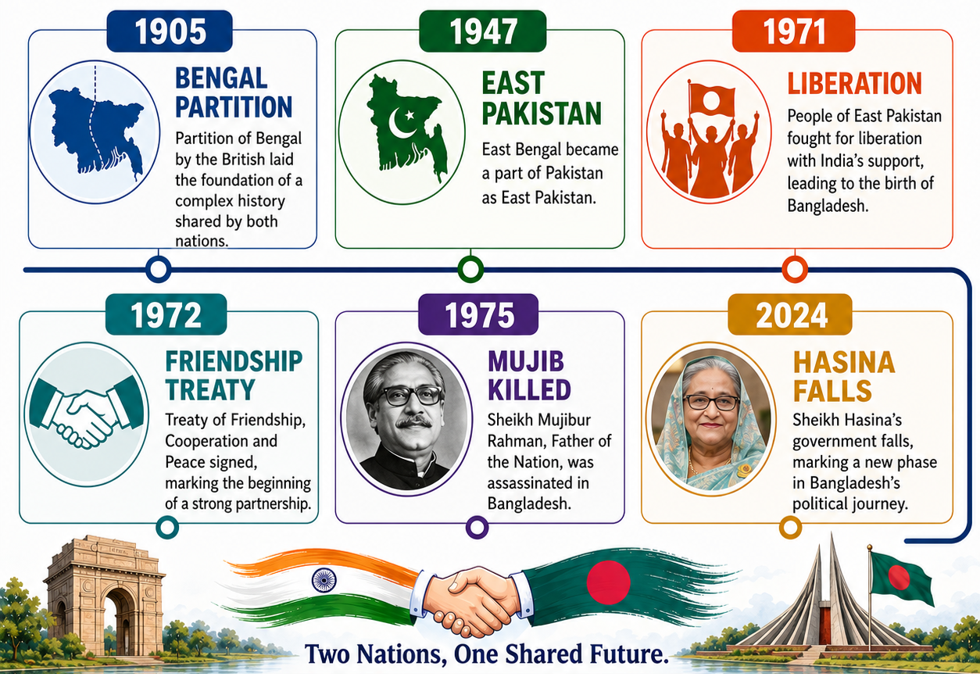
- First, the 1905 Partition of Bengal on Hindu-Muslim lines—reversed in 1911 after the Banga-Bhanga Andolan, but sowing the seed of communal division.
- Second, the 1947 Partition created East Pakistan.
- Third, in 1971, East Pakistan itself broke away to become Bangladesh.
The 1971 break flowed from deep grievances: East Pakistan’s under-representation, resource neglect, and the imposition of Urdu over Bengali.
When the Awami League under Sheikh Mujibur Rahman won the 1970 election, West Pakistan refused to hand over power and unleashed violence. India intervened militarily, and Bangladesh was born in December 1971.
The 1972 Treaty of Friendship and Cooperation became the foundation of modern India-Bangladesh relations. The assassination of Mujib on 15 August 1975 ended the early ‘honeymoon’ and began decades of political oscillation.
Significance and Areas of Cooperation
Bangladesh matters to India strategically, economically and for the security of the North-East. It is India’s bridge to Southeast Asia (a key partner in BBIN, BIMSTEC and the Act East policy), its largest trading partner in South Asia, and the indispensable gateway to its landlocked north-eastern states.
| Dimension | Substance |
| Trade | Bangladesh is India’s largest trade partner in South Asia; bilateral trade reached about USD 14 billion (2023-24). Both enjoy SAFTA preferences; a proposed Comprehensive Economic Partnership Agreement (CEPA) would cover goods, services and investment. India grants duty-free, quota-free access to most Bangladeshi exports. |
| Connectivity | Five operational rail links; the Akhaura–Agartala rail link (2023); inland-waterway routes; and a 2018 coastal-shipping agreement allowing India to use the Chattogram and Mongla ports (duty- and transit-free) to reach the North-East. Bus routes link Kolkata–Dhaka–Agartala and Dhaka–Guwahati. |
| Energy | Cross-border power grids and supply (including the Adani Godda plant); India, Nepal and Bangladesh signed a landmark trilateral pact for cross-border electricity trade; hydrocarbon and blue-economy cooperation. |
| Defence | Regular army and navy exercises; a 2013 extradition treaty; a 2017 defence-cooperation framework. Bangladesh is a leading contributor to UN peacekeeping—an outlet that keeps its military professionally engaged. |
| Maritime / blue economy | Cooperation on hydrocarbons, deep-sea fishing and marine ecology in the Bay of Bengal following the 2014 maritime boundary settlement. |
| Humanitarian | In 2018, India’s Operation Insaniyat sent relief for Rohingya refugees sheltered in Bangladesh. |
The Landmark Achievements
The Land Boundary Agreement (LBA)
The LBA is the crowning success of India-Bangladesh diplomacy. Radcliffe’s hasty 1947 line had left a bizarre legacy of enclaves (‘chitmahals’)—111 Indian enclaves inside Bangladesh and 51 Bangladeshi enclaves inside India—whose residents lived for decades without rights, services or a state.
First designed in 1974 between Indira Gandhi and Mujib, ratification stalled for 41 years. The breakthrough came with the 2011 Protocol (respecting residents’ wishes, no net cession of territory) and final Indian parliamentary ratification in 2015, completed by 2016.
The related Tin Bigha Corridor gave Bangladesh access to the Dahagram–Angarpota enclave. It was a rare case of a boundary settled entirely by negotiation, not conflict.
The Maritime Boundary Settlement (2014)
After eight rounds of talks failed, Bangladesh took the dispute (including over New Moore / South Talpatti Island) to the Permanent Court of Arbitration under UNCLOS.
On 7 July 2014, the tribunal upheld Indian sovereignty over New Moore while granting Bangladesh a large Exclusive Economic Zone (~19,000 sq km) and access to the open sea—ending its status as a ‘sea-locked’ nation.
Crucially, India gracefully accepted an award that expanded its neighbour’s rights, earning enormous goodwill.
The Enduring Irritant: River Waters
Bangladesh shares 54 of 57 transboundary rivers with India, making water the most emotive and persistent issue. Two rivers dominate.
The Ganga (Farakka) and its 2026 crossroads
India’s Farakka Barrage (completed 1975), built to flush silt and keep Kolkata port navigable, reduced downstream flow into Bangladesh’s Padma and long soured ties. The dispute was settled by the Ganga Waters Treaty of 1996, a 30-year dry-season water-sharing pact.
That treaty is now set to expire in December 2026, and renewal talks have begun—Dhaka seeks a long-term renewal while India prefers a flexible, data-based arrangement that also addresses Bihar’s flood concerns. Its outcome is a live and high-stakes test of the relationship.
The Teesta deadlock
The Teesta—the fourth-largest river in Bangladesh—remains the great unresolved dispute. An interim deal (India 42.5%, Bangladesh 37.5% in the dry season) was ready in 2011 but was blocked by the Chief Minister of West Bengal, illustrating how Indian federalism constrains foreign policy.
With water scarce in the dry months (drawn at the Gajoldoba and Dalia barrages), Bangladesh demands a 50% share, and China’s growing interest in Teesta management adds urgency.
Other Challenges
- Illegal migration & demographics — decades of undocumented migration from Bangladesh fuel political tension in Assam and West Bengal; NRC/CAA fears in turn stir anti-India sentiment in Dhaka.
- Border management — the 4,096.7 km border remains porous to smuggling, cattle trade, human trafficking and cross-border crime; border deaths are a recurring diplomatic irritant.
- Radicalisation — the spread of Wahhabism and the presence of Al-Qaeda/ISIS-linked elements (e.g., the 2016 Dhaka Holey Artisan attack) worry India, given the porous frontier and the 2014 Burdwan module.
- Trade imbalance & NTBs — the balance runs heavily in India’s favour; Bangladesh cites non-tariff barriers as obstacles, making CEPA important—especially as Bangladesh’s 2026 LDC graduation will erode its trade preferences.
- Minority rights — India has raised concerns over the treatment of Hindus and other minorities, an issue that sharpened after the 2024 transition.
- The China factor — Bangladesh’s growing engagement with China in infrastructure, ports and defence (including submarines) is a standing strategic concern.
- Tipaimukh dam — the proposed dam on the Barak river raises Bangladeshi fears over downstream summer flows.
The 2024–26 Political Reset: A New Chapter
The single most important recent development is the collapse of the Sheikh Hasina government. In August 2024, a student-led uprising ended Hasina’s fifteen-year rule and she fled to India, where her continued presence—and Dhaka’s demand for her extradition, sharpened after an International Crimes Tribunal sentenced her to death in November 2025—has become a major diplomatic irritant. An interim government under Muhammad Yunus governed until elections.
In the February 2026 general election, the Bangladesh Nationalist Party (BNP), led by Tarique Rahman, won a landslide (roughly two-thirds of seats), with Jamaat-e-Islami emerging second.
For India, this ends the era of Hasina-centric, predictable diplomacy and demands a shift toward institutional, state-to-state engagement—while managing greater space for China, Pakistan and Turkey in Dhaka.
| Is Bangladesh Drifting from India? The BNP-led regime and student groups have strengthened nationalist and periodic anti-India rhetoric.Growing room for China, Pakistan and Turkey, plus the Hasina asylum dispute and a push to revive SAARC, complicate ties.The measured verdict: this is a structural reset, not a rupture—India must decouple personality-driven nostalgia from durable, institution-based cooperation. |
Way Forward
Political and diplomatic reset
- Abandon ‘Hasina-centric’ nostalgia — engage the newly elected BNP government with generous economic diplomacy but firm red lines on anti-India militancy.
- Compartmentalise — insulate the friction over Hasina’s asylum from broader state-to-state and economic ties; use low-friction ‘ice-breakers’ such as fishermen and maritime governance to rebuild trust.
Water and ecology
- Renegotiate the Ganga Treaty (Dec 2026 deadline) with a flexible, climate-resilient, data-based formula that satisfies both Dhaka’s needs and Bihar’s flood concerns.
- Cooperate, not compete on river infrastructure (e.g., align Bangladesh’s Padma Barrage plans with Farakka management), and finally move on Teesta.
Economic integration
- Fast-track CEPA to buffer Bangladesh’s late-2026 LDC graduation and dismantle non-tariff barriers.
- Integrate supply chains — plug Indian cotton/yarn into Bangladesh’s massive garment (RMG) base rather than competing; preserve uninterrupted power supply and the Friendship Pipeline.
Security and border
- Fortify the Siliguri Corridor (the ‘Chicken’s Neck’) as a national-security priority, and deploy non-lethal border technology (CIBMS, drones, thermal sensors) to curb smuggling and end civilian border deaths.
- Protect minorities and counter radicalism through joint, transparent task forces.
Conclusion
The India-Bangladesh relationship is a paradox of profound closeness and recurring friction—bound by the blood of 1971 and the settlement of once-intractable boundary and maritime disputes, yet strained by water, migration and the tides of Dhaka’s politics.
The 2026 political reset marks the definitive end of personality-driven diplomacy and demands resilient, institutional statecraft. By expediting CEPA, pragmatically renegotiating the Ganga Water Treaty, and securing its eastern flank, India can insulate a vital partnership from adversarial geopolitics.
Managing this transition with enlightened pragmatism is not merely about bilateral stability—it is a prerequisite for the success of India’s Act East policy and maritime security in the Bay of Bengal.