
India and Myanmar
Introduction: The Gateway to the East
Myanmar occupies a singular place in India’s neighbourhood: it is the only ASEAN country that shares a land border with India (about 1,643 km) and the only Southeast Asian state on India’s frontier. This makes it the indispensable land bridge to Southeast Asia and the physical foundation of India’s Act East Policy.
The relationship is anchored in deep civilizational bonds—captured in the ‘Five Bs’: Buddhism, Business, Bollywood, Bharatnatyam and Burma teak—but it is also uniquely difficult, straddling India’s competing instincts to support democracy, secure its restive North-East, and counter a deeply entrenched China. The 2021 military coup and the civil war that followed have made this balancing act harder than ever.
| India’s Core Dilemma in Myanmar India must simultaneously engage whoever holds power in Naypyidaw (for the North-East and connectivity), counter Chinese dominance, and uphold its democratic values—three goals that constantly pull against one another. Pragmatism has usually won. |
Historical and Civilizational Background
The oldest link is Buddhism. Legend holds that the Buddha sent two merchants, Tapussa and Bhallika, with strands of his hair that were enshrined in the Shwedagon Pagoda; Ashoka later sent missionaries to Burma.
The colonial era bound the two lands tightly: Burma was administered as part of British India until 1937, the British exiled the last Mughal emperor Bahadur Shah Zafar to Yangon, and large numbers of Indians migrated as plantation and commercial workers.
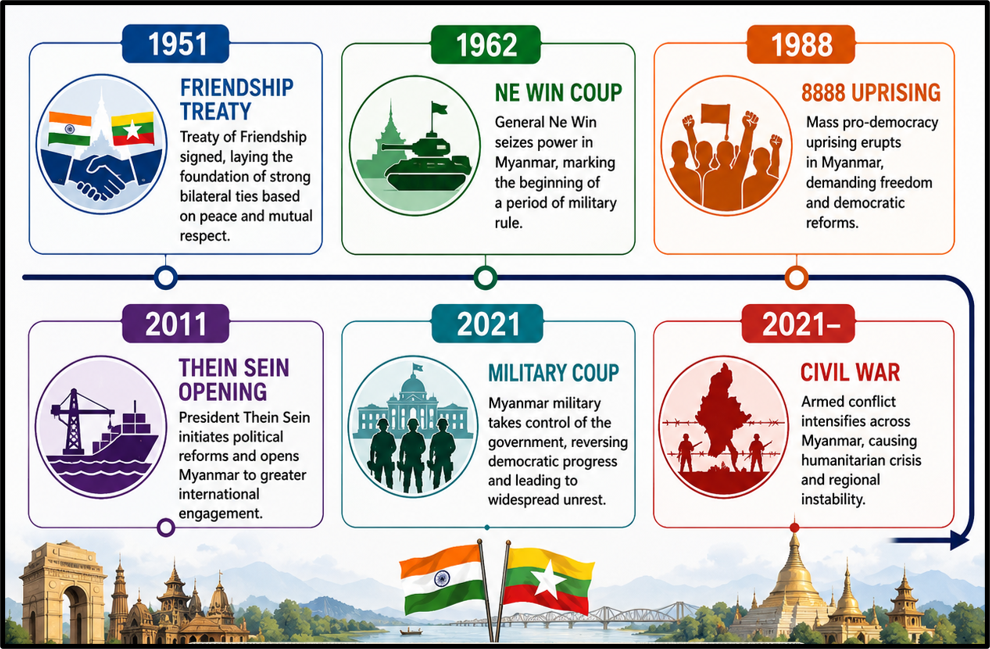
Both nations won independence within months of each other, and ties were warm under Nehru’s non-alignment. But the 1962 military takeover by Ne Win and his harsh nationalisation—which devastated the Indian diaspora—drove the two apart.
When the ‘8888 Uprising’ (8 August 1988) erupted and the National League for Democracy (NLD) under Aung San Suu Kyi swept the 1990 election only to be denied power by the junta, India backed democracy and condemned the human-rights abuses.
In the 1990s, however—recognising the strategic cost of ceding Myanmar to China—India pivoted to pragmatic engagement with the military, a shift that cost it goodwill among Myanmar’s democrats but secured its strategic interests. A tentative democratic opening under Thein Sein (2011) and NLD governments (2016) revived cooperation—until the coup of 2021.
Why Myanmar Matters: Strategic Significance
| Driver | Significance for India |
| Gateway to ASEAN | The only land bridge to Southeast Asia; the linchpin of the Act East Policy and the site where India unveiled the policy in 2014. |
| North-East security | Shares borders with sensitive states (Manipur, Nagaland, Mizoram, Arunachal); its territory has long sheltered NE insurgents (NSCN, ULFA), making border cooperation vital. |
| China containment | India’s development of Sittwe Port (under the SAGAR vision) directly counters China’s Kyaukpyu deep-sea port and the China–Myanmar Economic Corridor. |
| Connectivity | Host to flagship projects—the Kaladan Multimodal Transit Transport Project, the India–Myanmar–Thailand Trilateral Highway, and the MIST submarine-cable corridor. |
| Economy & energy | Offshore gas, oil and power cooperation (ONGC Videsh, GAIL); Myanmar is a major supplier of pulses to India. |
| Culture | Shared Buddhist heritage (India restored Bagan’s Ananda Temple); the ‘Five Bs’ underpin people-to-people ties. |
Areas of Cooperation
Development and Connectivity
India has extended over USD 1.75 billion in grant-based aid, making it one of Myanmar’s largest development partners. The two connectivity flagships are the Kaladan Multimodal Project (linking Kolkata to Sittwe by sea, Sittwe to Paletwa by river, and onward by road to Mizoram—opening India’s landlocked North-East to the sea) and the India–Myanmar–Thailand Trilateral Highway (a future gateway to ASEAN).
The Sittwe Port, the first phase of Kaladan, has been operationalised and is under Indian operation. Digital connectivity is advancing through the MIST submarine cable linking Singapore, Malaysia, Myanmar and India.
Commercial and Energy Ties
Bilateral trade is modest (around USD 1.7–2 billion), with India importing beans, pulses and forest products and exporting pharmaceuticals and steel; India is among Myanmar’s larger trade partners and investors, active in the oil and gas sector (ONGC Videsh and GAIL hold stakes, including in the Shwe field). Trade also flows through border trade at points such as Tamu–Moreh in Manipur.
Defence and Security Cooperation
Security is the ballast of the relationship, driven by North-East insurgency and the Golden Triangle drug trade (Myanmar being a major narcotics transit country). Cooperation rests on a web of agreements—the 1994 border-tranquillity MoU, intelligence-sharing, a Mutual Legal Assistance Treaty (2010), and a Defence Cooperation Agreement (2019).
The two hold joint exercises (IMBAX, IMCOR, IN-MN BILAT) and have conducted coordinated anti-insurgent operations such as Operation Sunrise (2019). India supplies arms and trains Myanmar’s forces, and helps patrol the Bay of Bengal.
| Case Study — Operation Golden Bird (1995) Acting on R&AW intelligence that an arms consignment for NE insurgents had landed near Cox’s Bazar (Bangladesh), the Indian Army’s 57 Mountain Division launched a major counter-insurgency operation along the Mizoram–Myanmar border. Troops were air-dropped, insurgent communications intercepted, and a key militant (Hathi Barvah, Pakistan-trained) captured—yielding valuable intelligence before the operation closed in May 1995. A landmark early example of India-Myanmar border cooperation—though, in reality, executed largely by India alone. |
The Rohingya Crisis
The Rohingya are a Muslim population concentrated in Myanmar’s Rakhine (Arakan) state, many descended from Bengali Muslims brought by the British from 1823. Under the 1982 Citizenship Law they were denied recognition as an official ethnic group and rendered stateless. Rising radical-Buddhist mobilisation—the 969 and 786 movements and figures such as Ashin Wirathu—fuelled communal riots from 2011.
After militant attacks by the Arakan Rohingya Salvation Army (ARSA) in 2017, a brutal military crackdown drove some 740,000+ Rohingya into Bangladesh, creating one of the world’s largest refugee crises.
| India’s Rohingya Dilemma India is not a signatory to the 1951 UN Refugee Convention, so it has no treaty obligation to accept refugees, though it grants asylum case-by-case via Long-Term Visas. India views the roughly 40,000 Rohingya on its soil as illegal immigrants and a security risk (fear of radicalisation, demographic concern) and favours their return to Myanmar. The tension: the customary-law principle of non-refoulement bars forcible return to danger, and India must balance ties with both Bangladesh and Myanmar while providing humanitarian aid (e.g., Operation Insaniyat). |
The Border and the Free Movement Regime
The India-Myanmar border is porous and runs through difficult, insurgent-inhabited terrain. To respect ethnic kinship—particularly among the Naga and Mizo/Chin peoples split by the colonial boundary—the two set up a Free Movement Regime (FMR) in 1968, allowing hill-tribe members to cross without a visa (movement progressively curtailed from 40 km to 16 km and then to about 10 km).
The FMR is now being rolled back. Citing internal security and the demographic balance of the North-East—concerns amplified by the 2021 coup, the ensuing civil war, and the 2023 Manipur ethnic violence—the Ministry of Home Affairs announced in February 2024 its decision to scrap the FMR and fence the entire ~1,643 km border.
A new QR-coded, biometric border-pass regime has been introduced, though full withdrawal is not yet complete and Mizoram and Nagaland strongly oppose the move on grounds of shared ethnicity and livelihoods.
The 2021 Coup and the Civil War
On 1 February 2021, the military (Tatmadaw) seized power, detained Aung San Suu Kyi, and reversed a decade of democratic opening. The coup triggered mass resistance—People’s Defence Forces and Ethnic Armed Organisations have since waged a nationwide civil war. By 2026 the junta controls barely a third of the country, while resistance forces administer large swathes.
This directly threatens Indian interests. In Rakhine state—home to the Kaladan project and Sittwe Port—the Arakan Army now controls most of the state and is assaulting Sittwe itself, stalling the Kaladan corridor. India has adopted a characteristically pragmatic posture: engaging the junta where necessary for connectivity and security while quietly maintaining channels to ethnic groups, and providing humanitarian relief (its Operation Brahma responded to the devastating March 2025 Myanmar earthquake).
The China Factor
China is the dominant external power in Myanmar—its top trading partner, largest arms supplier since 1988, and a major investor. Through the China–Myanmar Economic Corridor (CMEC) under the BRI, the Kyaukpyu deep-sea port, and a parallel oil-and-gas pipeline to Yunnan, Beijing gains a strategic outlet to the Indian Ocean that bypasses the Malacca Strait.
| India’s Concerns over the Chinese Footprint Debt-trap and strategic assets — risk that Myanmar cedes ports like Kyaukpyu to China. Strategic encirclement — Kyaukpyu and Gwadar together squeeze India from east and west. North-East insurgency — intelligence assessments point to Chinese arms and funding reaching NE insurgent groups via Myanmar. Threat to connectivity — Chinese dominance imperils the Kaladan corridor, the Trilateral Highway and Mekong-Ganga cooperation. |
Way Forward
- Advance the Act East Policy — deeper engagement with Myanmar is essential to India’s strategic and economic goals in Southeast Asia.
- Fast-track connectivity — accelerate the Kaladan project and the India–Myanmar–Thailand Highway to cement India’s role as a reliable partner and secure an alternative route to the North-East.
- Handle the Rohingya issue sensitively — balance ties with Bangladesh and Myanmar while addressing both humanitarian and security concerns.
- Strengthen security cooperation — deepen joint operations, intelligence-sharing and border management to curb insurgency, arms and drug trafficking.
- Manage, not merely seal, the border — reconcile legitimate security concerns with the ethnic and livelihood realities that fuel Mizoram’s and Nagaland’s opposition to ending the FMR.
- Use multilateral platforms — work through ASEAN, BIMSTEC and the Quad to promote stability and a rules-based order, diluting China’s unilateral dominance.
- Stay pragmatically engaged — keep channels open to both the junta and resistance/ethnic actors so India is not caught on the wrong side of the civil war’s outcome.
Conclusion
Myanmar is where India’s Neighbourhood First and Act East policies converge—the physical and civilizational gateway to Southeast Asia, and the frontline of its contest with China. Yet it is also where India’s ideals and interests collide most sharply, forcing a pragmatic accommodation with whoever rules Naypyidaw.
The 2021 coup and the ongoing civil war have frozen flagship projects like Kaladan and complicated every calculation, even as they open space for India to position itself as a stabilising, development-focused partner against a domineering China. India’s task is to keep its connectivity dreams alive, its North-East secure, and its options open—engaging patiently while the dust of Myanmar’s transformation settles.