
India and Sri Lanka
Introduction: A Relative, Not Merely a Friend
Few relationships are as intimate—or as fraught—as India’s with Sri Lanka. The two share a civilizational bond stretching back over 2,500 years, woven from Buddhism, the Ramayana and centuries of trade, migration and kinship.
As a Sri Lankan leader once put it, ‘India is a relative of Sri Lanka, while all other countries are friends.’ Yet this closeness has cut both ways: the ethnic Tamil question once dragged India into a bloody military intervention, and today the island’s position astride the Indian Ocean’s vital sea lanes makes it the sharpest arena of India’s contest with China. The relationship has decisively shifted from a political-security preoccupation to an economic-strategic partnership.
| Why Sri Lanka is Strategically Indispensable Sri Lanka sits astride sea lanes carrying roughly 90% of India’s maritime trade; India’s navy must round the island to move between the Bay of Bengal and the Arabian Sea. Whoever holds influence in Colombo shapes the security of India’s entire southern flank. |
Historical Background and the Tamil Question
The bond dates to the spread of Buddhism some 2,000 years ago and finds mythic expression in the Ramayana. The modern friction, however, is a colonial inheritance.
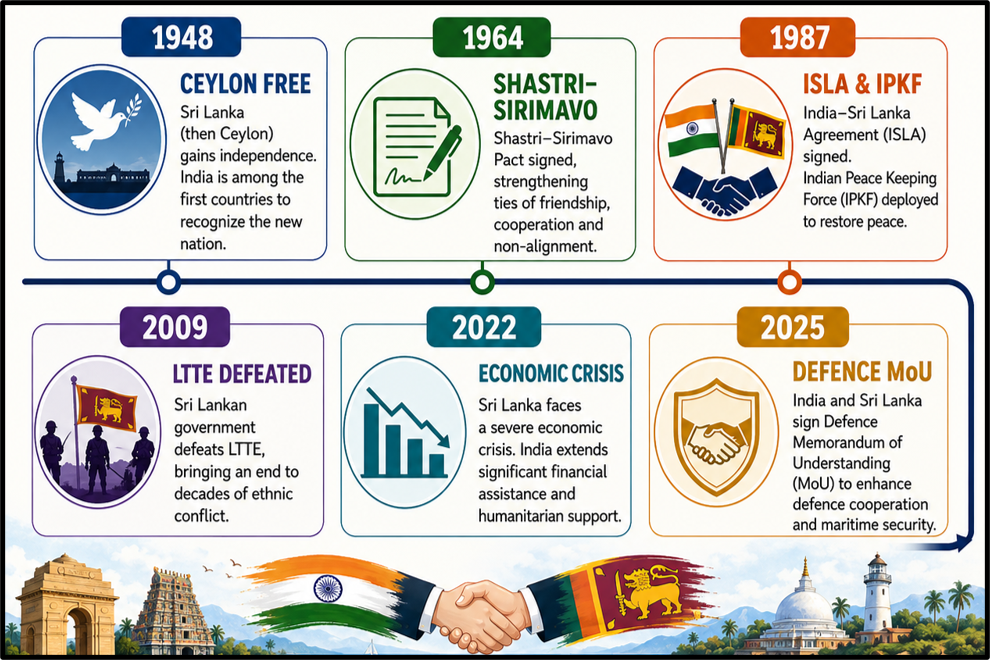
From the 1830s the British transported Indian Tamil labour to Ceylon’s plantations, settling them in the north. After independence (Ceylon in 1948, renamed Sri Lanka in 1972), the Sinhalese-majority state systematically discriminated against Tamils—through citizenship denial and the Sinhala-only language policy—sowing the seeds of ethnic conflict.
The Shastri–Sirimavo Pact (1964) tried to resolve the citizenship of stateless Indian Tamils, but the underlying alienation deepened.
India’s core motivation flowed from a single principle: national unity is the foundation of security. Delhi feared that Tamil separatism in Sri Lanka could have a spillover effect on Tamil Nadu.
- This drove a delicate, at times contradictory, policy—covertly supporting Tamil militants in the early 1980s to pressure Colombo, while never wanting them to succeed in creating a separate Eelam.
- Out of this cauldron emerged the LTTE (Liberation Tigers of Tamil Eelam), founded by V. Prabhakaran in 1976, which grew into a formidable insurgent force.
The Defining Trauma: ISLA, the IPKF and Its Legacy
The India–Sri Lanka Accord (ISLA), signed on 29 July 1987 by Rajiv Gandhi and Jayewardene, was India’s boldest attempt to shape its neighbour’s destiny.
Its logic was twofold: to draw the warring ethnic groups into mainstream politics and to secure political devolution for the Tamil regions. Under it, the LTTE was to surrender arms to the Indian Peace Keeping Force (IPKF), and Sri Lanka would devolve power via the 13th Amendment creating Provincial Councils.
It failed disastrously. The LTTE rejected the accord and turned its guns on the IPKF; the force swelled from 6,000 to nearly 100,000 and became mired in a bloody war. The Sinhalese resented the intervention as Indian interference, and President Premadasa demanded the IPKF’s withdrawal, even covertly aiding the LTTE against it.
India pulled out by March 1990, the devolution experiment collapsed, and in May 1991 the LTTE assassinated Rajiv Gandhi—after which it was banned and no Tamil party in India ever backed it again. The scars of this episode explain India’s later caution and ‘hands-off’ military posture.
| The 13th Amendment — Still the Unfinished Business Born of the 1987 Accord, the 13th Amendment created Provincial Councils to devolve power to Tamil areas—India’s enduring demand. But councils remained financially dependent on the centre, and successive governments withheld land and police powers (the ‘13-Plus’ promise going unfulfilled). Its full implementation remains India’s consistent ask in every dialogue—a test of Sri Lanka’s commitment to ethnic reconciliation. |
The civil war finally ended when the Rajapaksa government’s Eelam War IV (2006–2009) crushed the LTTE and killed Prabhakaran in 2009. But India’s absence from that final phase allowed Pakistan and especially China to step in with arms and aid—most consequentially, China’s entry into the Hambantota port that India had earlier declined to develop.
The Modern Partnership: Areas of Cooperation
Since the end of the Cold War, the relationship has been rebuilt on economic and security foundations. Sri Lanka was the first South Asian economy to liberalise (1978), and ties deepened with the India–Sri Lanka Free Trade Agreement (signed 1998, operational 2001).
| Dimension | Substance |
| Trade & investment | India is Sri Lanka’s largest trading partner (about USD 5.5 billion, 2023-24) and a major investor (over USD 2 billion). The FTA gives duty-free preferential access; talks on a deeper services pact (CEPA/ETCA) continue, though Sri Lanka fears Indian firms dominating its economy. |
| Defence & security | Annual exercises Mitra Shakti (Army) and SLINEX (Navy); maritime security, intelligence-sharing, counter-terrorism and cyber cooperation. A landmark first-ever Defence MoU (2025) now structures this cooperation. |
| Energy & connectivity | Development of Trincomalee as a regional energy hub (India–Sri Lanka–UAE tripartite); an India–Sri Lanka electricity grid interconnection; the Indian Oil Corporation’s presence; and UPI digital-payment linkage (2023). |
| Development assistance | High-Impact Community Development Projects, housing for displaced Tamils in the north, ITEC scholarships, and the Swami Vivekananda Cultural Centre. |
| Culture | Shared Buddhist heritage (the Ramayana and Buddhist circuits, Vesak Day celebrations, relics exchange) anchors people-to-people ties. |
The Colombo Security Conclave
A key institutional platform is the Colombo Security Conclave (CSC), a regional grouping of India, Sri Lanka, the Maldives, Bangladesh and Mauritius (with Seychelles as observer), focused on maritime security, counter-terrorism, cyber security, trafficking and disaster relief.
Established as a trilateral maritime group in 2011, it lapsed amid India–Maldives tensions in 2014, was revived and expanded in 2020, and now has a permanent Secretariat in Colombo—a vehicle for India to anchor Indian Ocean security cooperation.
Issues and Challenges
The China factor
The overriding strategic worry is China’s deepening footprint. Beijing’s 99-year lease of the Hambantota port (2017)—a textbook case of debt-trap diplomacy—and its interest in the nearby Mattala airport, along with Chinese submarine and research-vessel visits to Sri Lankan ports, raise fears of a military dimension astride India’s sea lanes. Countering this is now the central driver of India’s Sri Lanka policy.
The fishermen issue and Katchatheevu
The most emotive bilateral irritant is the fishermen dispute in the Palk Bay. With fish stocks depleted on the Indian side, Indian trawlers stray into Sri Lankan waters and face arrest; Sri Lankan fishermen, returning after the war, resent Indian bottom-trawling.
The dispute is entangled with the tiny island of Katchatheevu, which India recognised as Sri Lankan territory under the 1974 maritime agreement (Indians retained access for pilgrimage and net-drying, but not fishing rights).
The issue flared politically in India in 2024 but Sri Lanka regards it as settled. Joint working groups and a push for joint patrolling seek a humane resolution.
Other frictions
- The Tamil question — the unfulfilled 13th Amendment, resettlement and reconciliation for Tamils remain live grievances.
- Trade imbalance — the balance runs heavily in India’s favour, and Colombo seeks better market access.
- Domestic political sensitivity — Tamil Nadu’s politics heavily shape India’s Sri Lanka policy, while anti-India sentiment is periodically leveraged in Colombo.
- The UNHRC balancing act — India has navigated a careful line, voting for rehabilitation resolutions (2012–13) but abstaining in 2014 against an intrusive, country-specific international war-crimes probe, defending sovereignty.
India as First Responder: The 2022 Economic Crisis
Sri Lanka’s economic collapse of 2022–23—a sovereign default driven by debt, dwindling reserves and the pandemic—became a defining test of India’s neighbourhood credentials, and India emerged as the single most important partner, in stark contrast to a hesitant China. This is a favourite examination theme (‘India is an age-old friend of Sri Lanka’).
| India’s Assistance during the 2022–23 Crisis Financial lifeline — around USD 4 billion in emergency assistance, including a USD 1 billion credit line for essentials. Energy security — fuel supplies (diesel and petrol) and a USD 500 million credit line that averted a total fuel collapse. Currency & debt — a USD 400 million currency swap and crucial support for Sri Lanka’s USD 2.9 billion IMF bailout and debt restructuring. Humanitarian relief — large-scale food and medical aid. Global advocacy — lobbying at the IMF, G20 and World Bank to speed international assistance. |
Recent Developments: A New Strategic Depth
Relations have entered a confident new phase. Anura Kumara Dissanayake became Sri Lanka’s president in September 2024, and Prime Minister Modi’s April 2025 visit—the first by any foreign leader to the new government—cemented the partnership under the MAHASAGAR vision (Mutual and Holistic Advancement for Security and Growth Across Regions). Highlights included:
- Sri Lanka Mitra Vibhushana — Sri Lanka’s highest civilian honour conferred on PM Modi.
- First-ever Defence MoU — a landmark 5-year umbrella agreement on joint exercises, maritime surveillance and defence-industry cooperation, with Sri Lanka reaffirming that its territory will not be used against India.
- Energy & infrastructure — an India–Sri Lanka electricity-grid agreement and a tripartite (India–Sri Lanka–UAE) MoU to develop Trincomalee as an energy hub.
- Debt relief — India converted over USD 100 million of loans into grants and eased interest on others, alongside solar and railway projects.
- Digital & cultural — UPI rollout in Sri Lanka (2023) and a relics exchange for Vesak Day.
Way Forward
- Deliver on projects — complete Trincomalee, grid and connectivity projects on time to out-compete China on reliability.
- Resolve the fishermen issue humanely — pursue joint patrolling, deep-sea fishing alternatives and livelihood support in Tamil Nadu and the Palk Bay.
- Press gently for the 13th Amendment and Tamil reconciliation, using development in the north as the vehicle.
- Deepen maritime security through the Colombo Security Conclave and the new Defence MoU to blunt China’s naval reach.
- Treat Sri Lanka as an equal — sustain the shift from a big-brotherly, Tamil-centric lens to a partnership of shared prosperity aligned with Sri Lanka’s ‘India First’ outlook.
Conclusion
India–Sri Lanka relations have travelled a long road—from the trauma of the IPKF misadventure to a mature, economically anchored partnership. The Tamil question taught India the perils of intervention; the 2022 crisis showed the rewards of generosity; and the China challenge lends the relationship enduring strategic weight.
With the 2025 Defence MoU and the MAHASAGAR vision, the two neighbours have arguably never been closer. The task now is to convert this goodwill into delivered projects, resolved irritants and genuine equality—so that the ‘relative’ remains not just close, but trusted.