
India and Africa Policy
Setting the Context
India and Africa are bound by one of the world’s oldest and most organic relationships — a partnership rooted not in the arithmetic of power but in a shared history of anti-colonial struggle, a common developmental aspiration, and enduring people-to-people ties.
Africa is a continent of 54 sovereign states, home to a young and rapidly expanding population, vast mineral and hydrocarbon wealth, and some of the fastest-growing economies in the world. For a rising India, Africa is not merely a market or a resource frontier; it is a strategic partner in the making of a multipolar, equitable global order.
The defining feature of India’s approach is that it is consultative rather than extractive. India does not follow a ‘white man’s burden’ model of aid; it positions itself as a development partner sharing its own experiences and technologies for mutual benefit. This philosophy is captured in the guiding idea of ABBA — ‘Africa for Bharat and Bharat for Africa’, and in the framing of the relationship as ‘Partners in Progress’.
| Central Argument for Mains India’s Africa policy rests on a triple foundation: a historical-moral legacy (anti-colonialism, Gandhi, NAM), a hard-interest logic (energy, minerals, markets, maritime security), and a normative model of South-South Cooperation that distinguishes it sharply from China’s resource-centric engagement. |
Historical Foundations
The relationship is often said to ‘owe its origin to the monsoon winds.’ Long before formal diplomacy, the seasonal monsoon system carried Indian sailors to the East African coast and back, weaving a maritime trade lattice recorded as early as the Greco-Roman navigational text, the Periplus of the Erythraean Sea.
This ancient exchange — Indian textiles and grain for African ivory, gold, palm oil and incense — created a continuous Indian presence along the Zanj coast that later solidified into settled communities.
From Trade to Shared Suffering
- Ancient & medieval links: Maritime trade seeded diaspora settlements; the Siddis (descendants of Bantu peoples) served in Indian armies, illustrating deep people-to-people contact.
- Colonial convergence: European imperialism turned Africa into a colonial battleground and drew Indians across the ocean — skilled artisans to Mauritius and Reunion, and later indentured labourers (after the 1833 abolition of slavery in Britain) to sugar and cotton plantations and railway projects. India and Africa thus became fellow victims of imperialism.
- The freedom-struggle bond: Mahatma Gandhi forged and first tested Satyagraha in South Africa (1893-1914); the Indian National Congress opened overseas offices to support Africans; and at the 1927 Brussels Congress of Oppressed Nationalities, Jawaharlal Nehru linked India’s freedom struggle to Africa’s, giving birth to Afro-Asian solidarity that would mature into Non-Alignment.
| Anti-Racialism as a Diplomatic Tool When South Africa’s Ghetto Act (1946) institutionalised racial segregation, interim PM Nehru raised it at the UN, and India severed diplomatic ties with South Africa until apartheid ended in 1994. India thus added anti-racialism to its toolkit of anti-colonialism and anti-imperialism — a moral capital that still underpins African goodwill toward India. |
The Three Phases of Post-Independence Engagement
| PHASE I (1950s-1970s) — Solidarity & Decolonisation: India champions African independence through NAM; Gandhi’s legacy and Nehru’s advocacy build deep goodwill, though support wanes after 1962 as China preaches armed struggle. |
▼
| PHASE II (1970s-1990s) — Economic Reconnect: Strengthened by the Green Revolution and 1971, India makes NAM economy-oriented, deepens South-South Cooperation (Lusaka 1970), and re-values the diaspora as ‘ambassadors of India.’ The AFRICA Fund (1986, Harare) aids the anti-apartheid struggle. |
▼
| PHASE III (Post-Cold War to Present) — Strategic Partnership: Energy security, private-sector expansion, institutionalised summitry (IAFS), and maritime interests drive a comprehensive, forward-looking partnership under the ABBA vision. |
Why Africa Matters to India — Significance
The strategic significance of Africa for India can be captured in a single mnemonic — OIL, standing for Oil, Investment and Location — and then broadened across the political, economic, strategic, cultural and diaspora dimensions.
| Dimension | Why It Matters |
| Energy (O – Oil) | Africa holds an estimated 10% of the world’s oil and major gas reserves. India seeks equity oil — ownership in oil blocks — which gives deeper market exposure than buying on the spot market. The Gulf of Guinea is a rising hydrocarbon hotspot. |
| Economic (I – Investment) | Africa is a rising, youthful market (a growing middle class and large working-age population) offering opportunities for Indian FDI in agribusiness, pharmaceuticals, automobiles and consumer goods — the ‘next growth pole’ of the world. |
| Strategic (L – Location) | Africa’s geography links India to the Americas via the Cape of Good Hope and to West Asia via the Maghreb. The Indian Ocean littoral (Horn of Africa, island states) is central to India’s maritime security and anti-piracy interests. |
| Resources | Beyond oil: gold, diamonds, platinum, cobalt and critical minerals vital to India’s technology, defence and clean-energy sectors. |
| Diaspora & Culture | A large Indian-origin diaspora across East and Southern Africa acts as a living bridge; soft power — yoga, cinema, education, pharma — deepens goodwill. |
| Political / Multilateral | 54 votes in global forums make Africa central to India’s push for UN Security Council reform, Global South leadership, and a multipolar order. |
Key Drivers & Institutional Instruments
India’s intention, it has always maintained, is not merely to harness African resources but to assist the continent’s overall development. Rather than a donor-recipient hierarchy, India shares knowledge and developmental experience for mutual benefit. This philosophy is operationalised through a distinctive set of development-partnership instruments.
(1) ITEC — Indian Technical and Economic Cooperation
Launched on 15 September 1964, ITEC flows from the Nehruvian idea of ‘one world’ — an interdependent order where nations cooperate for shared well-being. It positions India as a trainer and capacity-builder for the developing world, offering training, scholarships and technical assistance.
It is administered by the Development Partnership Administration (DPA) division of the Ministry of External Affairs. In 2019 India launched the first e-ITEC pilot for African nations, and during the pandemic e-ITEC became the preferred mode of training, with courses expanding into big data, urban infrastructure, WTO issues and solar technology.
(2) South-South Cooperation (SSC)
Originating at the Bandung Conference (1955) and folded into NAM from 1961, SSC is a demand-driven, voluntary, horizontal partnership with no conditionalities and full respect for sovereignty. It differs fundamentally from North-South Cooperation (which India sees as a supplement, not a substitute) and from self-interested economic diplomacy. In the 21st century India pursues, through SSC, the goals of sustainable development, inclusive growth, infrastructure and energy.
(3) Connectivity, Health & Education Platforms
- Pan-Africa e-Network Project: Inspired by Dr. A.P.J. Abdul Kalam’s 2004 vision (addressing the Pan-African Parliament) of satellite-based connectivity, it delivers tele-education and telemedicine across African nations — inaugurated in 2010 and continued through e-VidyaBharati (education) and e-ArogyaBharati (health).
- TEAM-9 (2004): The Techno-Economic Approach for Africa-India Movement, a regional initiative for eight resource-rich West African states, backed by a US$500 million line of credit for infrastructure and low-cost technology.
(4) India-Africa Forum Summit (IAFS) — The Apex Platform
Following the models of Japan’s TICAD and China’s FOCAC, India institutionalised continental-level engagement through the IAFS. A key milestone was IAFS-III (2015), where India abandoned the restrictive Banjul Formula (which capped participation at 15 states) and invited all 54 African nations — pairing hard diplomacy with a soft-power opening of yoga and bhangra.
| Summit | Year / Venue | Key Outcomes |
| IAFS-I | 2008, New Delhi | New Delhi Declaration; shared vision on sustainable development, climate change and UN reform. |
| IAFS-II | 2011, Addis Ababa | Addis Ababa Declaration; framework of capacity building, peace and security; institutions like IITs/IIFT envisaged. |
| IAFS-III | 2015, New Delhi | Delhi Declaration – ‘Partners in Progress’; all 54 states invited; US$10 billion concessional credit + US$600 million grant; 50,000 scholarships; support for Agenda 2063. |
| IAFS-IV | 2026, New Delhi | Convened after a long gap under the theme IA SPIRIT (India-Africa Strategic Partnership for Innovation, Resilience and Inclusive Transformation), reaffirming health, digital and development cooperation. |
(5) Complementary Frameworks
- Asia-Africa Growth Corridor (AAGC): An India-Japan initiative (2017) for quality infrastructure and connectivity across Asia and Africa — a values-based alternative to debt-heavy models.
- International Solar Alliance (ISA): Co-founded by India and France; numerous African states have joined to advance solar energy adoption.
- Trade instruments: the Duty-Free Tariff Preference (DFTP) Scheme (2008, modified 2014) for LDCs; the Focus Africa Programme (2002-03) using Heads of Mission in 24 nations as commercial agents; and lines of credit channelled through Exim Bank.
Areas of Cooperation
Contemporary India-Africa cooperation is broad-based and multi-sectoral, having moved well beyond resources into technology, health, skills and the digital economy.
Economic & Commercial
- Trade & Investment: Bilateral trade has crossed US$100 billion (2024-25), and India ranks among the top investors in Africa, with cumulative investment of roughly US$75 billion. India champions the African Continental Free Trade Area ecosystem and open, integrated African markets (the Namaskar Africa vision).
- Regional resource map: Different sub-regions offer India distinct commercial opportunities and challenges (see table).
| Region | Key Centres | Core Strengths | Challenges |
| Western Africa | Nigeria, Ghana, Ivory Coast | Crude oil | Piracy in Gulf of Guinea |
| Southern Africa | Angola, South Africa | Oil (Angola), gold, diamonds, steel | Limited non-oil market access |
| Northern Africa | Egypt, Tunisia | Oil, chemicals, fertilisers | Post-Arab-Spring instability |
| Eastern Africa | Kenya, Mozambique, Mauritius, Seychelles | Leather, strategic island locations | Skill & technology gaps |
| Central Africa | Chad, Congo, Uganda, Rwanda | Vegetables, coffee | Poor transport & hinterland reach |
Southern African Customs Union (SACU)
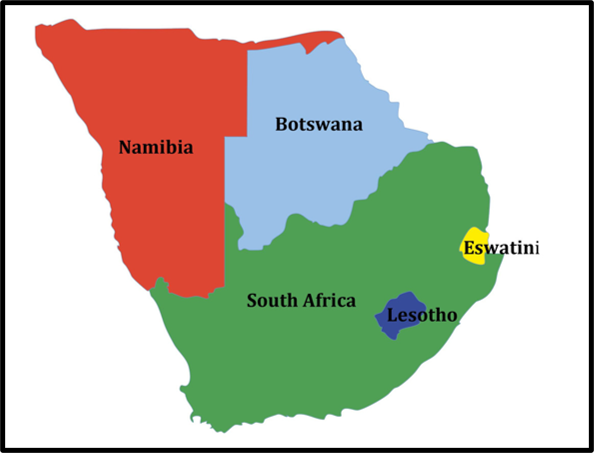
SACU is the world’s oldest working customs union — a single tariff wall around five Southern African economies. For India it is a gateway to critical minerals and a 75-million-consumer market, and a way to balance China’s heavy footprint in African mining.
About SACU
- Comprises five Southern African states: South Africa, Botswana, Namibia, Lesotho and Eswatini (formerly Swaziland). Headquarters: Windhoek, Namibia.
- Established in 1910, it is the world’s oldest continuously functioning customs union.
- Members maintain a unified Common External Tariff (CET) on non-members while allowing duty-free internal movement of goods; customs and excise pool into South Africa’s National Revenue Fund.
- As of 2026, SACU–India trade is $16.81 billion, with India running a trade deficit.
Development, Human & Digital
- Capacity Building & Education: India hosts 25,000+ African students; ITEC and thousands of scholarships skill African youth. India aims to be a global education and skilling hub for the continent.
- Health & Pharmaceuticals: Indian generics tackle HIV/AIDS, TB and malaria; medical tourism from Africa is rising sharply; hospital networks extend tele-medicine.
- Agriculture & Food Security: Technology transfer, irrigation and the India-Africa Agriculture Cooperation Plan; some Indian firms cultivate land in Africa to bridge domestic shortfalls.
- Renewable Energy & Climate: Africa is a low emitter but high sufferer of climate change; India offers solar, wind and tidal cooperation via the ISA.
| India-Africa Digital Partnership — A Model of Equal Partnership India shares affordable digital public goods without a donor hierarchy — the Pan-African e-Network served tele-education and telemedicine across 48 countries. Co-development: joint ICT centres of excellence; adaptation of India’s UPI / digital-payments expertise to African fintech; agritech and e-health platforms. Institutional depth: investment in broadband, data centres and satellite links, plus e-governance and cyber-security cooperation, institutionalised through the IAFS. |
Security, Peacekeeping & Maritime
India has been a consistent contributor of UN Peace Keeping Forces (PKF) in Africa — Namibia, Mozambique, Liberia, Sierra Leone, Rwanda, Congo and Sudan — focused on peace and humanitarian assistance rather than combat.
A landmark contribution was the deployment of the first-ever all-women Formed Police Unit (2007, Liberia), advancing gender equality in peacekeeping. India also seeks a more consultative model through a proposed India-Africa Defence Dialogue and defence training.
| The Piracy Challenge — Horn of Africa Piracy, based largely in Somalia (state collapse since 1991), targets ships for ransom and inflates trade and insurance costs across the Indian Ocean. India’s response: naval deployment since 2008, coordination for anti-piracy operations under a UN ambit, tracking of ransom flows, and presence via Mauritius, Seychelles and Maldives to secure sea-lanes. |
The China Factor — Comparative Approaches
China is India’s principal competitor in Africa. Through its ‘going out’ strategy and the Forum on China-Africa Cooperation (FOCAC), Beijing has built a dominant footprint. Critics argue the Chinese model is resource-centric and extractive — setting up factories with imported Chinese labour, extracting resources via Chinese-built infrastructure, and leaving little skill transfer, at times reducing host states to rentier dependence and raising debt-sustainability concerns.
China’s first overseas naval base at Djibouti and the ‘String of Pearls’ are read by Indian strategists as attempts at maritime encirclement.
| Parameter | India’s Approach | China’s Approach |
| Philosophy | Partnership, capacity-building, shared values | Transactional, resource-driven |
| Labour & Skills | Trains local manpower; skilling focus | Imports Chinese labour; limited skill transfer |
| Financing | Concessional credit, grants; no conditionalities on sovereignty | Large loans; debt-sustainability risks |
| Governance | Emphasises shared democratic values | Aid not conditional on governance/rights |
| Scale | Growing but smaller financial muscle | Dominant investment & infrastructure footprint |
Issues & Challenges
- Geopolitical crowding: Africa is a contested arena for China, the USA, EU, Russia, Japan, Turkiye and the UAE — all seeking markets, energy and leverage.
- China’s dominance: Superior financial muscle and high-level outreach constrain India’s relative influence.
- Absence of a coherent doctrine: India still lacks a single, well-articulated Africa strategy and a dedicated institutional ‘nerve centre.’
- Strategic diversion: Heavy focus on the Indo-Pacific, Quad and the West can crowd out sustained attention to Africa.
- Racial incidents: Attacks on African nationals in India damage goodwill and public perception.
- Instability & security burden: Conflicts in the DRC (M23), Ethiopia’s Tigray, Sudan, Nigeria and Mozambique, and coups in the Sahel, threaten critical-mineral supply chains (e.g., cobalt) and strain peacekeeping commitments.
- On-ground business obstacles: Political instability, corruption, weak regulatory frameworks, poor access to institutional finance, and hinterland connectivity gaps.
- Poor connectivity & publicity: Limited direct flights, and inadequate publicising of India’s development contributions (e.g., Ebola-response aid).
Way Forward
- Articulate a clear doctrine and appoint a dedicated Secretary/Ambassador for Africa in the MEA to act as the nerve centre of policy, ensuring implementation of Roadmap 2030 and the PM’s guiding principles.
- Revive summitry with regularity — hold the IAFS on a predictable cycle and widen it to include private sector and civil society, not only governments.
- Deepen economic partnership — launch an Africa Growth Fund, expand trade financing and project exports, and support the AfCFTA and integrated markets.
- Scale defence & maritime cooperation — more defence attaches, lines of credit for defence exports, an India-Africa Defence Dialogue, and continued anti-piracy presence.
- Invest in soft power & socio-cultural ties — a National Centre for African Studies, university and think-tank exchanges, cinema collaboration (Bollywood-Nollywood), and leveraging the diaspora as goodwill ambassadors.
- Prioritise skilling, digital public goods and green energy — export scalable, low-cost solutions (solar, UPI-style payments, tele-medicine, eco-housing) that meet Africa’s real needs.
- Improve connectivity & publicity — more direct flights and vigorous public diplomacy to make India’s contributions visible.
Conclusion
India’s Africa policy is a study in continuity and reinvention: the moral solidarity of the freedom struggle has matured into a strategic, interest-driven yet values-anchored partnership. Africa’s youth, resources and 54 sovereign voices make it indispensable to India’s ambitions for energy security, economic growth, maritime stability and a reformed multilateral order.
The decisive test ahead is execution — whether India can match its goodwill with a coherent doctrine, predictable summitry, deeper finance and visible delivery. If it does, the promise of ‘Partners in Progress’ can define a genuinely mutual, transformative chapter in South-South Cooperation.