
India–China Relations
Introduction and Strategic Significance
The relationship between India and China is among the most consequential in the world — a complex blend of cooperation and competition between two ancient civilisations, two of the fastest-growing major economies, and two nuclear-armed neighbours who share a long, disputed and largely un-demarcated frontier.
China is India’s largest neighbour and one of its biggest trading partners, yet it is also the most serious long-term strategic challenge to India’s rise. The relationship has been aptly described as a journey from ‘INCH’ (India-China) towards ‘MILES’ — a Millennium of Exceptional Synergy — an aspiration that remains constrained by deep, unresolved distrust.
Why the relationship matters for India
- Territorial security: A poorly demarcated 3,488-km Line of Actual Control (LAC), disputed in the Western (Aksai Chin) and Eastern (Arunachal Pradesh) sectors, keeps the boundary a live security concern.
- Economic weight: China is a top-tier trade partner, but the relationship carries a large and widening trade deficit and deep import dependence in critical sectors such as pharmaceuticals and electronics.
- Great-power competition: As India rises, China poses a challenge to its global aspirations — at the UN Security Council, the Nuclear Suppliers Group, and across the wider Indo-Pacific.
- The two-front dimension: China’s ‘all-weather’ partnership with Pakistan raises the spectre of a coordinated two-front challenge.
- Regional and maritime stakes: China’s expanding footprint in South Asia and the Indian Ocean directly contests India’s traditional sphere of influence.
| The central paradox India and China cooperate extensively on the global stage — on trade, climate, and reform of the international order — while remaining locked in a security dilemma at the bilateral level, where each side reads the other’s moves in the shared neighbourhood as a threat. |
Historical Background: A Diplomatic Journey
The relationship has swung between idealistic friendship and bitter conflict. Its evolution is best understood in phases.
The early years and the 1962 rupture
- 1950 — Recognition: India became the first non-socialist-bloc country to establish diplomatic relations with the People’s Republic of China. The same year, China annexed Tibet, removing the historical buffer between the two states.
- 1954 — Panchsheel: India recognised Tibet as part of China and both sides adopted the Five Principles of Peaceful Coexistence (Panchsheel), ushering in the ‘Hindi-Chini Bhai-Bhai’ bonhomie.
- 1959 — The turn: A Tibetan uprising led India to grant asylum to the Dalai Lama, convincing Beijing that India was interfering in Tibet. Border incidents at Longju and Kongka La followed.
- 1962 — The war: India’s under-resourced ‘forward policy’ and China’s counter-offensive culminated in a brief but humiliating war. China seized the initiative in both sectors, declared a unilateral ceasefire, and withdrew 20 km behind the LAC — but retained Aksai Chin. Ambassadorial ties were severed until 1976.
Normalisation and structured engagement
- 1976–1988 — Thaw: Ambassadorial relations resumed in 1976. In 1988, Rajiv Gandhi’s landmark visit de-linked the border dispute from wider engagement and set up a Joint Working Group (JWG) — a decisive shift towards building cooperation while managing the boundary.
- The CBM architecture: A series of agreements built stability along the LAC — the 1993 Border Peace and Tranquillity Agreement, the 1996 Agreement on Military Confidence-Building Measures, the 2005 Guiding Principles, the 2012 working-mechanism agreement, and the 2013 Border Defence Cooperation Agreement.
- 2003 — Special Representatives: A high-level Special Representatives (SR) mechanism was created to seek a political framework for the boundary settlement; China also implicitly accepted Sikkim as part of India.
- 2005 — Strategic partnership: The two established a Strategic and Cooperative Partnership, and India joined regional platforms such as the Shanghai Cooperation Organisation (SCO).
- Informal summits: The Wuhan (2018) and Chennai (2019) informal summits, along with ‘hometown diplomacy’, sought to stabilise ties at the leadership level after periodic frictions.
Arc of the relationship
| 1950–54: Recognition & Panchsheel (friendship) |
▼
| 1959–62: Tibet, border incidents & the 1962 war |
▼
| 1976–1993: Thaw, JWG & Peace/Tranquillity CBMs |
▼
| 2003–2019: SR talks, strategic partnership, informal summits |
▼
| 2020: Galwan rupture → 2024 disengagement → cautious reset |
The Tibet Question
Tibet lies at the historical and psychological root of the border dispute. The India–China boundary is, in effect, an India–Tibet boundary, and the status of Tibet shapes how each side reads the frontier.
- Historical status: Tibet was, for long stretches, neither fully independent nor an integral part of China; it existed in a shifting ‘priest–patron’ relationship with imperial China, punctuated by Chinese ‘Ambans’ (commissioners) and periods of autonomy.
- 1951 — Seventeen Point Agreement: China formally absorbed Tibet, promising autonomy that steadily eroded after the 1959 uprising.
- India’s dual position: India officially recognises Tibet as part of China (since 1954), yet hosts the Dalai Lama and the Tibetan government-in-exile in Dharamshala — a lever China deeply resents and cites as a breach of trust.
- China’s strategy: Beijing seeks to dilute the Dalai Lama’s influence, alter Tibet’s demography through Han settlement, and asserts a claim (from a 1792 imperial decree) to a role in selecting the next Dalai Lama.
| Why Tawang matters China claims Arunachal Pradesh as ‘South Tibet’ (Zangnan) largely because of Tawang, home to a major Tibetan-Buddhist monastery. Beijing believes its authority over Tibet is incomplete without control of Tawang — which is why the Dalai Lama’s visits there provoke such sharp reactions. |
The Border Dispute: Core of the Conflict
The boundary was never mutually delimited. A crucial distinction underlies the whole dispute: a boundary is a precise line dividing sovereign states, whereas a frontier is a broad zone — and the Himalayas have always been a frontier. The conflict is about exactly where the boundary should run within that frontier.
The three sectors
| Sector | Area in dispute | Position |
| Western (Ladakh) | Aksai Chin (~38,000 sq km), held by China | India claims it on the basis of the Johnson Line (1865); China holds it, vital for its Xinjiang–Tibet road. |
| Middle (HP, Uttarakhand) | Small pockets; relatively peaceful | The least contested and largely settled sector; maps were exchanged here in 2000. |
| Eastern (Arunachal) | Arunachal Pradesh (~90,000 sq km) | India holds it up to the McMahon Line; China claims it as ‘South Tibet’. |
The colonial cartographic legacy
- McMahon Line (1914): Drawn at the Simla Convention between British India and Tibet, it defined the Eastern boundary. China rejects it as an ‘imperialist’ creation, arguing Tibet had no authority to sign treaties.
- Johnson Line vs Macartney–MacDonald Line: In the West, the Johnson Line (1865) placed Aksai Chin within Kashmir, while the later Macartney–MacDonald Line (1899) placed it within China. India’s post-independence claim rested on the Johnson Line; the LAC today broadly follows the Macartney–MacDonald alignment.
The road to 1962
- The Aksai Chin road: China secretly built a strategic road through Aksai Chin linking Xinjiang and Tibet, completed in 1957 — the discovery of which brought the latent dispute into the open.
- The ‘forward policy’: From 1961, India established forward posts to assert its claims, on the flawed assumption that China would not attack. Crucially, these posts lacked logistical support, leaving them exposed.
- Missed settlements: China repeatedly offered a ‘package deal’ — accepting the McMahon Line in the East in exchange for Aksai Chin in the West. India, insisting on a sector-by-sector approach and on Aksai Chin, rejected it. The deal was declined again in 1960 and 1979.
Border agreements — the CBM framework
| Agreement | Contribution |
| 1993 — Peace & Tranquillity | Committed both sides to maintaining peace along the LAC pending a settlement; a foundational CBM. |
| 1996 — Military CBMs | Detailed measures to reduce military tension and prevent clashes along the LAC. |
| 2005 — Guiding Principles | Agreed political parameters and guiding principles for a boundary settlement. |
| 2012 — Working Mechanism | Established the Working Mechanism for Consultation and Coordination on border affairs. |
| 2013 — Border Defence Cooperation | Sought to avoid ‘tailing’ of patrols and manage face-offs — a strategic investment at a tactical cost. |
Recent Border Flashpoints
Despite the CBM architecture, the LAC has seen repeated standoffs, reflecting China’s tactic of ‘salami slicing’ — small, incremental encroachments that accumulate into larger territorial gains, backed by a ‘Three Warfare Strategy’ of media, psychological and legal pressure.
- Sumdorong Chu (1986–87): A tense standoff in the Eastern sector, met by India’s Operation Falcon and Exercise Chequerboard, before disengagement and the creation of a border JWG.
- Depsang (2013) and Chumar (2014): Incursions on Indian territory that tested the CBM framework.
- Doklam (2017): A 73-day standoff at the Bhutan–China–India tri-junction, triggered when China tried to extend a road towards the Jampheri ridge, threatening the strategic ‘Chicken’s Neck’ corridor. India intervened to assist Bhutan; ‘quiet diplomacy’ eventually restored the status quo, positioning India as a responsible power.
- Galwan (June 2020): The most serious clash in decades, with casualties on both sides in eastern Ladakh — the first combat deaths on the LAC since 1975. It fundamentally reset the relationship, ending the assumption that the border could be kept stable while other ties advanced.
| From disengagement to a cautious reset After a prolonged military standoff and multiple rounds of Corps Commander and diplomatic (WMCC) talks, India and China reached a disengagement agreement in October 2024 covering the last friction points at Depsang and Demchok, restoring patrolling access. This was followed by a leaders’ meeting on the margins of the BRICS Summit, reviving dialogue mechanisms — a fragile but significant step towards normalisation. |
The Nuclear Dimension
The nuclear question is woven into the strategic mistrust between the two states.
- China first, 1964: China tested nuclear weapons in 1964, two years after the war, opening a new dimension of insecurity for India.
- The ‘China threat’ rationale: India cited the Chinese threat — and China’s covert nuclear and missile assistance to Pakistan — as a key reason for the 1998 Pokhran-II tests. Beijing reacted sharply, treating this as an anti-China provocation, and the ‘China threat theory’ became a lasting irritant.
- No First Use: Both India and China maintain declared No First Use (NFU) postures and profess minimum credible deterrence, which makes a nuclear exchange between them highly unlikely.
- The status question: China remains reluctant to accept India as a nuclear-weapon state — a stance reflected in its opposition to India’s membership of the Nuclear Suppliers Group (NSG), where it cites India’s non-signatory status to the NPT and CTBT.
Areas of Cooperation
Alongside rivalry, the two states cooperate across several dimensions — most robustly at the global and economic levels.
Economic
- Deep trade ties: China is one of India’s largest trading partners, with two-way trade exceeding US$125 billion in recent years and India dependent on Chinese inputs across pharmaceuticals, electronics and machinery.
Multilateral and financial
- Shared platforms: The two cooperate within BRICS, the SCO, the Asian Infrastructure Investment Bank (AIIB) and the New Development Bank (NDB), and often align on reform of global governance, trade (WTO) and climate change.
- Counter-terrorism: Both face extremist threats and engage through mechanisms such as the SCO’s Regional Anti-Terrorist Structure (RATS).
Cultural and people-to-people
- Civilisational links: Long traditions of Buddhist and cultural exchange, yoga diplomacy, sister-city arrangements, and the Kailash Mansarovar pilgrimage sustain a people-to-people dimension.
| Convergence abroad, competition at home The pattern is consistent: India and China find the most common ground on global-order issues — a multipolar world, development finance, climate equity — where their interests as large developing economies align. The friction is concentrated in the shared neighbourhood, where the security dilemma dominates. |
The Economic Challenge: Deficit and Dependence
The economic relationship is a paradox: China is a top trading partner, yet the trade is dangerously lopsided. India runs a massive and widening trade deficit — of the order of $85–100 billion — and depends on China for critical inputs, including over half of its pharmaceutical raw materials (KSMs) and key electronics components. This dependence is a strategic vulnerability.
The response is the ‘China+1’ strategy — diversifying supply chains away from an over-reliance on China. Here India’s interests align with the West, which is actively courting India as an alternative manufacturing hub through initiatives like the India–EU Trade and Technology Council and the US–India iCET partnership on critical and emerging technologies.
Key Issues and Challenges
- The unsettled boundary: The un-demarcated LAC, China’s ‘Five Finger Policy’ (claims over Ladakh, Nepal, Sikkim, Bhutan and Arunachal), and large troop concentrations keep the border volatile.
- Salami slicing: Incremental encroachment — including the build-up of border ‘model villages’ in contested zones — is used to alter facts on the ground.
- BRI and sovereignty: India opposes the Belt and Road Initiative, above all the China–Pakistan Economic Corridor (CPEC), which runs through Pakistan-occupied Kashmir and violates Indian sovereignty.
- Strategic encirclement: China’s ‘String of Pearls’ — a network of ports and facilities around India (Gwadar, Hambantota, and presence in the Maldives) — challenges India’s maritime security.
- Debt-trap diplomacy: Large Chinese loans to neighbours shift regional alignments, seen in Sri Lanka’s Hambantota port lease and pressures on the Maldives and Nepal.
- Trade deficit and dependence: The deficit has widened to well over US$80 billion, with heavy reliance on Chinese inputs (for example, over half of India’s pharmaceutical key starting materials).
- The Pakistan factor: China’s arms supplies to Pakistan, its shielding of Pakistan-based terrorists at the UN, and CPEC together sustain India’s two-front concern — even as China formally claims its Pakistan ties are not aimed at India.
- Diplomatic friction points: China’s blocking of India’s NSG entry, its past holds on listing terrorists such as Masood Azhar, and its objections to Indian leaders’ visits to Arunachal (e.g., the Sela Tunnel) recur as irritants.
The Grand Design: One Belt, One Road (BRI)
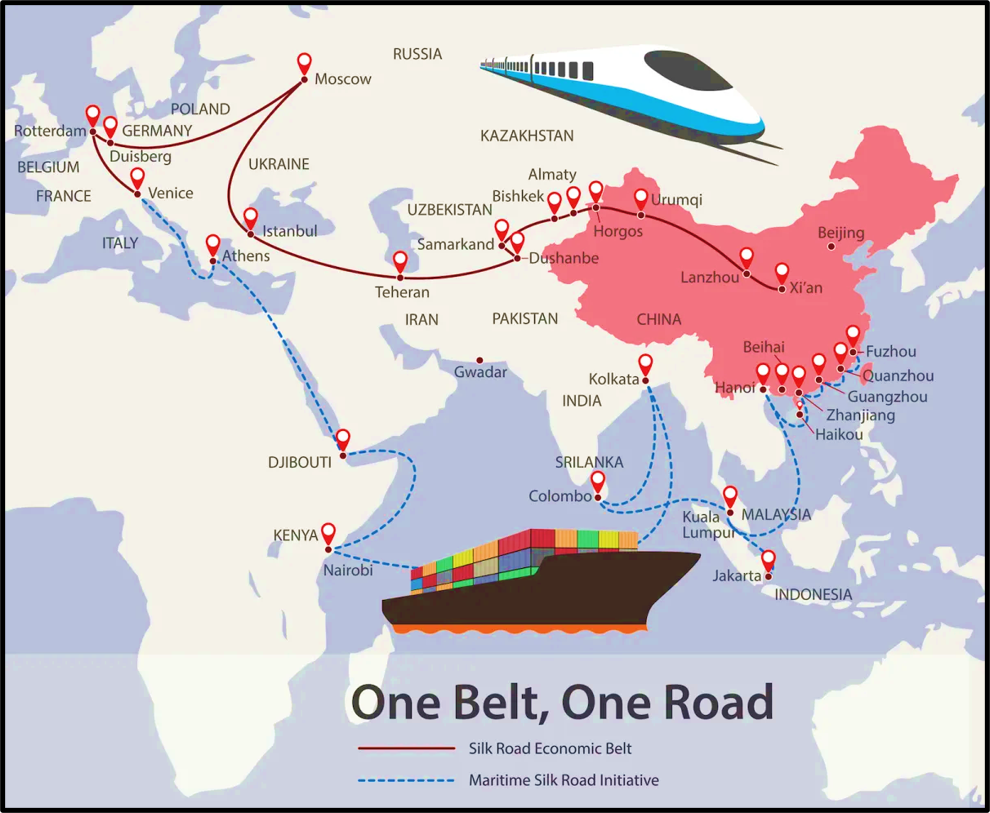
To understand most Sino-Indian frictions, one must first understand China’s signature project — the One Belt, One Road (OBOR) initiative, later rebranded the Belt and Road Initiative (BRI), launched by President Xi Jinping in 2013. It is nothing less than a plan to reshape global connectivity — and, with it, the global balance of power.
The idea draws consciously on the ancient Silk Road, the trade network built by the Han dynasty connecting Xi’an to the Roman Empire, which peaked under the Tang dynasty before declining with the rise of the Ottomans. China revives this romance of the Silk Road to lend its modern project a civilisational glow.
| Han Silk Road → Peak under Tang → Decline (Ottomans, 1453) → Revival as OBOR (2013) |
The BRI has two arms: an overland Silk Road Economic Belt (SREB) and a sea-based Maritime Silk Road (MSR). Through them China aims to redirect its vast surplus capital and industrial overcapacity (in steel, cement, aluminium) into infrastructure across Asia, Africa and Europe — creating markets for Chinese goods, securing resources and energy routes, and binding partner economies to Beijing.
CPEC and the China–Pakistan Axis
The flagship of the BRI — and the sharpest thorn in India’s side — is the China–Pakistan Economic Corridor (CPEC), formalised in April 2015. So close is the partnership that some call Pakistan ‘China’s Israel’: an all-weather ally cultivated as a strategic investment. CPEC bundled around 51 agreements worth roughly $46 billion to build power plants, railways and highways linking Kashgar in China’s Xinjiang region to the Gwadar Port on Pakistan’s Arabian Sea coast.
| Why CPEC Matters to China — Two Strategic Prizes Solving the ‘Malacca Dilemma’: most of China’s energy imports pass through the narrow, US-patrolled Strait of Malacca. An overland corridor from Gwadar to Xinjiang gives China an alternative route immune to a naval blockade. Stabilising its restive west: by creating jobs in Pakistan, China hopes to blunt the Islamic extremism that could inflame its own Uyghur-majority Xinjiang province, where separatist figures have found refuge across the border. |
India’s objection is twofold. First, CPEC runs through Gilgit-Baltistan in Pakistan-occupied Kashmir, violating Indian sovereignty — the core reason India boycotts the BRI. Second, the corridor carries a darker social dimension: just as China altered Xinjiang’s demography by settling Han Chinese among the Uyghurs, CPEC threatens demographic re-engineering in Gilgit-Baltistan — a Shia-majority region into which non-locals have been settled — turning it into a potential zone of ethnic, religious and sectarian conflict.
The Maritime and Regional Contest
String of Pearls vs Necklace of Diamonds
China’s ‘String of Pearls’ seeks a ring of commercial and military facilities across the Indian Ocean Region to encircle India and secure its energy and trade routes.
India’s counter — the ‘Necklace of Diamonds’ — builds naval strength and strategic access points such as Duqm (Oman), Chabahar (Iran) and Sittwe (Myanmar), alongside the Act East Policy and a stronger Andaman & Nicobar Command.
China’s rising influence in South Asia
Through the BRI and economic, military and diplomatic engagement, China has deepened its footprint across the region — CPEC and Gwadar in Pakistan, infrastructure and defence ties in Bangladesh, Hambantota in Sri Lanka, connectivity projects in Nepal, and island leases and port projects in the Maldives — eroding India’s traditional primacy and reinforcing the case for India’s Neighbourhood First response.
The South China Sea
Though India is not a claimant, the South China Sea (SCS) is central to its interests. It is one of the world’s most vital waterways, carrying over $3 trillion in annual trade, rich in oil, gas and fisheries, and a key artery for India’s own commerce and its Act East outreach.
The dispute pits China against the Philippines, Vietnam, Malaysia, Brunei and Taiwan over the Paracel and Spratly island groups. Modern China presses an expansive claim through its infamous ‘nine-dash line’, which swallows almost the entire sea, and has aggressively built and militarised artificial islands on reefs such as Mischief Reef and Scarborough Shoal.
| The 2016 Arbitration — Law vs Power After China seized the Scarborough Shoal (2012), the Philippines took the case to the Permanent Court of Arbitration (PCA). In July 2016, the tribunal ruled decisively for the Philippines, rejecting the legal basis of the nine-dash line under UNCLOS. China rejected the verdict. Because the PCA has no enforcement mechanism, little changed on the ground — a stark reminder that in the SCS, power still trumps law, and a warning about the fragility of the rules-based order India depends on. |
India’s position has therefore hardened around clear principles: freedom of navigation and overflight, respect for UNCLOS and the 2016 PCA ruling, peaceful settlement of disputes, and an early, binding Code of Conduct. China’s assertiveness has, in turn, deepened Quad security cooperation among India, the US, Japan and Australia and sharpened India’s Indo-Pacific priorities.
Water Relations
As the upper riparian on major transboundary rivers — above all the Brahmaputra (Yarlung Tsangpo) and the Sutlej — China holds a powerful lever, and there is no comprehensive water-sharing treaty between the two countries.
- Limited, conditional cooperation: China shares hydrological (flood-season) data under bilateral arrangements renewed annually, but has at times withheld data during periods of tension.
- Dam anxieties: Chinese dam-building on the Brahmaputra (such as the Zangmu dam) and plans for a very large upstream mega-dam raise concerns over water security, flood risk, sediment flow and ecology in Northeast India.
- Way forward on water: A dedicated water-cooperation agreement covering data-sharing, dam construction and minimum flows is needed, with the depoliticisation of water as a guiding principle.
Recent Developments (2020–2026)
| Development | Significance |
| Galwan clash (June 2020) | Deadliest LAC confrontation in decades; ended the ‘border-stable-while-ties-grow’ assumption and triggered India’s economic and strategic recalibration towards China. |
| Sela Tunnel (March 2024) | India inaugurated an all-weather tunnel (~13,000 ft) improving military access to Tawang; China protested, reaffirming its claim over Arunachal. |
| Disengagement (Oct 2024) | Agreement on patrolling at Depsang and Demchok completed disengagement at the last friction points, restoring pre-2020 access. |
| Leaders’ meeting (Oct 2024) | On the margins of the BRICS Summit, the two leaders agreed to revive Special Representative and other dialogue mechanisms. |
| Cautious reset (2025) | Steps to rebuild ties: resumption of the Kailash Mansarovar Yatra, an in-principle agreement to restart direct flights, reopening of border trade markets, and renewed boundary talks exploring an interim demarcation. |
The trajectory since 2024 marks a fragile normalisation — a return to managed engagement — even as the underlying strategic competition and the unresolved boundary remain firmly in place.
A Multidimensional Analysis
| Dimension | Key features and interlinkages |
| Political / Diplomatic | Border management via SR talks; China’s blocks at the UNSC and NSG; India’s use of the Tibet/Dalai Lama card as leverage. |
| Strategic / Security | Security dilemma along the LAC; salami slicing and the Three Warfare Strategy; the China–Pakistan nexus and the two-front challenge. |
| Economic | Deep trade interdependence alongside a large, widening deficit; supply-chain dependence driving the ‘China+1’ diversification strategy. |
| Maritime | String of Pearls vs Necklace of Diamonds; the South China Sea and freedom of navigation; Quad and Indo-Pacific cooperation. |
| Water / Environmental | China’s upper-riparian leverage on the Brahmaputra; absence of a treaty; mega-dam and data-sharing concerns. |
| Cultural / People-to-people | Civilisational and Buddhist links, yoga and pilgrimage diplomacy, sister cities — a thin but real cushion for the relationship. |
Way Forward
- Strengthen border infrastructure and management: Accelerate roads, tunnels and surveillance along the LAC, complete disengagement and de-escalation, and clarify the LAC through map exchange to prevent standoffs.
- Institutionalise crisis management: Reinforce military and diplomatic hotlines, the SR and WMCC mechanisms, and confidence-building to manage incidents.
- Rebalance economic interdependence: Pursue the China+1 strategy, diversify supply chains, and build domestic manufacturing to reduce dependence while retaining beneficial trade.
- Enhance maritime and regional security: Expand the Indian Ocean naval presence, deepen the Necklace of Diamonds and Act East, and lead regional connectivity to counterbalance the BRI.
- Leverage partnerships and pressure points: Work with Quad partners and the US to rebalance the Indo-Pacific, while using India’s own leverage (the Tibet question, the South China Sea, Indian Ocean geography) judiciously.
- Pursue cooperative water management: Negotiate a transboundary water-cooperation framework and keep water de-politicised.
- Sustain high-level engagement: Keep leadership-level and Special Representative channels active to build trust, recognising that China pursues its own national interests rather than seeking India’s outright containment.
Conclusion
India and China are bound by geography, history and a rising stake in the global order, yet divided by an unsettled boundary and a persistent security dilemma. The relationship is neither pure partnership nor open rivalry, but a demanding mix of both — cooperation abroad and competition at home.
The rupture at Galwan and the cautious reset that followed the 2024 disengagement capture this duality: a relationship that must be actively and continuously managed. India’s task is to hold the border firmly, reduce economic and strategic vulnerabilities, deepen its maritime and Indo-Pacific partnerships, and keep channels of dialogue open — advancing, patiently and from a position of strength, the long journey from ‘INCH’ towards ‘MILES’.
One Comment