
The North-East Insurgency Landscape
State-wise Status
The North-East is often spoken of as a single problem, but that is a beginner’s error. It is really eight distinct problems, each with its own history, its own set of groups, and its own trajectory towards or away from peace.
Having understood the region’s common context, history and drivers, we now walk state by state — because the examiner increasingly wants specific, current, state-level knowledge, not a generic lament about insurgency.
The good news is that the last decade has produced a remarkable run of settlements; the sobering news is that Manipur has moved in the opposite direction.
Nagaland — The Oldest Insurgency and the Unfinished Accord
Nagaland carries India’s oldest insurgency, and its evolution is the template for the whole region. Its central actor is the National Socialist Council of Nagaland (NSCN), formed in 1980 by Isak Chishi Swu, Thuingaleng Muivah and S.S. Khaplang in rejection of the 1975 Shillong Accord.
In 1988 the outfit split — a fault line that still runs through Naga politics — into the NSCN (Isak-Muivah), or NSCN-IM, and the NSCN (Khaplang), or NSCN-K.
The demand that defines the movement is ‘Greater Nagalim’ — the unification of all Naga-inhabited areas of the North-East and northern Myanmar under a single administration. Because those areas lie inside Manipur, Assam and Arunachal Pradesh, the demand is a direct threat to the territorial integrity of neighbouring states, and this is the rock on which every settlement has foundered.
The current peace process rests on the Framework Agreement of 3 August 2015, signed between the Government of India and the NSCN-IM. Its genius was ambiguity: the NSCN-IM read it as ‘shared sovereignty’, while Delhi read it as autonomy within the Constitution.
In 2017 the talks were widened to include the Naga National Political Groups (NNPGs), turning a bilateral process into a multilateral one. Since October 2019, however, the process has been deadlocked over two symbolic but non-negotiable demands.
- A separate Naga national flag.
- A separate Naga constitution (Naga Yezabo).
Delhi treats a distinct flag and constitution as incompatible with the Indian Union; the NSCN-IM treats them as the irreducible markers of Naga identity. A decade after the Framework Agreement, and after well over a hundred rounds of talks spanning the ceasefire years, a final settlement remains elusive — and the fragile peace is periodically shaken by incidents such as the Oting tragedy examined later in the treatment of security laws.
Manipur — The Valley, the Hills and the Present Crisis
Manipur is today the most disturbed state in the region, and understanding it requires holding its geography of grievance in mind. The Imphal Valley, barely a tenth of the land, is home to the largely Hindu Meitei majority; the surrounding hills, nine-tenths of the land, are home to the mostly Christian tribal groups, chiefly the Nagas and the Kuki-Zo. The state’s insurgencies grow directly out of the tension between these zones.
Historically, Manipur produced a dense cluster of valley-based Meitei insurgent groups demanding independence — the United National Liberation Front (UNLF), the People’s Liberation Army (PLA), PREPAK, KYKL and others — alongside Kuki groups seeking a separate hill administration and the spillover of the Naga movement into the state’s Naga-inhabited hills. The Kuki groups have been held in a Suspension of Operations (SoO) arrangement with the government since 2008, through the umbrella bodies Kuki National Organisation (KNO) and United People’s Front (UPF).
| A significant breakthrough — the UNLF comes overground, 2023 On 29 November 2023, the UNLF, Manipur’s oldest valley-based armed group, signed a peace agreement with the Union and State governments — the first Meitei valley-based outfit to abjure violence and enter a Suspension of Operations framework. In the middle of a wider crisis, this was a genuine gain, and the hope is that it draws other valley groups to the table. |
That gain, however, has been overshadowed by catastrophe. In May 2023, long-running friction between the Meiteis and the Kuki-Zo exploded into ethnic war. The immediate trigger was a court direction touching the demand to include the Meitei community in the Scheduled Tribe list — which the hill tribes fiercely oppose, fearing the Meiteis would then acquire land in the hills and capture tribal quotas. Beneath it lay deeper anxieties over land, the sharing of power, and migration.
| Case Study — The Meitei–Kuki conflict and the collapse of the state, 2023 onwards What began over Scheduled Tribe status became a territorial and communal rupture. The valley and hills separated into armed, mutually exclusive zones; over 250 people were killed and tens of thousands displaced into relief camps; more than 4,000 weapons were looted from state armouries and many remain unrecovered. The state administration effectively lost its neutrality in the eyes of both communities, and on 13 February 2025 the Centre imposed President’s Rule, since extended. Manipur is the clearest warning that the North-East’s harder problem is no longer secession from India but ethnic conflict between its own communities — a problem that accords with insurgent groups cannot solve. |
Assam — From ULFA to a Cluster of Settlements
Assam, the demographic and political heart of the region, once hosted its most powerful insurgency and has now become the showcase of its resolution. The United Liberation Front of Asom (ULFA), formed in 1979 with the goal of a sovereign Swadhin Asom, drew its strength from Assamese sub-nationalism and the anxiety over migration. The outfit split into a pro-talks faction led by Arabinda Rajkhowa and a hardline, anti-talks ULFA-Independent (ULFA-I) under Paresh Baruah.
The state’s other insurgencies were ethnic-homeland movements: the Bodo demand for a separate state, carried by the National Democratic Front of Bodoland (NDFB) and student bodies; the Karbi and Dimasa demands in the hill districts; and the Kamtapur movement of the Koch-Rajbongshi. Over five years, almost all of these were brought to settlement in a deliberate, sequenced peace push.
| Settlement | When | Who came in | What it delivered |
| Bodo Peace Accord | January 2020 | All factions of NDFB, ABSU, UBPO | Renamed BTAD as the Bodoland Territorial Region (BTR); NDFB factions disbanded and disarmed; wider powers and a development package |
| Karbi Anglong Agreement | September 2021 | Five Karbi armed groups (incl. KLNLF, PDCK) | Over 1,000 cadres surrendered; greater autonomy and funds for the Karbi Anglong council |
| Adivasi (tea-tribe) Accord | September 2022 | Eight Adivasi militant groups | 1,182 cadres laid down arms; rehabilitation and welfare package |
| Dimasa (DNLA) Settlement | April 2023 | Dimasa National Liberation Army | 168 cadres surrendered; addressed Dimasa political and cultural demands |
| ULFA Peace Accord | December 2023 | Pro-talks faction (Rajkhowa) | Faction disbanded; safeguards on Assamese land, culture and identity; development commitments |
Two cautions keep this success story honest.
- First, the ULFA-I faction under Paresh Baruah remains outside the process, reportedly operating from along the China–Myanmar frontier, so Assam’s flagship insurgency is contained but not formally closed.
- Second, the settlements have re-opened old fears among non-Bodos and other minorities inside the newly-empowered councils — a reminder that in the North-East, satisfying one community can unsettle the next, exactly as the drivers of insurgency predict.
Tripura — A Model of Recovery, Now Formally Closed
Tripura is the region’s great turnaround story. A princely state whose merger the insurgents disputed, it saw its indigenous tribal population reduced to a minority by successive waves of migration from East Bengal and Bangladesh — a demographic inversion that fuelled the insurgency of the National Liberation Front of Tripura (NLFT) and the All Tripura Tiger Force (ATTF) through the 1990s. A patient, multi-dimensional strategy of security operations, development and confidence-building brought violence down so far that AFSPA was withdrawn from the state in 2015.
Two recent settlements have all but closed the file. The Bru–Reang Agreement of January 2020 provided for the permanent resettlement in Tripura of thousands of Bru (Reang) families displaced from Mizoram years earlier, backed by a package of around ₹661 crore. And the Memorandum of Settlement of September 2024, signed with the NLFT and ATTF, formally ended the state’s decades-long insurgency, with the remaining cadres surrendering under a rehabilitation package.
Tripura demonstrates the region’s central lesson in the positive: insurgency is not an incurable condition where governance, development and dialogue are pursued together and sustained.
Mizoram — The Gold Standard of Conflict Resolution
If Manipur is the cautionary tale, Mizoram is the ideal. Two decades of armed secession by the Mizo National Front (MNF) under Laldenga — which had begun with a famine-driven uprising in 1966 — were ended cleanly by the Mizoram Accord of 1986, still studied as the model settlement in Indian counter-insurgency.
| Case Study — Why the Mizoram Accord worked Three ingredients made the 1986 settlement stick where others failed. Sincere political will at the top, with the Prime Minister personally investing in the talks. Statesmanship on both sides — the insurgent leader Laldenga was accommodated as Chief Minister, and the sitting Chief Minister stepped aside to make room for him, converting a rebel into a stakeholder. And a war-weary civil society, especially Mizo women and the influential church, that actively wanted peace. The rebels laid down arms, were granted amnesty, and Mizoram received full statehood in 1987. The deeper lesson: a settlement holds when the insurgent leadership is given a dignified path into democratic politics rather than merely a surrender. |
Mizoram has remained among the most peaceful states in the country ever since — proof that the ethnic and religious passions that drive North-Eastern insurgency can be durably channelled into constitutional politics.
Meghalaya, Arunachal Pradesh and Sikkim — The Residual Theatres
The remaining states carry only residual or spillover problems, but each is worth a line for precision.
- Meghalaya is among the least insurgency-affected states. Its historic outfits — the Hynniewtrep National Liberation Council (HNLC), representing Khasi-Jaintia grievances, and the now largely defunct Garo National Liberation Army (GNLA) — have faded, and AFSPA was withdrawn in 2018. Its live tensions are about ethnic friction between tribal and non-tribal settlers, identity, and migration from across the Bangladesh border, rather than organised armed rebellion.
- Arunachal Pradesh faces mainly spillover: the eastern districts of Tirap, Changlang and Longding remain troubled by the two NSCN factions and by ULFA-I, which uses the state as a transit corridor to its bases in Myanmar. Longstanding unease over Chakma and Hajong refugees persists as a demographic, not insurgent, concern.
- Sikkim, the eighth state, has no insurgency. Its significance is strategic rather than internal — it abuts the sensitive tri-junction with China and Bhutan, and its security story belongs to the discussion of the northern border rather than to North-Eastern insurgency.
| Current Status (as of July 2026) A decade of settlements. The period since 2020 has seen an unprecedented cluster of peace accords — Bodo (2020), Karbi Anglong (2021), Adivasi (2022), Dimasa and ULFA pro-talks (2023), and the Tripura NLFT–ATTF accord (2024) — alongside a sharp, sustained fall in violence across the region. Two open files. The Naga political settlement remains stuck on the flag-and-constitution question a decade after the Framework Agreement, and ULFA-I under Paresh Baruah stays outside the Assam peace process. The Manipur exception. The Meitei–Kuki-Zo conflict that began in May 2023 is unresolved; President’s Rule (imposed 13 February 2025) continues, and the state remains the single gravest internal-security concern in the North-East. |
The Cross-Border Dimension
No North-Eastern insurgency has ever been purely internal. As the drivers made clear, cross-border sanctuary is the oxygen that kept these movements alive — a guerrilla who can retreat across an international border among kinsmen cannot be militarily finished. The security response has therefore always been as much diplomatic as military, and the examiner tests this precisely through the lens of border management. Four external relationships shape the theatre.
Sanctuaries in Myanmar and the Cross-Border Operations
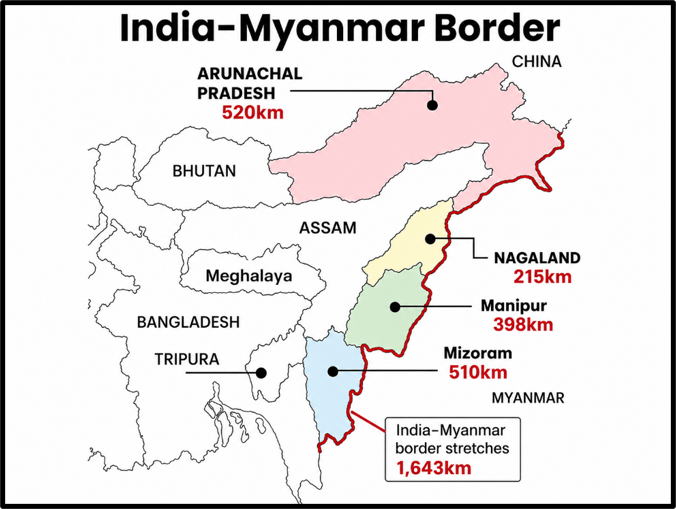
Myanmar is the single most important external factor. India shares a 1,643 km border with it across Arunachal Pradesh, Nagaland, Manipur and Mizoram, running through communities that are ethnically identical on both sides. The dense, lightly-governed Sagaing region across the border has for decades hosted camps, training facilities and safe houses of the Naga and Assam-based outfits. India’s approach has combined quiet diplomacy with occasional force.
| Operation | Year | Nature | Significance |
| Operation Golden Bird | 1995 | Joint India–Myanmar operation along the border | Early model of bilateral counter-insurgency cooperation against north-eastern outfits |
| Cross-border strike (‘Hot Pursuit’) | 2015 | Indian special forces strike after the Chandel ambush | Followed the killing of 18 soldiers in Manipur; hit NSCN-K and allied camps; signalled a more assertive posture |
| Operation Sunrise | 2019 | Coordinated India–Myanmar operations, in phases | Targeted camps of several north-eastern groups along the border in a synchronised effort |
Diplomacy has delivered too: the Myanmar government has at times handed over wanted militants to India and acted against Indian insurgent camps on its soil. But the military coup of 2021 and the civil conflict that followed have weakened Naypyidaw’s writ over the border region, reopening the sanctuary problem that cooperation had begun to close.
Bangladesh — From Sanctuary to Cooperation, and New Uncertainty
For decades Bangladesh was the rear base of the Tripura and Meghalaya outfits, which sheltered in the Chittagong Hill Tracts. This changed decisively after 2009, when the Sheikh Hasina government adopted a firm ‘zero-tolerance’ policy, dismantled camps, and handed several top insurgent leaders to India — a shift that did more to end the Tripura and Bodo insurgencies than any military operation.
The political change in Bangladesh in 2024, however, has injected fresh uncertainty into this cooperation, and Delhi is watching closely for any revival of sanctuary or a fresh migration surge along the eastern border.
China — Historical Linkages and Contemporary Allegations
China’s hand in the North-East is older than the insurgencies’ current phase. In the 1960s and 1970s, Naga and Mizo cadres travelled to China for arms and training, and Beijing extended moral and material support to secessionist groups as a pressure point against India.
That overt support faded, but contemporary allegations persist of a covert Chinese hand — reported contacts with Naga and Assam-based outfits, and the presence of the ULFA-I leadership along the China–Myanmar frontier.
Whatever the precise truth, the strategic logic is clear: a restive North-East serves an adversary well, which is why the region’s internal security is inseparable from the wider contest along the northern border.
The Free Movement Regime — Suspension and the Fencing Decision
The Free Movement Regime (FMR) was a bilateral arrangement that let people of the border communities travel up to 16 km across the India–Myanmar border without a visa, honouring the reality that a single ethnic community lived on both sides. Humane in intent, it was steadily misused for the smuggling of arms, drugs and cadres, and the Manipur crisis sharpened fears that it was enabling an influx of Kuki-Chin kin from Myanmar.
In February 2024, the Government announced two linked decisions: to scrap the FMR and to fence the entire 1,643 km of the Indo-Myanmar border, of which only a small stretch had been fenced. The rationale was internal security and the protection of the region’s demographic balance.
The move is contested — Nagaland and Mizoram, and civil-society bodies, oppose it as a rupture of ancient kinship ties and traditional livelihoods. The FMR debate captures the region’s permanent dilemma in miniature: the same openness that honours shared ethnicity also creates security vulnerability, and every policy here must choose its point on that spectrum.
| Current Status (as of July 2026) Myanmar remains the critical variable: post-2021 instability has weakened border control and revived sanctuary risks, even as the FMR stands scrapped and border fencing is being rolled out amid local opposition. Bangladesh cooperation, the quiet success of the last decade, faces fresh uncertainty after the 2024 political change. The cross-border problem has thus partly reopened just as the internal insurgencies have wound down — the frontier, not the hinterland, is now the harder half of the North-East security equation. |
Migration, Citizenship and Demography
If one thread runs through the entire North-East story, it is demographic anxiety — the fear of indigenous communities that they will be outnumbered, out-competed and eventually dispossessed in their own homelands.
This fear, established earlier as a root driver of unrest, expresses itself through a tangle of citizenship law that the aspirant must be able to hold together clearly, because it is among the most heavily-examined areas of the entire syllabus.
Illegal Migration from Bangladesh — Scale and Security Consequences
The region has absorbed successive waves of migration — as a colonial labour frontier, after the Partition of 1947, and around the 1971 Liberation War — and porous borders mean the flow never fully stopped.
The security consequences are real and multi-dimensional: demographic change that inverts local majorities (most starkly in Tripura and parts of Assam), competition for land, jobs and welfare, pressure on electoral outcomes, and recurring communal violence where indigenous and migrant communities collide.
The fuller institutional treatment of the eastern border belongs to the discussion of border management; here it is the root of the citizenship question.
The Assam Accord, Clause 6 and the NRC Exercise
The political response to Assam’s anti-foreigner agitation was the Assam Accord of 1985, signed between the Centre and the All Assam Students’ Union. Its architecture rests on a cut-off date: those who entered Assam before 24 March 1971 are treated as citizens, while later entrants are to be identified and removed. That date, tied to the eve of Bangladesh’s creation, is the pivot of everything that follows.
Two instruments flow from the Accord. Clause 6 promises constitutional, legislative and administrative safeguards to protect the Assamese people’s cultural, social and linguistic identity; a high-level committee under Justice (Retd.) Biplab Kumar Sarma submitted its report with a large set of recommendations, whose implementation is under way.
The more contentious instrument is the National Register of Citizens (NRC), updated to identify citizens against the 1971 cut-off.
| Case Study — The Assam NRC and its unfinished questions The updated NRC’s final list, published on 31 August 2019, included about 3.11 crore people and excluded 19,06,677 — a little over 19 lakh. The exclusion produced as many problems as it solved. The number was far lower than expected, dissatisfying those who had demanded it; many of the excluded were women, the poor and the illiterate unable to produce documents; and the fate of the excluded — appeals, tribunals, detention, statelessness — remains legally and humanly unresolved. The episode showed that a documentary test of citizenship, applied to a poor and flood-prone population, carries its own humanitarian and security risks, since a large body of stateless persons is itself a vulnerability. |
The Citizenship Amendment Act and its North-East Reception
The Citizenship (Amendment) Act, 2019, whose implementing rules were notified on 11 March 2024, offers a fast-tracked path to citizenship for Hindus, Sikhs, Buddhists, Jains, Parsis and Christians who fled religious persecution in Afghanistan, Pakistan and Bangladesh and entered India on or before 31 December 2014.
In most of India the debate over the CAA turned on secularism and the exclusion of Muslims; in the North-East the objection was different and deeper.
Here the fear was demographic and cultural: that regularising even non-Muslim migrants would legitimise settlement the indigenous communities had resisted for decades, and would undercut the 1971 cut-off of the Assam Accord by shifting it to 2014. This is why the CAA triggered its fiercest protests in Assam and the hills.
In recognition of these anxieties, the Act does not apply to areas under the Inner Line Permit (Arunachal Pradesh, Mizoram, Nagaland and Manipur) or to the Sixth Schedule tribal areas of Assam, Meghalaya and Tripura — a carve-out that itself shows how central demographic protection is to the region’s politics.
The Rohingya Influx — Security and the Humanitarian Question
The Rohingya, a stateless Muslim minority of Myanmar’s Rakhine State, fled in their hundreds of thousands after the 2017 military crackdown, overwhelmingly into Bangladesh but with a spillover into India, including the North-Eastern states of Mizoram and Manipur. Their presence poses a genuine dual dilemma.
- The security case treats them as illegal immigrants and a potential vulnerability — anxieties about radicalisation, trafficking networks, fake documentation, and the further straining of a demographically-sensitive region. The Government’s stated position favours deportation as a matter of national interest, noting that India is not a signatory to the 1951 Refugee Convention.
- The humanitarian case stresses the principle of non-refoulement — not returning people to persecution — and warns that deportation to Myanmar would expose them to grave danger, an argument pressed by rights bodies and tested in the courts.
For the aspirant, the Rohingya question is best framed not as a slogan either way but as a balancing problem between India’s security and demographic concerns and its humanitarian and constitutional obligations — the very balance that runs through this whole section.
| Current Status (as of July 2026) NRC: the 2019 Assam list remains mired in appeals and unresolved questions over the status of the excluded; a nationwide NRC has not been operationalised. CAA: the rules are notified and citizenship processing has begun, with the ILP states and Sixth Schedule areas exempt; legal challenges continue. Migration pressure on the eastern border is under fresh watch given the 2024 political change in Bangladesh; the Rohingya question stays legally and diplomatically unresolved. |
Drug Trafficking and the Golden Triangle Spillover
Sitting on the doorstep of the world’s second-largest opium-producing zone, the North-East has become a narcotics corridor, and drugs have quietly become one of the most corrosive security problems in the region — both a funding line for insurgency and a social catastrophe in its own right.
This connects directly to the wider theme of narco-terrorism and terror financing developed elsewhere in the study of internal security.
Routes, Substances and the Insurgency–Narcotics Economy
The region abuts the Golden Triangle — the tri-border opium belt of Myanmar, Laos and Thailand — and its porous borders and rugged terrain make it a natural transit route. Narcotics move in from Myanmar through crossing points such as Moreh in Manipur and Champhai in Mizoram, while parts of the Manipur and Nagaland hills have themselves seen illicit poppy cultivation. The traffic spans heroin, opium, cannabis and, increasingly, synthetic drugs — methamphetamine tablets and other party drugs moving in bulk.
The security danger is the fusion of drugs and insurgency into a single economy. The same networks and corridors carry narcotics, weapons and cadres; drug profits provide self-financing for armed groups, freeing them from any political sponsor; and addiction hollows out the youth who are both the region’s future and the insurgents’ recruitment pool.
The result is a vicious circle in which crime, insurgency and social breakdown reinforce one another — the Manipur crisis has been read, in part, through this narcotics lens.
State Responses and the ‘War on Drugs’ Campaigns
The response operates at two levels.
Nationally, the architecture combines the Narcotic Drugs and Psychotropic Substances Act with the Narcotics Control Bureau (NCB) as the lead agency, the four-tier Narco-Coordination Centre (NCORD) mechanism linking Centre, State, district and local levels, and the demand-reduction drive Nasha Mukt Bharat Abhiyaan.
At the state level, governments have mounted high-visibility ‘war on drugs’ campaigns — Assam reporting very large seizures and thousands of arrests over recent years, and Manipur running a poppy-eradication drive in the hills. These campaigns are politically potent but also contentious, since eradication and enforcement can intersect with the region’s ethnic fault lines. The durable answer, as with insurgency itself, lies less in seizures alone than in border management, alternative livelihoods, de-addiction and demand reduction pursued together.
| Current Status (as of July 2026) Instability in Myanmar since 2021 has increased the outflow of both opiates and synthetic drugs into the North-East, keeping seizure volumes high. State ‘war on drugs’ campaigns — most prominently in Assam and Manipur — continue, with large cumulative seizures and arrests, even as questions persist about their even-handedness across communities. Drugs remain tightly interwoven with the Manipur conflict and with cross-border smuggling, making narcotics one of the region’s defining current security challenges. |
AFSPA in the North-East
No single law shapes the relationship between the North-Eastern citizen and the Indian state as sharply as the Armed Forces (Special Powers) Act, 1958. To the security forces it is an indispensable enabler of counter-insurgency; to large sections of the population it is the very symbol of alienation.
Understanding AFSPA is therefore essential to understanding both the conflict and its possible resolution, and the debate here mirrors the broader tension between security laws and civil liberties examined in the foundations of internal security.
What the Act Does and Where it Applies
AFSPA can be invoked once an area is declared ‘disturbed’ by the Centre, the Governor or the administrator. Within such an area it confers on the armed forces a set of extraordinary powers, and — crucially — a shield of legal immunity.
- The power to use force, even to the extent of causing death, against a person contravening prohibitory orders, and to fire upon those carrying weapons.
- The power to arrest without warrant and to enter and search premises without a warrant.
- The power to destroy arms dumps, hideouts and training camps.
- Legal immunity: no prosecution of personnel acting under the Act except with the prior sanction of the Central Government.
AFSPA has historically applied across much of the North-East and, under a separate 1990 Act, in Jammu and Kashmir. It was withdrawn from Mizoram in the 1980s, from Tripura in 2015, and from Meghalaya in 2018, and it now applies, in shrinking measure, in parts of Nagaland, Assam, Manipur and Arunachal Pradesh.
The Phased Rollback and What it Signals
The most significant recent development is that the map of AFSPA is shrinking year by year. Beginning 1 April 2022, the Government undertook the first major reduction in decades, lifting the disturbed-area tag from a substantial number of police-station areas, with further reductions in 2023 and after.
- In Assam, AFSPA was withdrawn from most of the state, remaining in only a handful of districts.
- In Nagaland and Manipur, the disturbed-area notification was lifted from a growing list of police-station areas across several districts.
This rollback is meant to signal normalisation — a peace dividend tied to the fall in violence and the run of accords. But it is a calibrated signal, not a repeal: the Act stays in force wherever the security assessment is cautious, and the tragic Manipur crisis has shown how quickly a rollback can be overtaken by fresh disorder.
The Human-Rights Debate and the Judicial Position
The argument over AFSPA is one of the classic security-versus-liberty debates of Indian democracy, and a Mains answer should present both sides fairly before evaluating.
| The case for retaining AFSPA | The case for repeal |
| Provides the legal cover and operational latitude the forces need to fight insurgency in difficult terrain | Echoes colonial-era emergency law, enabling arrest and force on mere suspicion |
| Essential for securing sensitive borders and coordinating counter-insurgency | Held to violate fundamental rights to equality, life and liberty (Articles 14, 19, 21, 22) |
| Upheld as constitutionally valid by the Supreme Court, with safeguards | Its immunity clause breeds impunity and erodes accountability |
| Withdrawing it prematurely risks a security vacuum, as fragile gains can reverse | Militarises governance and deepens the alienation that feeds insurgency in the first place |
The judiciary has sought a middle path. In Naga People’s Movement of Human Rights v. Union of India (1997), the Supreme Court upheld the Act’s validity but insisted that it is not a licence — the ‘disturbed’ declaration must be reviewed periodically, and the forces must use minimum force and follow do’s-and-don’ts. In Extra Judicial Execution Victim Families Association v. Union of India (2016), the Court went further, holding that AFSPA confers no blanket immunity, that allegations of extra-judicial killing must be investigated, and that the armed forces are not above the law.
| Case Study — Oting (Mon), December 2021, and the limits of immunity On 4 December 2021, security forces in Oting village, Mon district, Nagaland, mistook a truck of coal miners returning home for insurgents and opened fire; in the killings and the clashes that followed, thirteen civilians and a soldier died. The tragedy reignited the demand to repeal AFSPA, drew resolutions from the state assembly, and exposed the human cost of the immunity clause when an operation goes wrong — even as the sanction requirement frustrated prosecution of the personnel involved. Oting is the concrete illustration of why the AFSPA debate is not abstract, and why the case for a calibrated rollback tied to genuine normalisation has gained ground. |
A balanced way forward, therefore, is neither blanket retention nor abrupt repeal, but a conditional, area-by-area withdrawal matched to the real security situation, coupled with genuine accountability for abuses and a political process that reduces the need for the Act in the first place. The recent rollback is a step along exactly this road — provided the gains hold.