
Understanding Terrorism in India
Terrorism is the sharpest edge of India’s internal security challenge because it fuses violence, ideology and, very often, the hidden hand of a hostile neighbour into a single instrument. Unlike an insurgency that seeks to hold ground or a criminal syndicate that seeks profit, terrorism trades in fear: it attacks the few to frighten the many and to coerce the state into concessions it would never make at the negotiating table.
This chapter builds the conceptual scaffolding first, then classifies the many faces of terrorism, maps where it actually operates within India, examines the newest mutations of the threat, and finally traces how ordinary individuals are drawn into it through radicalisation and recruitment.
Conceptual Foundations
The Definition Problem
Terrorism can be described as the planned, organised and systematic use of violence as a means of coercion for political, religious or ideological ends. It is a state of terror, panic and fear psychosis, deliberately manufactured by an individual or a group to force, blackmail or coerce authorities into accepting their demands.
Its defining feature is not the scale of the violence but its communicative purpose: the immediate victims are a means, and the true target is the wider audience whose behaviour the terrorist wants to change.
Yet the world has never agreed on a single, binding definition. Two obstacles recur.
- First, the cynical maxim that “one person’s terrorist is another’s freedom fighter” — the same act reads as criminal violence in one capital and as legitimate resistance in another.
- Second, several states quietly sponsor violence on foreign soil while condemning it at home, and therefore have no political will to accept a definition that would indict their own proxies.
The result is a definitional vacuum that itself becomes a barrier to international cooperation.
India’s own statutory definition is precise where the international community is vague.
Under the anti-terror law, a “terrorist act” covers any act intended, or likely, to threaten the unity, integrity, security, economic security or sovereignty of India, or to strike terror in the people or any section of the people, whether in India or abroad.
The explicit inclusion of economic security — counterfeit currency, disruption of financial systems — reflects India’s lived experience of proxy war.
| A Note on Vocabulary The words matter in the examination hall. Radicalism is the adoption of sweeping, uncompromising positions; it becomes extremism when those positions reject the legitimacy of dissent, and terrorism only when violence against non-combatants is used to advance them. All terrorism is extreme, but not all extremism is terrorist — the threshold is the deliberate, coercive use of violence against those who ought not to be attacked. |
India’s Push for a Comprehensive Convention on International Terrorism
To break the definitional deadlock, India tabled a draft Comprehensive Convention on International Terrorism (CCIT) at the United Nations as far back as 1996.
Its aims are ambitious and coherent: to arrive at a universal definition of terrorism, to criminalise all its forms, to deny terrorists safe havens, funds and arms, and to make prosecution or extradition of offenders a binding obligation on every signatory.
Three decades on, the CCIT remains stalled, blocked less by disagreement on the evil of terrorism than by disagreement on its definition. Three blocs have kept it in limbo.
- The Organisation of Islamic Cooperation wants national liberation movements — particularly in the Palestinian context — excluded from the definition.
- The United States wants the acts of state military forces exempted.
- Several Latin American states press for stronger human-rights and international-humanitarian-law safeguards.
Each carve-out would reopen the very “freedom fighter” loophole the Convention exists to close.
For India the stakes are direct. A binding convention would strip Pakistan-based groups of the political cover of “resistance” and force fence-sitting states to extradite or prosecute. India therefore raises the CCIT at almost every major multilateral platform, framing terrorism as a crime against humanity that admits no ideological justification.
Drawing the Lines — Terrorism, Insurgency, Left-Wing Extremism and Organised Crime
Precision here is repeatedly rewarded, because the four phenomena demand different legal tools, force mixes and political responses. They overlap at the edges — most obviously through the funding channel where crime finances terror — but their core logic differs.
| Dimension | Terrorism | Insurgency | Left-Wing Extremism | Organised Crime |
| Primary aim | Coerce the state and society through fear into political concessions | Overthrow or secede — capture political power or territory | Seize state power through protracted people’s war; install a “people’s government” | Private economic profit, not political power |
| Use of violence | Symbolic and spectacular; civilians attacked to send a message | Military-style; targets security forces to hold ground | Guerrilla ambushes; targets state symbols and “class enemies” | Instrumental; protects illicit markets, avoids publicity |
| Popular support | Usually lacks a mass base; relies on terror | Significant popular support in the affected region | Draws on genuine agrarian and tribal grievance | Parasitic; buys silence and complicity |
| Territory | Holds no territory | Seeks and holds territory | Carves out base areas / “liberated zones” | Controls turf and markets, not sovereignty |
| Illustration | Serial bombings in the hinterland; the Parliament attack | The early Naga movement | CPI (Maoist) in the Red Corridor | Smuggling and extortion syndicates |
The practical takeaway: insurgency and left-wing extremism are contained through a blend of security and political settlement, whereas terrorism — rootless, deniable and often externally driven — needs intelligence-led pre-emption and international pressure on its sponsors. The relationships among these categories are developed further in the treatment of Left-Wing Extremism and of the North-East and Kashmir theatres.
Terrorism as a “Competitive Industry”
A striking way to understand modern terrorism is to see it as a competitive industry rather than a single monolithic enemy. The metaphor, though provocative, captures real features of the phenomenon and organises an analytical answer well.
- Product and branding: groups compete for recruits, funds and media attention by “branding” spectacular attacks — the more shocking the strike, the greater the notoriety and the easier the fundraising.
- Market entry and franchising: global outfits license their name to local cells, much as a franchise does, so that a small module can claim the prestige of a transnational label without central direction.
- Supply chain: a support ecosystem of financiers, arms suppliers, forgers, radicalisers and over-ground workers services many groups at once, lowering the cost of “entry” for a new outfit.
- Innovation and technology: encryption, social media, drones and cryptocurrency are adopted rapidly because they confer competitive advantage, exactly as an industry adopts new tools.
- Mergers, splits and rebranding: groups fragment, merge and rename — a proxy front is spun up to preserve deniability and to appear “homegrown.”
The value of the framing is that it points to the pressure points: choke the finance, disrupt the supply chain, deny the media oxygen, and dismantle the brand. Its limit is that terrorism is not driven by profit alone — ideology, grievance and state sponsorship are motives no market model fully explains, so the metaphor illuminates the machinery without exhausting the causes.
Why Terrorism Spreads — The Drivers
No single cause explains terrorism; it emerges where several drivers converge. For analytical clarity they can be grouped across dimensions.
- Ideological and religious: fundamentalism and radicalism that recast political grievance as sacred duty, resisting perceived threats to faith with violence.
- Political: oppression, denial of representation or autonomy, and the collapse of legitimate avenues for dissent.
- Economic and social: poverty, unemployment, sharp inequality, and a sense of alienation and discrimination that extremist recruiters exploit.
- Technological: encrypted apps, social media and the dark web that compress the distance from grievance to recruitment to attack.
- External: state sponsorship, cross-border sanctuary, training and financing that turn a local disturbance into a sustained proxy war.
The impacts are equally multi-dimensional: terrorism erodes democratic institutions by inviting harsher security laws, deepens communal fault lines by targeting specific communities, damages infrastructure and investor confidence, and depresses tourism and livelihoods in affected regions — all while forcing the state to divert resources from development to security.
Classification of Terrorism
Terrorism can be sorted along two axes: by the motive that animates it, and by the means or domain it exploits. A clear taxonomy helps because each type calls for a distinct countermeasure — an ethno-nationalist insurgency-cum-terror problem is resolved differently from a drone-borne narco-terror threat.
By Motivation
The first cut is by the ideology or actor behind the violence.
| Type | Core driver | Illustration |
| Ethno-nationalist / separatist | Identity, homeland and self-determination | The Khalistan movement; several North-East outfits; the LTTE in Sri Lanka |
| Religious / politico-religious | A faith-based utopia and sectarian “purification” | Lashkar-e-Taiba, Jaish-e-Mohammed, the Islamic State and its Khorasan branch |
| Ideological — left | Class war and Maoist revolution | CPI (Maoist) in the Red Corridor |
| Ideological — right | Majoritarian or ethno-supremacist reaction | The reactionary blast cases of the mid-2000s |
| State-sponsored | Proxy war waged by another state through deniable groups | Pakistan’s Inter-Services Intelligence backing of LeT, JeM and their fronts |
These categories are not watertight. State sponsorship frequently hides behind a religious or ethno-nationalist label precisely to secure deniability, which is why India insists that the sponsor, and not only the proxy, must be held to account.
By Means and Domain
The second cut is by the tool or arena the terrorist weaponises. Several of these forms — narco, cyber, bio and drone-enabled terrorism — have grown sharply and are treated in depth further below; the taxonomy here fixes the vocabulary.
| Form | What it means | Indian relevance |
| Narco-terrorism | Fusion of drug trafficking with terror financing and logistics | Drone drops of heroin and arms across the Punjab border; the two “Golden” drug belts on either flank |
| Cyber-terrorism | Attacks on critical information infrastructure to coerce or disrupt | Threats to the power grid, financial systems and government data |
| Bio-terrorism | Deliberate release of pathogens or toxins against people, animals or crops | A CBRN-preparedness concern heightened after the pandemic |
| Agro-terrorism | Targeting food, agriculture and livestock to hit food security | An emerging, under-mapped vulnerability for a farm-dependent economy |
| Eco-terrorism | Violence in the name of environmental causes, or attacks on the environment | Marginal in India but relevant to global threat-mapping |
White-Collar, Nuclear and Radiological Terrorism
Two further categories deserve separate mention because they invert old assumptions about who a terrorist is and how much damage one can do.
White-collar terrorism describes the recruitment of educated, professionally placed individuals — doctors, engineers, academics, coders — in place of the stereotyped unemployed or marginalised youth.
The strategic logic is cold: professionals are rarely on watchlists, can move money, chemicals and information without arousing suspicion, hold clean tax and banking records that defeat basic anti-money-laundering checks, and enjoy the institutional cover of hospitals and universities.
Their radicalisation is typically digital, dressed up as intellectual debate or victimhood narrative, which lends extremism a false veneer of legitimacy on campuses and in workplaces.
Nuclear and radiological terrorism refers to the use, or threatened use, of fissile or radioactive material — including a “dirty bomb” that pairs conventional explosive with radioactive material to spread contamination and panic.
Though no such attack has occurred in India, the theft or diversion of radioactive sources and the smuggling of dual-use materials keep it on the preparedness agenda, backstopped by the Weapons of Mass Destruction Act of 2005.
| Case Study — The “White-Collar” Module and the Red Fort Car Blast (November 2025) On the evening of 10 November 2025, a car packed with explosives detonated near the Red Fort in Delhi, killing roughly fifteen people and injuring many more; the government formally declared it a terrorist incident. The investigation exposed a “white-collar” terror module centred on Al-Falah University in Faridabad, Haryana, staffed by radicalised doctors. The alleged suicide bomber, Dr Umar Un Nabi, was an assistant professor of medicine; several other physicians were arrested, and investigators recovered close to 2,900 kg of explosive material intended for a coordinated wave of bombings across Delhi and the National Capital Region. The module was linked to Jaish-e-Mohammed and the shadowy Ansar Ghazwat-ul-Hind, with radicalisation reportedly tracing back to a 2021 overseas contact and a conspiracy hatched around 2023. The lesson: the profile of the terrorist has changed. Clean records and institutional trust are now an operational asset for the adversary, exposing gaps in tenant, procurement and faculty vetting that traditional watchlist-based policing does not catch. |
Terrorism in India — The Map
Terrorism in India is not evenly spread; it concentrates in identifiable theatres, each with its own history, drivers and sponsors. Four of these — the Jammu and Kashmir theatre, the North-East, Left-Wing Extremism, and hinterland terrorism — form the conventional map, to which two cross-cutting concerns, the Khalistan revival and an emerging right-wing category, must now be added.
The Four Theatres at a Glance
The Jammu and Kashmir theatre is the most direct manifestation of Pakistan’s proxy war, run through Inter-Services Intelligence-created outfits and, since 2019, deniable fronts; it is examined in the treatment of Kashmir militancy.
The North-East blends ethno-nationalist insurgency with cross-border sanctuary, and is developed in the North-East chapter.
Left-Wing Extremism is ideological rather than externally sponsored, and is treated in its own chapter. This section concentrates on the two that are properly “terrorism” in the strict sense and are not covered elsewhere: hinterland terrorism and the Khalistan question.
Hinterland Terrorism — SIMI, Indian Mujahideen and the ISIS Modules
Hinterland terrorism is terrorism that strikes the interior of the country, away from the border theatres — in its political capital, financial capital, technology hubs, religious sites and tourist centres. Its trajectory, though it appears random, has been sequential.
After failing in conventional wars, Pakistan turned to sub-conventional or proxy war, seeking to “bleed India with a thousand cuts.” The seeds sown in 1980s Punjab shifted to Kashmir in the late 1980s and then into the hinterland, exploiting communal flashpoints to mobilise, recruit and radicalise.
The organisational thread runs through three names.
- The Students Islamic Movement of India (SIMI), formed in 1977, turned militant across the 1980s and 1990s and was banned in 2001.
- From its ranks emerged the Indian Mujahideen (IM), created in part to project terrorism as a purely indigenous grievance and to hide the cross-border hand; investigations revealed it as a front drawing support from Lashkar-e-Taiba and Pakistan-based handlers.
- The 2010s then brought the Islamic State and its regional branch as an ideological magnet operating largely online.
| Outfit | Nature | Status |
| SIMI | Indigenous radical student body that turned militant | Banned; parent stream of later hinterland networks |
| Indian Mujahideen | Front projecting terrorism as “homegrown”; tied to LeT/handlers | Proscribed; core leadership neutralised, capacity degraded |
| ISIS / its Khorasan branch | Transnational, ideology-led, online recruitment | Small footprint in India; modules periodically detected and dismantled |
| Popular Front of India | Socio-religious organisation accused of a radicalisation pipeline | Banned under the anti-terror law in 2022 for five years |
The ban on the Popular Front of India (PFI) in September 2022, along with its affiliates, marked a significant widening of the hinterland response — targeting not an armed cell but an organisational ecosystem alleged to feed radicalisation, on grounds of links to proscribed groups.
A crucial analytical point is that India’s hinterland record, when set against its population and against Europe, shows relatively shallow penetration by global jihadist ideology — a point returned to in the discussion of ISIS and Indian youth.
| Current Status (as of July 2026) The Global Terrorism Index for 2025 placed India fourteenth among the countries most impacted by terrorism — high in absolute terms, but with the impact heavily concentrated in specific theatres rather than diffused across the hinterland. The Red Fort car blast of November 2025 and the associated “white-collar” doctors’ module represent the most serious recent hinterland plot, signalling a shift toward professionally-camouflaged cells linked to Jaish-e-Mohammed. ISIS-linked modules continue to be detected and dismantled in small numbers; the organisation’s Indian footprint remains limited relative to global levels. |
The Khalistan Revival
The armed Khalistan movement of the 1980s and early 1990s was defeated within Punjab, but the demand has been kept alive abroad. A diaspora-driven revival is now visible in Canada, the United States, the United Kingdom and Australia, sustained by a fresh wave of radicalisation among sections of the overseas Sikh community and, by the Home Ministry’s own account, by moral and financial support from across the border.
Its most prominent vehicle is Sikhs for Justice (SFJ), a US-based group banned in India in 2020, which runs the so-called “Khalistan Referendum 2020” campaign — a series of non-binding overseas votes intended to internationalise the secessionist demand. Its founder, designated an individual terrorist by India, faces numerous cases at home.
The movement’s danger lies less in military capacity than in transnational propaganda, radicalisation and the potential to reignite communal polarisation within Punjab.
| Case Study — The Diaspora Dimension and the Canada Rift (2023 onwards) In June 2023, Hardeep Singh Nijjar, a Khalistan activist and SFJ figure who spearheaded the referendum campaign, was shot dead in Surrey, British Columbia. Canada subsequently alleged links between Indian agents and the killing; India rejected the claims, and a sharp diplomatic confrontation followed, including reciprocal expulsions of diplomats. A separate, alleged plot in the United States targeting another SFJ leader deepened the friction. The takeaway for internal security: the Khalistan question has become a foreign-policy problem as much as a law-and-order one. It sits at the intersection of diaspora activism, freedom-of-speech protections in host countries, and India’s insistence that secessionist violence enjoys no sanctuary — a genuinely delicate balance to manage. |
Right-Wing Extremism as an Emerging Category
Alongside the dominant strands, investigators have tracked a reactionary right-wing category, associated with a cluster of blast cases in the mid-2000s. It is generally read as having developed as a reaction to cross-border terrorism and to perceptions of appeasement, and as having targeted specific communities.
Two cautions belong in any answer.
- First, the evidentiary record in several of these cases has been contested through long trials, so claims must be stated carefully.
- Second, the analytically important point is the principle of even-handedness: a secular counter-terror doctrine treats terrorism as terrorism irrespective of the ideology or community of the perpetrator, which is precisely why India’s current policy framing explicitly delinks terrorism from any religion, ethnicity or nationality.
New and Emerging Forms
The character of terrorism is changing faster than at any time in India’s experience. The command-and-control cell of the past is giving way to the isolated self-starter; the cross-border infiltrator to the drone; the street collection to the cryptocurrency wallet. These mutations are harder to detect precisely because they leave a smaller signature.
Lone-Wolf Attacks and Self-Radicalised Actors
A lone-wolf attack is carried out by a single individual who prepares and acts alone, outside any command structure and without material assistance from a group. Unlike a conventional plot with multiple perpetrators, a hierarchy and family awareness, the lone wolf leaves almost no network to surveil.
Attacks range from stabbings and vehicle-ramming to shootings and suicide bombings, and are attractive to sponsors because they are low-cost, need minimal planning and can be executed quickly.
An important qualification: many attacks first labelled “lone wolf” turn out, on investigation, to have been remotely recruited, radicalised and even directed by a handler over the internet — making the actor technically not a lone wolf at all, but a remotely-run cell of one. This is why the challenge is fundamentally an intelligence and online-surveillance problem: with no chain of command to intercept, detection depends on spotting the digital footprint of radicalisation before it matures into action.
- Unpredictability: no network, low visibility, hard to detect in advance.
- Online radicalisation: anonymous access to extremist content enables rapid, solitary indoctrination.
- Copycat and bandwagon effects: a publicised attack inspires imitative violence by others seeking notoriety.
India’s vulnerabilities are structural: dense public gatherings offer abundant soft targets, a young and heavily-online population offers a wide recruitment pool, and episodes of communal friction supply the grievance that propaganda exploits.
Hybrid Terrorists and Sleeper Cells
The hybrid terrorist is a specific innovation of the Kashmir theatre that has wider significance. Such a person is not a listed militant and carries no visible record; radicalised enough to execute a single strike, he then melts back into ordinary life. Security agencies describe them as the “boys next door,” kept on standby by terror groups and activated for one task before reverting to a civilian identity — a design that defeats watchlist-based policing.
A sleeper cell is the older cousin of the same idea: an isolated grouping of agents that lies dormant, blending into society until it receives orders or decides to act. Both models share a purpose — to minimise the signature the security apparatus can detect. Countering them requires deep human intelligence, financial-trail analysis and community trust rather than perimeter defence alone.
Drone-Enabled Terrorism
The arrival of cheap, commercially available unmanned aerial vehicles has handed non-state actors a capability once reserved for states: aerial delivery. Drones are now used to drop weapons, explosives, narcotics and counterfeit currency across the border, to conduct surveillance, and — most alarmingly — as airborne weapons in their own right. They are hard to detect on radar, cheap to lose, and confer stand-off distance that keeps the operator safely across the line.
| Case Study — The Jammu Air Force Station Attack (June 2021) In the early hours of 27 June 2021, two low-intensity explosions struck the technical area of the Jammu Air Force Station, delivered by drones — widely regarded as the first drone-borne terror attack on Indian soil. The initial probe pointed to the Pakistan-based Lashkar-e-Taiba, with a suspected intent to hit parked helicopters and the air-traffic-control building; the case was handed to the national investigative agency. Significance: the attack announced a new threat vector — low-cost aerial delivery that bypasses conventional ground defences — and catalysed India’s investment in counter-unmanned-aircraft systems, jamming and detection grids along sensitive installations and borders. |
Narco-Terrorism
Narco-terrorism is the convergence of the drug trade and terrorism, where narcotics trafficking finances, arms and sustains terrorist activity, and terror networks in turn protect and move the drugs.
India’s geography makes it acutely exposed: it sits between the Golden Crescent (Afghanistan–Pakistan–Iran) to the west and the Golden Triangle (Myanmar–Laos–Thailand) to the east — two of the world’s largest illicit opium and synthetic-drug producing regions.
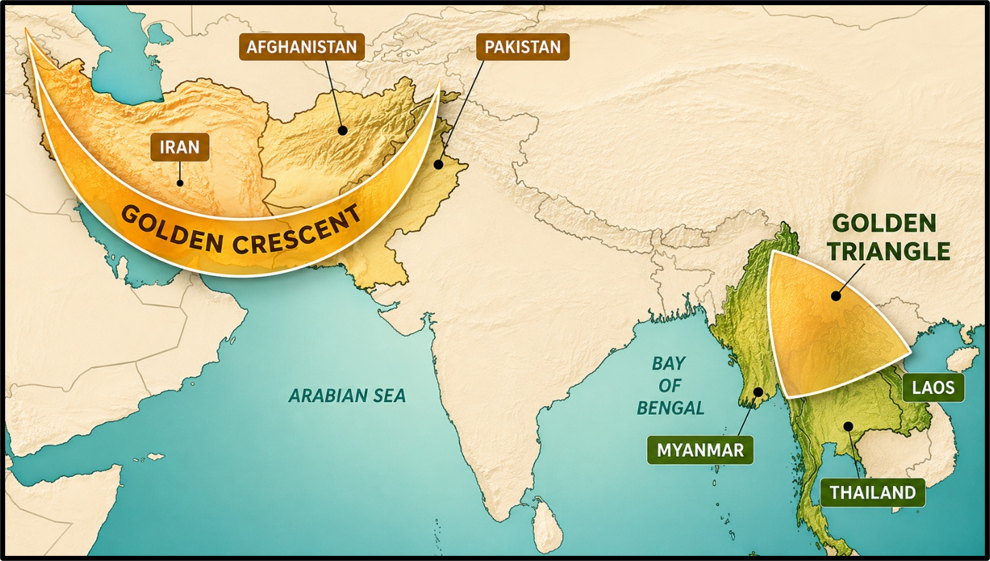
The mechanics are now well documented on the western front. Heroin and small arms are pushed across the Punjab and Jammu borders — increasingly by drone drops — where the proceeds fund militancy and the narcotics fuel a domestic addiction crisis that is itself a security problem.
On the eastern and maritime fronts, trafficking exploits porous land borders and the sea lanes, with record seizures underlining the scale. The financing and trafficking mechanics are examined in fuller detail in the treatment of organised crime and the crime-terror nexus; here the point is the fusion — a single pipeline that simultaneously earns money, arms cadres and corrodes society.
- Financing: drug profits are a self-renewing, deniable revenue stream immune to the freezing of formal accounts.
- Delivery convergence: the same drone and courier routes that move drugs move weapons and fake currency.
- Social corrosion: addiction in border states hollows out the very youth cohort the state needs to keep resilient.
Countermeasures run along the same seam: strengthened border interdiction and anti-drone cover, the NDPS Act framework, the Narcotics Control Bureau and the inter-agency NCORD mechanism, demand-reduction and de-addiction, and financial action against the money trail.
Bio-Terrorism and CBRN Preparedness
Bio-terrorism is the purposeful release of biological agents or toxins to sicken or kill people, animals or plants in order to intimidate or coerce a government or population. It is uniquely difficult to guard against: an intentional release is hard to distinguish from a natural outbreak, novel engineered agents cannot be anticipated, the agents are highly transmissible and lethal, and the latency period before symptoms appear lets an outbreak spread before it is even recognised.
The pandemic sharpened official attention to the wider CBRN spectrum — chemical, biological, radiological and nuclear threats.
India’s preparedness rests on several planks: integrating biosecurity into counter-terror and disaster planning, the NDMA’s biological-disaster guidelines, dedicated CBRN response capacity within the disaster-response force, high-containment laboratory infrastructure such as the BSL-4 facility at the National Institute of Virology, Pune, disease-surveillance networks, and controls on dual-use technology under the Weapons of Mass Destruction Act, 2005.
International cooperation — with the World Health Organization’s frameworks and bilateral vaccine and health-security partnerships — rounds out the response.
Cyber-Terrorism
Cyber-terrorism is the use of the internet and computer networks to attack critical infrastructure, financial systems or data in order to cause fear, disruption or coercion for political or ideological ends. It spans deliberate large-scale disruption of networks at one end and the exploitation of the internet for recruitment, training, propaganda and fund transfer at the other — a shift in terrorist modus operandi in which the entire cycle, from radicalisation to financing, can occur online without a recruit ever crossing a border.
Because the digital domain cuts across every other form of terrorism, it is treated comprehensively in the chapter on cyber security and information warfare; the essential counter-terror response is captured in a few lines: strong online surveillance and social-media monitoring capacity, inter-agency intelligence sharing among the national investigative agency, the Intelligence Bureau and state police, a counter-propaganda strategy built with civil society, international cooperation on internet governance, and the use of big-data analytics to flag and remove radicalising content.
Radicalisation and Recruitment
Behind every attack is a human journey from grievance to violence. Radicalisation is the process by which an individual or group, dissatisfied with the status quo, adopts an increasingly extreme political, social or religious ideology and comes to accept violence as a legitimate means of change.
Understanding this process is the foundation of prevention, because the state’s best opportunity to intervene lies before the recruit becomes operational.
From Radicalisation to Recruitment — The Pipeline
Radicalisation is best seen not as a switch but as a pipeline with identifiable stages: a grievance or search for meaning; exposure to an extremist narrative that frames that grievance as injustice demanding action; progressive immersion in a like-minded group, increasingly online; adoption of a worldview that dehumanises the “other” and sanctifies violence; and finally operational recruitment into a plot.
The social-psychological theory behind these stages is developed in the treatment of radicalisation as a social process; the security interest is in the transition points where intervention is still possible.
The drivers that push a person along the pipeline are familiar and multi-dimensional.
- Political: government apathy or heavy-handedness that turns hope into rage.
- Socio-economic: poverty, marginalisation and limited opportunity that make the vulnerable easy recruitment targets.
- Administrative: grievances such as unfair land acquisition and uncompensated displacement that generate lasting resentment.
- Religious and social: hate crimes, discrimination and communal friction that produce a sense of insecurity among targeted groups.
- Technological: the internet as an always-available engine of propaganda, funding and connection.
ISIS and Indian Youth — What the Numbers Actually Show
When the Islamic State was at its height, there was genuine fear that its slick online outreach would draw large numbers of Indian youth. The evidence points the other way.
Against a Muslim population of well over 170 million, the number of Indians who travelled to join the group is estimated in the low hundreds at most — strikingly small both in absolute terms and as a share of the community, and a tiny fraction of the several thousand foreign fighters who left the European Union.
Why so few? Several explanations recur, and a good answer holds them together rather than picking one.
- A composite, pluralist religious tradition in India that is largely resistant to the austere, transnational ideology the group preaches.
- Democratic space and citizenship that offer avenues for grievance-redress and identity that a caliphate ideology does not.
- Strong family and community structures that anchor young people and often report early signs of radicalisation.
- Effective, early intelligence and policing, including counselling-first “de-radicalisation” responses in several states that pulled waverers back before they travelled.
The correct framing for the examination is therefore calibrated, not alarmist: the threat is real and requires vigilance — detected modules, returnees and online sympathisers are not nothing — but India’s experience is a relative success story that should be explained, not exaggerated. Complacency is the actual risk, especially as recruitment shifts from travel to staying and acting at home.
Digital Indoctrination, Encrypted Platforms and Virtual Handlers
The decisive change of the last decade is that radicalisation and recruitment have moved online and encrypted. Earlier, a recruit had to be spotted, cultivated and smuggled abroad for indoctrination and training — a slow chain with many interception points.
Today the entire process can run through encrypted messaging apps, closed social-media groups and dark-web forums, and the recruit need never leave home.
This produces the phenomenon of the virtual handler: a remote operative who identifies a vulnerable individual, builds a relationship of trust, feeds ideology and operational instructions, arranges funds, and coaxes the target toward an attack — all without physical contact. Encryption defeats routine interception; anonymity defeats attribution; the transnational reach of the platforms defeats jurisdiction.
For educated recruits the same tools allow extremism to masquerade as intellectual debate, which is what makes the white-collar pathway so hard to spot. The response is inseparable from the wider debate on intermediary liability, traceability and lawful access taken up in the cyber and media chapter.
Counter-Narrative and Countering Violent Extremism
If radicalisation is a process, so is its reversal. De-radicalisation brings an already-radicalised person back into the mainstream, while counter-radicalisation prevents the vulnerable from being radicalised in the first place; together they form the field of Countering Violent Extremism (CVE). The insight behind CVE is that arrests alone cannot defeat an idea — the ideology must be contested where it lives, and the individual must be offered an off-ramp.
An effective programme is layered.
- A cyclic approach: awareness of the ideological contagion, detection of potential and existing recruits, and remedial action — in that sequence.
- Big-data analytics to gauge the depth of radicalisation, map networks, and trace sources of information, funding and leadership.
- Trained police and specialists, since ordinary forces are neither trained nor equipped to roll back radicalisation, supported by professional counsellors and psychologists staffing helplines.
- A rational counter-narrative built with civil society, religious leaders and NGOs to dismantle extremist propaganda with credible messengers.
- Family, school and community engagement, treating security awareness much as environmental awareness is taught, so that early warning comes from those closest to the individual.
The delicate part is doing all this without profiling or stigmatising an entire community, since heavy-handed or discriminatory measures are themselves a radicalisation driver. The most durable counter to violent extremism, in the end, is an inclusive society in which grievance finds a democratic outlet long before it finds a handler — a theme that connects directly to the developmental and social roots of extremism examined elsewhere.
One Comment