
International Economic Organisations
International economic organisations create rules, finance, surveillance, standards and forums for cooperation across borders.
They differ in legal character and power:
- the WTO is treaty-based and member-driven;
- the IMF and multilateral development banks lend under their Articles;
- the G20 and G7 are informal political forums;
- FATF standards operate through peer review; and
- bodies such as the World Economic Forum mainly convene non-state and public actors.
UPSC questions frequently test these institutional distinctions rather than broad mission statements.
A useful study method is to ask five questions about every body:
Who are its members? What instrument does it use? How are decisions and votes organised? Is India a member, partner, borrower, creditor or non-member? Which publication, facility or agreement is uniquely associated with it? Current membership numbers and institutional status are dated facts, so they must be separated from durable concepts.
| Institution | Core role | Current institutional fact | India |
| IMF | Monetary cooperation, surveillance and balance-of-payments finance | 191 members; Washington, DC | India is a founding member |
| World Bank / WBG | Long-term development finance, knowledge and private-sector support | IBRD has 189 members; Washington, DC | India is a founding member of IBRD and IDA; not an ICSID member |
| WTO | Negotiated trade rules, transparency, review and dispute settlement | 166 members; Geneva | India is a founding WTO member |
| G20 | Informal steering forum for international economic cooperation | 19 states + EU + AU; no permanent HQ | India held the 2023 presidency |
| FATF | Standards against money laundering, terrorist and proliferation financing | 40 members; secretariat in Paris | India is a member |
| BIS | Cooperation and banking services for central banks | 63 member central banks; Basel | RBI is a member |
International economic organizations are entities formed by countries to promote international trade, investment, and economic development. The role of international economic organizations has become increasingly important in today’s interconnected world, where the flow of goods, services, and capital across borders has become more prevalent.
Overall, international economic organizations play a critical role in shaping the global economic landscape and promoting international cooperation, making them a vital component of the global governance system.
The Bretton Woods Institutions are two international organizations that were established in 1944 at the United Nations Monetary and Financial Conference held in Bretton Woods, New Hampshire, USA.
The main objective of the Bretton Woods Institutions was to promote international economic cooperation and help rebuild the global economy after the devastation of World War II. The two institutions are:
- International Monetary Fund (IMF) – The IMF was created to oversee the international monetary system and help member countries maintain stable exchange rates and balance of payments.
- World Bank – The World Bank was established to provide long-term financing for reconstruction and development projects in member countries.
India is a founding member of both the IMF and World Bank and has received significant financial assistance from these institutions over the years. For example, during the 1991 balance of payments crisis, India received a loan from the IMF to help stabilize its economy.
The World Bank Group has provided finance and knowledge support across Indian infrastructure, health, education, rural livelihoods, urban development and institutional reform.
Bretton Woods Institutions
International Monetary Fund
| Current Status (as of August 2026) The IMF has 191 members. Its Executive Board has 25 elected Directors; the additional Sub-Saharan African chair became effective in November 2024. The United States held about 16.49% of total voting power as on August 2026. Major decisions specified in the Articles can require an 85% majority, giving the US blocking power for those decisions, not a universal veto. The 16th General Review approved a 50% equiproportional quota increase, but implementation required member consents, payments and the linked rollback of New Arrangements to Borrow. Quota-share realignment remained unfinished in 2026. |
The IMF is the central multilateral institution for international monetary cooperation. It conducts surveillance, lends to members with balance-of-payments needs, develops capacity and supports the stability of the international monetary system.
Objectives
- Promoting International Monetary Cooperation: The IMF aims to promote international monetary cooperation by facilitating exchange rate stability and providing resources to member countries experiencing balance of payments difficulties.
- Facilitating International Trade: The IMF seeks to facilitate international trade by promoting the stability of the international monetary system and ensuring the smooth functioning of the international payments system.
- Promoting Economic Growth: The IMF provides policy advice and technical assistance to member countries to help them achieve sustainable economic growth and reduce poverty.
- Providing Financial Assistance: The IMF provides financial assistance to member countries facing balance of payments difficulties, helping them to address short-term liquidity problems and avoid financial crises.
IMF Governance Structure
- Board of Governors: The highest decision-making body of the IMF. Each IMF member appoints a governor, typically the finance minister or central bank governor.
- Executive Board: Responsible for conducting the day-to-day business of the IMF. It is composed of 25 Executive Directors, who are appointed or elected by member countries or by groups of countries.
- Managing Director: The head of the IMF staff and Chair of the Executive Board. The Managing Director is appointed by the Executive Board for a renewable term of five years.
- IMF Staff: Thousands of employees from all over the world work at the IMF. Their responsibilities are divided among departments that handle economic research, fiscal affairs, monetary and capital markets, and many others.
- International Monetary and Financial Committee (IMFC): The IMFC, comprising finance ministers and central bank governors, is the primary advisory body of the IMF Board of Governors and deliberates on the principal policy issues facing the IMF. The Committee has 24 members, reflecting the composition of the IMF Executive Board. Each member country or group of countries that elects an Executive Director also appoints a member of the Committee.
- Development Committee (DC): A joint committee with the World Bank, advising on critical development issues and on financial resources required to promote economic development in developing countries.
IMF Quota
The IMF has member countries from around the world, and each member country has a quota and a corresponding voting power in the organization. The quota represents the financial contribution made by each member country to the IMF. This contribution determines the amount of resources that the IMF has at its disposal to provide loans to member countries and help stabilize the global financial system. Quotas are determined based on a country’s economic size, openness to international trade, and other factors.
For example, a larger economy like the United States would have a larger quota than a smaller economy like Bhutan. As of 2026, the United States has the largest quota in the IMF, with around 17.42%.
Voting power, on the other hand, determines a member country’s influence in the decision-making process of the IMF. The number of votes that a member country has is based on their quota, with larger quotas resulting in more voting power.
For example, the United States has the highest voting power in the IMF, with around 16.5% of the total voting power. It is important to note that decisions made by the IMF require a supermajority of 85% of the total voting power.
Only specified major decisions require an 85% majority; ordinary decisions use other voting thresholds. Because the United States held about 16.49% of total voting power in August 2026, it can block decisions requiring an 85% supermajority, but it does not possess a general veto over every IMF decision.
Special Drawing Rights (SDR)
SDR is a type of international reserve asset created by the International Monetary Fund (IMF) to supplement the existing official reserves of member countries.
IMF Financing
IMF financing refers to the financial assistance provided by the International Monetary Fund (IMF) to member countries facing balance of payments difficulties. IMF financing is typically provided through loan programs that are designed to help countries overcome their balance of payments difficulties.
Most IMF arrangements use policy conditionality and programme reviews, though the degree and timing vary by facility. Qualification-based precautionary instruments such as the FCL (Flexible Credit Line) differ from conventional ex-post conditionality. These conditions are designed to address the underlying economic issues that led to the balance of payments difficulties and to ensure that the country can achieve sustainable economic growth. There are several types of IMF financing, including:
- Stand-By Arrangement (SBA): Short-term support for emerging and advanced economies.
- Standby Credit Facility (SCF): Similar to SBA, designed for low-income countries.
- Extended Fund Facility (EFF): Long-term support for structural issues in emerging and advanced economies.
- Extended Credit Facility (ECF): Equivalent to EFF for low-income countries.
- Rapid Financing Instrument (RFI): Rapid assistance for urgent balance of payments needs.
- Rapid Credit Facility (RCF): Rapid assistance for crises in low-income countries.
- Flexible Credit Line (FCL): Short-term renewable credit line for strong policy countries.
- Precautionary and Liquidity Line (PLL): For countries with sound frameworks but remaining issues.
- Catastrophe Containment and Relief Trust (CCRT): Provides grants for debt relief during disasters.
- Policy Support Instrument (PSI): IMF advice without financial assistance for low-income countries. IMF financing has been used by many countries over the years, including India. For example, in 1991, India faced a balance of payments crisis, and the government sought assistance from the IMF. The IMF provided a loan of $2.2 billion to India, which helped the country to stabilize its economy and implement economic reforms that ultimately led to sustained economic growth.
Criticism
- Conditionality: One of the main criticisms of the IMF is its conditionality attached to its loans. When a country borrows money from the IMF, it has to agree to certain conditions, including economic reforms, austerity measures, and sometimes privatization. These conditions can be quite strict and can cause significant social and economic disruptions, especially in developing countries. Critics argue that the IMF’s conditionality policies often prioritize the interests of the lenders over those of the borrowers.
- Focus on macroeconomic stability over development: The IMF’s primary mandate is to promote macroeconomic stability, which is essential for economic growth and development. However, some critics argue that the IMF’s focus on macroeconomic stability often comes at the expense of social and human development. They argue that the IMF’s policies can exacerbate poverty and inequality, particularly in developing countries.
- Voting power and representation: The IMF’s decision-making process is based on a weighted voting system, where developed countries have a larger say in decisions than developing countries. Critics argue that this system is unfair and undemocratic and that it perpetuates the power imbalance between developed and developing countries.
- Lack of transparency and accountability: The IMF has been criticized for its lack of transparency and accountability in its decision-making processes. Critics argue that the organization’s policies are often made behind closed doors, without adequate consultation with affected communities or civil society organizations.
IMF Reforms
The IMF has been undergoing reforms to adapt to the changing global economic landscape and improve its effectiveness in achieving its mandate.
- Governance Reforms: The governance structure of the IMF was reformed to give emerging market and developing countries a greater say in the decision-making process. The reforms increased the voting power of developing countries and established a more representative Executive Board.
- Quota Reforms: The quota system of the IMF was reformed to reflect the changing economic realities of the world. The reforms increased the quotas of emerging market and developing countries, giving them a greater voice in the decision-making process.
- Financial Reforms: The IMF’s financial resources were increased through the expansion of the New Arrangements to Borrow (NAB) and the creation of the Bilateral Borrowing Agreements (BBAs). These reforms aimed to ensure that the IMF has sufficient resources to respond to financial crises.
- Lending Reforms: The IMF’s lending toolkit was reformed to provide more flexible and tailored lending programs to member countries. This includes the creation of the Flexible Credit Line (FCL), which provides countries with access to IMF resources without the need for policy conditionality.
These reforms have helped to modernize the IMF and make it more effective in promoting global economic stability. By increasing the voice and participation of emerging market and developing countries, the IMF is better able to reflect the diversity of the global economic landscape and provide more effective policy advice and financial assistance to its members.
For example, the IMF reforms allowed for a more significant role for China and other emerging markets in the decision-making process. This increased representation of developing countries has helped to improve the legitimacy and effectiveness of the IMF in promoting global economic stability.
World Bank Group
| Current Status (as of August 2026) IBRD has 189 members. The World Bank refers specifically to IBRD and IDA; the World Bank Group also includes IFC, MIGA and ICSID. The old Doing Business ranking was discontinued in 2021. The World Bank’s newer Business Ready (B-READY) programme assesses the business environment through a redesigned methodology, so the 2016 PYQ remains historically correct but should not be treated as a current ranking series. |
| Institution | Main instrument | Primary clients |
| IBRD | Sovereign loans, guarantees, risk products and advice | Middle-income and creditworthy lower-income countries |
| IDA | Highly concessional credits and grants | Eligible lower-income countries |
| IFC | Loans, equity, mobilisation and advice for private investment | Private enterprises in developing countries |
| MIGA | Political-risk insurance and credit enhancement | Investors and lenders in developing countries |
| ICSID | Conciliation and arbitration of investment disputes | Contracting states and covered investors; India is not a member |
The World Bank Group is an international organization with the primary objective of promoting economic development in its member countries.
It comprises five different institutions, each with a specific focus:
- International Bank for Reconstruction and Development (IBRD): Provides loans, guarantees, risk-management products and advisory services mainly to middle-income and creditworthy lower-income borrowers. These loans are typically used to finance infrastructure projects like roads, bridges, and energy projects.
- International Development Association (IDA): This institution provides low-interest loans and grants to the world’s poorest countries. The loans and grants provided by the IDA are typically used to finance projects in areas like education, healthcare, and agriculture.
- International Finance Corporation (IFC): This institution provides loans, equity, and other financial assistance to private sector companies in developing countries. The IFC’s primary objective is to promote private sector development and entrepreneurship in developing countries.
- Multilateral Investment Guarantee Agency (MIGA): This institution provides political risk insurance and credit enhancement guarantees to investors and lenders in developing countries. The aim of MIGA is to encourage foreign direct investment in developing countries by reducing the risk associated with such investments.
- International Centre for Settlement of Investment Disputes (ICSID): This institution provides a forum for the settlement of investment disputes between foreign investors and host countries. India is not a member of ICSID. All these institutions are collectively known as the World Bank Group, however, IBRD and IDA are the two arms which constitute the World Bank.
Criticism
- Conditionality: One of the main criticisms of the World Bank is its practice of attaching conditions to its loans. These conditions often require the borrower country to implement specific economic policies, such as privatization or deregulation, as a condition for receiving the loan. Critics argue that these conditions may not be in the best interest of the borrower country and may lead to negative social and environmental impacts.
- Governance: The governance structure of the World Bank has also been criticized for being undemocratic and lacking transparency. While the bank is supposed to represent the interests of all member countries, the majority of the voting power is held by developed countries, which may not always align with the interests of developing countries.
- Environmental and Social Impacts: The World Bank’s projects have been criticized for their environmental and social impacts. In some cases, projects have led to deforestation, displacement of indigenous peoples, and destruction of cultural heritage sites. Critics argue that the bank should prioritize environmental and social safeguards to ensure that its projects do not harm local communities or the environment.
- Anti-Poverty Strategies: While the World Bank’s primary goal is poverty reduction, its approach to achieving this goal has been criticized for being too focused on economic growth rather than social development. Critics argue that the bank should adopt a more comprehensive approach to poverty reduction that addresses social and economic inequalities.
Reforms in the World Bank
- Focus on Poverty Reduction: The World Bank has shifted its focus from providing loans for infrastructure projects to promoting poverty reduction and social development. This has led to the creation of initiatives like the Poverty Reduction Strategy Papers (PRSPs) and the Global Partnership for Education, which aim to support education and health programs in developing countries.
- Decentralization: The World Bank has also undergone a process of decentralization, with the establishment of regional offices in various parts of the world. This has helped to increase the bank’s presence in developing countries and improve its understanding of local contexts and needs.
- Results-Based Lending: The World Bank has also shifted towards results-based lending, which links disbursements to the achievement of specific development outcomes. This approach ensures that loans are used effectively and efficiently, and that they contribute to positive development outcomes.
- Environmental and Social Safeguards: The World Bank has introduced environmental and social safeguards to ensure that its projects do not have negative impacts on the environment or local communities. These safeguards require borrowers to conduct environmental and social impact assessments and consult with local communities before undertaking any projects.
- Governance Reforms: The World Bank has also undergone governance reforms to increase transparency and accountability. This includes the introduction of the Independent Evaluation Group (IEG), which assesses the bank’s performance and effectiveness, and the Inspection Panel, which provides an independent forum for affected communities to raise concerns about the bank’s projects.
World Trade Organization and the Rules-Based Trading System
World Trade Organization
| Current Status (as of August 2026) The WTO has 166 members after Comoros and Timor-Leste joined in 2024. Its Appellate Body remains unable to hear appeals because vacancies have not been filled, leaving the dispute-settlement system only partially functional. MC14 met in Yaounde in March 2026. It adopted decisions on small economies and on making special-and-differential treatment more operational in SPS and TBT, while major issues including agriculture, comprehensive fisheries-subsidy disciplines and wider reform remained for further work. |
The World Trade Organization (WTO) is an international organization that oversees and regulates global trade among its member countries. The organization was established in 1995, succeeding the General Agreement on Tariffs and Trade (GATT), which was created in 1948.
The WTO provides the institutional framework for negotiated trade rules, transparency, policy review and dispute settlement among its 166 members. It does this by providing a platform for member countries to negotiate and enforce trade agreements, resolve trade disputes, and monitor trade policies and practices. The WTO also provides technical assistance and training to help developing countries participate effectively in the global trading system.
Objectives of WTO
- Promoting free trade: The WTO’s primary objective is to promote free and fair trade among its member countries. The WTO does not require the elimination of every trade barrier. Members negotiate bound commitments while retaining specified exceptions and policy space under the agreements. By promoting free trade, the WTO aims to increase economic growth and create employment opportunities in member countries.
- Ensuring fair competition: The WTO aims to ensure that international trade is conducted in a fair and transparent manner. It seeks to prevent unfair trade practices like dumping, subsidies, and other forms of protectionism that can harm the interests of other countries. For example, if a country sells its products below the cost of production, it may constitute dumping if the WTO legal conditions are met, which can be harmful to domestic producers in importing countries.
- Providing a platform for negotiations: The WTO provides a platform for member countries to negotiate trade agreements, exchange information, and resolve disputes related to international trade. This helps to reduce trade tensions and improve economic cooperation among member countries.
- Promoting economic development: The WTO aims to promote economic development and reduce poverty in developing countries by providing them with access to global markets. The organization provides technical assistance and training to developing countries to help them build their capacity to participate in international trade.
- Ensuring environmental protection: The WTO recognizes the importance of environmental protection and sustainable development in international trade. It seeks to ensure that trade policies are not harmful to the environment and that they promote sustainable development practices. Structure of WTO
Principles of the WTO
- Most-favored-nation (MFN) principle: This principle requires member countries to treat all other members equally in terms of trade. This means that any advantage or concession granted to one member country must also be granted to all other member countries.
- National treatment: This principle requires member countries to treat foreign goods and services no less favorably than their own goods and services once they have entered their markets. In other words, imported goods and services should not be subject to discriminatory treatment.
- Prohibition on quantitative restrictions: The WTO prohibits the use of quantitative restrictions, such as quotas and import/export bans, on trade in goods, except in certain circumstances, such as for reasons of public health or national security.
- Transparency: The WTO requires member countries to be transparent in their trade policies and practices, by notifying other members of any new measures that may affect trade, and by providing information on their trade policies and regulations.
- Non-discrimination: The WTO aims to promote non-discrimination in trade by ensuring that member countries do not engage in discriminatory practices that favor their own goods and services over those of other countries.
- Gradual liberalization of trade: The WTO promotes the gradual liberalization of trade by reducing trade barriers over time, through negotiated agreements among its members.
- Special and differential treatment for developing countries: The WTO provides special and differential treatment for developing countries, recognizing that they may need more time and support to implement WTO agreements and to fully participate in international trade.
WTO Agreements
Core WTO Agreements
Agreement on Agriculture
The WTO Agreement on Agriculture is an international agreement that was signed in 1994 as part of the Uruguay Round of multilateral trade negotiations. It aims to reform trade in agricultural goods, reduce trade barriers, and improve the global food security situation.
The WTO Agreement on Agriculture has three main pillars:
- Market Access: This refers to the ability of countries to sell their agricultural products to other countries without facing any restrictions or unfair trade practices. This pillar aims to reduce tariffs and other barriers to trade in agricultural goods.
- Domestic Support: This refers to the subsidies and other forms of financial assistance that governments provide to their own farmers. This pillar aims to limit the amount of subsidies that governments can provide to their farmers, in order to prevent unfair competition and distortion of trade.
- Export Competition: This refers to the practices of exporting countries that may have a negative impact on the agricultural markets of importing countries. This pillar aims to regulate and limit practices such as export subsidies and dumping, which can harm the economies of developing countries.
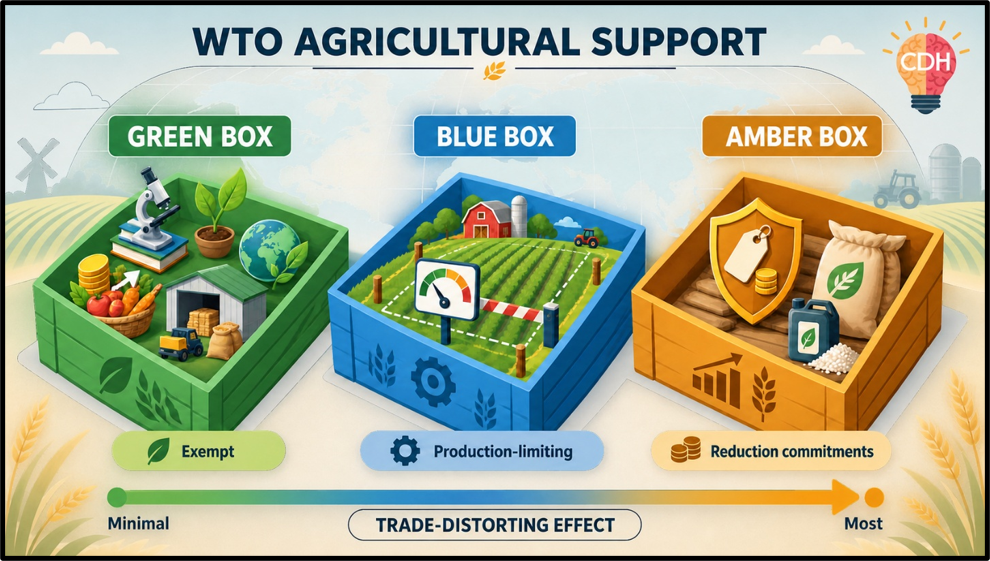
The WTO Agreement on Agriculture classifies subsidies provided by governments to their farmers into three boxes:
- Green Box: Annex 2 exempts support that has no, or at most minimal, trade-distorting effects and satisfies programme-specific conditions. Examples include qualifying general services, environmental programmes, decoupled support, domestic food aid and public stockholding acquired at current market prices.
- Blue Box: This includes subsidies that are more trade-distorting, but are subject to specific conditions. These subsidies must be linked to production-limiting programs, and must not provide support to specific products beyond certain levels.
- Amber Box: This includes subsidies that are considered the most trade-distorting, such as price supports and input subsidies. These subsidies are subject to reduction commitments under the WTO Agreement on Agriculture.
Impact of the WTO Agreement on Agriculture in India
India is a major agricultural producer and exporter, but it is also a developing country that relies heavily on agriculture for its economy and food security. The agreement has had both positive and negative impacts on India.
- On the positive side, the agreement has helped India increase its agricultural exports by reducing trade barriers in other countries. This has benefited Indian farmers and agribusinesses, and has contributed to the country’s economic growth.
- However, the agreement has also had negative impacts on India. The domestic support and export competition pillars of the agreement have put pressure on India to reduce its agricultural subsidies, which has been difficult for the country to do. This has led to concerns about the ability of Indian farmers to compete with heavily subsidized farmers in other countries.
Additionally, the classification of subsidies into the three boxes has been a contentious issue for India. The country has argued that many of its subsidies fall into the green box, but other countries have argued that they belong in the more trade-distorting blue or amber boxes. This has led to disputes and negotiations at the WTO.
Peace Clause
The Bali interim peace-clause decision of 2013 protects qualifying public-stockholding programmes for food security in developing members from specified legal challenges, subject to notification, transparency and safeguard conditions. It provides developing countries with protection from legal action if their agricultural subsidies exceed the limits set out in the WTO Agreement on Agriculture.
In essence, the Peace Clause allows developing countries to continue providing subsidies to their farmers beyond the limits set out in the agreement, as long as they meet certain conditions. These conditions include ensuring that the subsidies do not harm the trade interests of other countries, and that the subsidies are aimed at addressing food security concerns.
A 2014 General Council decision clarified that the interim protection continues until a permanent solution is agreed and adopted; the demand for a permanent solution remained unresolved after MC14 in March 2026.
India and other developing countries continue to demand a permanent solution on public stockholding for food security.
General Agreement on Trade in Services (GATS)
GATS is an agreement between countries to liberalize trade in services. It was established in 1995 as a part of the World Trade Organization (WTO) and aims to promote the expansion of trade in services between member countries.
Important aspects of GATS
Scope: GATS covers four modes of supply of services, which include
- Cross-border supply: This mode of supply involves the delivery of a service from one country to another without the service provider physically moving across the border. For instance, an Indian IT firm may provide software development services to a client in the United States over the internet.
- Consumption abroad: This mode of supply occurs when a service consumer travels to another country and consumes a service there. For instance, a Chinese student studying in an Australian university would be considered as a consumer of education services in Australia.
- Commercial presence: This mode of supply involves the establishment of a commercial presence, such as a branch office or subsidiary, in another country to provide services. For instance, a Japanese bank may establish a branch office in India to offer banking services to customers.
- Presence of natural persons: This mode of supply involves the movement of service providers across borders to provide services. For instance, an Australian architect may travel to India to provide architectural services for a construction project.
National treatment: Under GATS, national treatment applies in sectors and modes where a member has scheduled the commitment, subject to limitations entered in that schedule; it is not an automatic, economy-wide obligation identical to MFN treatment. Market access and national-treatment commitments must therefore be read from each member’s schedule.
- For example, if a foreign bank wants to provide banking services in India, it should be treated the same as domestic banks in terms of regulatory requirements and market access.
Most-favored-nation treatment: This aspect of GATS requires that a member country treat all other member countries equally in terms of trade in services. This means that a country cannot discriminate against another member country by providing more favorable treatment to a third country.
- For example, if India gives a particular benefit to the United States in the trade of a particular service, it must also provide the same benefit to all other GATS member countries.
Transparency: This aspect of GATS requires that member countries provide information on their services regulations and practices, including measures that affect trade in services, to ensure that other member countries are aware of them.
- For example, if India introduces new regulations affecting the provision of telecommunications services, it must notify other member countries and provide them with an opportunity to comment.
Flexibility: GATS allows member countries to maintain measures that restrict trade in services for certain reasons, such as protecting public health or national security.
- For example, India may restrict the import of certain medical services in order to protect public health.
Agreement on Trade-Related Investment Measures (TRIMs)
The TRIMs Agreement emerged from the Uruguay Round of negotiations (1986-1994), which led to the establishment of the WTO in 1995. The primary goal is to ensure that investment measures do not restrict or distort international trade.
The TRIMs agreement applies to investment measures related to trade in goods (does not cover services). There are several types of trade related investment measures implemented by governments to regulate foreign investment, including:
- Performance requirements: These require foreign investors to meet certain conditions to receive benefits from the host government, such as tax breaks or subsidies. For example, a government may require that a foreign company invests a certain amount of money in the local economy, hires a certain percentage of local workers, or uses local suppliers.
- Local content requirements: These require foreign investors to use a certain percentage of local materials or products in their operations. For example, a government may require that a car manufacturer use a certain percentage of locally sourced parts in their production process.
- Trade balancing requirements: These policies require foreign investors to balance their imports and exports, either by limiting imports or by increasing exports. For example, a government may require that a foreign company import a certain amount of goods in order to be allowed to export products from their local operation.
Critics argue that these measures can create barriers to entry for foreign investors and lead to inefficient allocation of resources.
Key Provisions of Agreement on TRIMS under WTO
- National Treatment: Ensures that member countries treat foreign investments and domestic investments equally. It prohibits discriminatory measures that favor domestic over imported goods.
- Elimination of Quantitative Restrictions: Prohibits measures that limit the quantity of goods that can be imported or exported.
- Prohibited TRIMs:
- Local Content Requirements: Mandating that a certain percentage of a product must be produced locally.
- Trade Balancing Requirements: Requiring that the amount of imports be balanced by a corresponding amount of exports.
- Foreign Exchange Restrictions: Imposing restrictions on access to foreign exchange for investment purposes.
- Domestic Sales Requirements: Mandating that certain products must be sold domestically. TRIMs Article 3 makes the general GATT exceptions applicable, so a measure must satisfy the legal conditions of the relevant exception; environmental, health or conservation objectives do not create an automatic blanket exemption.
Trade-Related Aspects of Intellectual Property Rights (TRIPS)
TRIPS is an agreement established by the World Trade Organization (WTO) that sets out minimum standards for the protection of intellectual property rights (IPRs) among its member countries. The agreement covers a wide range of intellectual property rights, including patents, trademarks, copyrights, and trade secrets. Its main objective is to promote innovation and creativity by providing a legal framework for the protection and enforcement of IPRs.
Here are some important aspects of TRIPS:
- Patent protection: TRIPS requires member countries to provide patent protection for all inventions, including pharmaceuticals, for a minimum of 20 years from the date of filing. This means that a company that invents a new drug can prevent others from making, using, or selling the drug for a certain period of time, which helps to incentivize innovation.
- For example, if a pharmaceutical company in India invents a new drug to treat a particular disease, they can apply for a patent and prevent other companies from copying their invention for 20 years. This gives the company a chance to recoup their investment and make a profit from their invention.
- Copyright protection: TRIPS requires member countries to provide copyright protection for a minimum of 50 years from the death of the author. This means that the creator of a literary or artistic work, such as a book or a painting, has exclusive rights to their work for a certain period of time.
- For example, if an Indian author writes a book, they can prevent others from copying or distributing their book for 50 years after their death. This gives the author and their heirs an opportunity to earn a living from their creative work.
- Enforcement mechanisms: TRIPS requires member countries to provide effective enforcement mechanisms for IPRs, including civil and criminal remedies. This means that if someone infringes on an IPR, such as by copying a patented invention or distributing copyrighted material without permission, the owner of the IPR can take legal action to stop the infringement and seek damages.
- For example, if an Indian company copies a patented invention belonging to a foreign company, the foreign company can sue the Indian company for patent infringement and seek damages. The Indian court can then order the Indian company to stop infringing on the patent and pay compensation to the foreign company.
Sanitary and Phytosanitary Measures Agreement (SPS Agreement)
The SPS Agreement is a treaty that was created by the World Trade Organization (WTO) to regulate the use of sanitary and phytosanitary measures in international trade.
Sanitary measures are measures designed to protect human and animal health, while phytosanitary measures are measures designed to protect plant health.
The main goal of the SPS Agreement is to ensure that these measures are applied in a way that is not arbitrary or discriminatory, and that they are not used as a way to unfairly restrict trade between countries.
Now, let’s take a closer look at some of the important aspects of the SPS Agreement:
- Non-discrimination: The SPS Agreement requires that countries apply their sanitary and phytosanitary measures in a non-discriminatory manner. This means that countries cannot use these measures as a way to favor their own domestic producers over foreign producers.
- For example, if a country requires all imported chicken to be tested for certain diseases, it cannot exempt its own domestic chicken from the same requirements. This ensures that all producers are subject to the same standards, regardless of where they are located.
- Scientific justification: The SPS Agreement requires that countries base their sanitary and phytosanitary measures on scientific evidence. This means that measures cannot be arbitrarily imposed, and must be based on sound science.
- For example, if a country bans the import of a certain fruit because it believes that the fruit is harmful to human health, it must provide scientific evidence to support this claim.
- Equivalence: The SPS Agreement recognizes that different countries may have different sanitary and phytosanitary measures, and requires an importing member to accept another member’s measure as equivalent when the exporting member objectively demonstrates that it achieves the importing member’s appropriate level of protection.
- For example, if one country requires imported chicken to be tested for certain diseases, while another country requires imported chicken to be raised in a certain way to prevent the spread of those diseases, the two measures must be considered equivalent in terms of their ability to protect human health.
- Transparency: The SPS Agreement requires that countries be transparent in their use of sanitary and phytosanitary measures. This means that countries must notify the WTO of any new measures they intend to implement, and provide information on the scientific basis for those measures.
- For example, if a country intends to ban the import of a certain type of seafood, it must notify the WTO of this intention and provide scientific evidence to support the ban.
Agreement on Subsidies and Countervailing Measures (SCM Agreement)
The SCM Agreement is a treaty under the World Trade Organization (WTO) that regulates the use of subsidies and countervailing measures in international trade.
- Countervailing measures are trade remedies, such as countervailing duties, imposed to offset the adverse effects of foreign government subsidies on domestic producers.
Its important aspects include:
- Prohibition of certain subsidies: The SCM Agreement prohibits certain types of subsidies that are considered trade-distorting, such as subsidies that are contingent on the use of domestic over imported goods, and export subsidies that directly encourage the export of goods.
- Regulation of subsidies that may cause trade distortion: The agreement also regulates other types of subsidies that may cause trade distortion.
- For example, subsidies that are specific to certain enterprises, industries, or regions can give them an unfair advantage over their competitors, and can distort trade flows. The agreement limits the use of such subsidies, and requires WTO members to notify and provide information about their subsidy programs.
- Provisions for countervailing measures: The agreement allows WTO members to take countervailing measures against subsidies that cause adverse effects to their domestic industries. The member countries are allowed to impose countervailing duties, which are additional tariffs, on the subsidized imports. The purpose of the countervailing duties is to offset the price advantage created by the subsidies and to restore fair competition.
In summary, the SCM Agreement is an important treaty that aims to promote fair competition and prevent trade distortion by regulating the use of subsidies and countervailing measures in international trade.
Global Economic and Financial Forums
G20
| Current Status (as of August 2026) The African Union became a permanent G20 member at the 2023 New Delhi Summit. The forum now comprises 19 countries plus the EU and AU, while retaining the established G20 name. The G20 is informal and consensus-based: declarations shape agendas and coordinate institutions, but are not treaties and normally require domestic or institutional implementation. |
The G20 is an informal, consensus-based forum comprising 19 countries, the European Union and, since the 2023 New Delhi Summit, the African Union. It represents around 85% of global GDP, over 75% of global trade, and about two-thirds of the world’s population.
Origin
The Asian Financial Crisis in 1997 led to the first meeting with finance ministers and central bank leaders in 1999. In 2008, another financial crisis made people realize that world leaders needed to work together.
So, it was decided that G20 leaders would meet once a year. Also, the finance ministers and central bank leaders from the G20 countries meet twice a year to get ready for these big meetings. These smaller meetings happen at the same time as meetings for the World Bank and the International Monetary Fund.
Members
The G20 consists of Argentina, Australia, Brazil, Canada, China, France, Germany, India, Indonesia, Italy, Japan, South Korea, Mexico, Russia, Saudi Arabia, South Africa, Turkey, the United Kingdom, the United States, and the European Union.
Spain isn’t officially a member of the G20, it is invited as a permanent non-member invitee.
Works of G20
The work of the G20 is divided into two main parts:
- The “finance track” involves meetings of finance ministers, central bank governors, and their deputies from the G20 countries. They meet several times a year to talk about money-related issues
- The “Sherpa track” deals with wider topics like politics, fighting corruption, development, and energy. Each G20 country has a representative, called a Sherpa, who does the planning and other tasks for their country’s leader.
Structure and Functioning
- Every year, a different country takes on the role of G20 President. This is done in a way that ensures all regions are represented over time.
- The 19 countries are split into five groups, each with no more than four countries. Each group gets a turn to have one of its countries be the president.
- For example, India is in a group with Russia, South Africa, and Turkey. The G20 doesn’t have a permanent office or headquarters.
- Instead, the G20 President is responsible for organizing the G20’s plans and responding to global economic events.
- There’s also a system called “TROIKA“. This is where the current G20 President works with the country that was President last year and the country that will be President next year. This helps keep the G20’s plans consistent and well-organized.
G20 Cooperation Areas
The G20 gets help and advice from several international organizations. These include:
- The Financial Stability Board (FSB), which looks after financial stability. It was set up by G20 leaders after the global financial crisis.
- The International Labour Organisation (ILO).
- The International Monetary Fund (IMF).
- The Organisation for Economic Co-operation and Development (OECD).
- The United Nations (UN).
- The World Bank.
- The World Trade Organisation (WTO).
The G20 also meets with non-governmental organizations regularly. Throughout the year, different groups from business (B20), civil society (C20), labor (L20), think tanks (T20), and youth (Y20) organize important events. The results of these events are used to help G20 leaders make decisions.
Issues Addressed by G20
The G20 focuses on a broad agenda of global issues; while issues related to the global economy dominate the agenda, other items have become more prominent in recent years, such as:
| Economic & Financial | Development & Social | Global & Environmental |
| Financial markets | Agriculture | Sustainable Development Agenda 2030 |
| Tax & fiscal policy | Employment | Climate change |
| Trade | Women’s advancement in the workplace | Global health |
| Energy | Inclusive entrepreneurship | Anti-terrorism |
| Fight against corruption |
India’s Priorities in G20 Summits
- Investigating tax evasion to fight corruption.
- Choking terror funds.
- Cutting the Remittances Cost.
- Market access for key drugs.
- Reforms in the World Trade Organisation to enhance its functioning.
- The Paris Agreement’s “full implementation”.
Achievements
- Flexibility: Its compact membership, relative to universal organisations, allows leaders to coordinate rapidly and adapt the agenda to emerging crises.
- Inclusivity: Each year, the G20 invites other countries, international organizations, and civil society groups to join. This helps them get a wider range of views on global issues and build agreement on how to deal with them.
- Coordinated action: The G20 has helped strengthen the rules for the world’s financial system, including better cooperation between countries.
- Crisis response: During the 2008 financial crisis, the G20 quickly provided emergency money.
- Financial oversight: The G20 works to improve how national financial institutions are monitored, to encourage changes in international financial institutions.
- Tax reforms: The G20 and the OECD have driven changes to the international tax system, including the Base Erosion and Profit Shifting (BEPS) project and the implementation of tax transparency standards.
- Better communication: The G20 brings together the world’s most developed and developing countries to discuss how to make decisions in a way that everyone can agree on.
Challenges
- No Enforcement Mechanism: The G20 can share information, set goals, and take action together. But unless all members agree, they can’t enforce any of this. The only pressure to follow through comes from peer review and public responsibility.
- No Legal Bind: The decisions made by the G20 aren’t legally binding. They come from discussions and agreements that lead to declarations, but these declarations can’t be legally enforced. The G20 is an advisory and agenda-setting forum whose agreed actions must be implemented through members or relevant institutions.
Significance
- It brings together the world’s strongest economies, both developed and developing, to talk about international economic and financial stability.
- The G20 helps create an environment that supports global growth and development that includes everyone.
- The G20’s work to provide financial stability, promote growth, and prevent and handle crises is very important in helping less developed countries find opportunities and solve problems.
G7
Origin: The G7 was formed following the 1973 oil crisis, when the finance ministers of France, West Germany, the US, the UK, and Japan met informally. In 1975, the French President expanded the group to include heads of state for further talks on the global oil crisis.
Membership: The G7 consists of seven industrialized democracies: the UK, Canada, France, Germany, Italy, Japan, and the US.
- Canada joined the group in 1976.
- The European Union has been a full member since 1981.
- Russia was a member from 1997 to 2014, during which the group was known as the G8.
- Russia was removed from G8 in response to its annexation of Crimea.
Aim: The G7 aims to provide a forum for the world’s leading industrialized nations to discuss and coordinate on key global issues, including economic governance, international security, and energy policy. The group’s decisions, while not legally binding, can significantly influence global trends and policies.
Criticism: Critics argue that the G7 is outdated and unrepresentative of the world’s largest economies, particularly as it excludes emerging powers like China, India, and Brazil. Others criticize the lack of enforcement mechanisms for the group’s decisions. The G7 has also been criticized for its focus on the interests of industrialized nations, potentially neglecting the needs and perspectives of developing countries.
Financial Action Task Force
| Current Status (as of August 2026) FATF has 40 members: 38 jurisdictions plus the European Commission and Gulf Cooperation Council. Its standards cover money laundering, terrorist financing and proliferation financing. As of 19 June 2026, the high-risk call-for-action list contained DPRK, Iran and Myanmar. The separate increased-monitoring list is commonly called the grey list and changes after plenary reviews; memorise the concepts rather than a static country list. |
Origin: The Financial Action Task Force (FATF) was established in 1989 by the G7 Summit in Paris to combat the growing problem of money laundering. The mandate of the FATF was expanded in 2001 to include efforts to combat terrorist financing.
Membership: FATF has 40 members: 38 jurisdictions and two regional organisations (the European Commission and the Gulf Cooperation Council). Membership is based on an assessment of the applicant’s commitment to the FATF’s objectives and standards.
Aim: The main objectives of the FATF are to set standards and promote effective implementation of legal, regulatory, and operational measures for combating money laundering, terrorist financing, and other related threats to the integrity of the international financial system.
Blacklist and Greylist: The FATF maintains two types of lists to identify countries that have deficiencies in their anti-money laundering and counter-terrorist financing regimes:
- Blacklist: Also known as the “Call for Action” list, it includes countries that the FATF calls on its members to apply enhanced due diligence or countermeasures, depending on the category and FATF call to protect the international financial system from the ongoing and substantial money laundering and terrorist financing risks emanating from the countries on the list.
- Greylist: Also known as the “Other Monitored Jurisdictions” list, it includes countries that have committed to address identified deficiencies in their regimes to combat money laundering and terrorist financing. While these countries are not subject to the FATF’s call for action, they are subject to increased monitoring.
Achievements
- Development of Recommendations: The FATF has developed a series of Recommendations that are recognized as the international standard for combating money laundering and the financing of terrorism and proliferation of weapons of mass destruction.
- Increased Compliance: The FATF monitors countries to ensure they implement the FATF Recommendations effectively and holds countries accountable that do not comply.
- Enhanced Global Cooperation: The FATF has fostered international cooperation among its members and beyond, promoting a coordinated global response to threats to the integrity of the financial system.
Criticism: The FATF has been criticized for its “blacklist” and “greylist” approach, which some argue can disproportionately affect poor and developing countries. Critics also argue that the FATF’s focus on regulation and enforcement can overlook the root causes of illicit financial flows. Furthermore, some critics argue that the FATF’s decision-making process lacks transparency and accountability.
Multilateral Development Banks
Multilateral development banks combine shareholder capital, market borrowing, concessional windows, guarantees, technical assistance and co-financing. Their mandates overlap, but governance, geographic focus, eligible borrowers and environmental-social frameworks differ.
| Bank | Operational start | Current membership | Headquarters | Primary focus |
| ADB | 1966 | 69 members; 50 regional | Mandaluyong, Philippines | Asia-Pacific development and regional cooperation |
| NDB | 2015 | 10 full members as of June 2026 | Shanghai | Infrastructure and sustainable development in emerging economies |
| AIIB | 2016 | 111 approved members as of April 2026 | Beijing | Sustainable infrastructure in Asia and beyond |
Asian Development Bank
| Current Status (as of August 2026) ADB has 69 members, 50 from Asia and the Pacific. Israel became the 69th member in September 2024. China: 6.43%, India: 6.32% of shares |
The Asian Development Bank is a multilateral development bank supporting inclusive, resilient and sustainable development in Asia and the Pacific. It has 69 members, 50 from the region, including India, and works closely with governments, businesses, and communities to promote sustainable and inclusive development.
Focus areas
- Infrastructure development: ADB supports the development of infrastructure projects such as transportation, energy, and water supply systems. These projects help improve connectivity, boost economic activities, and enhance the quality of life for people in the region.
- Poverty reduction and social development: ADB aims to reduce poverty and promote social development by investing in initiatives that improve education, healthcare, and social protection systems.
- Climate change and environmental sustainability: It supports projects that promote clean energy, sustainable natural resource management, and climate resilience to mitigate the impacts of climate change and protect the environment.
- Regional cooperation and integration: ADB encourages regional cooperation and integration among its member countries. It supports initiatives that promote trade, investment, and economic cooperation within the region to foster inclusive and sustainable development.
Major Criticisms
- Governance and Accountability: ADB has faced criticism for its governance and accountability practices. Some argue that decision-making processes within the bank lack transparency and participation from affected communities. Critics suggest that ADB should improve its governance mechanisms to ensure better accountability.
- Social and Environmental Impacts: Critics claim that some ADB-funded projects have had negative social and environmental impacts. They argue that in the pursuit of economic development, the bank should prioritize people’s rights, environmental sustainability, and community engagement. ADB has made efforts to address these concerns but still faces challenges in ensuring sustainable development outcomes.
Projects in India
Dedicated Freight Corridor Project: ADB has provided financial assistance for the construction of dedicated freight corridors in India. These corridors aim to improve the efficiency of freight transportation, reduce logistics costs, and boost trade and economic activities.
New Development Bank
| Current Status (as of August 2026) Uzbekistan deposited its instrument of accession on 5 June 2026 and became NDB’s tenth full member. The members are the five founders plus Bangladesh, UAE, Egypt, Algeria and Uzbekistan. Uruguay, Colombia, Ethiopia, Angola and Zimbabwe were listed as prospective members: Board admission alone does not make a country a full member until it deposits its instrument of accession. |
Membership Founding members: Brazil, Russia, India, China and South Africa.
New members: Bangladesh, UAE, Egypt and Algeria.
Prospective members: Uruguay, Uzbekistan, Colombia and Ethiopia
Founding members: 18.76% each; Egypt: 2.24%; Bangladesh: 1.77%; Algeria: 1.15%; UAE: 1.04%.
Founding members’ combined voting power cannot fall below 55%; no member has veto power The New Development Bank (NDB), also known as the BRICS Development Bank, is a multilateral development bank established by the BRICS countries (Brazil, Russia, India, China, and South Africa) in
- It was created with the aim of mobilizing resources for infrastructure and sustainable development projects in emerging economies.
Focus Areas
- Infrastructure Financing: The NDB focuses on providing financial assistance for infrastructure development projects such as roads, railways, ports, airports, and renewable energy projects. By investing in infrastructure, the NDB aims to promote economic growth and enhance connectivity among member countries.
- Sustainable Development: The bank supports projects that promote sustainable development and address environmental challenges. This includes funding for renewable energy initiatives, waste management systems, and water conservation projects.
- Technological Innovation: The NDB encourages innovation and technology transfer among member countries. It promotes investments in research and development, technological infrastructure, and digital initiatives that can drive economic growth and foster collaboration.
Major Criticisms
- Governance and Decision-Making: Some critics argue that decision-making within the NDB is dominated by the larger BRICS countries, particularly China. They suggest that smaller member countries may have limited influence over the bank’s operations and project selection.
- Sustainability Standards: Critics have raised concerns about the NDB’s environmental and social standards. They argue that the bank should enforce stricter guidelines to ensure that funded projects adhere to sustainable practices and do not harm local communities or the environment.
Projects in India
- Renewable Energy: The NDB provided funding to a solar power project in Rajasthan, India. This initiative aims to expand the use of clean energy sources and reduce greenhouse gas emissions.
- Transport Infrastructure: The bank approved a loan for the Mumbai Metro Rail Project, which aims to enhance the city’s transportation system and reduce congestion. This project will contribute to improving connectivity and promoting economic development in the region.
- Water Management: The NDB is supporting a project in Madhya Pradesh, India, focused on improving water supply and sanitation facilities. This initiative aims to enhance access to clean water and sanitation services for local communities, thereby improving their quality of life.
Asian Infrastructure Investment Bank
| Current Status (as of August 2026) AIIB reported 111 approved members as of April 2026. Approved membership and completion of all accession formalities should be distinguished where an exam question is precisely worded. |
The Asian Infrastructure Investment Bank (AIIB) is a multilateral development bank that was established in 2016. The bank was created to provide funding for infrastructure projects in Asia and to support sustainable economic development in the region.
Focus Areas: The AIIB finances a wide range of infrastructure projects, including transportation, energy, telecommunications, and water supply. The bank’s focus is on sustainable infrastructure development, with an emphasis on projects that support climate change mitigation and adaptation.
Issues
- Competition: The establishment of AIIB has led to competition with existing development banks like the World Bank and the Asian Development Bank.
- Governance: Some critics have raised concerns about the transparency and accountability of the AIIB’s operations and decision-making processes.
- Environmental and social standards: There have been concerns about the AIIB’s environmental and social standards, and whether the bank is doing enough to ensure that its investments are sustainable and socially responsible.
Projects in India
The AIIB has funded the construction of a new metro line in Mumbai, India, which will improve the city’s transportation infrastructure and reduce traffic congestion.
Overall, the AIIB has become an important player in infrastructure development in Asia, with a focus on sustainable and climate-friendly projects.
Commodity and Policy-Cooperation Organisations
Organization of the Petroleum Exporting Countries
| Current Status (as of August 2026) OPEC has 12 members after Angola’s withdrawal took effect in 2024. OPEC should be distinguished from OPEC+, the broader Declaration of Cooperation with non-OPEC producers such as Russia. |
OPEC Member Countries
Algeria, Congo, Equatorial Guinea, Gabon, Iran, Iraq, Kuwait, Libya, Nigeria, Saudi Arabia, United Arab Emirates, Venezuela
Focus area
OPEC’s primary focus is on coordinating and stabilizing the global oil market, particularly in terms of oil production and prices. OPEC achieves its goals through regular meetings where member countries discuss and decide on production quotas, export levels, and pricing strategies.
Example:
- When global oil prices are too low, OPEC may agree to reduce oil production to decrease the supply in the market. This reduction in supply can help increase prices, benefiting the member countries economically.
- Conversely, if prices are too high and threaten to decrease oil demand, OPEC may decide to increase production to ensure an adequate supply while potentially stabilizing prices.
Major criticism
- OPEC has faced criticism over the years for its market control and pricing strategies, with some arguing that it manipulates prices for its own benefit.
- Critics claim that OPEC’s actions can create artificial shortages or surpluses, leading to price volatility and economic uncertainty in oil-importing countries.
- The organization has also been accused of using its collective power to influence political dynamics and exert undue pressure on non-OPEC oil producers.
India’s Perspective
- India, as one of the largest importers of oil, has expressed concerns about the impact of OPEC’s decisions on its economy.
- India has advocated for stable and predictable oil prices that reflect market fundamentals, without excessive interference from OPEC or any other external factors.
- It advocates for a fair balance between the interests of oil producers and consumers.
Organisation for Economic Co-operation and Development
| Current Status (as of August 2026) The OECD has 38 members. India is not a member; it is one of five Key Partners alongside Brazil, China, Indonesia and South Africa. |
Origin: The Organisation for Economic Co-operation and Development (OECD) was established in 1961, evolving from the Organisation for European Economic Co-operation (OEEC), which was created in 1948 to administer the Marshall Plan for the reconstruction of Europe after World War II.
Aim: The OECD aims to promote policies that improve the economic and social well-being of people around the world. It provides a forum for governments to work together to share experiences and seek solutions to common problems.
Achievements
- Economic Surveys and Reviews: The OECD conducts regular reviews of its member countries’ economies and selected non-member economies, providing detailed economic analysis and policy recommendations. These surveys are highly regarded and influence policy-making in member countries.
- Development of Standards: The OECD has developed internationally agreed standards in a range of areas, such as taxation, corporate governance, and public sector transparency. For example, its work on Base Erosion and Profit Shifting (BEPS) has been instrumental in combating tax avoidance strategies that exploit gaps and mismatches in tax rules.
- Data Collection and Analysis: The OECD collects and analyzes a vast amount of data, which helps policymakers, researchers, and the public understand global trends and compare policy experiences.
- Promotion of Sustainable Development: The OECD has been a strong advocate for sustainable development, providing analysis and policy recommendations on how to achieve economic growth and development in a sustainable way.
Criticism: Critics argue that the OECD is a club of rich countries and its standards and policies may not always be suitable for or take into account the needs of developing countries. It has also been criticized for a lack of transparency and for being influenced by member countries with stronger economies.
India’s Perspective
- India is not a member of the OECD, but it has been an active participant in OECD activities and has had an Enhanced Engagement program with the OECD since 2007.
- India sees the OECD as an important platform to learn from the experiences of developed economies. It also uses its engagement with the OECD to showcase its own economic developments and policy reforms.
- However, India has also expressed concerns about certain OECD standards, such as those related to taxation, arguing that they do not always take into account the needs of developing countries.
Regional Organisations Relevant to India
South Asian Association for Regional Cooperation
| Current Status (as of August 2026) SAARC officially comprises eight members, and decisions are taken unanimously while bilateral and contentious issues are excluded. No leaders’ summit has taken place since the 18th Summit in Kathmandu in 2014. |
SAARC is an intergovernmental organization formed in 1985 with the goal of promoting regional cooperation among South Asian countries.
Focus areas
- SAARC aims to enhance cooperation in various areas, including trade, investment, agriculture, energy, transportation, tourism, and cultural exchanges.
- SAARC promotes economic integration, poverty alleviation, and socio-cultural development in the region. Major criticisms:
- SAARC has faced criticism for its slow progress in achieving its objectives. The organization has often been hindered by political tensions and conflicts among member countries.
- Some critics argue that SAARC has not been successful in addressing key regional issues such as terrorism, border disputes, and regional security challenges.
India’s Perspective
- India sees SAARC as an important platform for fostering regional cooperation and integration.
- It believes that economic collaboration among South Asian countries can lead to shared prosperity and development in the region.
- India has been actively involved in various initiatives under SAARC, such as the South Asian Free Trade Agreement (SAFTA), which aims to boost regional trade.
- However, India’s participation in SAARC has been affected by its strained relations with Pakistan, which has hindered progress and cooperation within the organization.
BIMSTEC
| Current Status (as of August 2026) The BIMSTEC Charter entered into force in 2024. At the Sixth Summit in Bangkok in April 2025, leaders adopted the Bangkok Vision 2030 and witnessed the signing of the Agreement on Maritime Transport Cooperation. |
Bay of Bengal Initiative for Multi-Sectoral Technical and Economic Cooperation (BIMSTEC) is a regional organisation that brings together seven countries located in the littoral and adjacent areas of the Bay of Bengal. It acts as a link between South Asia and Southeast Asia, with five members from South Asia and two members from Southeast Asia.
Member States: Bangladesh, Bhutan, India, Nepal, Sri Lanka, Thailand, Myanmar
The organisation came into existence in June 1997 through the Bangkok Declaration.
- Initially, it was known as BIST-EC, consisting of Bangladesh, India, Sri Lanka and Thailand.
- Myanmar joined later in 1997, after which it was renamed BIMST-EC.
- Nepal and Bhutan joined in 2004, and the grouping came to be known as BIMSTEC.
The BIMSTEC Secretariat was set up in Dhaka in 2014. BIMSTEC cooperation has been rationalised into seven broad sectors, with one lead country for each sector.
India’s Perspective: For India, BIMSTEC is important because it supports the Neighbourhood First Policy, Act East Policy and regional connectivity in the Bay of Bengal region. It also provides an alternative platform for regional cooperation at a time when SAARC has been affected by India-Pakistan tensions.
Criticism: BIMSTEC has been criticized for slow progress, inadequate resources and weak implementation of projects. However, with the BIMSTEC Charter entering into force in 2024 and the reorganisation of sectors, the grouping has gained a stronger institutional framework. Its future relevance will depend on how effectively it converts cooperation in connectivity, trade, energy, security and people-to-people contact into visible outcomes.
Association of Southeast Asian Nations
| Current Status (as of August 2026) Timor-Leste became ASEAN’s eleventh member on 26 October 2025. India remains outside RCEP after withdrawing from the negotiations in 2019, but continues its ASEAN engagement through the Act East policy, the ASEAN-India FTA framework and ASEAN-led forums. |
ASEAN is a regional organisation comprising eleven Southeast Asian members after Timor-Leste became a full member on 26 October 2025.
Member Countries: Brunei, Cambodia, Indonesia, Laos, Malaysia, Myanmar, Philippines, Singapore, Thailand, Timor-Leste, and Vietnam.
Background
ASEAN was established in 1967 with the signing of the ASEAN Declaration or Bangkok Declaration.
Focus areas
Economic Integration
- ASEAN aims to promote economic cooperation and integration among its member countries.
- It has implemented the ASEAN Economic Community (AEC) initiative, which aims to create a single market and production base within the region.
- This includes the free flow of goods, services, investments, and skilled labor, as well as the reduction of trade barriers and harmonization of economic policies.
Political and Security Cooperation
- ASEAN works towards maintaining peace, stability, and security in the region.
- It fosters dialogue, promotes conflict resolution, and encourages cooperation among member countries in dealing with political and security issues.
- ASEAN also engages in collaborations with external partners on security matters.
Socio-Cultural Cooperation
- ASEAN aims to strengthen cultural ties and promote social development in the region.
- It encourages collaboration in various fields, such as education, tourism, human rights, and public health.
- ASEAN organizes events and activities to promote cultural exchange and mutual understanding among member countries.
India’s point of view
- India has been actively engaging with ASEAN as part of its “Act East” policy, emphasizing closer ties with Southeast Asia.
- India sees ASEAN as a key partner in promoting economic cooperation, cultural exchange, and regional stability.
- India has been working towards enhancing trade and investment relations with ASEAN countries, including negotiating free trade agreements and participating in ASEAN-led forums such as the East Asia Summit.
Other Global Economic Institutions
Bank for International Settlements
| Current Status (as of August 2026) The BIS is owned by 63 central banks and monetary authorities, including RBI, and represents about 95% of world GDP. It hosts the Basel Committee but the BIS itself does not enact national banking law. |
Origin: The Bank for International Settlements (BIS) was established in 1930. It was initially created to manage German reparations payments mandated by the 1919 Treaty of Versailles. Over time, its role has evolved to serve as a bank for central banks and a forum for monetary cooperation.
Membership: The BIS has 63 member central banks, representing countries from around the world that together account for about 95% of world GDP.
Aim: The main goal of the BIS is to promote monetary and financial stability around the world. It does this by serving as a bank for central banks, providing a forum for policy dialogue, conducting research, and providing banking services to central banks and international organizations.
Achievements
- Financial Stability: The BIS has played a key role in promoting financial stability, providing a platform for central banks to exchange information and collaborate on financial and monetary matters.
- Basel Accords: The BIS has been instrumental in the development of the Basel Accords, which provide recommendations on banking laws and regulations to enhance financial stability.
- Research and Statistics: The BIS produces and shares high-quality research and statistics on economic and financial matters, helping to inform policy decisions.
Criticism: The BIS has been criticized for its lack of transparency and accountability, as it is not accountable to any national government. Some critics also argue that the BIS’s policy recommendations, particularly those related to fiscal austerity and financial deregulation, can contribute to economic inequality and instability.
SWIFT (Society for Worldwide Interbank Financial Telecommunication)
Origin: Founded in 1973 and based in La Hulpe, Belgium, SWIFT is a member-owned cooperative under Belgian law.
Role: It runs a secure messaging network for payment, trade and securities instructions among 11,500+ institutions in 200+ countries and territories. It carries messages only — the money moves through correspondent banks. It issues Business Identifier Codes (BIC) and uses the ISO 20022 messaging standard. The National Bank of Belgium is its lead overseer, together with the G-10 central banks.
Weaponisation concern: bound by EU law, SWIFT disconnected sanctioned Iranian banks (2012) and selected Russian banks (2022). This spurred rival rails — China’s CIPS (2015), Russia’s SPFS (2014) and the multi-CBDC platform mBridge. India’s route is rupee trade settlement through Special Rupee Vostro Accounts (RBI, 2022) and linking UPI with partner countries’ fast-payment systems.
World Economic Forum
| Current Status (as of August 2026) The WEF is not an intergovernmental treaty organisation or regulator. It is an international not-for-profit foundation that convenes public- and private-sector leaders and publishes research; its conclusions are not legally binding. |
The WEF’s annual meeting in Davos, Switzerland, is a major event where global leaders from various sectors come together to discuss and shape global, regional, and industry agendas.
Origin: The World Economic Forum (WEF) was founded in 1971 by Klaus Schwab, a German economist and engineer. It was initially named the European Management Forum and was designed to connect European business leaders to their counterparts in the United States.
Membership: The WEF is composed of the world’s largest corporations, political leaders, select intellectuals, and journalists. Participation and partnership arrangements vary by level of engagement and may involve invitation and fees.
Aim: The WEF aims to improve the state of the world by engaging business, political, academic, and other leaders of society to shape global, regional, and industry agendas. It serves as a platform for leaders from all sectors of society to come together and discuss issues of global concern.
Criticism: Critics argue that the WEF is a gathering of wealthy individuals and corporations that are primarily interested in promoting free trade and globalization, often at the expense of developing economies and the environment. It has also been criticized for its high costs and for being an exclusive club for the world’s elite.
India’s Perspective: India has been an active participant in the WEF. It sees the forum as a platform to showcase its economic potential, attract foreign investment, and engage with global leaders on issues of mutual interest. Indian leaders, including Prime Minister, have attended the annual meeting in Davos to present India’s growth story and its role in the global economy.
Sovereign Debt and Policy Concepts
Paris Club
| Current Status (as of August 2026) The Paris Club has 22 permanent official-creditor members. India is not a permanent member, but began participating as an observer in 2019 and may engage as an ad hoc creditor. Under the G20 Common Framework, G20 and Paris Club creditors coordinate debt treatment for eligible low-income countries, with comparable treatment expected from other official and private creditors. |
The Paris Club is an informal group of official creditors, mainly from developed countries, that provides financial services such as debt restructuring and relief to indebted countries. The group meets in Paris, and its goal is to find coordinated and sustainable solutions for countries facing payment difficulties.
Members: The Paris Club has 22 permanent official-creditor members. India is not a permanent member but has participated as an observer and may take part as an ad hoc creditor. These include countries like the United States, United Kingdom, Germany, France, Japan, and Canada.
Example: Suppose a developing country, Country A, is struggling to repay its debts to various creditor nations, including France, Germany, and Japan. Country A approaches the Paris Club for help. The Paris Club members meet and agree to restructure Country A’s debt by extending the repayment period and possibly reducing the interest rates. This helps Country A manage its debt more effectively and focus on economic recovery.
India’s Status: India is not a member of the Paris Club but has engaged with the club in the past.
India has sometimes been involved in discussions as a creditor nation, especially when its interests align with the goals of the Paris Club regarding debt relief for certain countries.
London Club
The London Club is an informal group of private creditors, primarily commercial banks, that work together to renegotiate the debt of sovereign states facing financial difficulties. It operates similarly to the Paris Club but involves private sector creditors instead of official government creditors.
Members: The London Club does not have a fixed membership. Instead, it comprises various commercial banks that come together on a case-by-case basis to address specific debt restructuring needs. The composition of the club changes depending on the creditors involved in each negotiation.
Example: Country B, another developing nation, has significant debt owed to international commercial banks. Due to economic challenges, it cannot meet its repayment obligations. Country B negotiates with the London Club, seeking to restructure its debt. The member banks of the London Club agree to reschedule the debt payments, possibly offering new loans or adjusting interest rates to provide relief to Country B.
India’s Status: India has not been prominently involved with the London Club, as it primarily deals with sovereign states’ debts to commercial banks. India typically engages more directly with multilateral financial institutions like the IMF and World Bank for its financing needs.
Washington Consensus
The Washington Consensus is John Williamson’s 1989 label for ten broad reform prescriptions associated with Washington-based policy institutions; it was never a treaty or a single legally binding programme. It includes policies like trade liberalization, privatization, deregulation, fiscal discipline, and open markets. These recommendations were promoted by institutions based in Washington, D.C., such as the International Monetary Fund (IMF) and the World Bank.
India implemented several reforms aligned with the Washington Consensus, especially during the economic liberalization period of the 1990s. These reforms included reducing trade barriers, liberalizing foreign investment policies, privatizing state-owned enterprises, and deregulating key industries. These changes helped India transition to a more market-oriented economy and achieve significant economic growth.
Critics argue that the Washington Consensus often leads to social inequality and economic instability. The emphasis on rapid privatization and deregulation can result in job losses and reduced public services, disproportionately affecting the poor and vulnerable populations.
IMF and World Bank: Quick Comparison
| Basis | IMF | World Bank Group |
| Core problem | External and macro-financial instability | Long-term development, poverty reduction and institutional capacity |
| Typical instrument | Surveillance, programme finance, precautionary facilities and capacity development | Project, programme and policy finance; guarantees, equity and knowledge |
| Time horizon | Often short- to medium-term adjustment, though some facilities are longer | Generally medium- to long-term development |
| Resource base | Quotas plus multilateral and bilateral borrowing arrangements | Shareholder capital and market borrowing; donor replenishments are central to IDA |
| Voting | Weighted substantially by quota plus basic votes | Weighted by capital subscriptions, with separate structures across WBG institutions |
The distinction is functional rather than absolute. Both provide policy advice, knowledge and finance; both use weighted voting; both attach safeguards or policy expectations to some operations. The key difference is the problem addressed: the IMF centres on the international monetary system and external stability, whereas the World Bank Group centres on long-term development and poverty reduction through public- and private-sector channels.
Cross-Cutting Critique and Reform Agenda
- Representation and legitimacy: Voting shares in the IMF and development banks do not fully track today’s distribution of global output and population. Reform must increase the voice of emerging and poorer economies without weakening the institutions’ financial capacity.
- Conditionality and ownership: Programmes may restore stability or improve project discipline, but excessive, front-loaded or generic conditions can impose social costs and weaken domestic ownership. Country context, sequencing, social protection and transparent evaluation are essential.
- Fragmentation: Competing banks, plurilateral arrangements, geopolitical blocs and unilateral measures can supply alternatives but also produce inconsistent standards, duplicated projects and divided payment or trade systems.
- Global public goods: Climate stability, pandemic preparedness, financial resilience, food security and digital governance cross borders. Mandates and finance designed for an earlier era must adapt without uncontrolled mission creep.
- Accountability: Independent evaluation, inspection mechanisms, disclosure, grievance redress and consultation with affected communities are required where international finance creates environmental, social or fiscal risk.
- Rule enforcement: WTO adjudication paralysis, voluntary G20 implementation and variable FATF follow-through show that agreement on standards is different from compliance. Monitoring and credible dispute or review mechanisms matter.
- India’s approach: Seek reformed multilateralism rather than institutional withdrawal—greater voice for the Global South, fairer agricultural rules, mobility for services, development-sensitive tax and climate standards, resilient supply chains and more local-currency development finance.
One Comment