
Press and Media Freedom in India
The Essentials at a Glance
| What it covers | Freedom of the press — its constitutional roots, the landmark cases, the regulators, and the threats to media independence. |
| Constitutional basis | Article 19(1)(a) (freedom of speech & expression), bounded by Article 19(2). |
| Key body (print) | Press Council of India — a statutory watchdog under the Press Council Act, 1978. |
| Registration | Press & Registration of Periodicals Act, 2023; Press Registrar General of India. |
| Status | No separate fundamental right — press freedom is judge-made, derived from free speech. |
The Fourth Pillar That the Constitution Never Named
A free press is routinely called the “fourth pillar” of democracy — the watchdog that scrutinises the other three. Yet the Constitution of India nowhere mentions the press by name. There is no clause that reads “freedom of the press.”
Instead, that freedom has been read into the general guarantee of free speech by the Supreme Court, case by case, since the very first year of the Republic. Understanding press freedom therefore means understanding one article of the Constitution — and the judgments that gave it life.
The Constitutional Basis
Press freedom flows from Article 19(1)(a), which guarantees every citizen the right to freedom of speech and expression. The Supreme Court has consistently held that this includes the freedom to publish and circulate ideas — the essence of a free press. That freedom, however, is not absolute: it can be limited only by “reasonable restrictions” falling within the specific grounds listed in Article 19(2).
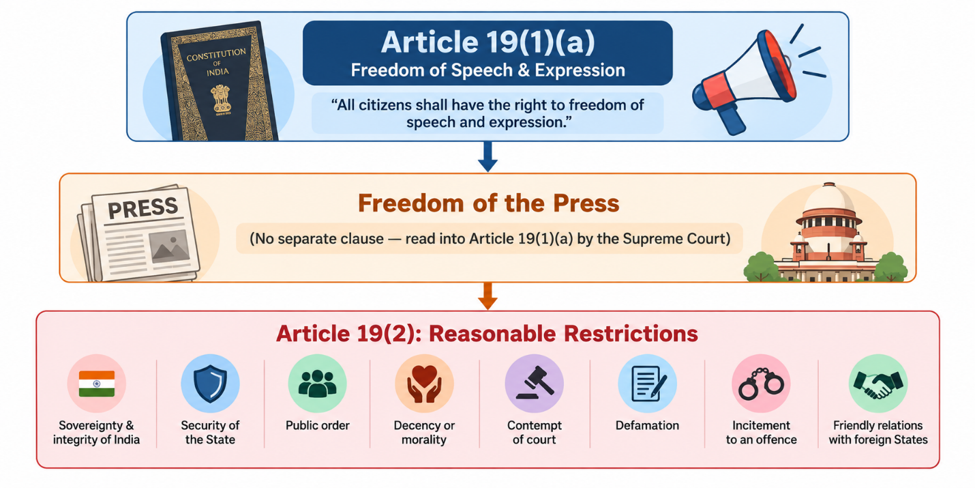
The restrictions permitted under Article 19(2) are limited and defined — the State cannot invent new ones. They are:
- Sovereignty and integrity of India; security of the State; friendly relations with foreign States.
- Public order; decency or morality.
- Contempt of court; defamation; incitement to an offence.
Crucially, any restriction must be reasonable — a test the courts police closely. A restriction that is vague, excessive or disguised (for example, an economic measure aimed at crippling a newspaper) will be struck down.
The Judgments That Built Press Freedom
Seven decades of case law have turned a single clause into a robust doctrine. The landmark decisions form a clear arc:
| Case | Year | Principle established |
| Romesh Thappar / Brij Bhushan v. State | 1950 | Press freedom is part of free speech; pre-censorship and vague “public order” curbs are suspect. |
| Sakal Papers v. Union of India | 1962 | The State cannot cap a newspaper’s pages or dictate its price to control it. |
| Bennett Coleman v. Union of India | 1973 | Newsprint quotas limiting pages were struck down as an indirect curb on the press. |
| Indian Express Newspapers v. Union of India | 1985 | Punitive taxation used to burden the press is unconstitutional. |
| Ministry of I&B v. Cricket Assn. of Bengal | 1995 | Airwaves are public property, to be regulated for plurality and the public good. |
| Shreya Singhal v. Union of India | 2015 | Section 66A of the IT Act struck down as vague — a landmark for online free speech. |
| Anuradha Bhasin v. Union of India | 2020 | Freedom of the press over the internet is protected; indefinite shutdowns are impermissible. |
Case principles summarised; primary judgments are available from the Supreme Court of India.
The Regulators and the Statutes
Press freedom in India is guarded less by a powerful regulator than by the courts and by self-regulation. The formal institutions are deliberately light-touch:
- Press Council of India (PCI). A statutory, quasi-judicial watchdog under the Press Council Act, 1978, chaired by a retired Supreme Court judge with 28 members. Its mandate is twin-edged: to preserve the freedom of the press and to maintain journalistic standards. But it covers only print and news agencies, and its powers stop at warning, admonishing or censuring — it has no power to fine or shut down, which critics call a body “without teeth.”
- Press Registrar General of India (PRGI). The Press & Registration of Periodicals Act, 2023 replaced the colonial Press and Registration of Books Act, 1867, moved newspaper registration online via the Press Sewa Portal, ended the requirement to file a declaration before a magistrate, and renamed the old Registrar of Newspapers (RNI) as the PRGI.
- Broadcast & digital news. Television news is largely self-regulated through industry bodies, while digital news and OTT come under the IT Rules, 2021 — the subject of the companion posts on media governance and on OTT platforms.
Media Independence and Its Challenges
A free press on paper can still be an unfree press in practice. The pressures on Indian media independence are real and widely debated:
| Challenge | Why it matters |
| Ownership concentration | Cross-media and concentrated ownership can narrow the plurality of voices. |
| Paid news & misinformation | Paid coverage and fast-spreading fake news erode credibility and informed debate. |
| Chilling effect of laws | Sedition (the old Section 124A, kept in abeyance by the Court in 2022), broad security laws and criminal defamation can induce self-censorship. |
| Commercial & TRP pressure | Ratings-driven sensationalism can crowd out serious journalism — a link back to Part 1. |
| Safety of journalists | Threats to reporters, especially in the field, deter accountability journalism. |
These concerns feed into contested global rankings: the World Press Freedom Index compiled by Reporters Without Borders has placed India low in recent years. The Government of India has disputed the Index’s small sample size and methodology, arguing it does not capture Indian realities. For a balanced view, both the rankings and the official reservations are worth weighing rather than either being taken at face value.
The Way Forward
- Strengthen self-regulation and media literacy so that credibility, not sensationalism, becomes the competitive edge.
- Ensure that any content or security law is narrowly drawn and reasonable, meeting the Article 19(2) test the courts insist on.
- Protect ownership plurality and the safety of journalists, so that independence is real and not merely formal.
Conclusion
The Indian press is free by inheritance rather than by explicit grant — a freedom the Supreme Court built, clause by clause, out of Article 19(1)(a), and one the Constitution allows to be limited only for good, narrowly defined reasons. The institutions around it are intentionally modest, which places the real burden of a free press on vigilant courts, credible self-regulation and an informed public. As media converges and moves online, the challenge is to carry that hard-won freedom into the digital age — protecting the watchdog even as the medium it barks through keeps changing.
One Comment