
Wildlife Sanctuaries in India
If national parks are the fortresses of India’s wild estate, wildlife sanctuaries are its far larger frontier — a network of about 574 wildlife sanctuaries[1] (as of Aug 2025) that shelters everything from the Indian wild ass of the Rann and the flamingos of Kutch to the musk deer of the high Himalaya.
Sanctuaries protect wildlife while still allowing certain regulated human activity, which makes them the most numerous and flexible category in India’s protected-area system. For the UPSC aspirant, they sit squarely at the crossroads of ecology, geography, polity and governance — a recurring theme in both Prelims and Mains.
This note maps the full picture: the constitutional and legal scaffolding that creates a sanctuary, how it differs from a national park, where sanctuaries fit within India’s wider environment and ecology framework, the institutions that run them, the notable sanctuaries and species you must know, and the conservation debates that examiners love to probe. Figures are drawn from official government sources, linked inline for verification.
At a Glance — Key Facts & Milestones
Before the detail, a revision-ready snapshot. A wildlife sanctuary is the second-strictest category of protected area under Indian wildlife law, and India’s roster of them dwarfs its national parks.
| Indicator | Status / Figure |
| Wildlife sanctuaries | 574 sanctuaries covering 1,27,241 km² — about 3.87% of India’s geographical area (as of Aug 2025). |
| Place in the wider network | Part of India’s network of over 1,000 Protected Areas that together span about 5.32% of the country. |
| Oldest wildlife sanctuary | Vedanthangal (1936), Tamil Nadu — a historic waterbird sanctuary. |
| Largest wildlife sanctuary | Kutch Desert WLS, Gujarat (~7,506 km²) — a vast saline flat and flamingo haven. |
| State with the most | Maharashtra has among the highest number of wildlife sanctuaries; every State and UT has some. |
| Legal basis | Sections 18 & 26A of the Wild Life (Protection) Act, 1972. |
| IUCN classification | Category IV (Habitat / Species Management Area) — active management for particular species and habitats. |
The Legal Foundation — Wild Life (Protection) Act, 1972
Like the national park, the wildlife sanctuary is a creature of statute. The Wild Life (Protection) Act, 1972 (WPA) is the parent legislation, enacted to protect wild animals, birds and plants and to constitute protected areas. It replaced a patchwork of state-level laws and gave the Centre a firm footing to coordinate conservation across the country.
Constitutional Backing
The Act draws its strength from the Constitution. The 42nd Constitutional Amendment (1976) moved ‘Forests’ and ‘Protection of Wild Animals and Birds’ from the State List to the Concurrent List, enabling Parliament to legislate on wildlife.
Two other provisions supply the moral and civic backbone:
- Article 48A — a Directive Principle directing the State to protect and improve the environment and safeguard forests and wildlife; and
- Article 51A(g) — a Fundamental Duty of every citizen to protect and improve the natural environment.
Together they anchor wildlife sanctuaries within India’s broader polity and governance as well as its ecology.
Wildlife Sanctuaries under Section 18
A wildlife sanctuary is declared by the State Government under Section 18 of the WPA. Unlike a national park, a sanctuary permits certain regulated human activity: pre-existing rights of local people may continue, and grazing or entry may be allowed at the discretion of the Chief Wildlife Warden. Its boundaries can also be altered more easily than a park’s — by the State Government on the recommendation of the National Board for Wildlife, rather than by a resolution of the State Legislature.
| Stage | Process | Description |
| 1 | Declaration of intent (Sec. 18) | The State Government issues a preliminary notification declaring its intention to constitute an area as a wildlife sanctuary. |
| 2 | Proclamation & claims (Sec. 21) | The Collector issues a proclamation specifying the limits and inviting people to file claims to their rights, usually within two months. |
| 3 | Settlement of rights (Sec. 19–24) | The Collector inquires into and settles the existing rights of individuals and communities over the land. |
| 4 | Final notification (Sec. 26A) | After rights are settled, the State Government issues a final notification declaring the area a wildlife sanctuary. |
| 5 | Regulated protection (Sec. 27–33) | Entry and activities are controlled by the Chief Wildlife Warden; some rights and activities may be permitted, unlike in a national park. |
Who Governs India’s Wildlife Sanctuaries
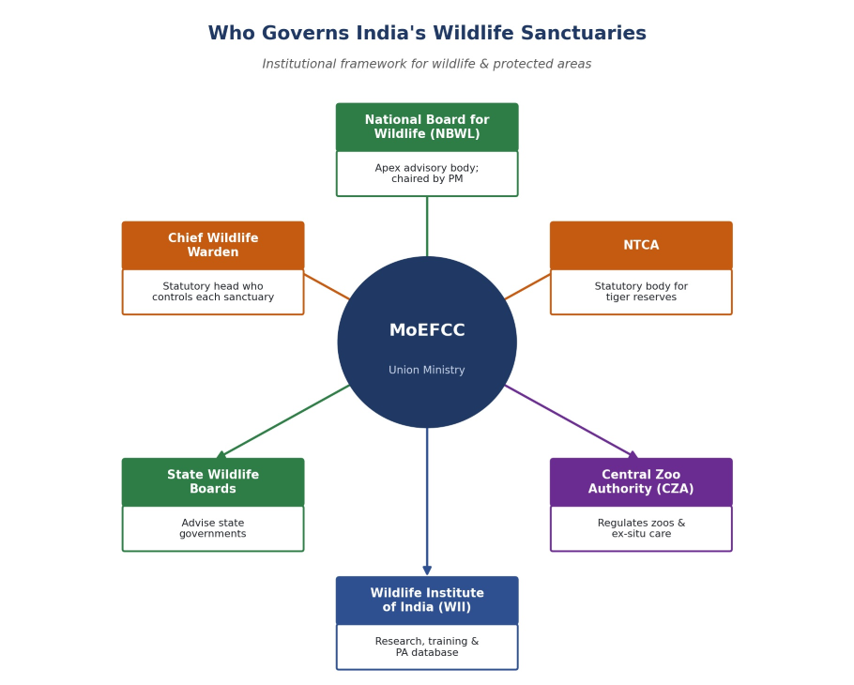
Wildlife sits on the Concurrent List, so governance is genuinely federal — a web of central ministries, statutory authorities, expert institutions and state officials. The Ministry of Environment, Forest and Climate Change (MoEFCC) is the apex policy body at the Centre, but the day-to-day custodian of any sanctuary is the state’s Chief Wildlife Warden.
- National Board for Wildlife (NBWL): The apex advisory body on wildlife conservation, chaired by the Prime Minister; its clearance is needed for projects in or near protected areas and for altering sanctuary boundaries.
- Chief Wildlife Warden: The statutory head of the wildlife wing in each state — the officer who controls entry, permits and management inside every sanctuary.
- Wildlife Institute of India (WII): A Dehradun-based research and training institute that maintains the National Wildlife Database underpinning the protected-area network.
- Central Zoo Authority (CZA) & NTCA: The CZA regulates zoos and ex-situ care, while the NTCA administers tiger reserves — many of which include sanctuaries within their core and buffer.
- State Wildlife Boards: Advise state governments on wildlife policy and the declaration and management of sanctuaries.
Notable Wildlife Sanctuaries — A Guided Tour
India’s 500-plus sanctuaries are as varied as its geography — from marine turtle rookeries to Himalayan musk-deer refuges. A quick regional tour fixes the major names to their landscapes and signature species, exactly the associations examiners test. Reading this alongside your geography notes helps lock the locations in place.
Himalayan & Northern India
- Kedarnath WLS (Uttarakhand) — the largest sanctuary in the western Himalaya and a stronghold of the endangered Himalayan musk deer.
- Hokersar & Overa-Aru (Jammu & Kashmir) — Hokersar is a Ramsar wetland and a wintering ground for vast flocks of migratory waterfowl.
Western India
- Kutch Desert & Wild Ass sanctuaries (Gujarat) — the Kutch Desert WLS is India’s largest sanctuary and a flamingo breeding ground, while the Wild Ass WLS in the Little Rann is the only home on Earth of the Indian wild ass.
- Tal Chhapar (Rajasthan) — a jewel-like grassland famed for blackbuck and raptors amid the Thar.
Central India
- Nauradehi (Madhya Pradesh) — the state’s largest sanctuary, home to wolves, leopards and a proposed reintroduction landscape.
- Bhimashankar & Radhanagari (Maharashtra) — Bhimashankar protects the Indian giant squirrel (Shekru), and Radhanagari, among India’s earliest sanctuaries, shelters the Indian bison (gaur).
Southern India
- Ranganathittu & Chinnar (Karnataka, Kerala) — Ranganathittu is India’s premier riverine bird sanctuary, and Chinnar shelters the rare grizzled giant squirrel in a rain-shadow scrub.
- Point Calimere (Tamil Nadu) & Rollapadu (Andhra Pradesh) — Point Calimere draws flamingos and blackbuck to its coast, while Rollapadu is a last refuge of the Great Indian Bustard.
Eastern, North-East & Coastal India
- Pobitora (Assam) — often called ‘mini Kaziranga’, it holds the highest density of one-horned rhinos in the world.
- Chilika–Nalabana & Gahirmatha (Odisha) — Nalabana is a birding paradise within the Chilika lagoon, and Gahirmatha Marine WLS hosts the world’s largest Olive Ridley turtle rookery.
Notable Wildlife Sanctuaries at a Glance
| Wildlife Sanctuary | State / UT | Best Known For |
| Vedanthangal | Tamil Nadu | India’s oldest wildlife sanctuary (1936); waterbirds. |
| Kutch Desert | Gujarat | India’s largest sanctuary; flamingo breeding. |
| Wild Ass (Little Rann) | Gujarat | Only home of the Indian wild ass. |
| Pobitora | Assam | Highest density of one-horned rhino. |
| Tal Chhapar | Rajasthan | Blackbuck and raptors on open grassland. |
| Nauradehi | Madhya Pradesh | MP’s largest sanctuary; wolves, leopards. |
| Bhimashankar | Maharashtra | Indian giant squirrel (Shekru). |
| Ranganathittu | Karnataka | Premier riverine bird sanctuary. |
| Chinnar | Kerala | Grizzled giant squirrel; rain-shadow scrub. |
| Thattekad (Salim Ali) | Kerala | Kerala’s first bird sanctuary. |
| Point Calimere | Tamil Nadu | Flamingos and blackbuck; coastal wetland. |
| Rollapadu | Andhra Pradesh | Great Indian Bustard grassland. |
| Chilika (Nalabana) | Odisha | Migratory birds; Irrawaddy dolphins. |
| Gahirmatha (Marine) | Odisha | World’s largest Olive Ridley turtle rookery. |
India has over 570 wildlife sanctuaries, but studying each one individually is neither practical nor necessary. Focus primarily on the notable sanctuaries listed above and those appearing in current affairs.
For a complete state-wise reference, you may consult: List of Wildlife Sanctuaries of India — Wikipedia.
Beyond the Sanctuary — Allied Conservation Designations
A sanctuary rarely wears a single label. The same wetland may be a bird sanctuary and a Ramsar site; a forest sanctuary may lie inside a tiger reserve or a biosphere reserve. These overlapping designations come from different legal or international frameworks and serve different purposes — a distinction examiners exploit ruthlessly.
| Designation | Latest Status | Framework / Purpose |
| Tiger Reserves | 58 reserves across 18 states. | Project Tiger, administered by the NTCA under the WPA. |
| Elephant Reserves | 33 reserves (14 states; ~80,777 km²). | Project Elephant (1992) for elephants and corridors. |
| Biosphere Reserves | 18 reserves (13 in UNESCO’s WNBR). | UNESCO Man and the Biosphere Programme; MoEFCC. |
| Ramsar Wetlands | 101 sites (many are bird sanctuaries). | Ramsar Convention on wetlands of international importance. |
| Natural World Heritage | 7 natural + 1 mixed site. | UNESCO World Heritage Convention. |
Many of India’s most famous sanctuaries owe their fame to these overlapping tags: wetland sanctuaries such as Chilika and Point Calimere feature among the country’s Ramsar sites, and several forest sanctuaries form the buffer of tiger reserves, sitting alongside India’s UNESCO World Heritage Sites — underlining how a single landscape can carry several layers of protection at once.
Flagship Species & the Sanctuaries That Guard Them
Because sanctuaries are declared to protect particular species, they are often the last line of defence for India’s most range-restricted animals. Several owe their survival almost entirely to a single sanctuary. Deeper profiles sit in the species of conservation concern notes.
| Species | Key Sanctuary | Why It Matters |
| Indian Wild Ass | Wild Ass WLS, Little Rann of Kutch (Gujarat) | The only population on Earth. |
| Great Indian Bustard | Rollapadu (AP) & Desert NP | Critically endangered grassland bird. |
| One-horned Rhinoceros | Pobitora (Assam) | Highest rhino density in the world. |
| Olive Ridley Turtle | Gahirmatha Marine WLS (Odisha) | World’s largest nesting rookery. |
| Blackbuck | Tal Chhapar (Rajasthan), Point Calimere (TN) | Iconic antelope of open plains. |
| Grizzled Giant Squirrel | Chinnar (Kerala) | Restricted-range Western Ghats endemic. |
Bird sanctuaries deserve special mention: dozens of India’s wetland sanctuaries double as Ramsar sites and as critical stop-overs on the Central Asian Flyway. These conservation wins are supported by an ecosystem of government schemes spanning wetland management, species recovery and community incentives.
Challenges & Pressures
For all their number, sanctuaries operate under mounting strain — and because they permit human use, the pressures are often sharper here than in a national park. The strongest Mains answers connect these threats rather than listing them in isolation.
- Habitat fragmentation: Roads, railways, canals and mines slice through sanctuaries and the corridors that connect them, isolating populations and eroding genetic health.
- Human–wildlife conflict: With settlements, grazing and farms often inside or beside a sanctuary, crop and livestock losses and retaliatory killing are common — a challenge examined in depth in the note on human–animal conflict in India.
- Poaching and illegal wildlife trade: Demand for skins, horn, bone and exotic pets keeps organised poaching networks alive despite tighter enforcement.
- Development vs conservation: Linear infrastructure, hydropower, mining and tourism force difficult trade-offs, often testing the strength of NBWL clearances and eco-sensitive zone rules.
- Invasive species and climate change: Weeds like Lantana crowd out native forage, while shifting rainfall and temperature reshape habitats — and dry out wetland sanctuaries — faster than species can adapt.
- Rights and livelihoods of forest communities: Balancing regulated protection with the rights of forest-dwelling communities under the Forest Rights Act remains a live governance and ethical dilemma.
The Way Forward
Contemporary conservation thinking has moved from fencing sanctuaries off to embedding them within functioning landscapes and local economies.
- Landscape and corridor conservation: Protecting the wildlife corridors between sanctuaries so that populations can disperse, breed and remain resilient.
- Community-led and eco-tourism models: Turning local communities into stakeholders through employment, revenue-sharing and eco-development committees.
- Technology in monitoring: Camera traps, drones, GPS collars and AI-assisted analytics for real-time surveillance and anti-poaching response.
- Wetland and species recovery: Targeted programmes for bird sanctuaries, the Great Indian Bustard, the wild ass and other range-restricted species.
- Strengthening eco-sensitive zones: Using the buffer around sanctuaries to cushion them from development pressure while permitting sustainable local use.
Conclusion
India’s wildlife sanctuaries are the broad base of its conservation pyramid — more numerous, more varied and more entangled with human life than its national parks. They guard species found nowhere else, buffer the country’s tiger reserves and biosphere reserves, and turn wetlands into internationally important refuges. Their central challenge is also their defining feature: protecting wildlife while sharing space with people.
[1]Total numbers may differ across sources.