
Formation of the Solar System
The sky that dazzles us with planets, stars, and galaxies did not always exist in its current form. Over centuries, scientists and philosophers have tried to answer how this solar system came into existence. Let’s understand the major theories, from early philosophical ideas to modern scientific explanations.
🌀 Gaseous Hypothesis — Immanuel Kant
Imagine the early universe as a massive, ancient cloud of gas and dust, quietly rotating in space — this is where Kant begins. He proposed that:
- A primeval cloud made up of dust, vapour, and gas was present.
- Due to mutual gravitational attraction, particles within the cloud collided.
- Collisions generated friction and heat, converting matter into a gaseous form.
- This hot, rotating cloud became a nebula.
- As temperature increased, the nebula spun faster and expanded, forming concentric rings around the centre.
- These rings later condensed into planets.
🧠 Kant’s idea was imaginative but lacked scientific backing about the behavior of gases and the role of angular momentum.
🌀 Nebular Theory — Laplace
Laplace refined Kant’s hypothesis into a more structured scientific theory:
- A gaseous nebula began to cool and contract.
- As it shrank, its rotational speed increased (due to the conservation of angular momentum).
- This caused the equator to bulge and matter to spread outward.
- Eventually, rings of gas separated from the equator due to the increased centrifugal force.
- These rings cooled and condensed into planets, while the remaining central mass became the Sun.
🧠 This theory attempted a more physical explanation, but couldn’t explain how planets achieved their present-day orbits.
🌟 Planetesimal Hypothesis — Chamberlin & Moulton
Now let’s imagine two cosmic bodies: a proto-sun and a passing star.
- As the star came close, its gravitational pull ripped off small pieces from the proto-sun.
- These pieces, called planetesimals, floated in space.
- Gradually, they aggregated and collided, forming the nuclei of planets.
🧠 Although it introduced the idea of external disturbance, it couldn’t justify how a star could come that close without disrupting the whole system.
🌊 Tidal Hypothesis — James Jeans & Harold Jeffrey
Taking Chamberlin’s idea further:
- A near-collision between the proto-sun and an intruding star occurred.
- This gravitational tug-of-war pulled filament-like matter from the sun (like stretching hot toffee).
- This cigar-shaped filament later cooled and fragmented into planets.
🧠 The visual analogy is appealing, but like its predecessor, it couldn’t explain the precise angular momentum distribution among Sun and planets.
🌟 Binary Star Hypothesis — Russell
Russell theorized a scenario with three stars:
- A companion star revolved around the proto-sun.
- A third star approached, collided with the companion star.
- This collision ejected matter, which began orbiting around the proto-sun and later formed the planets.
🧠 Complex and dramatic, but lacked astronomical evidence.
💥 Supernova Hypothesis — Fred Hoyle
A more scientifically grounded idea based on stellar life cycles:
- There were two stars: the primitive sun and a companion star.
- Due to excessive nuclear fusion, the companion star exploded — a supernova.
- The explosion released gaseous matter that formed a rotating disc around the primitive sun.
- This disc material became the raw material for planets.
🧠 This idea brought the role of supernova into planetary formation, linking it with the life and death of stars.
🌌 The Modern Understanding: Big Bang to the Solar System
🔭 The Big Bang Theory
- About 13.8 billion years ago, the universe was in an extremely hot and dense state and began expanding.
- The Big Bang describes the expansion of space itself, occurring throughout the universe.
- As the universe expanded and cooled, subatomic particles and the nuclei of light elements—mainly hydrogen and helium—formed.
- About 380,000 years later, electrons combined with atomic nuclei to form atoms, releasing radiation observed today as the cosmic microwave background.
- Stars and galaxies formed later when gravity caused slightly denser regions of matter to collapse.
- Heavier elements were subsequently produced inside stars and during stellar explosions.
- In 1927, Georges Lemaître developed an expanding-universe model and related the recession speeds of galaxies to their distances.
- In 1929, Edwin Hubble published observational evidence supporting this relationship, now called the Hubble–Lemaître law.
🌀 Solar Nebular Disk Model
The solar nebular disk model, also called the nebular theory, is the most widely accepted general framework for explaining the formation of the solar system.
Timeline
- Earliest solar-system solids formed: approximately 4.568 billion years ago.
- Solar nebula collapsed and the young Sun formed: approximately 4.6 billion years ago.
- Giant planets formed: probably within the first 10 million years.
- Rocky planets formed: over tens of millions of years.
☀️ Formation of the Sun
Let’s understand how:
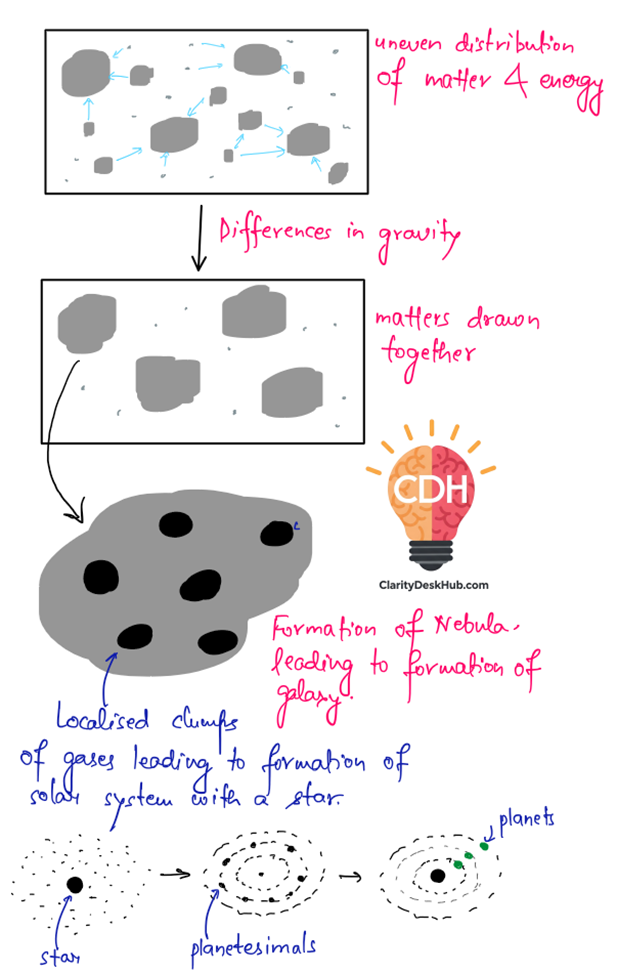
- The solar system began inside a cold molecular cloud composed mainly of gas and dust.
- A region of this cloud became sufficiently dense and began collapsing under its own gravity.
- A disturbance such as a stellar wind or nearby supernova shockwave may have contributed to the collapse, although the exact trigger is uncertain.
- As the cloud contracted, conservation of angular momentum caused it to rotate faster and flatten into a protoplanetary disk.
- Most of the material accumulated at the centre, forming a hot and dense protostar.
- Continued contraction raised the temperature and pressure inside the protostar.
- When sustained hydrogen nuclear fusion began in its core, the protostar became the Sun.
- The Sun now contains approximately 99.8% of the solar system’s total mass.
- Some of the remaining disk material formed planets and smaller bodies, while much of the leftover gas and dust was dispersed by the young Sun.
🪐 Formation of the Planets
Within the solar protoplanetary disk:
- Microscopic dust and ice grains collided and combined, producing larger aggregates and pebbles.
- These materials became concentrated and formed larger bodies called planetesimals.
- Planetesimals collided, merged and grew through accretion.
- Larger planetesimals developed into planetary embryos called protoplanets.
- Continued accretion and collisions eventually produced the planets.
🪨 Formation of the Rocky Planets
- The inner region of the disk was comparatively hot.
- Metals and heat-resistant silicate minerals could remain solid, while many volatile substances could not easily condense.
- This favoured the formation of the rocky terrestrial planets → Mercury, Venus, Earth, Mars
❄️ Formation of the Giant Planets
- Farther from the Sun, temperatures were low enough for water and other volatile compounds to condense as ice.
- The boundary beyond which water ice could condense is called the snow line or frost line.
- The greater supply of solid material beyond this line allowed large planetary cores to form.
- Jupiter and Saturn accumulated massive hydrogen-and-helium envelopes and became gas giants.
- Uranus and Neptune retained greater proportions of heavier volatile substances and became ice giants.
- Interactions between the planets and the surrounding disk probably caused some planets to migrate from their original formation locations.
☄️ Asteroids, Comets and Other Small Bodies
- Some planetesimals were never incorporated into planets.
- Other small bodies formed when larger objects collided and fragmented.
- Many rocky remnants remained in the main asteroid belt between Mars and Jupiter.
- Jupiter’s gravity disturbed this region and restricted the growth of its material into a full-sized planet.
- Icy remnants survived mainly as comets in regions such as the Kuiper Belt and the distant Oort Cloud.
- These small bodies preserve important evidence about conditions in the early solar system.
🌍 Core Formation & Planetary Differentiation
As Earth grew approximately 4.57–4.45 billion years ago:
- Accretionary impacts, compression, radioactive decay and gravitational energy produced extensive internal heating and melting.
- Many planetesimals and protoplanets incorporated into Earth had already separated into metallic cores and silicate mantles.
- During large collisions, dense molten iron-rich metal, including nickel and other metal-loving elements, separated from silicate material and moved towards Earth’s centre.
- Repeated impacts added more metallic material to the growing core.
- Less-dense silicate material formed the mantle.
- Cooling and crystallisation of molten silicate produced an early crust.
- Volatile materials, including water-bearing compounds, could remain dissolved in magma, become incorporated into minerals or escape through outgassing.
- The separation of a planetary body into layers with different compositions and densities is called planetary differentiation.
- Earth’s core formed progressively during accretion over tens of millions of years.
- The mantle and crust continued evolving through melting, cooling, volcanism, impacts and geological recycling.
You can draw the following simplified diagram in the exams to enrich your mains answer writing:
🧭 Conclusion
Each theory — from Kant to Hoyle — tried to explain a cosmic mystery. Some were imaginative, some partially scientific. But the modern nuclear disc model, backed by astrophysics and observational data, gives us the most coherent picture of how stars and planets formed from stardust.
Summary for Revision
| Theory Name | Proponent | Core Concept | Key Shortcoming |
|---|---|---|---|
| Gaseous Hypothesis | Immanuel Kant (1755) | A primeval cloud of cold matter collided due to gravity, creating heat and rotation (Nebula). | Violated the Law of Conservation of Angular Momentum. |
| Nebular Hypothesis | Laplace (1796) | A pre-existing hot, rotating nebula cooled and contracted, shedding rings that became planets. | Could not explain why the Sun holds 99% mass but very little angular momentum. |
| Planetesimal Hypothesis | Chamberlin & Moulton | A passing star pulled “planetesimals” (solid fragments) from the Sun through gravitational attraction. | Does not explain the circularity and spacing of planetary orbits. |
| Tidal Hypothesis | James Jeans & Harold Jeffrey | A massive star’s gravity pulled a “cigar-shaped” filament of gaseous matter from the Sun. | Failed to explain how matter pulled from the Sun could reach such great distances. |
| Binary Star Hypothesis | H.N. Russell | A companion star to the Sun was struck by a third passing star; debris formed the planets. | Highly improbable astronomical event with no physical evidence. |
| Supernova Hypothesis | Fred Hoyle | A companion star exploded as a Supernova, leaving behind a disc of heavy elements around the Sun. | Mathematical difficulty in explaining how the debris stayed in stable orbits. |
| Modern Nebula (Nuclear Disc) | Modern Astrophysics | A nebula collapsed due to a supernova shockwave; 99.8% mass became the Sun. | Most accepted model; explains chemical differences between rocky and gas planets. |
The Modern Timeline and Key Processes
| Phase | Mechanism | Key Result |
| Nebular Collapse | Gravity-driven collapse of molecular-cloud material about 4.6 billion years ago. | Formation of the proto-Sun and rotating disk. |
| Accretion | Dust and ice grains combined; gravity then assembled larger bodies. | Formation of planetesimals and protoplanets. |
| Differentiation | Heating and melting separated dense metal from lighter silicates. | Formation of the core, mantle and early crust. |
| Zonation | The disk’s temperature gradient allowed rock nearby and ice beyond the snow line. | Terrestrial planets inside; gas and ice giants outside. |
One Comment