
Classification of Mountains
We are dealing with the classification of mountains, and mountains can be classified on three bases:
- Period of Origin (When they were formed)
- Mode of Origin (How they were formed)
- Location (Where they are found)
1. Classification Based on the Period of Origin
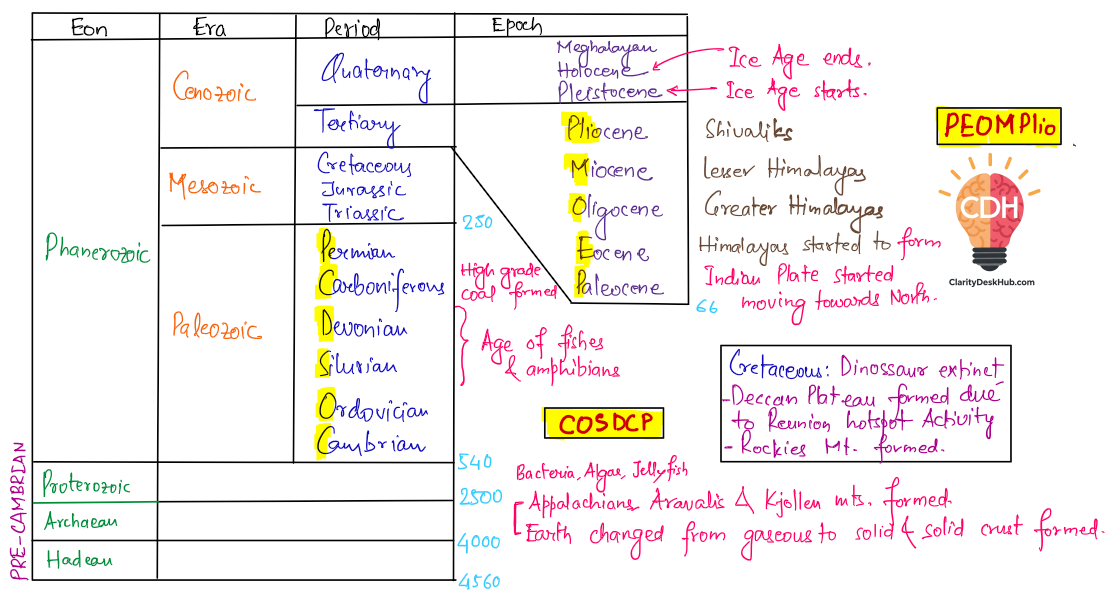
Mountains are not formed in a single event. Instead, they are the results of orogenic movements (mountain-building movements) that have taken place in Earth’s history. Till now, nine major orogenies have occurred. Out of these, three are most important for us: Caledonian, Hercynian, and Alpine.
(a) Precambrian Mountains
- Belong to the Precambrian Period (4600 million years ago – 541 million years ago).
- These are extremely old mountains, which over time have faced upheaval, denudation, and metamorphosis.
- Today, they survive only as residual mountains.
- Example: Laurentian & Algoman mountains (north of St. Lawrence & Ottawa Rivers).
👉 In short: These are “fossils” of mountains, mostly worn down.
(b) Caledonian Mountains
- Formed in the late Silurian and early Devonian Period (430–380 million years ago).
- Example: Appalachians (North America), Aravallis (India), Mahadeo Hills.
(c) Hercynian Mountains
- Originated during Upper Carboniferous to Permian Period (340–225 million years ago).
- Found mainly in Europe & Asia.
- Examples: Vosges, Black Forest (Germany), Ural (Russia), Altai, Tien Shan (Asia).
(d) Alpine Mountain System (Most Important)
- Origin: Tertiary Period (65 to 7 million years ago).
- Still comparatively young and active mountains.
- Examples:
👉 Being young, these are lofty, rugged, and still rising (like the Himalayas).
2. Classification Based on Mode of Origin
Here we look at how mountains were formed.
(a) Original or Tectonic Mountains
Formed by tectonic forces. They are of three types:
- Fold Mountains – created by folding of earth’s crust.
- Examples: Himalayas, Rockies, Andes.
- Block Mountains – formed when large crustal blocks are raised or lowered along faults.
- Examples: Vosges (France), Black Forest (Germany), Vindhya & Satpura (India).
- Volcanic Mountains – built by accumulation of lava and volcanic materials.
- Examples: Mount Fujiyama (Japan), Mount Kilimanjaro (Africa), Mauna Kea (Hawaii).
(b) Circum-Erosional / Relict / Residual Mountains
- These are leftovers of old fold mountains after denudation (wearing away of surface).
- Examples: Aravallis (India), Urals (Russia).
- Sometimes, plateaus get deeply dissected by rivers, forming denudation mountains.
- Examples: Highlands of Scotland, Scandinavia, Deccan Plateau (India).
3. Classification Based on Location
(a) Continental Mountains
- Coastal Mountains: Near the coastlines.
- Examples: Rockies, Appalachians, Alpine chain, Western & Eastern Ghats.
- Inland Mountains: Located away from the coast.
- Examples: Vosges, Black Forest, Urals, Aravallis, Himalayas, Satpura, Maikal, Kunlun, Tien Shan, Altai.
(b) Oceanic Mountains
- Found on continental shelves and ocean floors.
- Example: Mauna Kea (Hawaii) –
- Height above sea level: 4207 m
- Height from ocean floor: 9140 m (making it the tallest if measured this way).
- It is a dormant volcanic mountain formed at a hotspot.
🎯 How to Remember for UPSC
- By Age: Precambrian → Caledonian → Hercynian → Alpine.
- By Origin: Fold (Himalayas), Block (Vindhyas), Volcanic (Fujiyama).
- By Location: Continental (Himalayas, Rockies), Oceanic (Mauna Kea).
👉 So, mountains are not just “heaps of rocks.” They are records of Earth’s history, each type telling us when, how, and where they were formed.