
The Fall of the Mughals & Rise of Regional States
🧭 Background: What was happening in India in the early 1700s?
The 18th century in Indian history was a period of transition — a time when the centralized authority of the Mughal Empire weakened, and in that vacuum, new powers began to emerge. Imagine a once-mighty tree that has decayed at its core. Its branches, which once grew in harmony, now fall apart and begin to spread in different directions.
This was the story of India after the death of Aurangzeb in 1707. The Mughal Empire still existed, but only in name. The emperor continued to sit on the throne, but real power had slipped out of his hands.
🏰 Emergence of Regional States
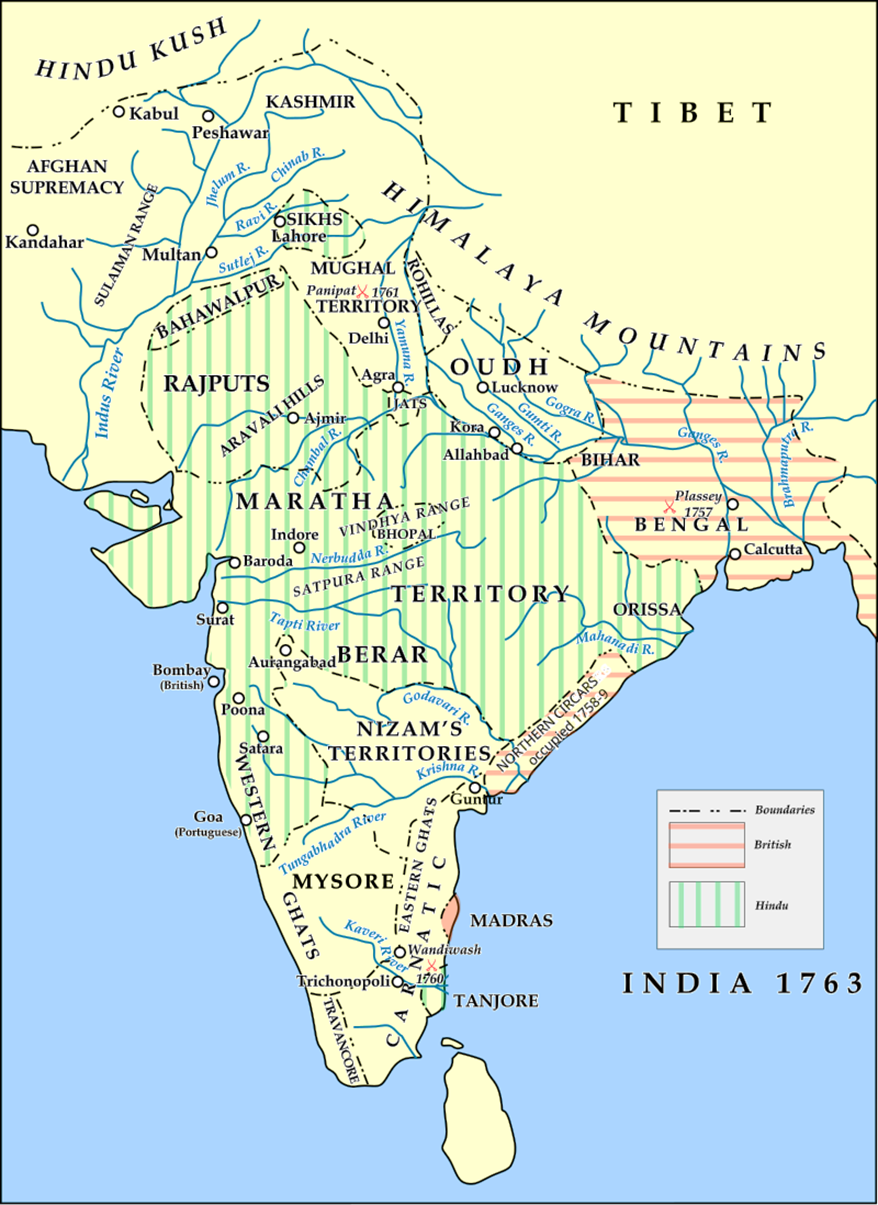
As Mughal control disintegrated, several independent and semi-independent states sprang up. These included Bengal, Avadh, Hyderabad, Mysore, and the powerful Maratha Confederacy.
While these states became prominent in the first half of the 18th century, their political ambitions brought them into direct confrontation with the British in the second half of the century.
🧩 Classification of these States
Scholars have grouped these regional powers into three broad categories:
- Successor States
These were provinces of the Mughal Empire that declared autonomy while maintaining a formal connection to the Mughal throne.
📌 Examples: Bengal, Avadh, Hyderabad - New or Insurgent States
These were founded by rebels or insurgents who actively defied Mughal authority.
📌 Examples: Marathas, Jats, Sikhs - Independent Kingdoms
These emerged independently, often in regions where the Mughal presence had never been very strong, taking advantage of the general breakdown of imperial control.
📌 Examples: Mysore, Rajput kingdoms, Kerala states
👉🏼 The rise of these regional states was one of the defining features of 18th-century Indian polity.
🏛️ Characteristics of Regional Powers
Let’s now understand what defined these regional kingdoms:
1. Nominal Supremacy of the Mughal Emperor
Even after real power was lost, the title of the Mughal Emperor retained symbolic value.
- Kings still sought imperial sanads (royal decrees) to legitimize their rule.
- The emperor was like a rubber stamp, but that stamp still mattered in the eyes of many.
🔍 Think of it like a powerless president who still performs ceremonial duties — the real decisions are being taken elsewhere.
2. Continuity of Mughal Administrative Traditions
- These states reorganized their governance, but the Mughal model remained dominant, especially in land revenue systems.
- Successor states naturally continued these practices, while even new states found them efficient and adopted them.
🗂️ This was not just imitation but also a matter of administrative convenience and continuity.
3. Establishment of Law and Order
- These states tried to create stable governance, law enforcement, and economic structures.
- Trade routes were protected, and internal administration was restructured.
4. Secular Politics
- Despite growing communal tensions later in Indian history, most 18th-century regional states were secular in political practice.
- Governance was largely based on pragmatism rather than religious ideology.
5. Promotion of Trade
- Internal trade was preserved, and in many regions, foreign trade was encouraged (especially by states like Bengal and Mysore).
- This maintained the economic vitality of many regions despite political instability.
⚠️ Weaknesses of Regional Polities
Despite many strengths, these states suffered from deep structural problems, which prevented them from becoming a unified national alternative to Mughal rule.
1. Regional Character and Limitations
- These powers were regional — strong in their territories but unable to build pan-Indian empires.
- They lacked the vision and resources to unify the subcontinent under a single political framework.
2. Constant Wars and Rivalries
- The regional states often fought with each other.
👉 Marathas vs Nizam vs Mysore rulers — these conflicts weakened all sides. - Their lack of unity made it easy for the British to play one against the other and eventually dominate them all.
🤝 Unity was missing. If they had formed coalitions, India’s fate might have been different.
3. Decentralised Authority
- Many of these states suffered from fragmented power structures.
- Jagirdars, Zamindars, and local chiefs often had more real power than the ruler.
- In most places, provincial rulers had to negotiate with powerful local interests to retain control.
- Exception: Mysore had strong central control, and local chieftains were not tolerated.
4. Jagirdari Crisis
- The Mughal-era Jagirdari system became unsustainable:
- The number of Jagirdars increased, but the land available for revenue declined.
- This created a fiscal crisis.
- The condition of peasants worsened, as they bore the brunt of revenue pressures.
5. Economic and Institutional Weakness
- These states failed to reform their economic systems or build strong institutions.
- Financial mismanagement, administrative inefficiency, and military disorganization were common.
- They lacked a long-term developmental vision.
6. Backwardness in Science and Technology
- Industrial and technological modernization was completely absent.
- No effort was made to modernize agriculture, manufacturing, or military industries.
- This technological stagnation put them at a disadvantage against the British, who had access to modern arms and strategies.
✅ Summary: Why These States Mattered (and Why They Failed)
The regional powers of 18th-century India represent a moment of opportunity that was ultimately missed.
They were:
- Powerful, but not united
- Administratively functional, but economically weak
- Traditional, but not innovative
In short, they preserved the legacy of the Mughals, but couldn’t replace their empire with something stronger or more unified. Their internal rivalries, structural weaknesses, and failure to modernize paved the way for a new kind of power — the British East India Company — to take control of India.
This topic is part of the complete Modern Indian History Notes for UPSC. Explore the full subject coverage here.