
Molybdenum
Let’s begin with a fundamental point:
Molybdenum (symbol: Mo) is a silvery-grey refractory metal, which means it can withstand very high temperatures without deforming or corroding. However, like many other strategic metals, it does not occur freely in nature.
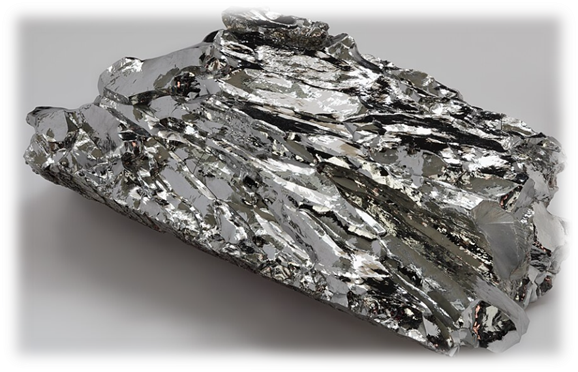
The main ore from which molybdenum is extracted is called Molybdenite (MoS₂) – a sulphide mineral.
Interestingly, a good amount of molybdenum is also obtained as a by-product during the processing of tungsten and copper ores. This means even if a mine is focused on extracting copper or tungsten, molybdenum can “tag along” in the mineral matrix.
Geological Occurrence in India
In the Indian context, molybdenum is not a standalone mineral. It usually occurs in association with other metals, particularly:
- Copper
- Lead
- Zinc
So, wherever we have mining of these metals, there’s a potential of molybdenum being present.
Applications of Molybdenum: Why is it Important?
Molybdenum is a critical industrial metal, especially for modern and strategic sectors. Let’s understand its key uses:
(a) As an Alloying Agent
- When added to steel, cast iron, or superalloys, molybdenum significantly increases:
- Strength
- Hardness
- Resistance to wear
- Resistance to corrosion
- It also retains strength at high temperatures, making it ideal for:
- Aerospace
- Military hardware
- Automobile engines
(b) Electrical and Electronic Industry
- Used in components such as:
- Electrodes
- Semiconductors
- Vacuum tubes
- It is especially useful where thermal conductivity and high-temperature stability are required.
(c) Green Technology & Energy Sector
- Molybdenum is finding increasing importance in renewable energy technologies, including:
- Wind turbines
- Solar panels
- Hydrogen fuel cells
- As India and the world move towards a green economy, the demand for molybdenum may increase sharply.
🔍 UPSC Relevance: Understanding such minerals through the lens of energy transition and strategic resource dependence gives your answers a contemporary edge.
Distribution of Molybdenum in India
Let’s now see where molybdenum is found in India. Although India has modest reserves, they are strategically dispersed across several states:
| State | Notable Deposits | Type of Deposit |
|---|---|---|
| Tamil Nadu | Karadikuttam | Primary |
| Madhya Pradesh | Malanjkhand (copper belt) | Associated with copper |
| Jharkhand | Rakha & Jaduguda mines | Associated with copper & uranium |
| Rajasthan | Dariba-Rajpura | Lead-zinc association |
| Meghalaya | Umpyrtha multimetal deposit | Mixed metals |
| Karnataka | — | Small reserves |
⚠️ Note: Molybdenum is also produced intermittently from uranium ores at the Jaduguda mine (Jharkhand).
Reserve and Production Status: India vs the World
Let’s now examine where India stands in terms of reserves and production:
India’s Reserves (2020):
| State | Reserves (in MT) |
| Tamil Nadu | 17.88 |
| Madhya Pradesh | 8 |
| Karnataka | 1.32 |
| Total | 27.2 MT |
✅ This is enough to note that India has potential, but no major production infrastructure yet.
World’s Reserves in Million tons (2024):
| Country | Share of Global Reserves |
| China | 39% |
| Chile | 23% |
| USA | 13% |
| Global Total | 15 MT |
Clearly, China dominates the world’s molybdenum reserves, making it a critical geo-economic player in this domain.
World Production (2018):
| Country | Production Share |
| China | 42% |
| Peru | 16% |
| Chile | 15% |
| USA | 13% |
Molybdenum and Copper: The Global Trend
Globally, about two-thirds of molybdenum production comes as a by-product of copper mining. This is crucial because:
- The fate of molybdenum often depends on global copper demand.
- Any disruption in copper mining (like price crashes or environmental regulations) affects molybdenum supply as well.
Conclusion: Why is Molybdenum Strategically Important for India?
- Molybdenum is a critical mineral, especially in the context of steel-making, defence, electronics, and the green energy revolution.
- Despite having some reserves, India currently lacks large-scale extraction capabilities.
- Hence, like lithium or rare earth elements, molybdenum should be classified under strategic minerals, and India needs to:
- Boost exploration & domestic production.
- Consider value-addition through metallurgical industries.
- Diversify and secure import sources for long-term resilience.