
Basic Concepts in Environment
🌿 Understanding the “Environment”
Whenever we use the word environment, most of us imagine trees, rivers, mountains, animals — basically, “nature.”
But scientifically, Environment means the total surroundings in which living beings exist and interact — both biotic and abiotic.
Biotic and Abiotic Components
Let’s understand them:
- Biotic components → All living things and even once-living things.
👉 Includes plants, animals, microbes, dead and decaying matter, bones, fossils, etc. - Abiotic components → All non-living physical and chemical elements.
👉 Includes air, water, soil, temperature, sunlight, humidity, minerals, lightning, etc.
Now, these two aren’t separate — they are constantly interacting.
For example:
🌞 Sunlight (abiotic) → helps plants (biotic) → which are eaten by animals (biotic) → whose waste returns nutrients to the soil (abiotic).
This chain of interaction forms the foundation of life.
⚖️ Note the Difference: Biotic ≠ Organic
Many students confuse “biotic” with “organic,” but there’s a key distinction:
- Biotic → refers to living or once-living things.
- Organic compounds → chemical substances that have at least one carbon–hydrogen (C–H) bond — like carbohydrates, proteins, lipids, nucleic acids.
So, an organic compound can come from a biotic source, but the two words don’t mean the same thing.
- Inorganic compounds, on the other hand, come from minerals and usually lack C–H bonds.
Example: water (H₂O), sodium chloride (NaCl), carbon dioxide (CO₂).
🌍 So, what does Environment include?
In biology, the environment is made up of:
- Physical factors: air, water, nutrients, climate.
- Biological factors: organisms and biomolecules.
- Chemical interactions: like biogeochemical cycles — carbon, nitrogen, phosphorus cycles, etc.
In short, every organism depends on its environment — for food, energy, water, oxygen, and shelter.
No organism can exist in isolation.
🏡 Understanding “Habitat”
Let’s now zoom in.
If the environment is like the world, then the habitat is like your home address in that world.
➡️ Habitat means the physical place where an organism lives — its address.
For example:
- A fish → lives in a pond (aquatic habitat).
- A tiger → lives in a forest (terrestrial habitat).
A single habitat can host many organisms that share similar environmental needs.
So in a lake, you’ll find fish, frogs, crabs, and plankton — all sharing the same “address.”
Habitat vs Environment — Easy Comparison
| Basis | Habitat | Environment |
|---|---|---|
| Meaning | Physical place where an organism lives | Total surroundings influencing life |
| Presence of life | Always has life | May or may not have life |
| Scope | Specific to one species | Broader — may include many habitats |
| Relationship | Habitat is a part of environment | Environment includes many habitats |
| Control | Environment determines properties of habitat | Habitat doesn’t control environment |
👉 Hence: All habitats are environments, but not all environments are habitats.
🌱 Understanding “Ecosystem”
Now we go one step higher — from place (habitat) to process (ecosystem).
An Ecosystem is a functional unit of nature — where living organisms (biotic) interact with non-living surroundings (abiotic) through energy flow and nutrient cycles.
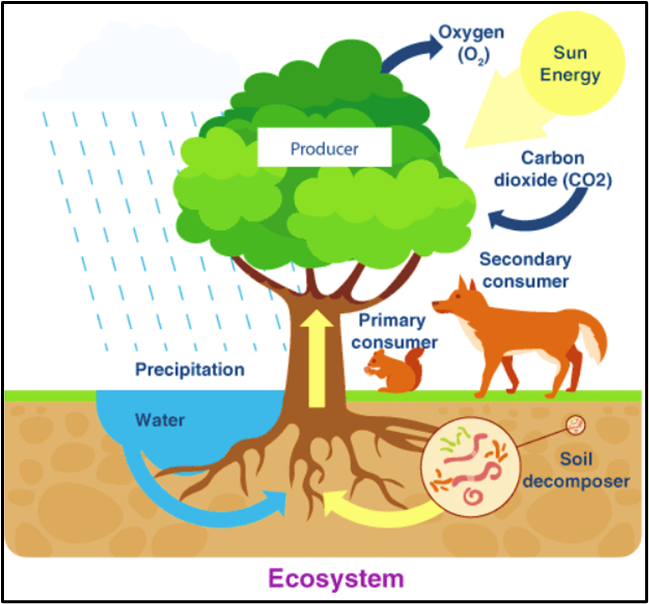
Let’s visualize it:
🌿 Producers (plants) capture sunlight → 🌾 produce food → 🐇 Consumers (animals) eat it → 🍂 Decomposers (fungi, bacteria) break down waste → return nutrients to soil → plants reuse them.
That’s the beautiful cycle of life — the ecosystem in action.
Key Features
- An ecosystem can be of any size — as small as an aquarium or as vast as a forest.
- It includes both biotic and abiotic components linked by nutrient cycles (like carbon or nitrogen) and energy flow (from sun to plants to animals).
- Every part is interdependent.
So if one component is damaged (say, deforestation), the entire system gets affected — less rainfall, soil erosion, species loss, etc.
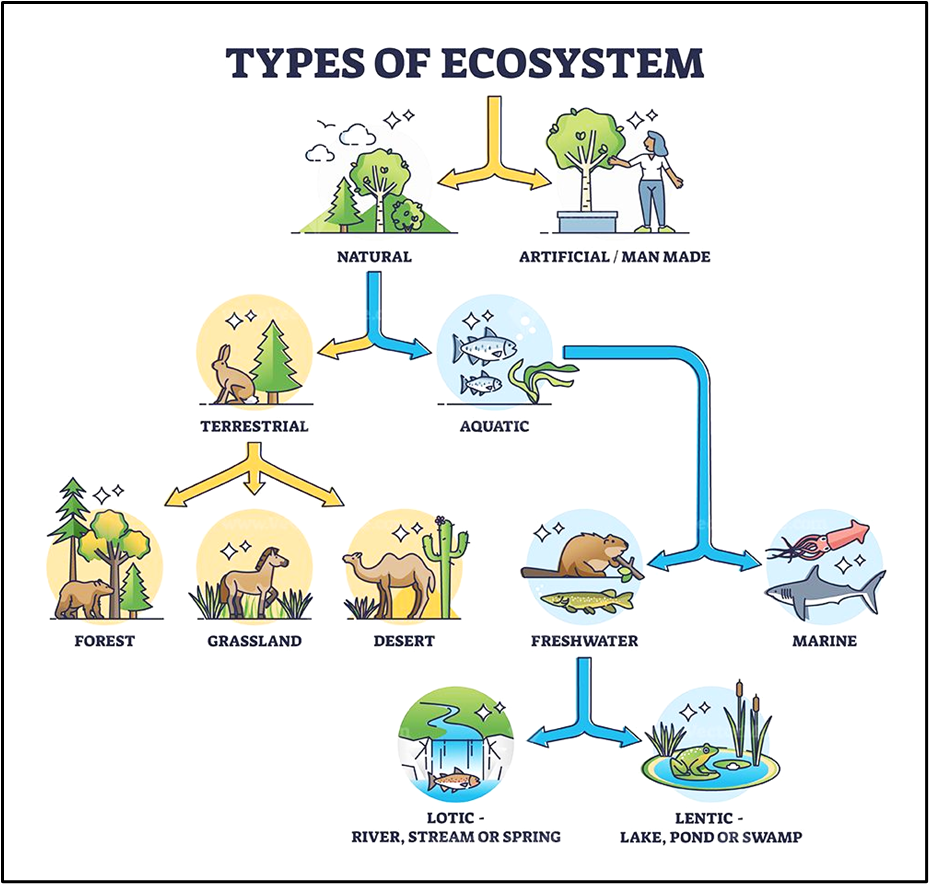
🧭 Classification of Ecosystems
Ecosystems are broadly classified into:
1. Terrestrial Ecosystems
→ Found on land.
Examples: Forests, Grasslands, Deserts, Tundra.
2. Aquatic Ecosystems
→ Found in water.
Examples: Ponds, Lakes, Wetlands, Rivers, Estuaries, Oceans.
There are also Human-made Ecosystems — like crop fields and aquariums, where humans manage the interactions.
🌿 Functions of an Ecosystem
An ecosystem is never static — it’s a living, breathing system performing key functions to sustain life:
- Ecological Succession – the natural process of ecosystem growth and transformation over time.
- Homeostasis – the self-regulating ability of nature to maintain balance through feedback mechanisms.
- Energy Flow – the transfer of energy from the Sun → producers → consumers → decomposers.
- Nutrient Cycling – the continuous recycling of vital elements like carbon, nitrogen, and water through biogeochemical cycles.
We will discuss these in details in the upcoming chapters.
🌏 Ecosystem vs Environment vs Ecology
This is where students often get confused — so let’s make it crystal clear:
| Concept | Meaning | Key Idea |
|---|---|---|
| Ecosystem | Functional unit of nature where biotic & abiotic components interact | Has life; smaller & specific |
| Environment | Total surroundings (biotic + abiotic) | May or may not have life; broader |
| Ecology | Science of relationships between organisms and their environment | The study part |
🧩 So, think of it this way:
Environment is the whole picture,
Ecosystem is one working part of that picture,
and Ecology is the study of how everything fits together.
✅ In summary:
- Environment = All surroundings, living + non-living.
- Habitat = Specific place where an organism lives.
- Ecosystem = Functional unit where life and environment interact.
- Ecology = The scientific study of these interactions.
This topic is part of the complete Environment Notes for UPSC. Explore the full subject coverage here.