
Conurbations and Metropolitan Regions
Imagine this: there’s a city that is rapidly growing. Population is rising. Industries are expanding. Infrastructure—especially transport—is developing fast. And in the process, the physical boundaries of this city begin to stretch outward, eventually touching and merging with the boundaries of nearby towns or cities. This is not a sudden change—it happens slowly and gradually, almost like ink spreading on blotting paper. This process is what gives rise to what we call a Conurbation.
What is a Conurbation?
Let’s first break down the term:
- The word Conurbation is formed by combining ‘continuous’ and ‘urban area’.
- It was first coined by Patrick Geddes in 1915, a prominent urban planner and biologist.
- He used it to describe a continuous urban area that includes two or more urban centres, each possibly retaining its own territorial identity, but functionally and physically connected.
So, in essence:
Conurbation is a geographical region that emerges when multiple cities or urban centres expand and merge due to urbanisation and regional development.
Now, let’s move deeper and understand how a conurbation differs from a regular city or metropolitan region.
How is a Conurbation Formed?
There are three driving forces behind the formation of a conurbation:
- Population Growth – As more people move into urban areas, the demand for space and services increases, pushing city boundaries outward.
- Industrial Development – Factories and economic zones often sprout on the periphery, drawing labour and infrastructure along with them.
- Technological Advancements – Especially in transportation and communication, which link far-flung urban areas more efficiently, knitting them into a single spatial unit.
Thus, urban sprawl (the outward expansion of cities) eventually leads to the coalescence (joining together) of nearby urban centres.
Characteristics of a Conurbation
Let’s now logically examine the key features that help identify a conurbation:
1. High Population Density
A conurbation typically has a much higher population than any of the nearby towns. This high density is due to the combined urban mass of all the coalesced cities.
2. Diverse Industrial Activities
Within a conurbation, you’ll find a variety of industries—textiles, chemicals, technology, etc. These industries depend on:
- A large pool of labour (thanks to the dense population),
- Excellent transportation infrastructure (for both raw materials and finished goods),
- And the urban ecosystem that facilitates business and commerce.
3. Transport as a Lifeline
Thanks to cheap and efficient transport facilities, conurbations often act as shopping and service hubs for the surrounding hinterland—rural or semi-urban areas that depend on them for goods, markets, and employment.
4. Financial Individuality
Even though the conurbation is a single functional region, its constituent urban units might maintain separate financial identities—like different municipal corporations, revenue structures, and administrative frameworks. However, the degree of this individuality may vary from one conurbation to another.
🌐 A Simple Analogy
Think of a conurbation like a cluster of grapes:
- Each grape (city) is distinct,
- But all are connected through the stem (transport, economy, population flow),
- Together, they form one composite urban entity.
Distinction Between Conurbations and Metropolitan Regions
In Settlement Geography, it’s very important to understand not just the definitions but also the subtle distinctions between related terms. Two such closely linked yet fundamentally different concepts are:
Conurbation vs. Metropolitan Region
At first glance, both involve urban expansion, multiple cities or towns, and complex transport and planning systems. But the logic behind their formation, structure, and purpose is quite different.
Let’s understand:
1. Basis of Formation
✅ Conurbation:
A conurbation is formed when two or more previously separate urban settlements gradually expand and merge into one continuous urban stretch.
This often happens along major transportation routes—like highways, railways, or coastlines.
📍 Example:
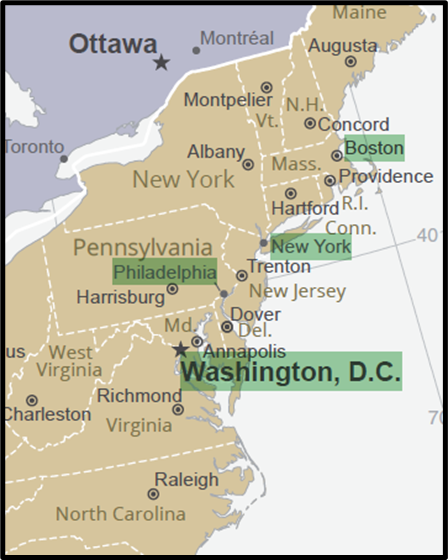
BOS-WASH Conurbation (USA) – A mega-urban corridor stretching from Boston through New York, Philadelphia, Baltimore, and all the way to Washington D.C.
This is a classic conurbation where cities have expanded outward and physically coalesced.
✅ Metropolitan Region:
A metropolitan region, on the other hand, is a region centred around a single major city (called a metropolis)—like the nucleus of a cell.
It’s more of a functional and planning concept, designed to manage urban expansion, transportation, housing, and infrastructure development around that city.
📍 Example:
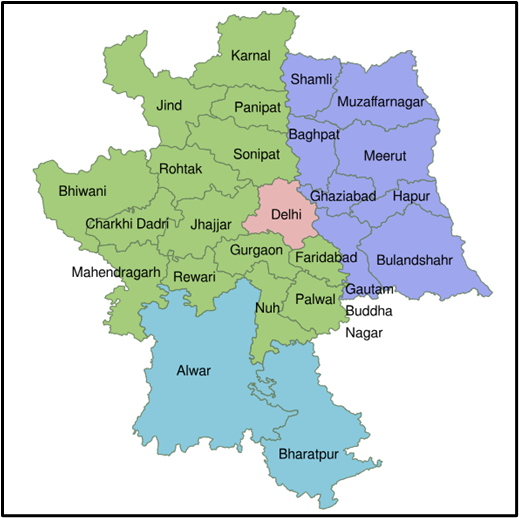
National Capital Region (NCR) in India, with Delhi at the centre, and Gurgaon, Noida, Ghaziabad, Faridabad, etc., as surrounding urban nodes.
2. Composition of the Region
✅ Conurbation:
Conurbations are typically made up of multiple large cities or metropolises that have expanded into each other.
- There is no rural landscape in between.
- The urban fabric is continuous and dense—city flows into city without any significant countryside in between.
✅ Metropolitan Region:
Metropolitan regions are much more heterogeneous. They can include:
- Satellite towns (e.g., Greater Noida),
- Suburbs (e.g., Rohini or Dwarka in Delhi),
- Even villages, agricultural fields, and semi-urban patches.
The city and the countryside coexist within the metropolitan region.
3. Identity and Purpose
✅ Conurbation:
In a conurbation:
- Each city or urban unit maintains its administrative and cultural identity,
- But the labour market is integrated.
- People live in one city and commute to another for work—this is called commuter interdependence.
✅ Metropolitan Region:
A metropolitan region is largely a planning and governance strategy.
Its main goals are:
- To manage urban sprawl,
- Control in-migration into the central city,
- And promote balanced development by creating jobs and infrastructure in peripheral areas.
It is more of an urban planning response than an organic geographical formation.
🎓 Conclusion
So, while both conurbations and metropolitan regions deal with urban expansion, their genesis, structure, and purpose are very different.
- Conurbation = organic merging of cities, driven by population and infrastructure growth
- Metropolitan region = planned integration of urban and semi-urban spaces to ensure balanced development
Understanding this difference is crucial for writing high-quality answers in Geography Optional and also for framing real-world urban policy insights in the UPSC Mains.
Emerging Conurbations in India: The Urban Future in the Making
Now that we clearly understand what a conurbation is and how it differs from a metropolitan region, let’s shift our focus to India.
You might ask— “Do we have any conurbations in India?”
The answer is: not yet fully, but we are on the verge of seeing emerging conurbations, driven by rapid urbanisation, population growth, and infrastructural connectivity.
Let’s explore what this means in the Indian context.
🚧 India: Conurbations in the Making
Technically, India does not yet have any fully developed conurbation in the way we see in the USA or Western Europe. But there are regions showing clear signs of growing into conurbations due to the spatial expansion and economic integration of multiple urban centres.
✅ Examples of Emerging Conurbation Corridors:
- Agra to Chandigarh Corridor
A continuous urban belt is taking shape from:
Agra → Mathura → Faridabad → Gurgaon → Delhi → Sonipat → Panipat → Ambala → Chandigarh
- This corridor follows NH-44 (formerly NH-1), a major North-South transportation axis.
- The proximity of cities, improved highways, metro networks, and a growing economy are knitting them into a potential conurbation.
- Mumbai to Ahmedabad Corridor
Another high-potential urban stretch is developing from:
Mumbai → Valsad → Surat → Vadodara → Anand → Ahmedabad
With an extension towards Pune on the southern side.
- This belt is supported by industrial hubs, SEZs, port cities, and the upcoming Mumbai–Ahmedabad bullet train corridor.
- Cities are gradually coalescing along highways and industrial zones, showing classic signs of a nascent conurbation.
📍 Contrasting with Metropolitan Regions
While these emerging corridors point to future conurbations, let’s not forget:
- A metropolitan region like Delhi NCR still revolves around a central metropolis, whereas
- A conurbation involves multiple major cities, often of comparable size, merging spatially and economically.
So, while NCR is a planned administrative region, Agra to Chandigarh or Mumbai to Ahmedabad are examples of natural urban expansion—the hallmark of a conurbation.
⚠️ Problems with Emerging Conurbations in India
Now, here’s where the Indian scenario gets more alarming than inspiring.
Our conurbations are developing, yes—but in a largely unplanned and unsustainable manner.
❌ Key Challenges:
- Inadequate Infrastructure
- Roads, sewage, electricity, public transport—none are expanding at the pace of population.
- Lack of Affordable Housing
- As rural migrants arrive for jobs, they find no proper housing, leading to:
- Slums,
- Squatter settlements,
- And overburdened urban services.
- As rural migrants arrive for jobs, they find no proper housing, leading to:
- Rise of Slums
- A staggering 49% of India’s urban population now lives in slum areas as of 2020 as per world Bank data .
- These areas suffer from:
- Poor sanitation,
- Inadequate clean water,
- High crime rates,
- And almost zero civic dignity.
🔍 This clearly shows that India’s conurbations are not comparable to those in the developed world, where urban planning ensures a high quality of life and systematic development.
✅ The Silver Lining: Economic Opportunities
Despite the problems, emerging conurbations do offer some benefits:
- They create employment opportunities for people migrating from rural areas.
- Commuter culture is growing—workers live in peripheral towns but travel to cities for jobs.
- This can reduce pressure on core urban centres if managed properly.
🧭 The Way Forward: Planning is the Key
India is at a critical juncture—either:
- We allow unregulated urban growth, or
- We intervene with planning, foresight, and infrastructure investment.
So, it becomes imperative for the government to:
- Develop affordable housing,
- Expand urban infrastructure,
- Promote smart city models,
- And ensure a decent quality of life in these urban corridors.