
Mackinder’s Heartland Theory
Let’s begin by asking a simple question:
In international politics, who holds power — those who control the seas or those who control the land?
This question lies at the heart of Halford Mackinder’s famous Heartland Theory, one of the foundational theories in Geopolitics, proposed in 1904.
🧠 Basic Premise of Mackinder’s Theory
Mackinder viewed world history as a constant power struggle between two forces:
- Sea powers (like Britain and later the US)
- Land powers (like Russia or Central Asian empires)
And he believed that eventually, it would be the land powers who would dominate.
His conclusion was based not on politics or military power alone — but on a deep observation of the physical map of the world.
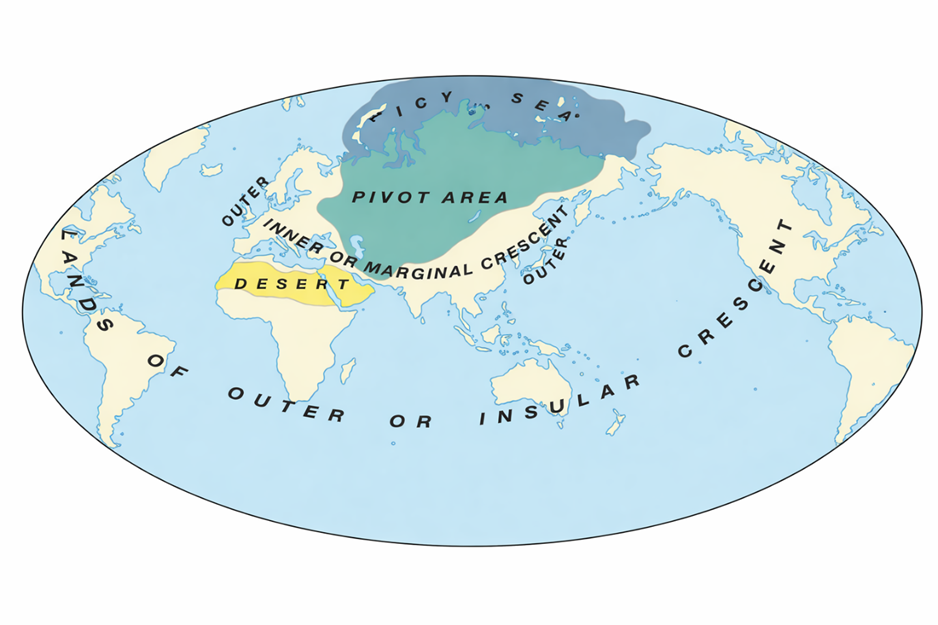
🗺️ The Threefold Division of the World
Mackinder divided the landmass of the world into three concentric zones:
1️⃣ The Heartland (also called the Pivot Area)
- Location: The central part of the Eurasian landmass — present-day parts of Russia, Central Asia, and Eastern Europe.
- Surrounded by:
- High mountains in the south (e.g., Himalayas)
- Arctic Ocean in the north
- Ice and poor navigability which make it inaccessible from sea.
- Mackinder believed this was a strategically secure zone — hard to invade by sea powers.
- However, it was vulnerable from Eastern Europe, particularly through the Steppe region.
This Heartland is the core of global geopolitical power, according to Mackinder.
2️⃣ The Inner or Marginal Crescent
- This forms a crescent-shaped belt around the Heartland.
- It includes Europe (excluding Eastern Europe), South Asia, China, the Middle East, and other coastal areas of Eurasia.
- These areas have access to the seas, and rivers drain into navigable waters — hence they became the bases of maritime empires.
- These regions were considered powerful but vulnerable, depending on the strength of the Heartland.
3️⃣ The Outer or Insular Crescent
- This is the third zone, including North and South America, Australia, Japan, and the British Isles.
- These are isolated continental masses, mostly strong sea powers with high maritime capabilities.
- Though geographically distant from the Heartland, they can project naval power.
🧩 The Core Logic of Mackinder’s Theory
Mackinder summed up his strategic thinking in a now-famous three-tiered formula:
- Whoever rules Eastern Europe, commands the Heartland
- Whoever rules the Heartland, commands the World Island
- Whoever rules the World Island, commands the World
Let’s decode this:
- Eastern Europe is the gateway to the Heartland.
- The World Island includes Europe, Asia, and Africa — the largest and most populous landmass.
- If one power can dominate the Heartland, they could eventually control the World Island and, therefore, dominate the entire globe.
📝 This was a time when land-based empires (like Russia) were rising, and Britain’s global naval dominance was being challenged.
🛠️ Modification in 1919: The Strategic Heartland Redefined
After World War I, Mackinder revised his theory in 1919, expanding the definition of the Heartland:
- He now included regions like:
- Baltic Sea
- Middle and lower Danube
- Black Sea
- Asia Minor
- Persia
- Tibet and Mongolia
Earlier, his World Island was limited to Europe, Asia, and North Africa.
But now, it included the entire continent of Africa — recognizing Africa’s strategic and resource potential.
This made his theory more comprehensive and adaptive to changing geopolitical realities.
📌 Relevance and Criticism
- Mackinder’s theory influenced Western strategic thinking, especially during the World Wars and Cold War.
- However, with the rise of air power, missile technology, and naval dominance, some critics argue that land control alone is no longer sufficient for global power.
Yet, even today, control over Central Asia, Eastern Europe, and surrounding regions remains central to global geopolitics — proving that Mackinder’s insights were remarkably prescient.
🧭 Conclusion: Why It Matters
Mackinder’s Heartland Theory teaches us that geography is not just about maps — it shapes global power.
- By identifying the Heartland as the most secure and powerful landmass,
- Dividing the world into zones of influence, and
- Showing the strategic importance of Eastern Europe, he gave us a geopolitical lens through which we can understand many of the world’s conflicts and power rivalries — even today.