
Introduction to Art and Culture
Art and Culture are not separate compartments of human life; they grow together and enrich each other.
Culture represents the collective way of life of a society—its shared values, beliefs, attitudes, traditions, goals, and practices.
Art, on the other hand, is one of the most refined expressions of that culture. Through art, a society gives visible and audible form to its ideas, emotions, and worldview.
In simple terms, culture is the soil, and art is the flower that blooms from it. When culture evolves, art also transforms—new forms emerge, old forms adapt, and traditions find new meanings.
Art
Definition of Art
Art can be understood as the creative use of skill and imagination to produce something that is beautiful, meaningful, or thought-provoking. It is not limited to beauty alone; art can also question, disturb, inspire, or awaken thought.
In more precise terms, art is:
“The use of skill and imagination in creating aesthetic objects, environments, or experiences that can be shared with others.”
Indian Perspective on Art
Indian tradition offers a very expansive view of art. It recognises 64 kinds of arts, reflecting the civilisational depth of India. Among these:
- Lalit Kala (Fine Arts): Music, Dance, Theatre, Painting, Architecture (including Sculpture)
- Kushala Kala / Hasta Kala: Crafts and decorative arts
This classification shows that Indian culture never drew a rigid line between “high art” and “useful art”; both were seen as essential for a complete life.
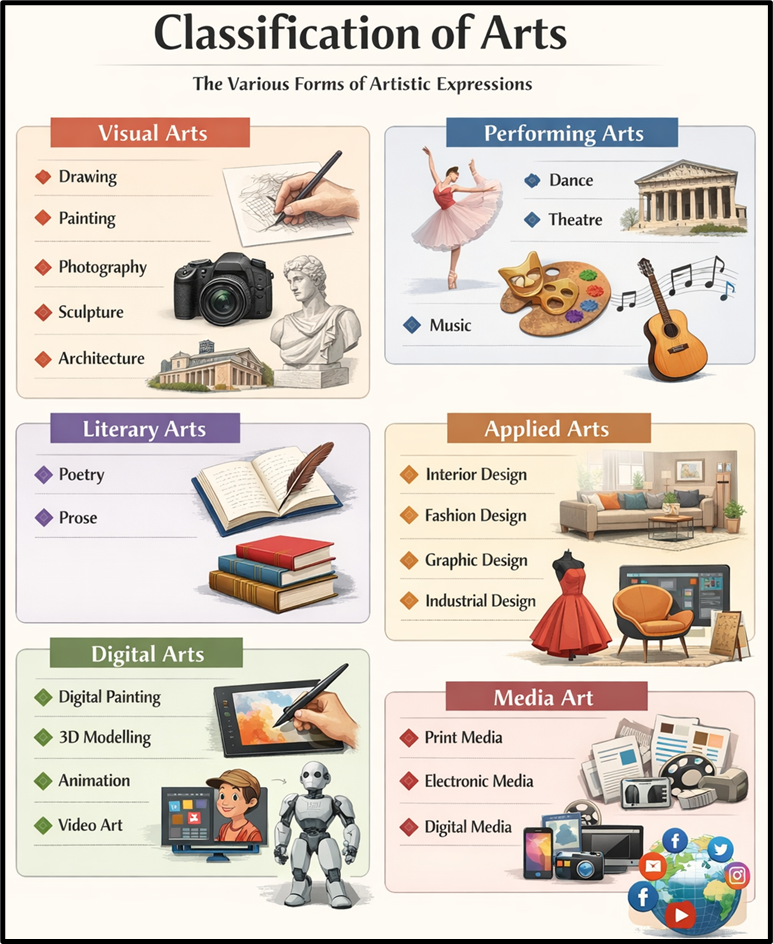
Classification of Arts
To understand art systematically, it is classified based on mode of expression, sensory engagement, and purpose.
1. Visual Arts
Visual arts communicate ideas and emotions primarily through visual perception. The eye becomes the main medium of understanding.
Major Forms of Visual Arts
- Drawing
The most basic visual art form. It involves marking surfaces—usually paper—using tools like pencils, pens, or charcoal. Drawing often forms the foundation of other visual arts. - Painting
Painting uses pigments applied to surfaces such as canvas or paper. Different techniques give rise to forms like oil painting, watercolour, and acrylic painting. Painting allows both realism and imagination to coexist. - Photography
Photography captures reality through a camera but interprets it through the artist’s vision. It can be documentary, commercial, or purely artistic—such as portrait, landscape, or abstract photography. - Sculpture
Sculpture creates three-dimensional forms using materials like stone, clay, metal, or wood. It brings art into physical space and allows interaction from multiple angles. - Architecture
Architecture is a unique blend of functionality and aesthetics. While buildings must serve practical needs, they also express cultural values, technological progress, and artistic vision.
2. Performing Arts
Performing arts are live art forms. They unfold in time and space, directly connecting the artist with the audience.
Major Forms of Performing Arts
- Dance
Dance uses rhythmic body movements, often set to music, to express emotions, ideas, or stories. It includes classical, folk, tribal, and contemporary forms. - Theatre
Theatre narrates stories through dialogue, acting, and movement. Plays and dramas aim not only to entertain but also to provoke thought and reflect social realities. - Music
Music is the organised creation of sound using voice or instruments. It is often described as the mother of all arts and the direct language of the soul, because it can evoke emotions beyond words—joy, sorrow, devotion, or peace.
3. Literary Arts
Literary arts rely on language as their primary medium. They express human thought and emotion through words.
Major Forms of Literary Arts
- Poetry
Poetry uses rhythm, imagery, and symbolism to convey deep meanings in a condensed form. It appeals strongly to emotion and imagination. - Prose
Prose is straightforward writing used in novels, essays, and short stories. Unlike poetry, it lacks rhythmic or metrical structure but allows detailed and logical expression.
4. Applied Arts
Applied arts focus on beautifying everyday life. They combine utility with aesthetics, proving that functionality need not be dull.
Major Forms of Applied Arts
- Interior Design
Designing indoor spaces to be functional, comfortable, and visually pleasing. - Fashion Design
The creation of clothing and accessories that merge style with practicality. Fashion often reflects social trends and individual identity. - Graphic Design
Visual communication using images, typography, and layout—commonly seen in advertising, branding, and digital platforms. - Industrial Design
Designing mass-produced products with attention to aesthetics, functionality, and ergonomics, such as furniture, electronics, and household goods.
5. Digital Arts
With technological advancement, digital art has emerged as a powerful modern form of expression. Technology becomes both the tool and the medium.
Major Forms of Digital Arts
- Digital Painting
Artists use software to recreate traditional painting techniques on digital devices. - 3D Modelling
Creation of three-dimensional digital objects and environments, widely used in animation and video games. - Video Art
Artistic manipulation of video footage to convey concepts, often experimental in nature. - Animation
The creation of moving images through sequences of drawings or models, used in films, television, and online media. - Decorative Art
The artistic beautification of spaces—homes, temples, and public buildings. It emphasises taste, balance, and restraint, not excessive decoration.
6. Media Art
Media art is the most accessible and far-reaching form of art. It communicates ideas to large audiences across regions and countries, hence known as Mass Media.
Types of Media Art
- Print Media
Newspapers, magazines, books, billboards, and illustrations. - Electronic Media
Cinema, television, and radio—audio-visual forms with strong emotional impact. - Digital Media
Computers, the internet, and social media platforms, representing the most dynamic and rapidly evolving form of artistic communication.
Principles of Art
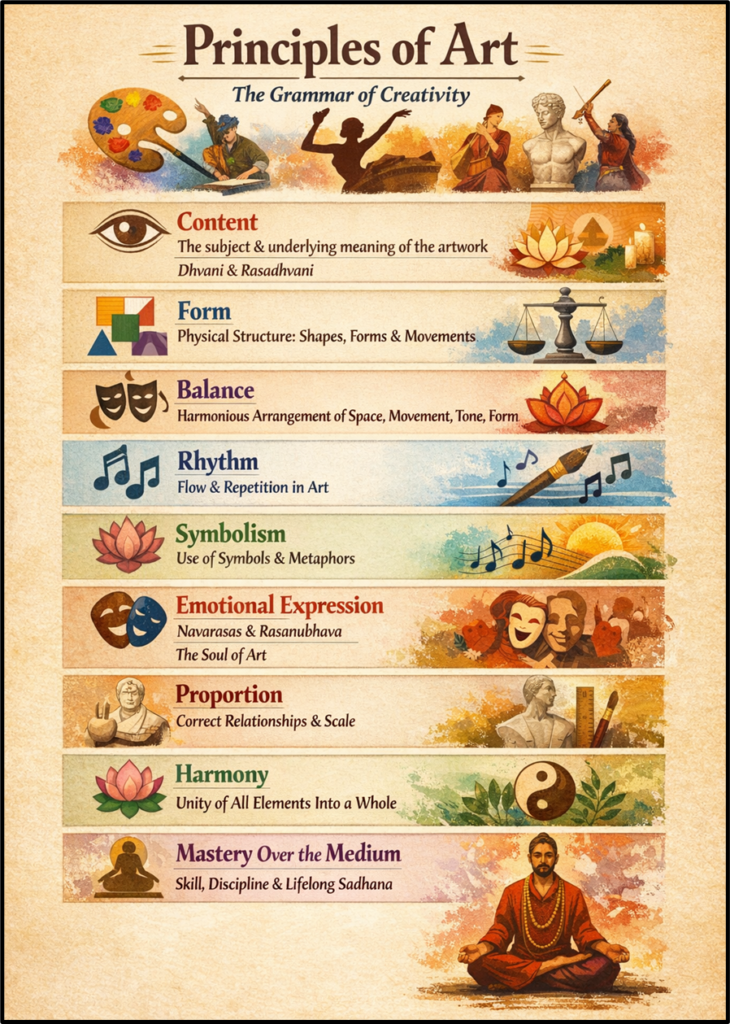
When we look at any great artwork—be it a painting, a sculpture, a musical composition, or a dance performance—it may appear effortless. But in reality, every art form is governed by certain fundamental principles. These principles act like the grammar of art: they give structure, depth, and meaning to creative expression.
Let us unfold these principles:
Core Principles of Art
Art is not random creativity. It rests on carefully balanced elements such as content, form, balance, rhythm, symbolism, emotional expression, proportion, harmony, and mastery over the medium.
1. Content
Content refers to the subject matter, theme, or idea of an artwork. It answers the question: What is the artist trying to say?
In Indian aesthetics, content is not limited to what is seen or heard. Two deeper layers are emphasised:
- Dhvani – the inner or suggested meaning of the artwork
- Rasadhvani – the emotional meaning that the artwork evokes in the audience
Thus, an artwork is considered complete only when it communicates both intellectual meaning and emotional depth.
2. Form
Form is the physical or structural shape an artwork takes.
- In painting or geometry, form may appear as squares, circles, triangles, or compositions on a canvas.
- In sculpture, form exists in three dimensions.
- In dance, form is created through bodily movements, postures, and gestures.
Form gives visibility and structure to the artist’s idea.
3. Balance
Balance refers to the harmonious arrangement of elements within an artwork.
Every art form must balance → Space, Movement, Tone, Form
For example, a painting balances empty space and filled space, while a dance balances movement and stillness. This balance creates compositional stability and prevents the artwork from appearing chaotic.
4. Rhythm
Rhythm is often associated with music, but it is present in all art forms.
- In music, rhythm is obvious through beats and tempo.
- In dance, it appears through repeated movements.
- In poetry, rhythm is felt through words.
- In painting, rhythm emerges through brush strokes and repeated patterns.
Rhythm gives art a sense of flow and continuity.
5. Symbolism
Art rarely communicates only in literal terms. It relies heavily on symbols.
Examples:
- Colours like white or blue symbolise peace
- Ragas such as Bhupali in Hindustani music symbolise early morning and sunrise
- A single tree on stage may symbolise openness or nature
Symbols help convey complex ideas and emotions in a condensed form.
6. Emotional Expression
Emotion is the soul of art. Without emotion, art becomes mechanical.
Indian aesthetic theory places special emphasis on:
- Navarasas – the nine emotional states
- These rasas guide creative expression and shape the audience’s response
The experience generated in the viewer or listener is called Rasanubhava—the aesthetic or emotional experience derived from art.
7. Proportion
Proportion gives structure and discipline to art by defining relationships between elements.
- In music, it determines voice range and harmony between instruments
- In dance, it governs the relationship between time, space, and movement
- In painting, it controls the relationship between lines, figures, and canvas size
Correct proportion ensures visual and experiential balance.
8. Harmony
Harmony is the coordination of all principles—content, form, rhythm, emotion, proportion—into a unified whole.
When harmony is achieved, the artwork feels complete, coherent, and pleasing.
9. Mastery over the Medium
Art demands continuous practice and discipline.
In Indian tradition, art is considered Sadhana—a lifelong spiritual and creative pursuit.
Through training, repetition, and dedication, the artist gains mastery over the chosen medium and gradually moves toward excellence and inner refinement.
Refinement of Art: Classical and Folk Traditions
Indian thinkers made a clear distinction between refined and natural forms of art.
Classical Art
- Known as Samskruti, Margi, or Shastriya
- Characterised by:
- Formal, restrained expression
- Rule-bound systems based on prescribed texts
- Learning through Guru–Shishya Parampara
- Emphasis on discipline, values, and perfection
The ultimate goal of classical art is perfection of expression.
Folk Art
- Known as Prakriti or Desi
- Created by ordinary people
- Rooted in:
- Community welfare (Lokamangala)
- Local materials and simple techniques
- Daily life and seasonal festivals
Folk art is spontaneous, functional, and community-oriented.
Tribal Art
Tribal art is closely related to folk art but reflects the distinct lifestyle, beliefs, and environment of tribal communities.
Purpose and Role of Art
Purpose of Art
Art is not created merely for display; it serves multiple purposes in human life and society.
1. Informative
Art communicates information—for example → Illustrations in books, Advertisements, Maps and signposts
2. Communicative
Art transmits ideas and values.
The Taj Mahal, for instance, communicates the idea of eternal love without using words.
3. Livelihood and Profession
Historically, artists were patronised by kings and nobles. Even today, art serves as a source of livelihood and professional identity.
4. Social Function
Art reflects society and also unites people.
A music or dance performance creates collective joy and shared experience.
5. Relaxation and Entertainment
Art refreshes the human mind—through cinema, music, dance, or even video games—providing emotional release and mental relaxation.
Role of Art in Human Life
Art plays a profound role in shaping individuals and society:
- Develops personality and self-confidence
- Elevates the human soul and creates inner peace
- Cultivates balance, self-restraint, and compassion
- Helps individuals adapt to life’s challenges
- Removes negativity, as love and care are the core essence of all art forms
So, Remember:
Art is not an ornament of civilisation; it is its inner strength.
By refining emotions, disciplining the mind, and connecting individuals with society, art transforms humans into better, more sensitive beings—which is why every great civilisation has always placed art at its centre.
Culture
After understanding art as a refined expression of human creativity, we now turn to culture, which forms the larger framework within which art, beliefs, customs, and institutions develop. If art is the visible expression, culture is the invisible force that shapes how people think, behave, and live together.
Definition of Culture
The word culture comes from the Latin term “cultura”, meaning to cultivate. This origin itself is deeply symbolic—it suggests that culture is something nurtured, refined, and developed over time, just like a field or a human mind.
In social sciences, culture refers to a shared system of learned behaviours, values, beliefs, symbols, and practices that define a group of people. It includes → Arts, Religion, Customs, Social institutions, Ways of living
All these are transmitted from one generation to the next, ensuring continuity.
Thus, culture may be understood as a human-made environment, consisting of:
- Material culture – tangible objects like dress, food, tools, houses, and household goods
- Non-material culture – ideas, beliefs, values, morals, traditions, and worldviews
Thinkers on Culture
- Cicero, the ancient Roman scholar, viewed culture as “the cultivation of the soul” and the highest ideal of human development.
- Samuel Pufendorf, a modern thinker, described culture as “all the ways by which human beings overcome their original barbarism to become fully human.”
Together, these views show that culture is not merely lifestyle—it is a process of refinement and humanisation.
Indian Concept: Samskriti
In Indian thought, culture is expressed through the Sanskrit term “Samskriti”, derived from the root “Kri” (to do).
Three related concepts are important:
- Prakriti – raw or natural condition
- Samskriti – refined or cultivated condition
- Vikriti – decayed or distorted condition
This framework beautifully conveys that culture is refinement, achieved through conscious effort. When refinement is lost, decay follows.
Key Characteristics of Culture
Culture has certain universal features that help us understand its nature.
1. Learned Behaviour
Culture is not inherited biologically. It is learned through → Family, Education, Peer groups, Media
This learning ensures intergenerational continuity.
2. Symbolic Nature
Culture works through symbols—objects or signs that carry shared meanings.
Examples include → National flags, Religious icons, Traditional attire
These symbols evoke collective identity and emotional attachment.
3. Shared and Collective
Culture is inherently social. It binds individuals into communities by providing common values, norms, and practices.
4. Dynamic and Adaptive
Culture is not static. It evolves with → Technological change, Globalisation, Migration, Social movements
Thus, culture continuously adapts to new realities.
5. Integrated and Holistic
Culture functions as a system. Economic practices, religion, family, and law are interconnected.
A change in one aspect inevitably influences others.
6. Normative and Prescriptive
Culture lays down norms and guidelines for behaviour—what is acceptable and what is not. These norms influence dress, food habits, social conduct, and interpersonal relations.
7. Diverse and Unique
Every culture is distinct, shaped by its geography, history, and social experience. This diversity reflects the richness of human civilisation.
8. Transmitted Through Symbols and Language
Language is the primary carrier of culture. Along with language, art, music, dance, and rituals transmit cultural meaning across generations.
Culture and Civilisation: A Conceptual Distinction
Culture and civilisation are closely related, yet not identical.
Culture
- Refers to beliefs, customs, art, language, and traditions
- Represents the way of life and value system of a group
Civilisation
- Refers to advanced social organisation
- Includes governance, education, writing systems, technology, and standards of measurement
Key Difference
- Culture focuses on values and practices
- Civilisation focuses on institutional and technological development
Both together shape human progress and collective identity.
Role of Geography in Indian Culture
India’s cultural diversity cannot be understood without geography. The vast size of the subcontinent, combined with varied landforms and climates, has created a cultural mosaic unmatched in the world.
Topographical Diversity and Cultural Development
Himalayas
- Acted as a natural barrier, offering protection from invasions
- Encouraged spiritual traditions and philosophies
- Home to pilgrimage centres like Badrinath and Kedarnath
Indo-Gangetic Plains
- Cradle of ancient civilisations such as the Indus Valley and Vedic civilisation
- Fertile soil enabled agriculture, urbanisation, and complex social systems
Thar Desert
- Harsh climate shaped Rajasthan’s culture
- Gave rise to unique folk music, dances like Kalbelia, and climate-adapted architecture
Deccan Plateau
- Relative isolation fostered Dravidian languages, literature, and classical dance traditions
- Rich mineral resources supported prosperous kingdoms
Coastal Regions
- Centres of maritime trade and cultural exchange
- Contact with Romans, Arabs, and Chinese
- Entry points of foreign religions like Judaism, Christianity, and Islam
- Resulted in cosmopolitan cultures, diverse cuisines, and architectural styles
Mountain Passes
- Passes such as the Khyber facilitated movement of traders and invaders
- Introduced Persian, Greek, and Central Asian influences into Indian art, architecture, and language
Climate and Culture
- Monsoon-dependent regions shaped crop patterns and harvest festivals like Pongal and Makar Sankranti
- Arid regions like Rajasthan and Gujarat developed food habits based on millet, bajra, and legumes
Water Bodies and Cultural Life
Rivers in India are not merely physical resources; they are cultural and spiritual lifelines.
- The Ganga is sacred in Hinduism and central to rituals and pilgrimages
- Rivers like Yamuna, Godavari, Narmada, Brahmaputra, and Kaveri shape regional traditions and beliefs
Trade Routes and Cultural Exchange
India’s links to the Silk Road and other trade routes enabled the exchange of → Goods, Ideas, Art, religion, and philosophy
These interactions enriched Indian culture while also allowing Indian ideas to spread beyond its borders.
Remember:
Culture is not inherited—it is cultivated.
It evolves through history, geography, interaction, and human creativity. In the Indian context, culture reflects a deep synthesis of diversity and continuity, where geography, climate, belief systems, and social life come together to create one of the world’s richest civilisational traditions.
India’s Contribution to World Civilization
India’s civilisation is not inward-looking; it has always shared knowledge, ideas, and values with the world. Over thousands of years, Indian thought has travelled across continents—sometimes through trade and travel, sometimes through scholars and monks, and sometimes through quiet cultural influence. Let us understand these contributions:
1. Spiritual and Philosophical Thought
India has been one of the earliest global centres of spiritual inquiry.
- Hinduism, Buddhism, and Jainism emerged from India and offered deep reflections on life, suffering, ethics, and liberation.
- Buddhism, born in India, spread to East and Southeast Asia—China, Japan, Sri Lanka, Thailand—shaping their spiritual practices, monastic traditions, and moral philosophy.
Indian philosophy emphasised self-realisation, compassion, non-violence, and harmony, values that remain globally relevant even today.
2. Literature and Language
Indian civilisation made enduring contributions through language and literary imagination.
- Sanskrit literature produced epics like the Ramayana and Mahabharata, philosophical dialogues like the Bhagavad Gita, and classical poetry and drama by Kalidasa.
- These works shaped global ideas on duty, morality, devotion, and human struggle.
In the modern period:
- Rabindranath Tagore carried Indian literary sensibility to the world. His Gitanjali earned global admiration and enriched world literature with spiritual humanism.
3. Science and Mathematics
India’s scientific contributions form the foundation of modern knowledge systems.
- The invention of zero and the decimal system revolutionised mathematics and made modern science possible.
- Aryabhata made pioneering contributions to astronomy, explaining planetary motion and calculating the value of π.
- Sushruta, through the Sushruta Samhita, laid the foundations of surgery, including techniques for plastic surgery.
India also gifted the world Ayurveda, one of the oldest holistic medical systems, now practised globally for preventive and lifestyle-based healthcare.
4. Art, Architecture, and Music
Indian aesthetics have captivated the world across centuries.
- Architectural marvels like the Brihadeshwara Temple and the Taj Mahal represent both spiritual symbolism and engineering excellence.
- Indian classical music, with instruments such as the sitar and tabla, influenced Western musicians, including The Beatles.
Modern Indian artists further globalised Indian creativity:
- Raja Ravi Varma blended Indian themes with Western techniques
- M. F. Husain brought Indian modern art to international platforms
- A. R. Rahman fused Indian classical music with global sounds, winning worldwide acclaim
5. Yoga and Meditation
Yoga is among India’s most influential global gifts.
- Originating in India, Yoga today is practised worldwide for physical health, mental balance, and emotional well-being.
- Meditation and mindfulness, rooted in Indian and Buddhist traditions, are now integral to modern psychology and wellness practices.
Global spiritual figures such as Dalai Lama have played a major role in spreading these ideas internationally.
6. Culinary Influence
Indian cuisine has become a global cultural ambassador.
- Known for its spices, diversity, and regional richness, Indian food is enjoyed worldwide.
- Dishes like dosa and chicken tikka masala are especially popular in the UK, where Indian cuisine has deeply influenced national food culture.
Cuisine reflects not just taste, but history, climate, trade, and cultural exchange.
7. Human Resource and Global Service
India’s contribution today extends beyond culture into global governance and human capital.
- Indians lead major multinational corporations, scientific institutions, and academic bodies worldwide.
- India plays a key role in United Nations peacekeeping missions across conflict zones.
- The global community has acknowledged India’s contribution in managing and supporting efforts during the Coronavirus crisis, especially through medical supplies and vaccines.
Always Remember:
India’s contribution to world civilisation is not confined to the past. It is continuous and evolving.
From spiritual wisdom to scientific knowledge, from artistic excellence to global service, India has consistently enriched humanity’s shared heritage. Its civilisational message emphasises harmony, coexistence, and holistic progress—making the world not only more knowledgeable, but also more humane.
This topic is part of the complete Art and Culture Notes for UPSC. Explore the full subject coverage here.
I’m really waiting for the arts and culture section. Thank you. In love with your notes, as they are comprehensive and easy to understand.