
Modern and Contemporary Indian Art
Introduction
Indian painting does not stop with folk, tribal, or classical traditions. With colonial contact, new ideas, techniques, and visual philosophies entered India, giving birth to Modern and Contemporary Art—the most recent phase in the long evolution of Indian painting.
At its core, Modern Art represents a conscious break from tradition, driven by experimentation. Unlike traditional Indian art, which was largely narrative and religious, modern art moves towards abstraction, symbolism, and individual expression.
Contemporary (Post-modern) Art refers to more recent artistic practices that continue this experimental spirit while responding to present-day realities.
What Makes Indian Modern Art “Modern”?
1. Shift in Artistic Language
- Movement away from storytelling and religious narration
- Emphasis on form, colour, emotion, and abstraction
- Influence of Western movements such as Impressionism, Cubism, and Expressionism
2. Timeline
- Took shape in the late 19th and early 20th centuries
- Coincided with colonial rule and exposure to European art education
3. Colonial Encounter
Under British rule, Indian artists came into contact with → European realism, Oil painting, Perspective and anatomy
This interaction produced a hybrid style—Indian themes expressed through modern techniques.
Key Pioneer of Modern Indian Art
Raja Ravi Varma (1848–1906)
Raja Ravi Varma is widely regarded as the founder of modern Indian painting.
Life and Background
- Born in Kilimanoor Palace
- Mastered Western oil painting, realism, and perspective
- Applied these techniques to Indian mythological and social themes
Artistic Contribution
- First Indian artist to:
- Use Western perspective and composition for Indian subjects
- Employ lithographic reproduction, making art accessible to the masses
- His visualisation of epic characters shaped popular imagination of the Ramayana and Mahabharata
Famous Paintings
- Shakuntala Looking for Dushyanta
- Galaxy of Musicians
- Descent of Ganga
- Jatayu Fights Ravana
- Nair Lady Adoring Her Hair
- The Maharashtrian Lady
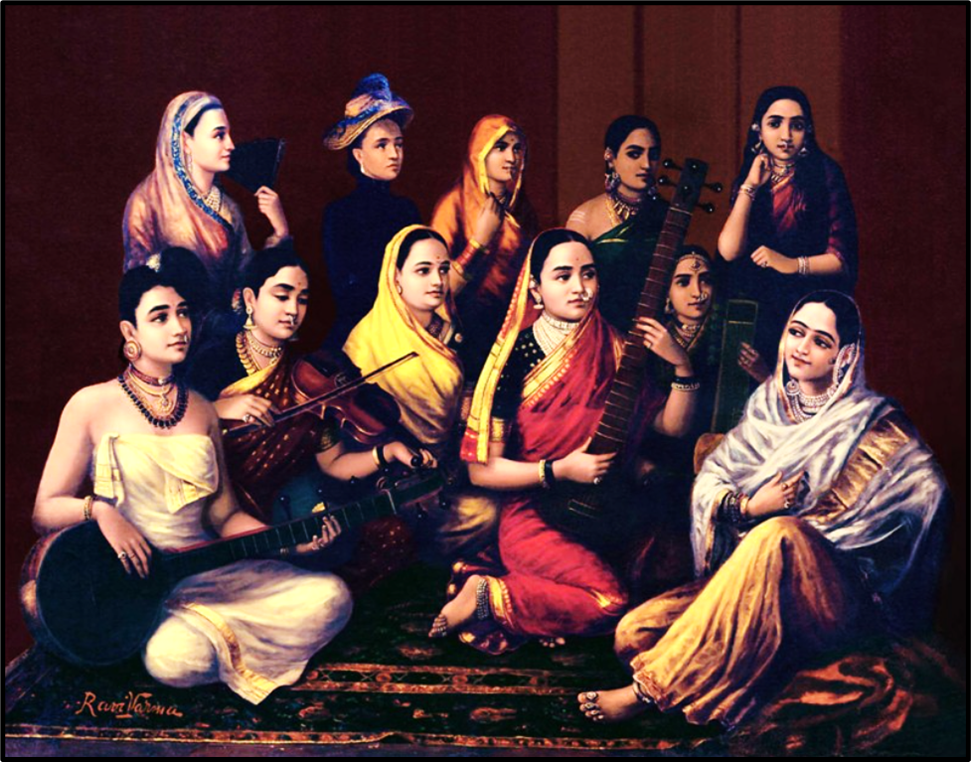
Recognition
- Won first prize at the Vienna Art Exhibition (1873)
- Conferred the title “Raja” by Lord Curzon
- Many works are housed at Laxmi Vilas Palace
👉 UPSC Insight: Raja Ravi Varma represents modern technique + Indian content.
Progressive Artists’ Group (PAG)
After Independence, Indian artists felt the need to move beyond both colonial realism and revivalist traditions.
Formation and Vision
The Progressive Artists’ Group was formed in 1947.
Key Members → M. F. Husain, F. N. Souza, S. H. Raza
Objectives
- Break away from academic realism and traditional styles
- Embrace avant-garde and experimental approaches
- Engage with global modernism while remaining rooted in Indian experience
👉 PAG marks the true modernist turn in Indian art.
Themes in Modern Indian Art
1. Tradition + Modernity
- Use of Indian myths, symbols, and folk motifs
- Addressed through modern styles and techniques
2. Independence and Identity
Post-1947 art reflects:
- Search for national identity
- Social change, political upheaval, and personal expression
- Anxiety and hope of a newly independent nation
Styles and Techniques
Diversity of Expression
Modern Indian art is not one style, but many → Abstract, Figurative, Symbolic, Surreal
Fusion of Forms
Artists often incorporate → Folk art, Tribal motifs, Miniature painting aesthetics → into modern compositions—creating a unique Indian modernism.
Nationalist Art
Colonial Context
British rulers claimed Indians lacked artistic sensibility. In response, a Nationalist Art movement emerged to assert India’s cultural depth.
Sources of Inspiration → Ajanta murals, Mughal miniatures, Pahari painting traditions
Institutional Centre → This movement evolved at Kala Bhavana, located in Shantiniketan.
Leading Artists → Nandalal Bose, Asit Kumar Haldar
Their work sought:
- Revival of Indian aesthetics
- Freedom from colonial artistic standards
- Creation of a national visual language
Bengal School of Art
The Bengal School of Art represents one of the most ideologically charged phases in the history of Indian painting. It was not merely an artistic movement—it was a cultural response to colonial domination, a conscious attempt to reclaim India’s artistic selfhood.
If Raja Ravi Varma symbolised the technical modernisation of Indian art, the Bengal School symbolised its cultural decolonisation.
Origin and Intellectual Background
The Bengal School emerged in the early 20th century in Calcutta, at a time when the Swadeshi and Nationalist movements were gaining momentum.
Founders and Early Support
- Abanindranath Tagore – founder and ideological leader
- E. B. Havell – Principal of the Calcutta School of Art, who encouraged Indian aesthetics
- Other major intellectual influences → Nandalal Bose, A. K. Coomaraswamy
The movement later flourished at Shantiniketan, where Rabindranath Tagore established Kala Bhavana as a centre for Indian art education.
Ideology and Artistic Philosophy
Rejection of Western Academic Realism
The Bengal School rejected the art of Raja Ravi Varma, criticising it as → Overly Westernised, Excessively realistic, Detached from Indian spiritual and aesthetic traditions
Revivalist and Renaissance Character
The Bengal School is often called:
- Revivalist School – for reviving Indian traditions
- Renaissance School – for reinterpreting them in a modern context
Sources of Inspiration
- Ajanta murals, Mughal miniatures, Pahari painting traditions
- Wash techniques from East Asian (especially Japanese) painting
This marked a clear move away from oil painting and realism towards line, wash, rhythm, and mood.
Integration of Folk and Tribal Traditions
A major contribution of the Bengal School was its respect for rural and tribal art.
Instead of treating folk art as inferior, Bengal School artists:
- Studied village traditions
- Incorporated folk simplicity into elite art
- Bridged the gap between urban art education and rural creativity
This approach helped preserve India’s cultural diversity while shaping a national aesthetic.
Nationalist Spirit and Swadeshi Influence
The Bengal School was deeply aligned with → Swadeshi Movement, Cultural nationalism
Its goal was to:
- Instil pride in Indian heritage
- Counter Western claims of Indian cultural inferiority
- Create art that felt emotionally Indian, not technically European
Major Artists of the Bengal School
Abanindranath Tagore
Abanindranath Tagore is the founding figure of the movement.
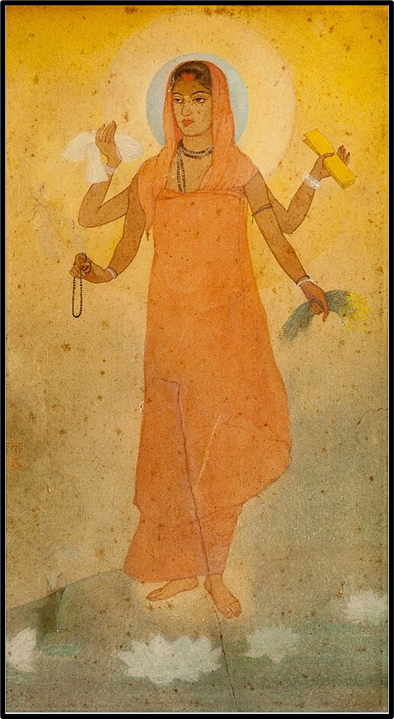
- His iconic painting “Bharat Mata” depicts India as a four-armed ascetic woman, symbolising spiritual strength, learning, and self-reliance.
- Another notable work: “My Mother”
👉 His art transformed nationalism into visual symbolism.
Gaganendranath Tagore
- Brother of Abanindranath Tagore
- Painter, cartoonist, and social critic
- Co-founded the Indian Society of Oriental Art in 1907
- Introduced satire and experimentation into nationalist art
Nandalal Bose
Nandalal Bose was Abanindranath’s most influential disciple.
- Drew inspiration from folk art and Japanese painting
- Close associate of Mahatma Gandhi
- Created a famous series of sketches on Gandhi’s Dandi March, portraying Gandhi as a humble yet resolute hero
👉 His line-based style became a symbol of Indian modernism and nationalism.
Asit Kumar Haldar
- Grandnephew of Rabindranath Tagore
- Along with Nandalal Bose, documented Ajanta cave paintings (1909–1911)
- First Indian:
- Principal of a Government Art School (Lucknow, 1925)
- Fellow of the Royal Society of Arts, London (1934)
Jamini Roy
Jamini Roy drew inspiration from Kalighat Pat traditions.
- Rejected academic realism
- Used flat forms, bold lines, and earthy colours
- Preferred to call himself a patua
- Magnum opus: “Ramayana” (17 canvases)
- Other works: Faces, Bride and Two Companions
Benode Behari Mukherjee
- Famous mural “Medieval Saints” at Shantiniketan
- Depicts lives of Tulsidas, Kabir, and other saints
- Emphasised humanism and ethical values
Ramkinkar Baij
- Celebrated nature and environment
- His art emerged as a direct response to his surroundings
- Bridged painting and sculpture in modern Indian art
Kala Bhavana: Cradle of Indian Modernism
Kala Bhavana was founded in 1919 at Visva Bharati University by Rabindranath Tagore.
Significance
- India’s first national art school
- Promoted culture-specific modernism
- Offered training in → Painting, Sculpture, Murals, Traditional and experimental forms
Its ideals were carried forward by → Nandalal Bose, Benode Behari Mukherjee, Ramkinkar Baij
Bengal School vs Nationalist Art
Let us clarify a common UPSC confusion:
- Nationalist Art → Broad cultural movement across India against colonial dominance
- Bengal School of Art → Most influential regional expression of Nationalist Art
👉 Not all nationalist art belonged to the Bengal School.
For example:
- The Progressive Artists’ Group was nationalist in spirit but not Bengal School in style.
Progressive Artists’ Group (PAG)
With India’s Independence in 1947, a new question confronted Indian artists:
How should a free nation express itself visually?
The answer came through the Progressive Artists’ Group, which became the most powerful voice of modern Indian art after Independence.
Formation and Members
The Progressive Artists’ Group was formed in Bombay in 1947 under the leadership of F. N. Souza.
Key members included → S. H. Raza, M. F. Husain, K. M. Ara, S. K. Bakre, H. A. Gade
Ideology and Vision
The PAG:
- Rejected academic realism and revivalist nationalism
- Embraced Western modernism, abstraction, and experimentation
- Yet retained Indian themes, colours, and sensibilities
This group represented modern art of independent India, confident, questioning, and unafraid.
Contrasting Artistic Approaches
- F. N. Souza
- Questioned morality, beauty, and tradition
- Used distortion, exaggeration, and nudity
- Saw modern art as freedom from conventions
- M. F. Husain
- Wanted modern art to be understood by Indian society
- Used Expressionist techniques with bright Indian colours
- Drew inspiration from → Indian mythology, Miniature paintings, Folk toys and village crafts
👉 Because of this balance, Husain’s art became globally identified with “modern Indian art.”
Abstraction
Abstraction refers to art that does not attempt to depict reality pictorially. Instead, it communicates ideas and emotions through → Forms, Lines, Colours, Textures
An abstract artwork may:
- Remove elements from real objects (abstraction)
- Distort or exaggerate forms
- Replace representation with emotional or conceptual expression
Abstraction in Indian Modern Art
With the rise of modernism, Indian artists adopted abstraction—but Indianised it.
Major Abstract Artists
- S. H. Raza – Used abstraction to express Indian cosmology and philosophy
- V. S. Gaitonde
- Akbar Padamsee
- Tyeb Mehta
Neo-Tantric Art and K. C. S. Panikkar
In South India, abstraction took a distinctly Indian turn under K. C. S. Panikkar.
- Drew from:
- Tamil and Sanskrit scripts
- Yantras and mandalas
- Floor decorations and rural crafts
- This style came to be called Neo-Tantric Art
- Represented Indianised abstraction, rooted in spiritual geometry
Cholamandal Artists’ Village
- Established in 1966 in Chennai by K. C. S. Panikkar
- India’s largest artists’ commune
- A unique experiment in collective self-sufficiency
- Named after the Chola dynasty, famed for artistic patronage
👉 UPSC angle: Cholamandal symbolises continuity of Indian tradition through modern collective practice.
Contemporary Art
Contemporary art refers to the most recent and evolving forms of artistic expression. It does not follow a single style.
It includes → Digital art, Installations, Mixed media, Performance and conceptual art
Artists now respond to → Technology, Globalisation, Urbanisation, Changing identities
New Media Art
- Emerged with Liberalisation and Globalisation
- Artists moved away from → Easel painting, Traditional sculpture
- New tools included → Photography, Video, Digital media
Photography, once considered a rival of painting, inspired styles like photorealism, where images resemble high-resolution photographs.
Installation Art
Installation art combines → Painting, Sculpture, Photography, Video, Light and sound
It transforms space into an immersive experience, engaging multiple senses and redefining how audiences interact with art.
Famous Modern Indian Paintings
1. The Lives of Medieval Saints
- Mural by Benode Behari Mukherjee
- Located at Shantiniketan
- Depicts Bhakti saints like → Ramanuja, Kabir, Tulsidas, Surdas
- Symbolises India’s syncretic and tolerant tradition
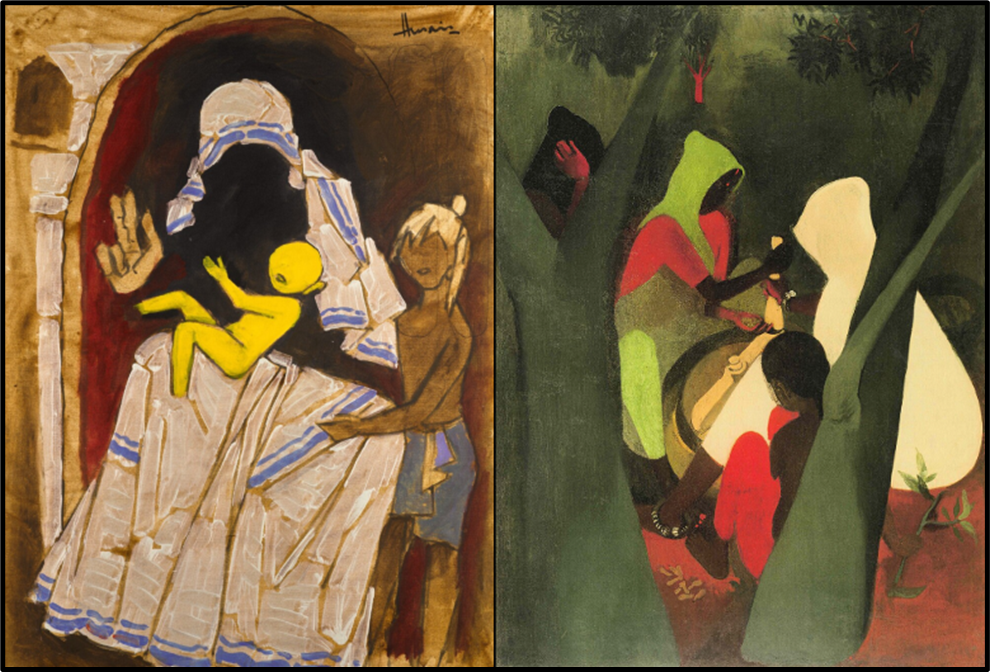
2. Mother Teresa
- Painting by M. F. Husain (1980s)
- Central composition resembles Michelangelo’s Pietà
- Reflects compassion, sacrifice, and universality
3. Haldi Grinder
- Painted in 1940 by Amrita Sher-Gil
- Depicts Indian women grinding turmeric
- Use of bright colour patches and contrast
- Stylistically reminiscent of Basohli miniature paintings
4. Fairy Tales from Purvapalli
- By K. G. Subramanyan
- Figures resemble Kalighat painting
- Flat pictorial space, figures stacked vertically
- A clear marker of modern compositional thinking
For chapter-wise Art and Culture Notes for UPSC Prelims and Mains, refer to the complete Art and Culture notes page.