
Sculpture of the Gupta Period
(4th – 6th century CE)
The Gupta age is widely described as the “Golden Age” of Indian art, not because art suddenly appeared, but because all earlier experiments finally matured into a harmonious classical form.
During this period:
- Hinduism, Buddhism, and Jainism all flourished together,
- Sculpture became deeply spiritual yet aesthetically restrained,
- And the Indian artist arrived at an ideal way of representing the divine through the human form.
Broad Features of Gupta Sculpture
1. Classical Idealism
Gupta sculptures are known for → idealised beauty, not raw realism, graceful, slender bodies, calm, meditative expressions reflecting inner spirituality.
The aim was not to show physical strength or ornamentation, but divine calm and moral perfection.
2. Material and Technique
- Sandstone (especially light-coloured)
- Bronze
- Surfaces are smooth and gently polished, but never flashy, unlike Mauryan polish.
3. Treatment of the Human Form
- Bodies are fluid and well-proportioned.
- Muscles are suggested, not exaggerated.
- Movement is subtle and controlled.
This balance becomes the benchmark of classical Indian sculpture.
4. Drapery and Ornamentation
This is a crucial conceptual shift:
- In Kushana art, drapery highlighted the flesh.
- In Gupta art, drapery is used to conceal the flesh, eliminating nudity.
Clothes appear → thin, simple, almost transparent, yet they do not distract attention from the spiritual presence of the figure.
5. Abandonment of Foreign Influence
By the Gupta period:
- Hellenistic features of Gandhara art are fully abandoned.
- Indian sculpture becomes completely indigenous in expression.
The Sarnath School of Art
The most refined expression of Gupta sculpture is seen in the Sarnath School of Art, centred around Sarnath.
Why Sarnath is important
- It represents the peak of Buddhist sculptural refinement.
- Buddha images here are the most serene and balanced in Indian art history.
Key Features
- Buddha seated in Dharmachakra mudra (gesture of turning the wheel of law).
- Plain monastic robe covering both shoulders.
- Minimal ornamentation.
- A large, well-decorated halo symbolising spiritual radiance.
- Facial expression is calm, compassionate, and inward-looking.
Iconic Work: Buddha Turning the Wheel of the Law
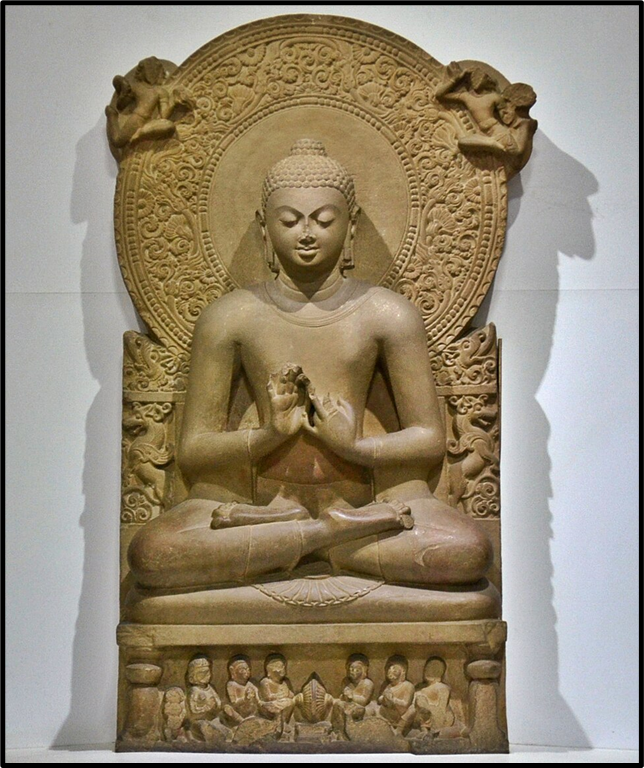
This sculpture is also known as the Seated Buddha, depicting Buddha delivering his first sermon.
Visual Description
- Buddha sits in a composed posture.
- Fingers form the Dharmachakra mudra.
- Eyes are half-closed, with a gentle smile.
- Body appears rounded yet weightless.
Narrative Elements
- At the base → a wheel (chakra), flanked by deer, and a row of devotees listening attentively.
This sculpture perfectly combines → spiritual symbolism, narrative clarity, and aesthetic restraint.
Hindu Sculpture in the Gupta Period
Gupta art also marks the systematic development of Hindu iconography.
Major Sites and Works
1. Deogarh Temple Sculptures
At Deogarh:
- Scenes from Vaishnavite mythology,
- Nanda and Yashoda with Krishna and Balarama,
- Narrative reliefs showing emotional warmth.
2. Surya (Sun God) from Gwalior
- Smiling face, Right hand raised in blessing, Calm and benevolent expression.
3. Dancer Relief from Pawaya (near Gwalior)
- Shows grace and rhythm, Accompanied by girl musicians, Reflects joy of life without excess ornamentation.
4. Krishna Lifting Mount Govardhana
- Found near Arra (Uttar Pradesh), Krishna shown protecting villagers,
- Balanced composition and symbolic strength.
The Great Boar (Varaha) Relief – Udayagiri
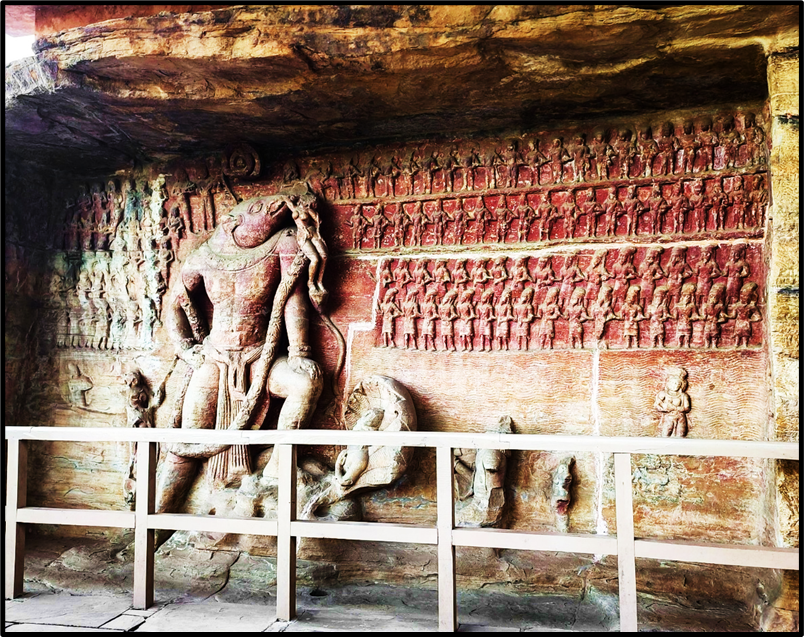
The most powerful Hindu sculpture of the Gupta age is found at Udayagiri Caves.
- Depicts Varaha, the boar incarnation of Vishnu,
- Rescuing the Earth from the cosmic ocean,
- Carved in high relief at the cave entrance.
This sculpture combines → cosmic symbolism, controlled power, and classical balance.
Gupta Metallurgical Excellence: Mehrauli Iron Pillar
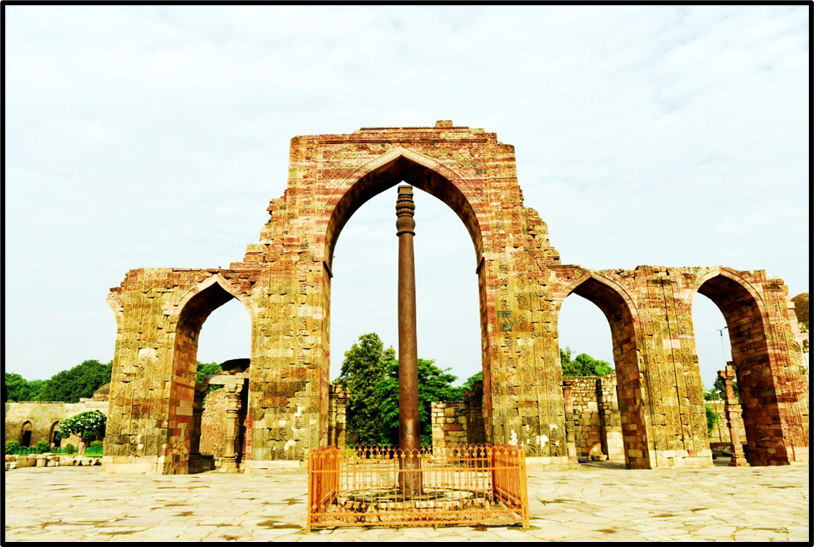
Gupta mastery was not limited to stone.
- The Mehrauli Iron Pillar near Qutub Minar, Delhi → made of almost pure iron, rust-free even after 1500 years.
It stands as evidence of advanced metallurgical knowledge and scientific skill of Gupta artisans.
Jain Sculptures of the Gupta Period
- Found at Durjanpura near Vidisha.
- Three Jain figures shown in dhyana-mudra.
- Halos behind the head show evolving Gupta stylistic norms.
- Inscriptions mention Gupta king Ramagupta.
These sculptures indicate → Jainism’s continued importance, adoption of Gupta aesthetic principles across religions.
Mudras in Iconography
(The Visual Language of Meaning)
In Indian art, hands speak. A mudra is not a decorative gesture—it is a symbolic code that conveys inner states of mind, spiritual authority, ethical assurance, or philosophical truth.
The systematic use of mudras is most clearly developed in Buddhist iconography, first appearing prominently in Gandhara sculptures, and later refined in Mathura, Sarnath, and Gupta art.
Mudras are most commonly shown in → Buddha images, Bodhisattvas. Later absorbed into Hindu, Jain iconography, and classical dance traditions
The Five Primary Mudras in Buddhism
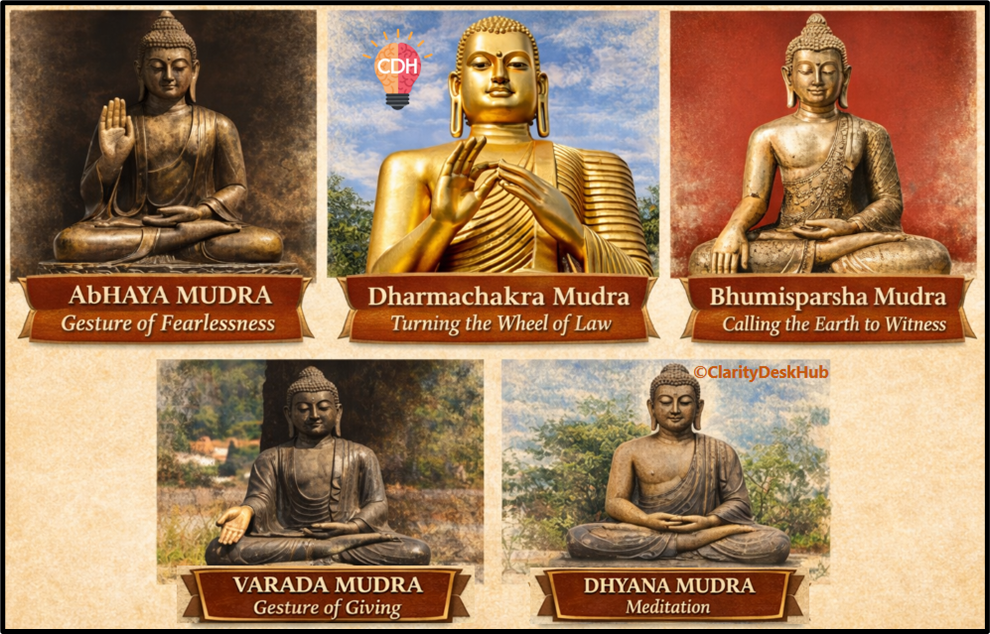
1. Abhaya Mudra – Gesture of Fearlessness
- Right hand (sometimes both hands) raised
- Palm facing outward, fingers extended
Meaning → Fearlessness, Reassurance, Protection, Peace and friendship
It tells the devotee: “Do not fear.”
2. Dharmachakra Mudra – Turning the Wheel of Law
- Both hands held near the chest
- Thumb and index finger of each hand touch to form a wheel
Meaning → Buddha’s first sermon at Sarnath, Teaching of Dharma, Spiritual awakening
This is the most commonly depicted mudra in Buddhist sculpture.
3. Bhumisparsha Mudra – Calling the Earth to Witness1
- Seated Buddha, Right hand touches the earth, Left hand rests on lap
Meaning → Moment of enlightenment, Triumph of spirit over matter, Defeat of Mara (temptation and evil)
This mudra captures the decisive spiritual victory of Siddhartha.
4. Varada Mudra – Gesture of Giving
- Palm facing outward, Fingers pointing downward, Often thumb and index finger touch
Meaning → Charity (dāna), Compassion, Granting of boons
It expresses benevolence and generosity.
5. Dhyana Mudra – Meditation
- Seated in padmasana, Both hands resting on lap, Right hand over left, palms upward
Meaning → Deep meditation, Inner balance, Path to enlightenment
This is the mudra of spiritual discipline and stillness.
Mudras Beyond Buddhism
Mudras are not limited to Buddhism. For example:
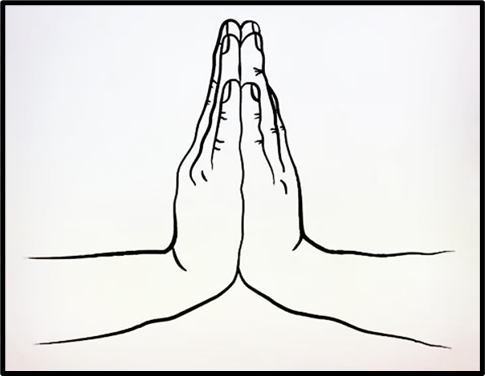
Anjali Mudra
Palms joined at chest, Fingers vertical
Meaning:
- In Hindu tradition: humility, surrender
- In Buddhist tradition: reverence and devotion
This mudra is also central to classical Indian dance, showing the deep continuity between art, ritual, and movement.
Udayagiri Caves
The Udayagiri Caves are among the earliest surviving Hindu temple complexes in India, marking a decisive moment when Hindu iconography takes monumental sculptural form.
Location and Period
- Near Vidisha, Madhya Pradesh
- Date: 3rd to 5th century CE (Gupta period)
Structural Features
- 20 rock-cut caves → 1 Jain cave, Remaining dedicated to Hinduism
Iconography
- Dominated by Vaishnavite and Shaivite themes
- The most famous relief → Varaha (Boar incarnation of Vishnu) rescuing the Earth from the cosmic ocean
This relief is not decorative—it is cosmic symbolism in stone.
Inscriptions
- Gupta dynasty inscriptions of → Chandragupta II, Kumaragupta I
These inscriptions firmly establish Udayagiri as a royal-religious centre of the Guptas.
Other Places Named Udayagiri
- Udayagiri hill at Rajgir (Bihar)
- Udayagiri–Khandagiri caves in Odisha
This reminds us that names often recur, but context and chronology matter.
Comparative Snapshot: Four Major Schools of Indian Sculpture
This table is extremely useful for prelims and mains alike.
| Feature | Gandhara | Mathura | Amaravati | Sarnath |
|---|---|---|---|---|
| Material | Grey schist stone | Red sandstone | White marble / limestone | Light sandstone |
| Influence | Greco-Roman | Indigenous Indian | Buddhist narrative | Gupta refinement |
| Primary Focus | Realism, anatomy | Spiritual vitality | Narrative reliefs | Serenity, idealism |
| Buddha’s Depiction | Draped robes, curly hair | Cheerful face, halo | Slender, dynamic | Calm, perfectly balanced |
| Major Patrons | Kushanas, Sakas | Kushanas | Satavahanas | Guptas |
- UPSC Prelims 2012 ↩︎
For chapter-wise Art and Culture Notes for UPSC Prelims and Mains, refer to the complete Art and Culture notes page.
One Comment