
Traditional Crafts of India
India has a long and rich history of traditional crafts. These crafts:
→ Reflect cultural values
→ Express spiritual beliefs
→ Represent social identity
→ Provide livelihood to millions
Unlike industrial products, Indian crafts are deeply connected to local ecology, caste traditions, guild systems, patronage networks, and regional aesthetics.
Let us begin with one of the most important craft traditions of India — Textile Crafts.
🧵Textile Crafts of India
India has been historically famous for textiles. In fact, Roman writers praised Indian cotton, and medieval travellers described Indian fabrics as “woven air.”
Indian textile traditions broadly include → Weaving, Printing, Dyeing, Painting
Hand-Printed Textiles in India
Hand-printing is one of the most sophisticated textile traditions of India. It is classified into:
- Direct Block Printing
- Resist Block Printing
- Resist Dyeing
Let us examine them one by one.
1️⃣ Direct Block Printed Textiles
What is Direct Block Printing?
In this technique:
- Wooden or metal blocks are carved with designs
- The block is dipped into dye
- It is stamped manually onto fabric
- The design appears directly on the cloth
This is called “direct” because dye is applied straight onto the textile surface.
Major Centres → Sanganer (Rajasthan); Jodhpur (Rajasthan); Barmer (Rajasthan); Bagh (Madhya Pradesh); Varanasi (Uttar Pradesh); Kutch (Gujarat)
Each region has its own motifs:
- Rajasthan → Floral and Mughal-inspired patterns
- Bagh → Natural dyes, geometric and tribal influences
- Kutch → Bold designs, earthy colours
Why is it Important?
Because this technique represents → Artisan skill; Sustainable dyeing; Localised aesthetic identity; Pre-industrial production systems
2️⃣ Resist Block Printed Textiles
Now comes a more intellectually interesting technique — Resist Printing.
What is Resist Block Printing?
Here, instead of directly printing colour:
- Certain portions of cloth are covered with resist material
- Materials used → Wax, Mitti (mud), Gum
- These covered areas resist dye penetration
- After dyeing, the covered areas remain undyed
- A pattern emerges through contrast
This technique requires careful planning — it is almost mathematical in execution.
Major Traditions → Ajrakh (Gujarat); Dabu (Rajasthan); Batik (West Bengal)
Conceptual Importance
Resist printing teaches us something profound:
Sometimes design emerges not by adding colour, but by strategically preventing colour.
This is civilisational wisdom encoded in textile craft.
3️⃣ Resist Dyed Textiles (Tie and Dye)
Here, carved blocks are not used.
Instead:
- Cloth is tied at various points
- It is dipped into dye
- Tied portions resist dye
- After opening knots → intricate patterns appear
Important Centres → Kutch (Gujarat), Rajasthan
Bandhani (Bandhej)
The most famous example.
- Cloth is tied into hundreds or thousands of tiny knots
- Dyed in vibrant colours
- Produces dotted patterns
- Used in bridal and festive garments
Bandhani reflects → Regional identity; Gendered craftsmanship (often women-led); Celebration aesthetics
Hand-Painted Textiles
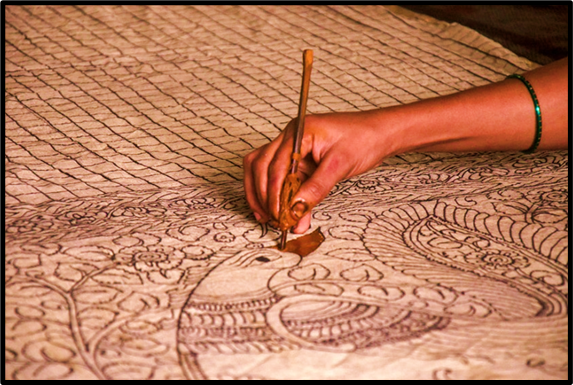
Unlike printing or dyeing, here the artisan directly paints on fabric.
Process
- A brush or pen is used; Natural dyes are applied manually
- Often involves narrative scenes
Major Traditions
- Kalamkari (Andhra Pradesh)
- Thangka (Himachal Pradesh)
Kalamkari
- “Kalam” means pen
- Mythological themes; Temple backdrops; Religious storytelling
Thangka
- Influenced by Tibetan Buddhist tradition
- Sacred iconography; Spiritual teaching tools
Now we move to one of the most fascinating segments of Indian textile tradition — Hand Embroideries of India.
If block printing is about impression, and dyeing is about colour chemistry, then embroidery is about needle philosophy. It is the slowest, most intimate, and most narrative form of textile art.
Embroidery in India is not merely decoration — it encodes community identity, gendered labour, ritual symbolism, and regional ecology.
Let us explore this:
Hand Embroideries of India
Embroidery is practised in almost every Indian state. It is deeply localised — often associated with specific communities rather than just regions.
For clarity, we will study them under broad regional clusters.
🌄 Kashmir – The Land of Subtle Sophistication
Sozni (Sozan Kaari) – Kashmir
- Fine needlepoint embroidery; Done on woollen and silk fabrics
- Famous on Pashmina shawls
- Extremely delicate floral and paisley motifs
Sozni reflects Persian aesthetic influence combined with Kashmiri refinement.
Kashida – Kashmir
- Used on phirans (woollen kurtas) and namdahs (woollen rugs)
- Known for mastery of a single stitch technique
- Motifs: chinar leaves, flowers, birds
The brilliance lies not in complexity, but in perfection of execution.
Aari – Kashmir, Rajasthan, Uttar Pradesh
- Uses a hooked needle
- Produces chain-stitch based intricate patterns
- Often incorporates Zari-Zardozi
Aari embroidery is fast yet detailed — combining finesse with productivity.
👑 Mughal-Influenced Embroidery Traditions
Chikankari – Uttar Pradesh (Lucknow)
- Fine, delicate hand embroidery; White thread on white muslin
- Famous for shadow work; Floral motifs dominate
Tradition associates its introduction with Nur Jahan, wife of Jahangir.
Chikankari represents Mughal elegance translated into textile language.
Phool Patti ka Kaam – Uttar Pradesh
- Flower Embroidery of Aligarh
Zari – Gujarat
- Metallic thread made from gold/silver; Used in silk sarees and brocades
- Surat is world’s largest producer
Zari is the foundation material.
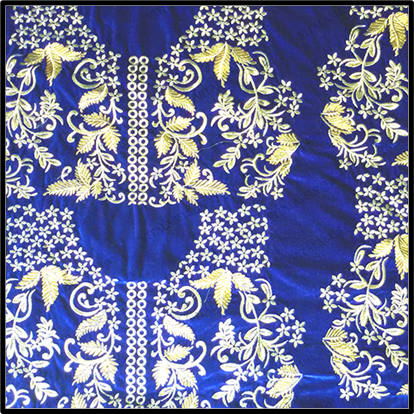
Zari-Zardozi – Uttar Pradesh, Jammu & Kashmir, Delhi
- Persian origin; Introduced by the Mughals
- “Zar” = gold, “Dozi” = embroidery
- Most expensive form; Embellished with pearls and stones
Zardozi symbolised imperial opulence.
🌾 Punjab and Himachal – Vibrancy and Ritual
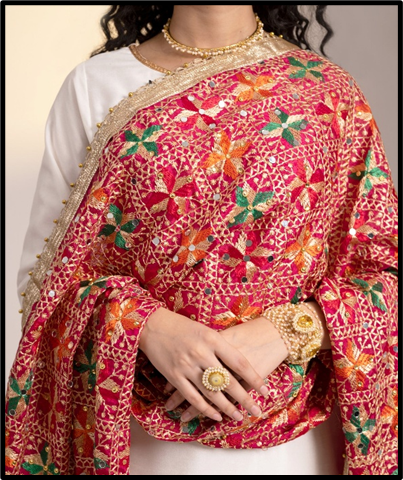
Phulkari – Punjab
- “Phul” = flower
- Bright silk threads on coarse cloth; Used in shawls and dupattas
- Bridal and ceremonial importance
Phulkari reflects agrarian optimism — bright, bold, celebratory.
Chamba Rumal – Himachal Pradesh
- Embroidered handkerchief; Used as marriage gift
- Bright colours, detailed narrative scenes
- GI-registered product
It often depicts mythological stories — almost like painting with thread.
🏜️ Gujarat & Rajasthan – Mirror of the Desert
This region is embroidery heaven — especially Kutch.
Rabari
- Community-based embroidery; Heavy mirror work; Extremely colourful
Suf
- Worked from the back; Geometric triangular patterns; Highly intricate symmetry
Pakko
- “Pakko” means strong; Dense chain stitches; Practised by Sodha and Jadeja communities
Heer Bharat (Banni)
- Silk floss; Vibrant colours; Shisha (mirror) work
Ahir
- Circular mirrors; Rhythmic embroidered rows
Kutch / Mochibharat / Aribharat
- Done by mochis (cobblers); Hooked needle technique
Mutwa
- Tiny round mirrors; Extremely minute stitches
Dharaniya
- Wall hangings; Freehand trees, birds; Black border with sun-like mirrors
Kathi
- Embroidery technique by ‘Kathi’ the cattle breeders, which combines chain stitch, appliqué work and mirror-like insertions
🌊 Eastern India
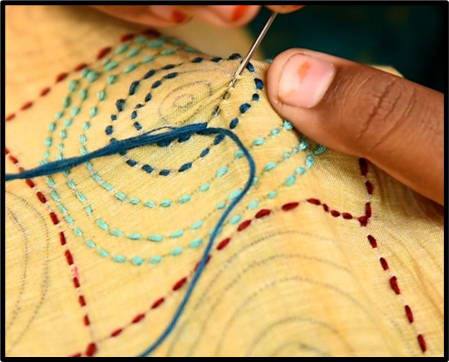
Kantha – West Bengal
- Running stitch technique; Multiple layers (quilting); Designs visible on both sides
- Called Dorukh
Kantha converts old cloth into narrative quilts — sustainability meets storytelling
Sujini – Bihar
- Quilts made from old clothes; Done exclusively by women; Storytelling motifs; GI-registered
It is textile as social commentary.
Shamilami – Manipur
Combines weaving and Embroidery
🌿 South India
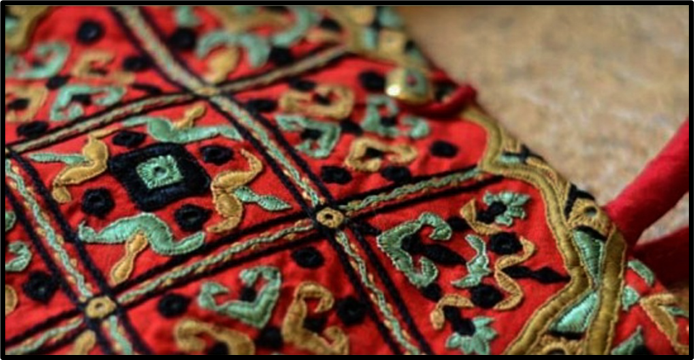
Banjara – Andhra Pradesh
- traditional embroidery of the Lambada tribes of Andhra Pradesh and Madhya Pradesh.
- characterised by a mix of applique with mirrors and beadwork
Kasuti – Karnataka
- Folk designs inspired by rangoli; Over 5,000 stitches;
- Sarees called Chandrakali
Lambani – Karnataka
- Colourful threads; Mirror work; Community-based craft
Kaudi – Karnataka
- blanket or bedspread embroidery characterised by reusing old fabrics cut into pieces and stitched with a simple running stitch
Toda – Tamil Nadu
- Practised by Toda tribe; Buffalo motif central; Peacock feather eye motif
Applique (Pipli, Odisha)
- Fabric pieces stitched on base cloth; Also called Chandua
- Origin: Pipli village
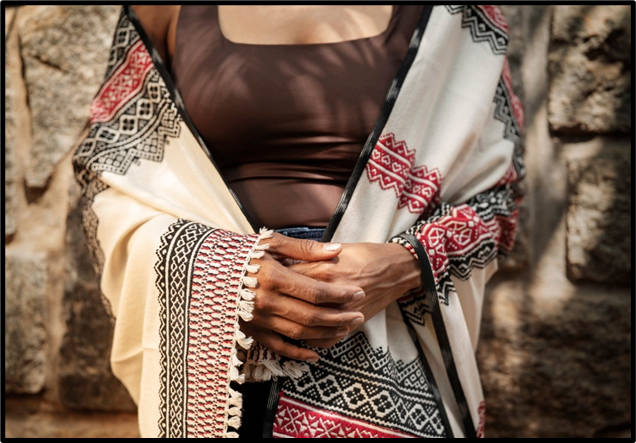
🧵 Mirror Work (Shisha)
Practised in → Gujarat, Rajasthan, Haryana
Technique:
- Small mirrors inserted
- Secured with buttonhole stitches
Symbolically, mirrors ward off evil — functional spirituality.
📌 Conceptual Understanding
1️⃣ Community Identity
Many embroideries are community-specific → Rabari, Ahir, Lambani, Toda
2️⃣ Gender Dimension
Most embroidery traditions are → Practised by women, Domestic craft turned livelihood
3️⃣ Ecological Influence
- Desert → mirror work
- Cold Kashmir → wool embroidery
- Agrarian Punjab → bright floral Phulkari
4️⃣ Mughal-Persian Influence
- Zari, Zardozi, Chikankari
5️⃣ GI Tag Importance
- Chamba Rumal, Sujini and Many others
🪡Handloom Weaving in India
India has one of the largest handloom traditions in the world. Handloom refers to weaving done manually on a loom without the use of electricity.
Three broad strands are important:
- Saree traditions
- Ikat technique
- Khadi movement
🧵 Sarees – The Civilisational Garment
The saree is not merely clothing. It is → Regional identity, Ritual attire, Social marker, Cultural continuity
Among handloom sarees, two iconic examples are → Kanjivaram, Banarasi
We will study these in detail shortly.
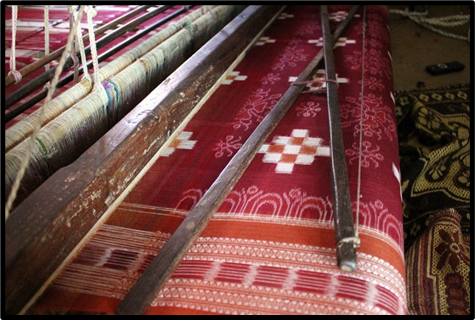
🧶 Ikat – The Science of Pre-Weaving Dyeing
Ikat is a resist dyeing technique applied to yarn before weaving.
Process:
- Yarn is tied at specific points → It is dyed → The tied sections resist dye → After dyeing, threads are woven → Patterns appear during weaving
This requires mathematical precision — because the pattern must align perfectly during weaving.
Regions:
- Odisha (Sambalpuri)
- Telangana (Pochampally)
- Gujarat (Patola – double ikat)
Double Ikat (Patola) is especially complex because both warp and weft threads are resist-dyed.
🧵 Khadi – Fabric as Freedom
Khadi is hand-spun and hand-woven cotton fabric.
Its significance goes beyond textile:
- Associated with the Indian independence movement
- Symbol of Swadeshi
- Promoted by Mahatma Gandhi
Khadi represented → Self-reliance; Rural empowerment; Resistance against British industrial textiles
Khadi is political economy woven into cloth.
Popular Handloom Saree Weaving Crafts of India
Now we move state-wise.
1. Banaras Silk – Varanasi, Uttar Pradesh
- Rich silk fabric
- Intricate zari work
- Heavy brocade patterns
- Mughal floral influence
Banarasi sarees are associated with wedding traditions.
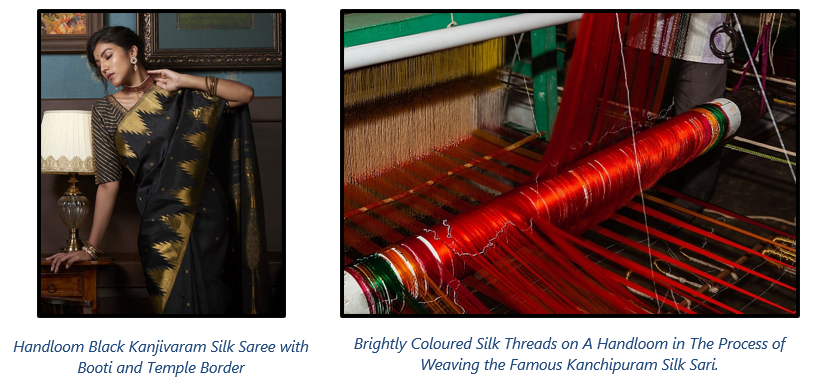
2. Kanjeevaram Silk – Kanchipuram, Tamil Nadu
- Heavy silk; Vibrant colours; Contrast borders
- Checks and temple motifs
- Rich zari
Weavers are traditionally believed to be descendants of Sage Markanda.
3. Chanderi – Madhya Pradesh
- Fine silk or cotton; Sheer texture; Lightweight; Traditional motifs
Patronised by the Scindia rulers.
4. Paithani – Maharashtra
- Peacock motifs; Floral designs; Vibrant silk
- Elaborate zari borders
Symbol of Maharashtrian bridal identity.
5. Patola – Patan, Gujarat
- Double Ikat technique; Vibrant geometric designs; Extremely labour-intensive; High prestige
A single saree may take months to produce.
6. Baluchari – West Bengal
- Silk fabric; Intricate pallu
- Mythological scenes depicted
The pallu functions almost like a narrative panel.
7. Assam Silk (Muga) – Assam
- Natural golden colour; Strong fibre; Traditional Assamese motifs; Does not fade easily
Muga silk is unique to Assam.
8. Kota Doria – Kota, Rajasthan
- Lightweight; Transparent texture; Square check pattern (called “khat”)
Suitable for hot climates.
9. Pochampally Ikat – Telangana
- Resist dyed threads; Geometric patterns; GI-registered
10. Jamdani – West Bengal
- Sheer muslin; Intricate floral motifs; Extra-weft weaving technique; Highly delicate craftsmanship
Historically exported globally.
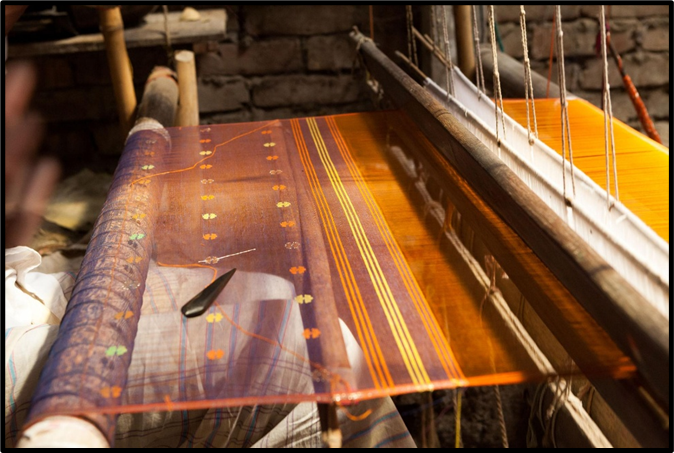
11. Maheshwari – Maheshwar, Madhya Pradesh
- Silk-cotton blend | Striped borders | Vibrant colours
- Patronised by Queen Ahilyabai Holkar
12. Sambalpuri – Odisha
- Tie-dye + Ikat | Traditional motifs like shankha, chakra | Strong cultural symbolism
13. Uppada – Andhra Pradesh
- Silk-cotton blend | Lightweight | GI-registered
- Also called Uppada Jamdani
14. Kantha Sarees – West Bengal
- Running stitch embroidery | Each piece unique
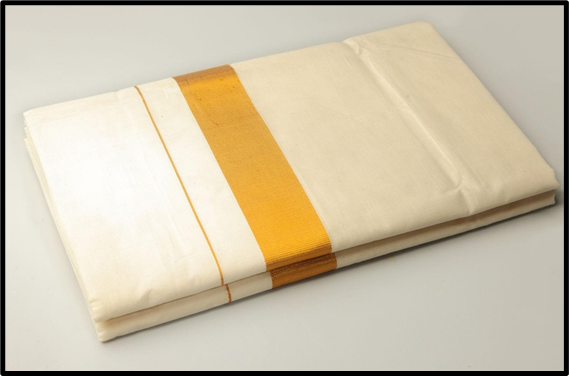
15. Kasavu – Kerala
- Off-white base | Gold zari border | Simple elegance | Worn during Onam and festivals
Minimalism meets tradition.
16. Tussar – Bihar & Jharkhand
- Natural sheen | Earthy tones | Textured finish
Tussar silk reflects forest ecology.
Analytical Understanding for UPSC
Patronage System
- Maheshwari → Queen Ahilyabai
- Chanderi → Scindia rulers
- Banarasi → Mughal influence
Technique-Based Classification
- Ikat → Pre-dye weaving
- Jamdani → Extra-weft insertion
- Double Ikat → Warp + weft dyed
- Brocade → Zari weaving
Ecological Link
- Assam → Muga silk
- Kerala → Cotton for humid climate
- Rajasthan → Lightweight Kota Doria
GI Significance
Many of these are GI-registered — important for Prelims.
Conceptual Summary Table
| Saree | State | Technique | Distinct Feature |
|---|---|---|---|
| Banarasi | UP | Brocade | Zari work |
| Kanjeevaram | TN | Heavy silk weave | Contrast border |
| Patola | Gujarat | Double Ikat | Geometric precision |
| Jamdani | WB | Extra weft | Sheer muslin |
| Paithani | MH | Silk + zari | Peacock motif |
| Sambalpuri | Odisha | Ikat | Traditional symbols |
🏺Pottery and Ceramics in India
India has an ancient pottery tradition dating back to → Indus Valley Civilisation; Painted Grey Ware culture; Northern Black Polished Ware
Pottery in India varies according to → Local clay availability, Climate, Ritual needs, Community practices
Broadly, pottery can be classified into → Utility pottery, Ritual pottery, Decorative pottery
Now we examine specific traditions.
🏺 Terracotta (Clay Craft)
Terracotta literally means “baked earth.” It is clay fired at relatively low temperatures.
Terracotta in India is → Temple art, Folk sculpture, Household utility, Decorative craft
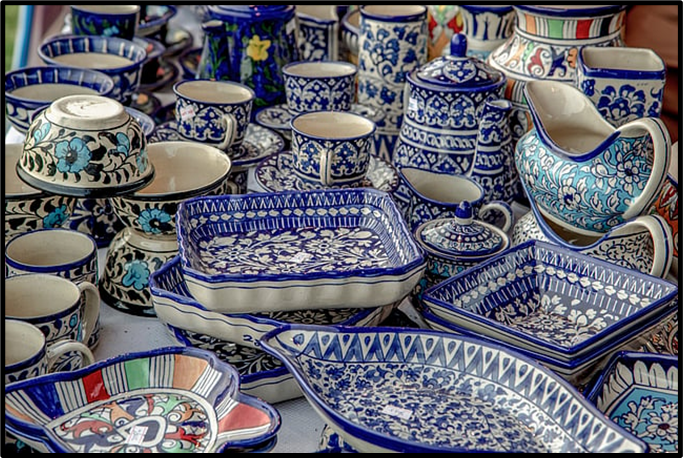
1️⃣ Blue Pottery – Jaipur, Rajasthan
- Famous for blue dye
- Intricate floral and geometric designs
- Persian influence
- Not traditional clay-based — uses quartz paste
Blue pottery represents Indo-Persian synthesis.
2️⃣ Kullu Pottery – Himachal Pradesh
- Earthenware pottery; Used in temples and shrines
- Rustic aesthetic; Closely linked to hill rituals
Here pottery serves religious functions.
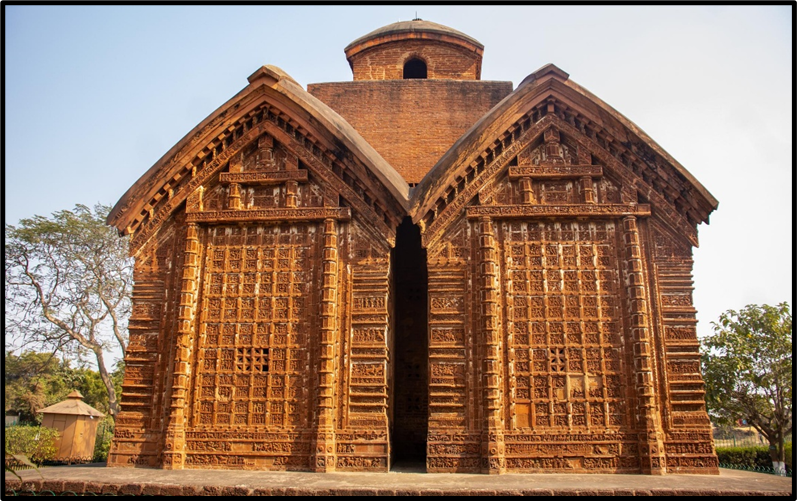
3️⃣ Bishnupur Terracotta – West Bengal
Bishnupur is famous for:
- Small terracotta temples
- Decorative terracotta tiles
- Narrative panels depicting → Shiva, Durga, Radha-Krishna
The walls function like stone manuscripts — storytelling through baked clay.
4️⃣ Madhubani Pottery – Bihar
- Intricate patterns
- Mythological themes
- Inspired by Madhubani painting tradition
Here, pottery becomes canvas.
🧸 Toys and Woodwork
Woodcraft in India combines → Utility, Play, Ritual symbolism, Decorative art
India’s wooden craft traditions are regionally diverse and community-driven.
Let us examine toys state-wise.
🎨 Toys of India
Karnataka – Channapatna Toys
- Turned wooden toys | Bright lacquer colours| GI-tagged
- Known as “Gombegala Ooru” (Toy Town)
These toys are eco-friendly and child-safe.
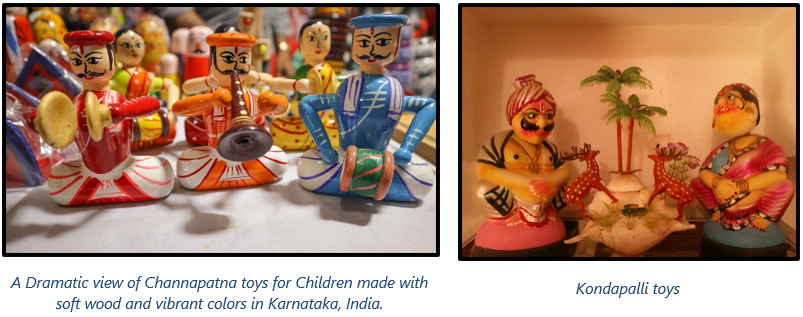
Andhra Pradesh – Kondapalli Toys
- Made from softwood | Mix of Islamic and Rajasthani style
- Themes → Mythology, Village life, Animals
Realistic expressions are their hallmark.
Etikoppakka Toys (Etikoppakka Bommalu) – Andhra Pradesh
- Softwood toys | Lacquered surface
- Subjects → Bullock carts, Lord Ganesha, Lord Balaji
Telangana – Nirmal Toys
- Fusion of Indian and Mughal art | Enamel colours | Glossy finish
Kerala
- Toys from coconut palm leaves
- Coir and coconut shell toys
- Lacquer ware combining metal and wood
Eco-materials dominate.
Tamil Nadu – Thanjavur Toys
Thanjavur Thalaiyatti Bommai
- Dancing dolls
- Head oscillates (nods continuously)
Choppu Saman
- Role-play utensils
- Made of wood or clay
- Painted with natural colours
These toys reflect socialisation patterns — teaching children through imitation.
Punjab
- Chankana whistle toy
- Lattu (spinning top)
Simple, kinetic toys.
Rajasthan
- Udaipur wooden toys (doodhia wood) | Bassi (Chittorgarh district) | Jaipur cloth dolls
Uttar Pradesh
- Varanasi lacquered toys | Mirzapur wooden lacquerware | Chitrakoot wooden toys
Maharashtra – Sawantwadi Toys
- Mango wood toys | Made by Chitari/Chitrakar community
- Famous for:
- Ganjifa playing cards
- Bahatuktli miniature sets
Miniature domestic worlds recreated in wood.
🪵 Wood Work
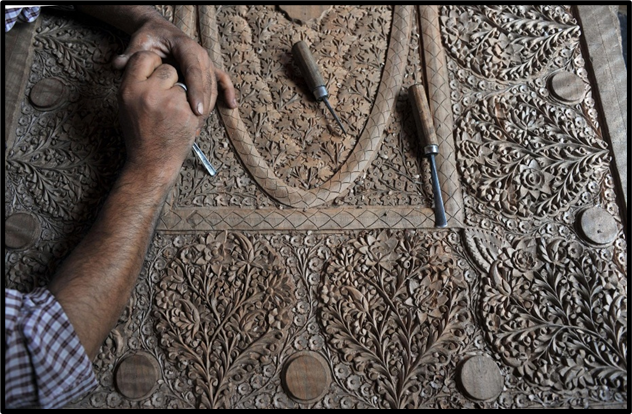
Kashmir Wood Carving
- Intricate walnut wood carving | Floral motifs | Furniture, windows, panels
Persian influence visible.
Pattachitra – Odisha
Although primarily a painting tradition, wood panels are also used for:
- Mythological depictions
- Intricate carvings
- Religious storytelling
🔔 Metal Crafts of India
Indian artisans have worked with metals for centuries. Metal craft in India historically served → Ritual functions | Household utility | Ornamentation | Royal patronage | Temple architecture
Metals used include → Brass, Copper, Bronze, Silver, Gold
We will divide this into two sections:
- Brass and Copper Work
- Gold and Silver Jewellery
🛎️ Brass and Copper Work
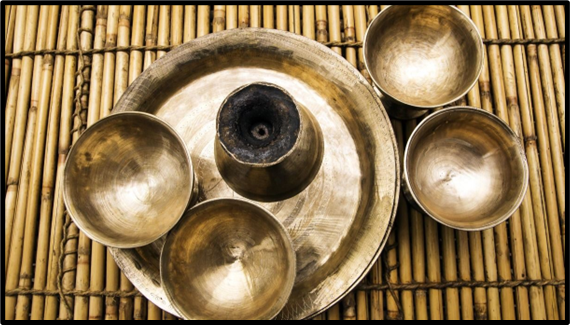
1️⃣ Bell Metal – Assam
- Alloy of copper and tin
- Used for → Bell-shaped items, Ritual objects, Utensils, Sculptures
- Deep metallic resonance
Bell metal reflects ritual acoustics — sound as sacred vibration.
2️⃣ Bidriware – Bidar, Karnataka
- Origin: Bidar (Karnataka)
- Metal object made of white brass | Surface is blackened
- Intricate silver inlay patterns | Persian influence
- GI-tagged since 2006
Technique:
- Casting
- Engraving patterns
- Inlaying silver
- Blackening surface
Contrast between black base and shining silver creates dramatic elegance.
💍 Gold and Silver Jewellery
Jewellery in India is not mere ornamentation — it is → Social status | Ritual necessity | Investment | Inheritance | Community identity
Two major techniques:
Kundan – Rajasthan
- Origin: Rajasthan
- Precious stones set in gold | No metal prongs used
- Jaipur is major centre
Kundan is associated with royal courts and bridal jewellery.
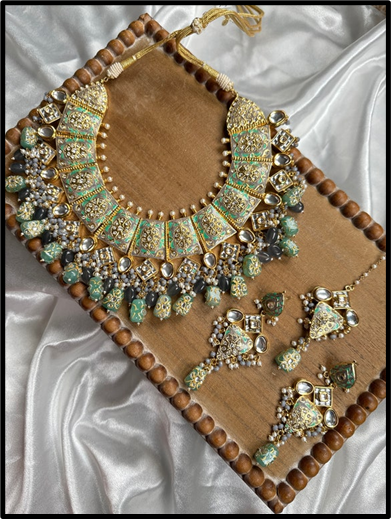
Meenakari – Rajasthan (Persian Origin)
- Originated in Iran
- Introduced during Mughal period | Enamel painting on metal
- Often paired with Kundan
Used in → Jewellery, Serving dishes, Containers, Frames
Meenakari adds colour to metal — art through enamel chemistry.
👞 Leatherwork
Leather crafts are widespread, especially in → Rajasthan, Uttar Pradesh, Tamil Nadu
Leather craft combines durability with aesthetics.
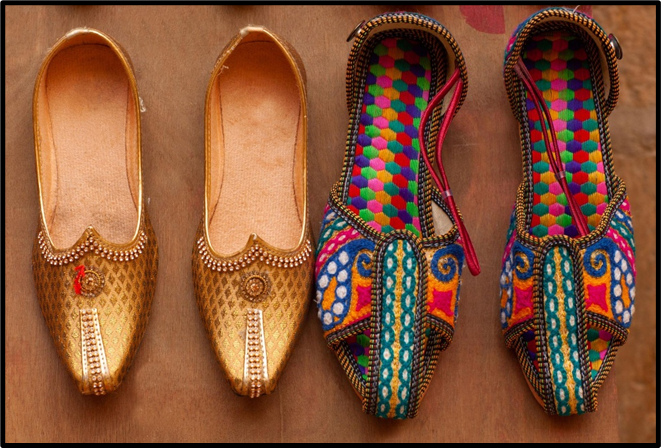
Juttis – Punjab & Rajasthan
- Handcrafted footwear | Decorated with beads, embroidery, sequins
- Major centres → Amritsar, Patiala
Juttis reflect regional dress culture.
Leather Puppets – Rajasthan
- Used in folk theatre
- Shadow puppet traditions
- Narrative storytelling
Leather becomes theatre 😊
Kolhapuri Chappals – Maharashtra & Karnataka
- Vegetable-tanned leather | Handcrafted | GI-tagged (2019)
Durable, eco-friendly footwear tradition.
🔮 Glass and Beadwork
Indian artisans use → Glass, Beads, Mirror pieces
For jewellery, textiles, and decorative items.
Madhubani Glasswork – Bihar
- Colourful glass tiles | Traditional motifs
Rajasthani Beadwork
- Intricate bead patterns | Used in garments and jewellery | Vibrant desert colours
🌾 Basketry and Fiber Crafts
India’s craft tradition is deeply sustainable.
Natural fibres used → Bamboo, Grass, Palm leaves, Coconut fibre
Bamboo Craft – Assam & Tripura
- Baskets | Mats | Furniture | Household items
Bamboo is eco-friendly and abundant in Northeast India.
Coir Craft – Kerala
- Made from coconut fibres
- Mats, ropes, rugs
- Coastal ecology-based craft
For chapter-wise Art and Culture Notes for UPSC Prelims and Mains, refer to the complete Art and Culture notes page.
One Comment