
Types of Money
Understanding the Forms Money Can Take
After understanding what money is, how it evolved, and what functions it performs, the next logical step is to examine the different types of money.
This classification helps us understand why some forms of money derive value from metal, some from law, and some purely from trust.
Broad Classification of Money
Economists classify money based on intrinsic value, legal status, and backing. Let us go step by step.
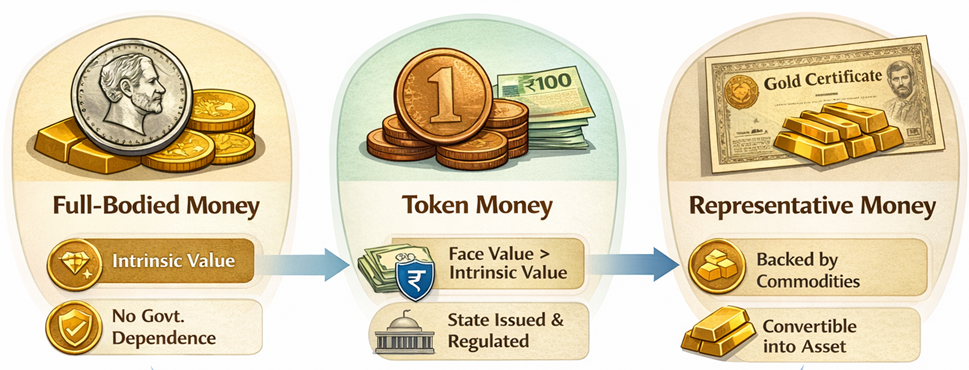
1. Full-Bodied Money
Full-bodied money is money whose face value is equal to its intrinsic value.
In simple words, the material used to make the money itself is valuable.
Key Features
- Made of precious metals like gold or silver
- Value comes from the metal itself
- No dependence on government guarantee
Examples → Gold coins, Silver coins
Significance
Historically, full-bodied money created high public trust, but it was impractical in modern economies due to limited supply and difficulty in monetary expansion.
2. Token Money
Token money has little or no intrinsic value, but it is accepted at a value much higher than its material worth.
Key Features
- Face value ≫ intrinsic value
- Issued and regulated by the state
- Economical and easy to use
Examples → Coins made of copper, nickel; Paper currency
Why Token Money Became Popular
- Saves precious metals
- Easier to carry and circulate
- Enables expansion of money supply
Modern economies primarily function on token money, not full-bodied money.
3. Representative Money
Representative money represents a claim on a physical commodity held by the issuing authority.
Key Features
- Backed by commodities like gold or silver
- Convertible into the underlying asset
- Acts as a certificate of value
Examples → Gold certificates, Silver certificates
Historical Importance
This system acted as a bridge between commodity money and fiat money, ensuring trust while improving convenience.
Fiat Money
Fiat money is money that has no intrinsic value and is not backed by any physical commodity, but derives its value from government authority and public confidence.
Core Idea → Fiat money has value because the government says it has value—and people trust that statement.
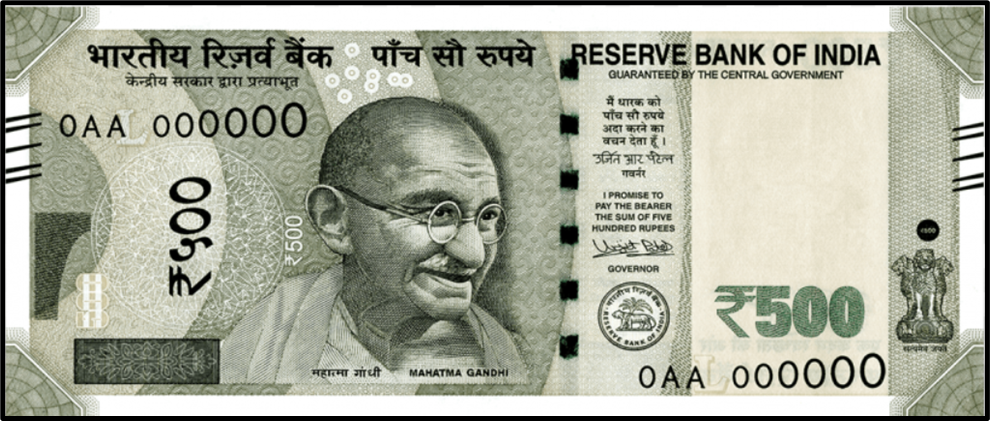
Example → The Indian Rupee, issued by the Reserve Bank of India. Observe the following 500 rupees note and see what’s written: GUARANTEED BY THE CENTRAL GOVERNMENT
Determinants of Value
- Economic strength of the country
- Monetary and fiscal policies
- Inflation control
- Public confidence
Advantages
- Flexibility in monetary policy
- Government can regulate money supply
- Useful during economic crises
Risks
- Over-issuance can lead to inflation
- Purchasing power may erode
Modern economies across the world, including India, operate on fiat money systems.
Legal Tender Money
Legal tender money is money that must be accepted by law for settling debts and paying taxes.
Key Features
- Backed by legal authority
- Mandatory acceptance
- Ensures uniformity in transactions
Indian Context
- Indian rupee notes and coins issued by RBI are legal tender
- Creditors cannot refuse it for debt settlement
Importance
Legal tender laws ensure:
- Smooth functioning of markets
- Standardisation of payments
- Efficient tax collection
Without legal tender, economic transactions would become chaotic.
Non-Legal Tender Money
Non-legal tender money is not legally mandatory for acceptance, even if it is widely used.
Examples → Gift cards, Loyalty points, Cryptocurrencies like Bitcoin
Advantages
- Innovation in payment systems
- Convenience and incentives
- Greater privacy in some cases
Risks
- High price volatility
- No legal protection
- Risk of fraud or platform collapse
In India, cryptocurrencies are not legal tender, though they may be traded.
Legal Tender vs Non-Legal Tender: A Conceptual Snapshot
| Basis | Legal Tender | Non-Legal Tender |
| Legal obligation | Must be accepted | Optional |
| Issuer | Government / Central Bank | Private entities |
| Example (India) | Rupee notes & coins | Gift cards, crypto |
| Use for taxes | Yes | No |
Near Money (Quasi-Money / Quasi-Liquid Assets)
What is Near Money?
Near money refers to financial assets that are not money in themselves, but can be easily and quickly converted into cash without significant loss of value.
In other words, → Near money is almost money, but not fully money.
Key Characteristics of Near Money
- High liquidity, but less liquid than cash
- Low risk
- Short-term maturity
- Cannot be used directly for day-to-day purchases
Examples of Near Money
- Savings bank deposits
- Money market accounts
- Short-term government securities (Treasury Bills)
These assets store value efficiently and can be mobilised quickly when required.
Near Money vs Cash
| Aspect | Cash | Near Money |
|---|---|---|
| Liquidity | Perfectly liquid | Highly liquid |
| Direct use in transactions | Yes | No |
| Return (interest) | No | Usually earns interest |
| Risk | Nil | Very low |
Practical Illustration
Emergency savings are the best real-life example.
People often keep emergency funds in savings accounts or money market instruments—not as cash—because:
→ Money remains safe
→ Some interest is earned
→ Funds are quickly accessible
Role in Monetary Policy
Short-term government securities (near money assets) are often used by governments and central banks to:
→ Manage liquidity
→ Influence interest rates
→ Control money supply
Thus, near money plays a crucial indirect role in monetary management, even though it is not money itself.
Cryptocurrency
What is Cryptocurrency?
A cryptocurrency is a digital or virtual currency that uses cryptography for secure transactions and operates without central authority control.
Unlike fiat money, cryptocurrencies are decentralised and function on blockchain technology.
Key Characteristics of Cryptocurrencies
1. Decentralisation
- No central bank or government control
- Operates through a network of computers (nodes)
- Reduces reliance on intermediaries
2. Blockchain Technology
- A public, distributed ledger
- Records all transactions permanently
- Ensures transparency, security, and immutability
Each block contains transaction data and is linked to the previous block, forming a chain.
3. Peer-to-Peer Transactions
Cryptocurrencies allow direct transfers between users without banks or payment intermediaries, reducing transaction time and cost.
4. Mining and Verification
- Transactions are verified through mining
- Miners solve complex mathematical problems
- Successful verification adds a new block
- Miners are rewarded with new coins
This process ensures system integrity but raises energy consumption concerns.
5. Digital Wallets
- Cryptocurrencies are stored in digital wallets
- Wallets generate unique addresses
- Used for sending and receiving crypto assets
Risks and Concerns
- High price volatility
- Regulatory uncertainty
- Cybersecurity risks
- Environmental impact of mining
From a UPSC perspective, cryptocurrencies raise questions related to monetary sovereignty, financial stability, consumer protection, and regulation.
NFT (Non-Fungible Token)
What is an NFT?
An NFT (Non-Fungible Token) is a unique digital asset that represents ownership or authenticity of a specific digital or physical item.
Unlike money or cryptocurrencies, NFTs are non-fungible, meaning:
One NFT cannot be exchanged for another on a one-to-one basis.
Key Features of NFTs
- Each NFT is unique and non-interchangeable
- Stored and verified using blockchain
- Acts as proof of ownership and authenticity
Areas of Use → Digital art, Collectibles, Music and videos, Gaming assets, Intellectual property
Artists can directly sell digital creations as NFTs, ensuring authenticity and traceability.
NFTs and Money: A Clear Distinction
- NFTs are not money
- Cannot function as a medium of exchange
- Cannot act as a unit of account
- Primarily represent ownership rights, not purchasing power
Thus, NFTs belong more to the domain of digital assets rather than money.
Conceptual Summary for UPSC
| Category | Is it Money? | Liquidity | Key Role |
| Cash | Yes | Perfect | Transactions |
| Near Money | No | Very high | Savings, liquidity |
| Cryptocurrency | Not legal tender (India) | Variable | Digital value transfer |
| NFT | No | Low–Moderate | Ownership proof |
To explore all Indian Economy topics in a structured manner, visit the complete Indian Economy UPSC Notes page.