
Taxation in India
Taxation is one of the pillars of public finance. At its core, it is a system through which the State mobilises compulsory contributions from individuals and businesses to finance public goods and services—education, healthcare, defence, infrastructure, social welfare, and administration.
In simple terms, taxation converts private income into public resources, enabling the government to perform its constitutional and developmental responsibilities.
But taxation is not only about revenue collection. It is also a powerful instrument of economic policy, influencing income distribution, consumption behaviour, investment decisions, and overall economic stability.
Classification of Taxes Based on Equity (Fairness)
One important way to understand taxes is by examining who bears the burden and how fair the burden is across income groups. This brings us to the concept of tax equity.
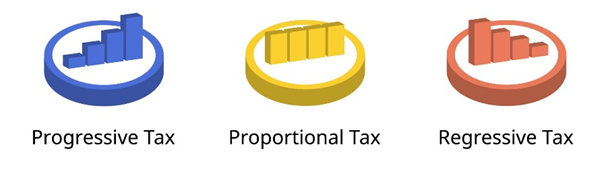
1. Progressive Taxes
A progressive tax is one where the tax rate increases as income increases.
This means:
- Higher-income individuals pay a higher percentage of their income as tax.
- Lower-income individuals pay a lower percentage.
Rationale:
This system is based on the principle of ability to pay. Those who have greater economic capacity are expected to contribute more to society.
Indian Example:
- Income Tax in India follows a progressive structure through tax slabs.
- As income rises, marginal tax rates increase.
➡️ From a UPSC perspective, progressive taxation is often linked to social justice and redistribution of income.
2. Regressive Taxes
A regressive tax is one where the effective tax rate decreases as income increases.
In practical terms:
- Lower-income groups spend a larger proportion of their income on tax.
- Higher-income groups spend a smaller proportion.
Why is it considered unfair?
Because it imposes a disproportionately heavier burden on those who can least afford it.
Indian Example:
- GST on basic necessities such as food items or clothing.
- Even if the tax rate is uniform, poorer households spend most of their income on consumption, making the tax regressive in effect.
➡️ This is why exemptions or lower GST slabs on essentials are often justified on equity grounds.
3. Proportional Taxes
A proportional tax (also called a flat tax) is one where the tax rate remains constant, regardless of income level.
Key feature:
- Everyone pays the same percentage of income or value.
- The tax burden rises in absolute terms but remains constant in relative terms.
Indian Example:
- Property Tax, where a fixed percentage of the property’s value is levied on all property owners.
➡️ Proportional taxes are considered neutral—neither explicitly redistributive nor overtly regressive.
Direct and Indirect Taxes — Based on Incidence and Burden
Another fundamental classification of taxes is based on who pays the tax and who ultimately bears its burden.
1. Direct Taxes
Direct taxes are imposed directly on individuals or entities, and their burden cannot be shifted to someone else.
Key characteristics:
- Direct relationship between taxpayer and government
- Progressive in nature
- Important for income redistribution
Indian Examples:
- Income Tax, Corporate Tax, Capital Gains Tax, Wealth Tax (historically)
Illustration:
If you earn a salary or profits, you directly pay tax to the government. There is no intermediary, and the liability cannot be transferred.
2. Indirect Taxes
Indirect taxes are initially collected from intermediaries but are ultimately borne by the final consumer.
Key characteristics:
- Burden can be shifted
- Generally regressive
- Embedded in the price of goods and services
Indian Example:
- Goods and Services Tax (GST)
Illustration:
A shopkeeper collects GST when selling goods, but the tax is included in the price. The consumer finally bears the burden, even though the government collects it from the seller.
➡️ For UPSC, remember: “Liability and incidence differ in indirect taxes.”
Cess and Surcharge — Additional Instruments of Taxation
A. Cess
A cess is a tax levied over and above an existing tax and is meant for a specific purpose.
It is often described as a “tax on tax.”
Key points:
- Applicable to all relevant taxpayers
- Collected for a clearly defined objective
- Proceeds go to the Consolidated Fund of India
Examples of Cess in India:
| Cess | Purpose | Rate |
|---|---|---|
| Swachh Bharat Cess | Cleanliness drive | 0.5% on taxable services |
| Krishi Kalyan Cess | Agricultural initiatives | 0.5% on taxable services |
| Health and Education Cess | Health & education | 4% on income tax and corporation tax |
| Road & Infrastructure Cess | Roads and infrastructure | Varies |
| Cess on Crude Oil | Educational financing | Varies |
➡️ In exam answers, always highlight “specific purpose” as the defining feature of cess.
B. Surcharge
A surcharge is an additional tax on the existing tax liability, imposed primarily on high-income individuals or entities.
Key characteristics:
- Applied on tax amount, not income
- Targeted at higher income slabs
- No specific purpose attached
- Revenue goes to the Consolidated Fund of India
Income-based Surcharge Structure (Illustrative):
| Total Income (INR) | Surcharge Rate |
|---|---|
| Up to 50 lakh | Nil |
| 50 lakh – 1 crore | 10% |
| 1 crore – 2 crores | 15% |
| 2 crores – 5 crores | 25% |
| Above 5 crores | 37% |
Note: Under the new regime, surcharge is capped at 25% (even for income above ₹5 crores)
➡️ Key distinction for UPSC:
- Cess → specific purpose
- Surcharge → general revenue
Constitutional Framework
To truly understand taxation in India, one must go back to its constitutional roots. Unlike an ordinary administrative function, taxation is a sovereign power, and therefore, the Indian Constitution carefully lays down who can levy which tax, under what authority, and to what extent.
This constitutional design ensures federal balance, legality, and accountability in the taxation system.
Constitutional Philosophy Behind Taxation
India follows a federal structure with a strong Centre, and this is clearly reflected in its taxation framework. The Constitution:
- Prevents arbitrary taxation
- Clearly demarcates taxing powers
- Recognises local self-government as a fiscal entity
- Encourages cooperative federalism, especially after GST
Let us now understand the key constitutional provisions one by one.
Article 265 — No Tax Without Authority of Law
Core Principle → “No tax shall be levied or collected except by authority of law.”
What does this mean?
- Taxation is not an executive privilege.
- Every tax must be backed by a valid law passed by → Parliament, or State Legislature (as the case may be)
Why is this important?
- Protects citizens from arbitrary or illegal taxation
- Upholds Rule of Law
- Ensures democratic legitimacy in fiscal matters
➡️ For UPSC, always associate Article 265 with constitutional limitation on taxing power.
Article 246 & Seventh Schedule — Distribution of Taxing Powers
Article 246, read with the Seventh Schedule, forms the backbone of India’s fiscal federalism.
Three Legislative Lists:
- List I – Union List
- Taxes levied exclusively by the Centre
- Example: Income tax (except agricultural income), Customs duty, Excise on certain goods
- List II – State List
- Taxes levied exclusively by States
- Example: State excise, taxes on entertainment (subject to GST changes), taxes on vehicles
- List III – Concurrent List
- Subjects where both Centre and States can legislate
- Historically limited taxation role, but important post-GST coordination
Key Idea:
- Taxing power follows legislative competence
- A government can levy a tax only if the subject falls within its list
➡️ This prevents jurisdictional overlap and fiscal conflict.
Article 246A — A New Fiscal Federalism (GST Era)
The introduction of GST required a constitutional re-engineering, and Article 246A is the result.
Article 246A(1)
- Both Parliament and State Legislatures have the power to make laws on GST.
- Reflects cooperative federalism rather than rigid separation.
Article 246A(2)
- Parliament has exclusive power to legislate GST in → Inter-state trade or commerce
Significance:
- Ensures uniformity in inter-state transactions
- Prevents fragmentation of the national market
➡️ This dual structure balances state autonomy with national economic integration.
Article 279A — GST Council
Article 279A provides for the establishment of the GST Council, a unique constitutional body.
Role of the GST Council:
- Recommends → GST rates, Exemptions, Model GST laws
- Acts as a platform for → Centre–State coordination, Consensus-based decision-making
Constitutional Importance:
- Institutionalises cooperative federalism
- Reduces fiscal disputes
- Ensures harmonised indirect taxation
Article 275 — Grants from Union to States
Not all states have equal revenue-raising capacity. Article 275 addresses this imbalance.
Key Provision:
- Allows the Centre to provide grants-in-aid to States
- Aimed at addressing revenue deficiencies
Why is this necessary?
- Promotes balanced regional development
- Supports states with weaker tax bases
- Strengthens fiscal equity across the federation
➡️ Often linked with Finance Commission recommendations in exams.
Local Government Taxation — Panchayats & Municipalities
Article 243H — Panchayats
- Introduced by the 73rd Constitutional Amendment
- Empowers Panchayats to → Levy, collect, and appropriate taxes, duties, tolls, and fees
- Subject to limits prescribed by State Legislature
Article 243X — Municipalities
- Introduced by the 74th Constitutional Amendment
- Similar fiscal powers granted to Urban Local Bodies
Why is this significant?
- Strengthens grassroots democracy
- Encourages fiscal decentralisation
- Enables local governments to fund local needs
➡️ Always mention State control and limits to show constitutional accuracy.
Putting It All Together — Practical Illustration
- Centre taxing cigarettes
→ Law by Parliament + subject in Union List - State taxing movie tickets
→ Law by State Legislature + subject in State List - Panchayat taxing property
→ Power delegated by State Legislature within prescribed limits
This illustrates a simple rule:
Authority + Subject + Constitutional Backing = Valid Tax
Tax–GDP Ratio
The Tax–GDP ratio is one of the most important indicators used to assess a country’s tax effort, fiscal capacity, and revenue mobilisation strength. It tells us how effectively an economy converts its economic output into government revenue.
What is the Tax–GDP Ratio?
The Tax–GDP ratio measures the total tax revenue collected by the government as a percentage of the country’s Gross Domestic Product (GDP).
Formula:
Tax-GDP ratio = (Total Tax Revenue / GDP) x 100
Why is it important?
- Reflects the government’s ability to raise resources
- Indicates the depth of the tax base
- Helps assess fiscal sustainability
- Used for international comparison
➡️ A higher Tax–GDP ratio generally indicates → Better tax compliance, Wider tax base, Stronger state capacity
India’s Tax–GDP Ratio: Where Do We Stand?
India’s Tax–GDP ratio has historically remained low.
- FY 2023–24: ~ 11.6%
- Developed economies (USA, UK, Germany): 25–35%
What does this gap indicate?
- India’s state collects much less tax relative to the size of its economy
- Limits government spending on → Health, Education, Infrastructure, Social security
➡️ For UPSC, this comparison is crucial in answers related to fiscal capacity and welfare expenditure.
Reasons for Low Tax–GDP Ratio in India
1. Large Informal Sector
- A substantial part of India’s economy operates outside the formal system
- Informal businesses → Are unregistered; Do not maintain proper accounts; Remain outside the tax net
➡️ Result: Low tax base despite large economic activity
2. Tax Evasion
- Underreporting of income; Concealment of assets; Use of cash transactions
These practices directly reduce tax collections, especially in → Income tax, Capital gains, corporate tax
3. Low Tax Compliance
- Complex tax laws
- Frequent procedural changes
- Time-consuming compliance requirements
This discourages voluntary compliance, particularly among → Small businesses, Self-employed individuals
➡️ Hence, compliance cost becomes a deterrent to tax honesty.
Government Initiatives to Increase the Tax–GDP Ratio
Recognising this structural weakness, the government has undertaken systematic reforms.
1. Simplification of the Tax System
- Introduction of Goods and Services Tax (GST)
- Replacement of multiple indirect taxes with a single unified tax
- Reduction in cascading effect
➡️ GST aims to formalise the economy and widen the tax base.
2. Improving Tax Administration
- Increased use of technology and data analytics
- Online filing, faceless assessments
- Reduction in discretionary powers
These measures → Lower compliance burden, Improve efficiency, Increase trust in the tax system
3. Broadening the Tax Base
- Voluntary disclosure schemes to bring undisclosed income into the tax net
- Encouraging first-time taxpayers
- Linking databases (PAN–Aadhaar, GST–Income Tax)
➡️ Objective: More taxpayers, not higher tax rates
4. Cracking Down on Tax Evasion
- Implementation of Benami Transactions (Prohibition) Act
- Confiscation of assets held under fictitious names
- Action against shell companies and black money
These steps aim to → Deter tax evasion, Improve tax morale, Strengthen enforcement credibility.
Tax Expenditure
In public finance, not all government support appears as direct spending in the Budget. A significant portion operates silently through the tax system. This brings us to the concept of Tax Expenditure—a crucial but often overlooked idea for understanding fiscal policy in India.
What is Tax Expenditure?
Tax expenditure refers to the revenue forgone by the government due to special provisions in the tax law such as → Exemptions, Deductions, Credits, Deferrals, Concessional tax rates
In simple terms, it is potential tax revenue that the government deliberately gives up to achieve certain economic or social objectives.
👉 Think of it as government spending through the tax route instead of the budget route.
Examples of Tax Expenditure in India
Some common tax incentives that lead to tax expenditure include:
- Deduction for contribution to the New Pension Scheme (NPS)
- Deduction on health insurance premiums
- Deduction on interest on loan for higher education
- Deduction on interest on housing loans
- Deduction for donations to political parties
- Deduction for donations to charitable trusts and institutions
- Higher exemption limits for senior citizens
- Higher exemption limits for super-senior citizens
Each of these reduces the taxable income of the taxpayer and, consequently, the tax revenue of the government.
Why Does the Government Use Tax Expenditure?
Tax expenditure is not accidental; it is a policy tool. The government uses it for multiple objectives.
1. Encouraging Desired Behaviour
Tax incentives are designed to nudge citizens and businesses towards activities the government wants to promote. Example: Incentives for pension savings or renewable energy investments
➡️ This reflects the idea of behavioural fiscal policy.
2. Stimulating Economic Growth
By lowering the effective tax burden:
- Businesses are encouraged to invest
- Innovation and R&D are promoted
- Employment generation is supported
Example: Tax incentives for research and development activities.
3. Reducing Tax Burden
Tax expenditure:
- Increases disposable income of individuals
- Leaves more capital with businesses
- Encourages consumption, savings, and investment
➡️ This can have a multiplier effect on the economy.
4. Addressing Social and Equity Concerns
Tax incentives can be targeted to:
- Support low-income groups
- Promote education, health, and housing
- Provide age-based relief (senior citizens)
➡️ In this sense, tax expenditure functions as an indirect welfare mechanism.
Criticisms of Tax Expenditure
Despite its usefulness, tax expenditure is not free of problems.
1. Selective and Unequal Benefits
- Benefits often accrue disproportionately to:
- Higher-income individuals
- Corporates with better tax planning capacity
- This can worsen income inequality
2. Revenue Loss to the Government
- Every exemption or deduction means less revenue
- Reduced fiscal space can:
- Constrain public spending
- Increase fiscal deficit
- Affect funding for health, education, and infrastructure
➡️ This is why tax expenditure is sometimes called “hidden deficit”.
3. Complexity and Loopholes
- Multiple exemptions complicate the tax system
- Increase:
- Compliance costs
- Scope for tax avoidance and evasion
- Undermines transparency and simplicity
4. Questionable Effectiveness
- Desired outcomes may not always materialise
- Incentives may:
- Reward behaviour that would have happened anyway
- Become permanent without periodic evaluation
➡️ This raises concerns about efficiency and cost-effectiveness.
This topic is covered under the Indian Economy notes series designed for UPSC Prelims, Mains, and Interview preparation.