
Key Events and their Impact on Stock Markets
When we try to understand the stock market, it is tempting to think that prices move only because of company-specific factors—such as profits, management decisions, or product launches. However, in reality, markets operate within a larger economic environment.
Several macro-economic events, policy decisions, and global developments constantly influence investor sentiment. Therefore, a serious student of markets must not only analyze companies but also track major economic indicators and events that shape the broader economic landscape.
Let us examine some of the most important events that influence the Indian stock market and understand how markets typically react to them.
Monetary Policy – The RBI’s Influence on the Economy
One of the most powerful drivers of the economy and financial markets is Monetary Policy. In India, monetary policy is formulated by the Reserve Bank of India (RBI), which acts as the country’s central bank. Every major economy has a similar institution—for instance, the Federal Reserve in the United States or the European Central Bank in the Eurozone.
The core objective of monetary policy is to control the supply of money in the economy, mainly by adjusting interest rates. While doing so, the RBI faces a delicate balancing act between economic growth and inflation.
If interest rates are high, borrowing becomes expensive. Corporations find it difficult to take loans for expansion, infrastructure projects slow down, and consumption weakens. As a result, economic growth tends to slow.
On the other hand, when interest rates are low, borrowing becomes cheaper. Companies invest more, consumers spend more, and economic activity increases. However, this increase in spending can also push prices upward, resulting in inflation.
Thus, the RBI must carefully calibrate interest rates to maintain a balance between stimulating growth and controlling inflation.
Inflation – The Silent Erosion of Purchasing Power
Another critical macroeconomic variable influencing the stock market is inflation.
Inflation refers to the sustained increase in the general price level of goods and services in an economy. As prices rise, the purchasing power of money declines. For example, if the price of 1 kg of onions rises from ₹15 to ₹20, the same amount of money now buys fewer goods than before.
While some level of inflation is natural and unavoidable in a growing economy, excessively high inflation creates economic instability. High inflation increases uncertainty, reduces consumer purchasing power, and discourages investment. As a result, markets generally view rising inflation negatively.
Index of Industrial Production (IIP)
The Index of Industrial Production (IIP) is an important indicator that measures the short-term performance of India’s industrial sector.
Published monthly by MOSPI, the IIP tracks production levels across various industries such as manufacturing, mining, and electricity. The index measures changes relative to a base year, which serves as the reference point.
Approximately 15 major industries report their production data, which is then compiled into the IIP index.
If the IIP increases, it indicates rising industrial activity, stronger production, and expanding economic growth. This is generally seen as positive for the stock market.
Conversely, if the IIP declines, it signals slowing industrial activity, which can dampen investor confidence.
Interestingly, a weak IIP figure often puts pressure on the RBI to reduce interest rates to stimulate industrial growth through cheaper credit.
Purchasing Managers’ Index (PMI)
The Purchasing Managers’ Index (PMI) is another widely tracked economic indicator that reflects the health of business activity.
Unlike IIP, PMI is survey-based. It collects responses from purchasing managers of companies regarding their perception of business conditions compared to the previous month.
Separate surveys are conducted for Manufacturing sector and Services sector
The survey covers several aspects such as:
- New orders
- Production output
- Employment levels
- Business expectations
The PMI value usually fluctuates around 50, which serves as the neutral benchmark:
- Above 50 → Economic expansion
- Below 50 → Economic contraction
- Exactly 50 → No change in business conditions
Because PMI reflects current business sentiment, markets track it closely for early signals about economic trends.
Union Budget – Policy Direction of the Economy
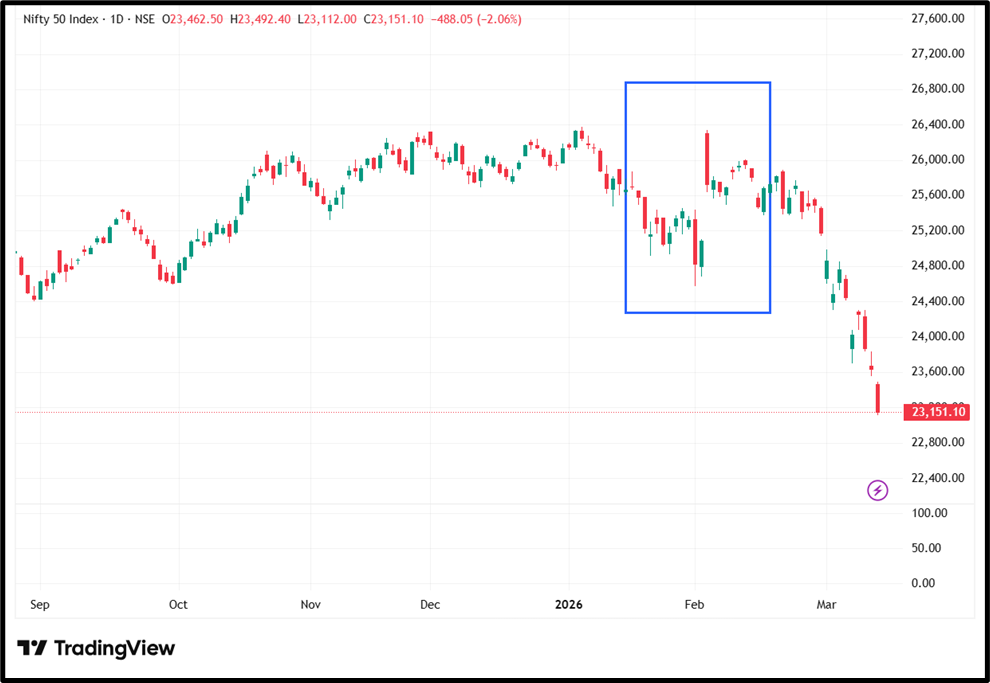
The Union Budget is one of the most significant annual economic events in India.
Every year, the Finance Minister presents the budget on behalf of the Ministry of Finance, outlining the government’s:
- Revenue and expenditure plans
- Tax policies
- Fiscal deficit targets
- Sectoral incentives and reforms
Since budget announcements often involve policy changes, they can have immediate effects on different industries.
For example, if the government increases excise duty on cigarettes, the price of cigarettes rises. Higher prices may reduce consumption, which could lower the profits of cigarette companies such as ITC.
Since ITC is a heavyweight stock in market indices, a fall in its share price can even drag down the broader stock market.
Thus, the Union Budget often triggers sharp movements in sector-specific stocks.
Corporate Earnings Announcements
Apart from macroeconomic indicators, company-specific events also significantly affect stock prices. One of the most important among them is the quarterly earnings announcement.
All listed companies are required to publish their financial results every quarter, providing detailed information about their business performance.
These announcements include data on:
- Revenue growth
- Expenses
- Profitability
- Debt and finance costs
- Industry outlook
- Future business guidance
Market participants compare the announced earnings with what analysts expected. These expectations are called “street expectations.”
- If earnings exceed expectations, stock prices usually rise.
- If earnings fall below expectations, stock prices tend to decline.
- If earnings merely match expectations, the reaction is often neutral or slightly negative because markets prefer positive surprises.
Non-Financial Events – The Unpredictable Forces
Finally, markets are also influenced by non-financial or geopolitical events.
These include events such as:
- Global pandemics (e.g., COVID-19)
- Wars (e.g., Russia–Ukraine conflict)
- Geopolitical tensions (e.g., China–Taiwan tensions)
- Elections and political developments
Such events can disrupt global supply chains, increase commodity prices, and create economic uncertainty.
For example, the Russia–Ukraine war disrupted natural gas and crude oil supplies, increasing energy prices worldwide. This had ripple effects across multiple industries globally.
Similarly, domestic political events such as general elections in India can influence investor confidence and impact the stock market.
Concluding Insight
Therefore, the stock market is not merely a reflection of corporate performance. It is deeply intertwined with economic indicators, government policies, global developments, and investor expectations.
A successful trader or investor must continuously monitor:
- Monetary policy decisions
- Inflation trends
- Industrial production data
- Business sentiment indicators like PMI
- Budget announcements
- Corporate earnings
- Global and geopolitical events
In essence, the stock market behaves like a mirror of the broader economy. Understanding these macro events helps investors anticipate market reactions and make more informed decisions.
This article forms part of the broader Indian Economy syllabus for UPSC preparation.