
Buddhist Architecture
Now we enter a very foundational dimension of Indian architecture — Buddhist Architecture.
If Hindu temples represent the cosmic body of divinity,
Buddhist architecture represents the spiritual memory of the Buddha.
It is quieter, more symbolic, and deeply meditative.
Buddhist architecture broadly consists of → Stupas, Chaityas, Viharas
🟡 Stupas
A Stupa is a mound-like structure containing Buddhist relics and used as a sacred site for worship.
Its origin is very interesting.
Before Buddhism, India had earthen burial mounds.
Buddhism adopted this form and transformed it into a sacred monument.
After the Mahaparinirvana of the Buddha, his relics were distributed.
Later, Emperor Ashoka built stupas across India to enshrine these relics.
Thus, the stupa becomes → Architecture of remembrance.
Types of Stupas
- Relic Stupa – Contains actual relics
- Commemorative Stupa – Marks important events in Buddha’s life
- Votive Stupa – Built as offering in fulfilment of a vow
Important associated places:
- Lumbini (Birth)
- Gaya (Enlightenment)
- Sarnath (First Sermon)
- Kushinagar (Mahaparinirvana)
Architectural Components of a Stupa
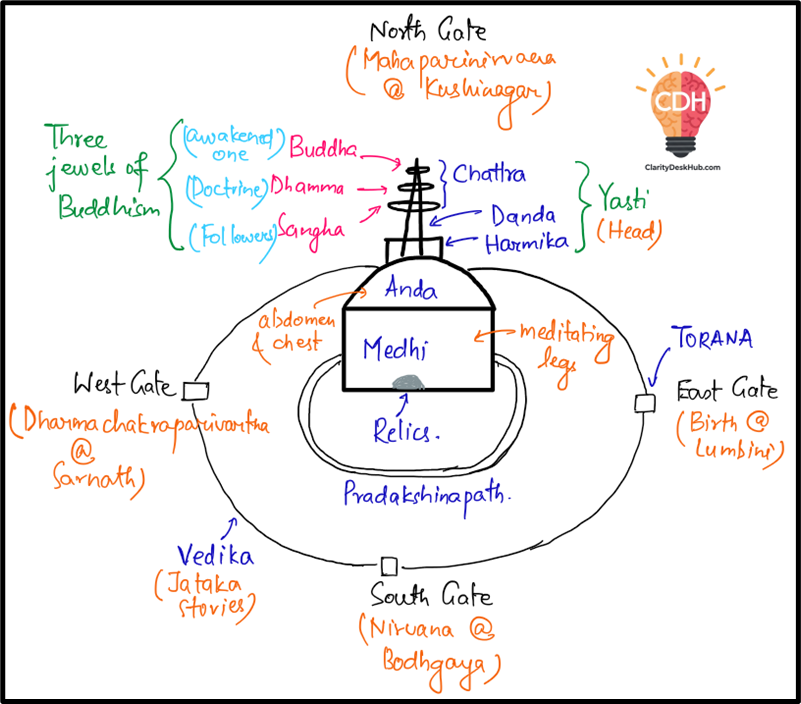
Let us decode the symbolism of each element.
1️⃣ Anda
- Hemispherical mound
- Solid, cannot be entered
- Originally built of earth, later brick or stone
- Relics buried inside
Symbolism → Cosmic womb, Burial mound, World mountain
2️⃣ Harmika
- Square railing on top of the dome
- Marks sacred space
It represents the abode of the gods.
3️⃣ Chattri (Triple Umbrella)
- Central pillar with three umbrella discs
- Symbolizes the Three Jewels → Buddha, Dharma, Sangha
It also signifies spiritual sovereignty.
4️⃣ Torana
- Ornamental gateway
- Two vertical pillars + three horizontal beams
- Located at cardinal directions
These are richly carved with → Jataka tales, Folk motifs, Symbolic representations of Buddha
5️⃣ Medhi
- Circular terrace
- Used for circumambulation (Pradakshina)
6️⃣ Vedika
- Stone railing surrounding the stupa
- Composed of horizontal and vertical members
The railing separates sacred from secular.
🏛️ Sanchi Stupa
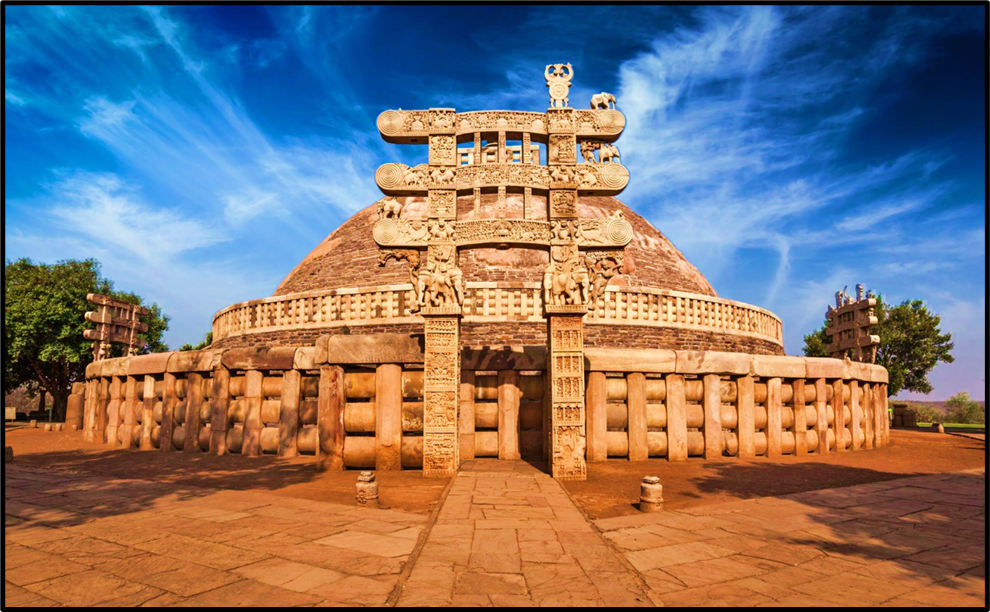
Located in Madhya Pradesh.
Originally built by Emperor Ashoka in the 3rd century BCE.
Initially:
Simple brick hemispherical mound
Later (Shunga period):
- Enlarged to twice its size
- Stone casing added
- Wooden railing replaced with stone
In 1st century BCE:
- Four toranas added
- Donated partly by King Satakarni (inscription evidence)
Sanchi shows how a simple relic mound evolves into monumental sacred architecture.
🏛️ Dhamek Stupa (Sarnath)
Located at Sarnath (Deer Park).
Marks the place where Buddha delivered his first sermon.
Current structure:
- Built during Gupta period
- Replaced earlier Ashokan structure
Features:
- 43 meters tall; 28 meters wide
- Cylindrical
- Lower part decorated with floral carvings; Upper portion unfinished
It reflects Gupta-era refinement.
🏛️ Barhut Stupa
Located in Madhya Pradesh (now largely in ruins).
Built around 250 BCE during Ashoka’s time; expanded during Shunga period.
Features:
- Stone railing (Vedika); Toranas; Numerous inscriptions; Donor names recorded
Panels depict:
- Jataka tales; Yakshas and Yakshinis;
- The Dream of Maya (white elephant entering her body)
Important point:
Early Buddhist art does not depict Buddha in human form.
Instead, symbols like → Bodhi tree, Empty throne, Footprints
This is called Aniconism.
🟢 Chaityas
Now we move from relic monument to congregational hall.
The word “Chaitya” means sacred spot.
Chaityas were → Prayer halls; Teaching spaces; Places for interaction between monks and lay followers
Architectural Features of Chaityas
- Entrance doorway; Long hall; Vaulted roof
- Apsidal (semi-circular) end
- Stupa at the end
- Path for circumambulation around stupa
The roof often imitates wooden beams, even in stone.
This shows continuity from timber architecture.
🔵 Viharas
Viharas were monasteries — residential complexes for monks.
Unlike Chaityas (congregational), Viharas were residential.
Features of Viharas
- Entrance doorway; Central hall; Cells for meditation; Dining chambers
- Shrine containing Buddha image (in later period)
Important sites → Ajanta, Ellora, Karle, Kanheri, Bagh, Badami
In later Mahayana phase, Buddha images appear inside viharas.
This article forms part of the broader Art and Culture syllabus for UPSC preparation.