
Islamic Architecture
Now we move to a very different architectural language.
With the establishment of the Delhi Sultanate, Islamic architectural principles entered India.
Gradually, a synthesis developed — called Indo-Islamic Architecture.
This synthesis happened because:
- Persian-Central Asian ideas met Indian craftsmanship
- Local artisans adapted new structural techniques
Core Features
Structural Innovations
- True Arch (first in Balban’s tomb)
- True Dome (first perfected in Alai Darwaza)
- Use of arches, domes, minarets
Earlier Indian architecture used corbelled arches. Islamic architecture introduced the true voussoir arch.
Decorative Features
- Calligraphy (Kufi script), Geometric patterns, Arabesque motifs, Floral designs
Instead of anthropomorphic images, decoration became abstract.
Spatial Features
- Courtyards with cloisters, Gardens (Charbagh under Mughals), Symmetry and axial planning
Materials of Construction
Early phase:
- Spolia from demolished temples
- Example: Quwwat-ul-Islam Mosque
Later developments:
- Rubble masonry, Lime plaster (chunam), Quartzite, Sandstone, Marble, Polychrome tiles
Gradually, construction becomes more refined.
Three Streams of Islamic Architecture in India
- Delhi Sultanate (Imperial Style)
- Mughal Architecture
- Regional Islamic states
Let us now examine the Delhi Sultanate phases.
Architecture under the Delhi Sultanate
Islamic architecture evolved in stages.
1️⃣ Early Stage
- Local artisans used, Lintel-and-slab method continued,
- Transitional phase
2️⃣ Khalji Phase
Distinct Central Asian influence.
Features → True dome, Recessed arches, Red sandstone, Decorative marble relief, Bold calligraphy, Arabesque patterns
Alai Darwaza is the first true Islamic construction in India.
3️⃣ Tughluq Phase
Features → Stone rubble masonry; Thick battered (sloping) walls; High platforms; Four-centred arch with beam support; Encaustic tiles; Octagonal tomb plans; Reduced ornamentation
Architecture becomes more austere and massive.
4️⃣ Lodhi Phase
Delhi looked like a sprawling graveyard (qabristan). Two types of tombs:
Octagonal plan
- Central chamber
- Surrounded by arched verandah
- Projecting eaves
Square plan
- No verandah
- Simpler form
Important innovation:
- Double dome
- First example: Tomb of Sikandar Lodi
Double dome allows:
- Impressive exterior height
- Proportionate interior space
Major Monuments of Delhi Sultanate
🕌 Quwwat-ul-Islam Mosque
- Built by Qutb-ud-din Aibak (1198 CE)
- First mosque in Delhi
- Constructed using remains of 27 temples (inscription evidence)
Shows transitional Indo-Islamic experimentation.
🗼 Qutub Minar
- 70 meters high; Five storeys
- Begun by Aibak → Completed by Iltutmish → Restored by Firuz Shah Tughlaq
Contains inscriptions in → Arabic and Nagari script
Symbol of victory and Islamic sovereignty.
🕌 Alai Darwaza
- Built by Ala-ud-din Khalji
- First monument built entirely using Islamic structural methods
- True dome and arch perfected
Marks architectural maturity.
Architecture under the Mughals.
If the Delhi Sultanate introduced structural innovations like the true arch and dome,
the Mughals perfected them into symmetry, elegance, and monumental beauty.
Let us understand this evolution.
🌿 Foundations of Mughal Architecture
Mughal architecture is a synthesis of:
- Indo-Islamic architectural base (from Delhi Sultanate)
- Persian grandeur and garden planning
- Hindu decorative refinement and craftsmanship
Core Features
- Large bulbous domes; Slender corner minarets; Massive vaulted gateways
- Symmetrical planning; Delicate ornamentation
- Red sandstone + white marble
- Charbagh (four-part garden layout)
The Mughal building is not just a structure — it is a carefully composed visual balance.
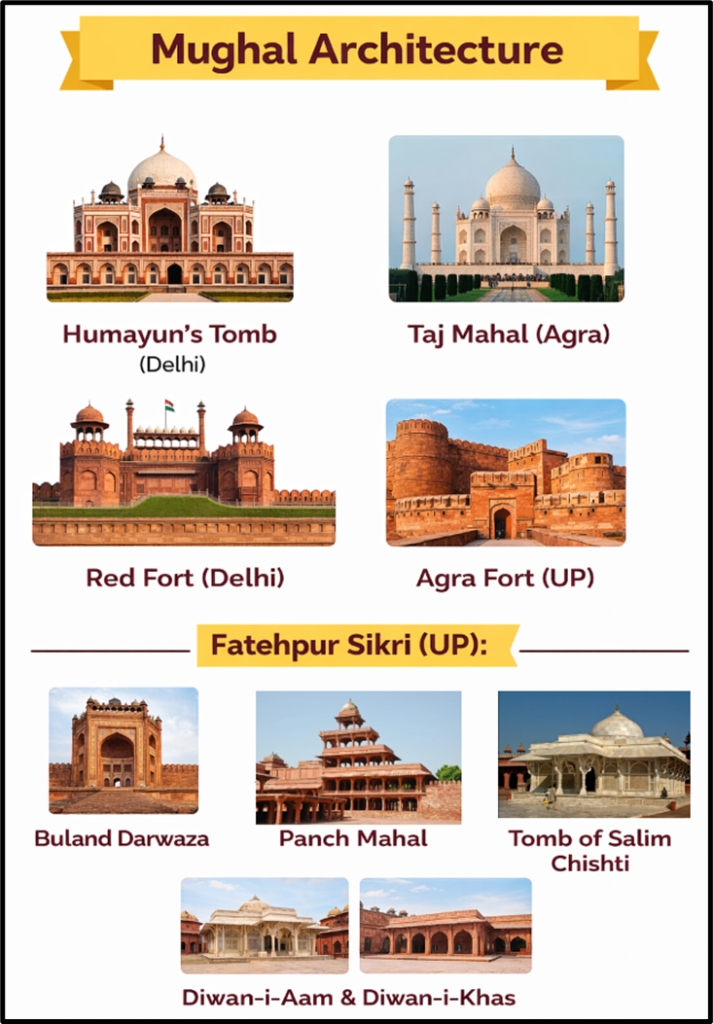
🟢 Babur (1526–1530)
Babur did not build many monumental structures.
His contribution was mainly:
Garden Architecture
- Persian Chahar Bagh style
- Terraced gardens
- Water channels
Example:
- Aram Bagh (Agra)
He also built Kabuli Bagh Mosque (Panipat)
Mughal architecture begins with landscape planning rather than grand monuments.
🟡 Humayun (1530–1540; 1555–56)
Humayun himself built little. But his tomb marks a turning point.
🏛️ Humayun’s Tomb (Delhi)
- Built during Akbar’s reign
- First garden-tomb in India
- Red sandstone + white marble
- Central dome
- Symmetrical charbagh layout
It is considered the precursor of the Taj Mahal. Here we see the mature Persian garden-tomb concept entering India.
🔵 Akbar (1556–1605)
Akbar is the real initiator of Mughal architectural identity.
His architecture reflects → Strength, Experimentation, Cultural synthesis
🏙️ Fatehpur Sikri (Uttar Pradesh)
Fatehpur Sikri, meaning the “City of Victory”, was established by Emperor Akbar as his imperial capital, located about 40 km from Agra in present-day Uttar Pradesh. It represents a remarkable example of Mughal architectural synthesis, blending Persian, Central Asian, and indigenous Indian styles.
The city was not merely a political centre but also a cultural and intellectual hub, reflecting Akbar’s vision of religious tolerance, administrative innovation, and artistic excellence.
One of the most distinctive features of Fatehpur Sikri is the diversity of its structures—ranging from religious spaces and palaces to administrative halls and recreational buildings.
These structures collectively illustrate Akbar’s inclusive ideology, especially visible in spaces like the Ibadat Khana, where interfaith dialogues were encouraged, and in architectural motifs that combine Hindu and Islamic elements.
Major Structures
| Structure | Description | Key Features / Significance |
| Ibadat Khana | House of Worship | Venue for discussions among scholars of different religions; reflects Akbar’s policy of Sulh-i-Kul (universal tolerance) |
| Buland Darwaza | Grand gateway to Jama Masjid | Built to commemorate Gujarat victory; 41 m high (highest gateway); Persian inscription mentioning Jesus and Quranic verses in Naskh script |
| Jodha Bai Palace | Residence of Mariam-uz-Zamani | Largest palace; built in red sandstone; fusion of Hindu + Persian styles; includes temple, Tulsi math, and Krishna motifs |
| Maryam’s Palace | Named after Akbar’s mother | Known as Golden Palace due to gold paintings; depicts scenes like Rama worshipped by Hanuman |
| Panch Mahal | Five-storeyed palace | Inspired by Buddhist vihara style; entirely columnar; used for recreation; overlooks Anup Talao |
| Anup Talao | Ornamental water tank with pavilion | Central platform connected by four bridges (Char-Chamad); used for entertainment and cultural performances |
| Tomb of Salim Chishti | Mausoleum of Sufi saint | White marble structure; located in Jama Masjid courtyard; reflects Gujarat Sultanate style |
| Jama Masjid | Congregational mosque | Among the earliest buildings; religious centre of the complex |
| Diwan-i-Aam | Hall of Public Audience | Venue where Akbar addressed common people |
| Diwan-i-Khas | Hall of Private Audience | Used for discussions with nobles and advisors |
| Other Buildings | Administrative & utility structures | Includes Birbal’s House, Hiran Minar (Elephant Tower), Karkhana (workshop), Khazana (treasury), Hammam (Turkish baths) |
🟣 Jahangir (1605–1627)
Jahangir was more interested in painting.
But his reign refined Mughal ornamentation.
🏛️ Tomb of Itmad-ud-Daula (Agra)
- First Mughal building fully in white marble
- Extensive pietra dura inlay
- Called “Baby Taj”
This marks transition from red sandstone to marble elegance.
🔴 Shah Jahan (1628–1658)
He represents the zenith of Mughal architecture.
His style is → Symmetrical, Refined, Marble-dominated, Delicate
🌟 Taj Mahal (Agra)
- Built in memory of Mumtaz Mahal
- White marble; Pietra dura inlay; Perfect symmetry
- Bulbous dome; Four minarets; Charbagh layout
Architect → Ustad Ahmad Lahori
It represents balance, proportion, and emotional architecture.
🏰 Red Fort (Delhi)
- Built for new capital Shahjahanabad
- Red sandstone exterior
- Marble interiors
- Lahore Gate & Delhi Gate
Inside → Diwan-i-Aam, Diwan-i-Khas, Moti Masjid (later added by Aurangzeb)
🏰 Agra Fort
Originally developed by Akbar.
Shah Jahan added → White marble palaces, Moti Masjid, Shish Mahal (glass mosaic work)
Historical significance:
- Aurangzeb imprisoned Shah Jahan here
- Shivaji visited Diwan-i-Khas (1666)
Agra Fort reflects layered Mughal history.
⚫ Aurangzeb (1658–1707)
Period of decline in Mughal architecture.
Main monument:
🕌 Badshahi Mosque (Lahore)
- Red sandstone + marble
- Largest Mughal mosque
- Last imperial mosque
Architecture becomes simpler and less ornamental.
Comparative Overview
| Emperor | Architectural Character |
|---|---|
| Babur | Gardens |
| Humayun | Garden-tomb foundation |
| Akbar | Strength + synthesis |
| Jahangir | Ornamentation refinement |
| Shah Jahan | Marble elegance & symmetry |
| Aurangzeb | Simplicity & decline |
Architecture of Regional Islamic States.
Once the Delhi Sultanate weakened, regional powers emerged.
And with political autonomy came architectural individuality.
These regional styles reflect:
- Local materials
- Climate
- Indigenous craftsmanship
- Interaction between Islamic forms and regional traditions
Let us examine them one by one.
🟤 Bengal Style (Islamic Bengal)
Centres: Gaur and Pandua
Early Phase
- Adeena Masjid (14th century, Pandua)
- Built using remains of Indian temples
- Large hypostyle hall
Later Phase – Semi-Indigenous Style
Bengal had → Heavy rainfall, Lack of stone, Abundant clay
So, architecture adapted.
Key Features:
- Curved roofs (inspired by bamboo huts)
- Terracotta tile decoration
- Brick construction
Thus, Islamic architecture in Bengal absorbed local environmental logic.
This is a perfect example of Climate shaping architecture.
🟠 Jaunpur Style (Sharqi Architecture)
Founded by Malik Sarwar in 1394.
Capital: Jaunpur (Uttar Pradesh).
Influence: Strongly derived from Tughluq style.
Key Features
- Battered walls
- Arch-beam combination
- Massive imposing gateways
- Minimal ornamentation
Important monuments → Atala Masjid, Jami Masjid
Jaunpur architecture emphasizes monumental façade over intricate decoration.
🟣 Malwa Style
Centres → Dhar, Mandu, Chanderi
Tughluq architectural influence visible.
Features → Battered walls, Arch-beam combination, Use of coloured stones, Marble inlay, Decorative tilesRepresentative monument:
Jahaz Mahal (Mandu)
- Built between two artificial lakes
- Appears like a floating ship
Malwa style blends strength with aesthetic colour variation.
🟢 Gujarat Style
Developed under Gujarat Sultans.
Unlike Deccan, Gujarat style strongly absorbed indigenous temple traditions.
Key Features
- Slender minarets; Intricate jali work
- Temple-like carved pillars; Rich ornamentation
Major examples:
- Jami Masjid (Ahmedabad); Rani Sabrai Mosque
- Muhafiz Khan Mosque; Champaner Jami Masjid
The famous Sidi Saiyyed jali (tree of life motif) represents peak stone carving skill.
This is Indo-Islamic synthesis at its finest.
🔵 Deccan Style
The Deccan region developed a distinct style.
Influences → Tughluq architecture, Persian architecture
Less borrowing from local temple tradition (compared to Gujarat).
Gulbarga
Jami Masjid features → Wide arches, Low piers, Enclosed courtyard
Bidar
Features: Fine coloured tile decoration; Strong Persian influence
Important monument: Madrasa of Mahmud Gawan
Bijapur
The most famous Deccan monument:
Gol Gumbaz1
- Mausoleum of Mohammad Adil Shah
- Massive dome
- One of the largest single-chamber structures in the world
- Whispering gallery effect
Architectural ambition here becomes structural engineering excellence.
🌙 Chand Minar (Daulatabad)
- 63 metres high, Four storeys
- Built by Bahmani rulers
- Commemorates victory over Vijayanagar (1443)
Resembles Qutub Minar but includes indigenous bracket supports.
Represents Indo-Islamic adaptation in South India.
⚪ Kashmir Style (Kashmir Sultanate)
Centres → Srinagar
Distinct due to strong indigenous (Himalayan + Buddhist) influence
Key Features:
- Extensive use of wood (due to availability of timber)
- Pagoda-style pyramidal roofs (influenced by Buddhist architecture)
- Absence of large minarets
- Multi-tiered sloping roofs suited to snowfall
- Large courtyards with wooden colonnades
Representative Monument: 🕌 Jama Masjid, Srinagar (1394 CE)2
- Built under Sultan Sikandar Shah Mir, later rebuilt by Zain-ul-Abidin
- 370+ wooden pillars
- Pagoda-like roof structure
- Persian layout + local construction techniques
👉 This style represents maximum regional adaptation of Islamic architecture in India
Comparative Overview
| Region | Key Character |
|---|---|
| Bengal | Curved roofs + terracotta |
| Jaunpur | Massive gateways |
| Malwa | Colour + stone beauty |
| Gujarat | Indigenous carving fusion |
| Deccan | Persian influence + engineering ambition |
| Kashmir | Wood + Pagoda Roof |
This article forms part of the broader Art and Culture syllabus for UPSC preparation.
One Comment