
Musical Instruments
Now we come to the instrumental dimension of Indian music.
If raga is the soul and tala is the rhythm, then instruments are the vehicles through which this inner vibration becomes audible.
Indian tradition classifies musical instruments into four major categories. This classification is ancient and appears in texts like the Natya Shastra. It is not arbitrary — it is based on the principle of sound production.
Let us understand this.
Classification of Musical Instruments
Indian music divides instruments into four types:
- Tata Vadyas (String instruments)
- Avanaddhya Vadyas (Percussion instruments with membrane)
- Ghana Vadyas (Solid or idiophone instruments)
- Sushir Vadyas (Wind instruments)
This classification is based on how sound is produced.
1. Tata Vadyas (String Instruments / Chordophones)
These are instruments where sound is produced by vibrating strings.
They are of two main types:
- Plucked (with fingers or plectrum)
- Bowed (with a bow)
Examples → Sitar (plucked); Sarangi (bowed)
2. Avanaddhya Vadyas (Membranophones)
- “Avanaddhya” means “to be covered.” These are drums where a leather membrane covers a hollow body. They are primarily used for rhythm.
- According to Indian tradition: All drums originated from the damru of Lord Shiva.
- Examples → Tabla, Mridangam, Pakhawaj
3. Ghana Vadyas (Idiophones)
- These are solid instruments. Sound is produced by → Striking, Shaking, Scraping
- They do not require tuning and cannot produce precise melodic pitches. Hence, they are used mainly for rhythmic support.
- They are considered the earliest instruments used by humans.
- Examples → Manjira, Ghatam, Kartal
4. Sushir Vadyas (Wind Instruments)
- These produce sound through air vibration. They may be → Mouth-blown, Bellows-blown
- Examples → Flute, Shehnai, Trumpet, Bugle
- In India, flutes are traditionally made from bamboo.

Important String Instruments
Let us now examine major string instruments individually.
1. Sitar
- Plucked string instrument; Long neck; Seven strings (5 steel, 2 brass)
- Mainly used in Hindustani music
It played a major role in introducing Indian classical music to the West.
Most famous exponent → Ravi Shankar
2. Sarod
- Believed to have evolved from the Afghan Rebab
- Fretless; Deep, resonant tone
Famous exponent → Amjad Ali Khan
3. Veena (Saraswati Veena)
- One of the oldest instruments mentioned in Vedic texts
- Primarily used in Carnatic music; Popular in South India
- Considered counterpart of Sitar in the South
It is culturally associated with Goddess Saraswati.
4. Santoor
- Folk instrument of Kashmir; Used in Sufiana Kalam
- Trapezoid-shaped; Played with lightweight wooden hammers (mezrab)
Believed to be related to ancient Shatatantri Veena.
5. Tambura (Tanpura)
- Long-necked instrument; Usually 4 or 5 strings
- Provides harmonic drone
- Essential in both Hindustani and Carnatic music
- In North India → Made of dry gourd
- In South India → Made of wood
Tambura does not play melody — it sustains the tonal base (Sa).
6. Sarangi
- Bowed string instrument
- Considered closest to human voice
- Powerful accompanying instrument in Hindustani music
Its tonal depth makes it ideal for vocal accompaniment.
7. Dilruba
- Combination of Sitar and Sarangi
- Has frets like Sitar; Skin-covered belly like Sarangi
- Played with bow
Common in Sikh devotional music
8. Gottu Vadyam (Chitra Veena)
Also known as Chitra Veena or Maha Nataka Veena
- Important Carnatic concert instrument
- Similar to Veena, but unlike Veena, it has no frets
- Like the tambura, it is supported at the neck and has four strings.
9. Rabab
- National instrument of Arabs which reached India via the Middle East
- Popular in Kashmir; Flourished during Mughal period
Associated with Guru Nanak’s companion Bhai Mardana
In Tansen’s lineage:
- Rababiyas (used Rabab)
- Binkars (used Veena)

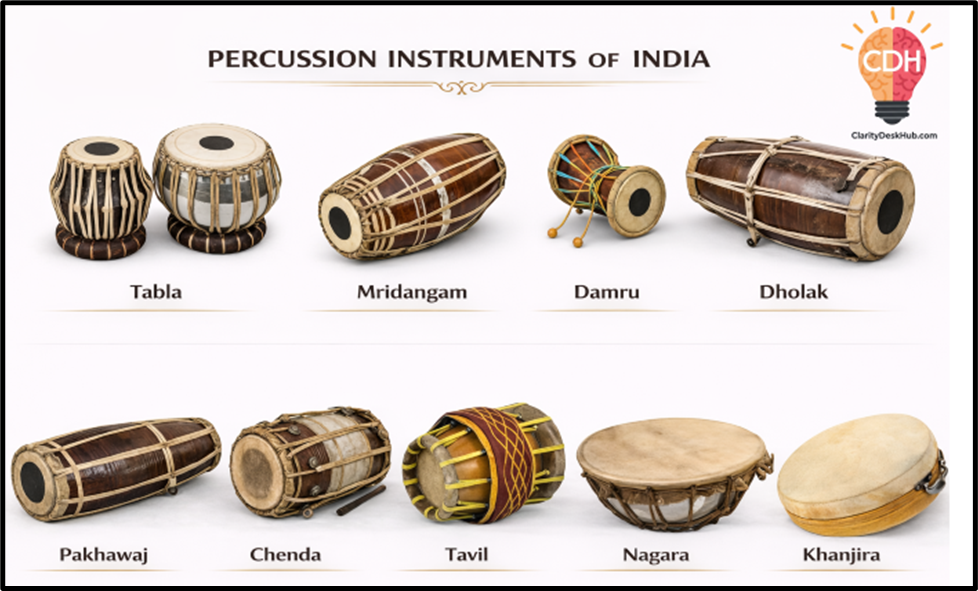
Percussion Instruments (Avanaddhya Vadyas)
These are instruments where sound is produced by striking a stretched membrane.
1. Tabla
- The most iconic percussion instrument of Hindustani music.
- It consists of two drums:
- Dayan → Smaller drum (played with dominant hand)
- Bayan → Larger drum (played with non-dominant hand)
- Used in → Hindustani classical, Devotional music, Ghazal, Mehfils
- Legendary exponent → Zakir Hussain
- Tabla allows intricate rhythmic improvisation.
2. Mridangam
- Primary percussion instrument of Carnatic music.
- Meaning → “Body of clay” (Mrid + Anga)
- Barrel-shaped; Double-headed
- Central to Carnatic rhythm
- In Bengal, a smaller variant is called → Khol or Srikhol
3. Damru
- Hourglass-shaped
- Associated with Shiva Nataraja; Symbol of cosmic rhythm
Indian tradition holds that all drums originated from Shiva’s damru.
4. Dholak / Dhol / Dhak
- Two-headed hand drum
- Used in folk and Bollywood music
Variations:
- Dhol → Smaller, popular in North India
- Dhak → Larger, used during Durga Puja in Bengal
- Dholkee → Smaller, often used by women
Played:
- Suspended from neck; On lap; On ground
5. Pakhawaj
- Barrel-shaped drum
- Used in Dhrupad singing; Popular in North India
It predates the tabla and has a deeper, majestic tone.
6. Chenda
- Cylindrical drum
- Popular in Kerala; Used in Thrissur Pooram, Kathakali, Koodiyattam
It produces powerful, high-volume sound.
7. Tavil
- Barrel-shaped
- Used in Tamil Nadu; Traditionally accompanies Nadasvaram
8. Nagara (Naqqara)
- Kettle drum
- Used in temples and processions; One of the oldest percussion instruments
Two drums:
- Madi (female) → higher pitch
- Nar (male) → lower pitch
9. Khanjira
- Frame drum; Supporting instrument in Carnatic music
- One of the oldest folk instruments
10. Mandar
- Double-headed, barrel-shaped folk drum — a membranophone (Avanaddhya Vadya) of the Chotanagpur plateau; hollow red-clay shell with a central bulge.
- Animal-hide heads of unequal size — the narrower right head gives a higher pitch, the broader left head a deep bass; tuned with leather lacing and a black tuning paste; slung from the shoulder so the drummer can dance while playing.
- Integral to the Oraon, Munda, Santhal and Ho communities (Sarhul, Karma, weddings). Received the Geographical Indication (GI) tag in 2026 (Jharkhand), adding to the State’s GI basket and protecting tribal artisans from imitations.
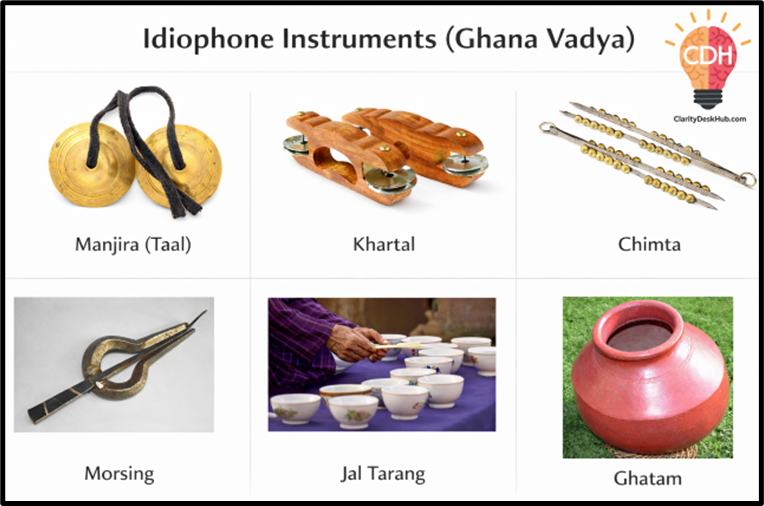
Idiophone Instruments (Ghana Vadyas)
These produce sound through the vibration of the solid body.
1. Manjira (Taal)
- Small brass cymbals
- Used in bhajans and devotional songs
2. Khartal
Means: “Rhythm of the hands”
- Wooden clapper | Used in folk and devotional music
3. Chimta
- Pair of metal tongs with jingles
- Popular in Punjab; Used in bhajans and folk songs
4. Morchang (Morsing)
- Metal instrument with vibrating tongue
- Secondary rhythmic instrument; Used in both Hindustani and Carnatic traditions
5. Jaltarang
- Set of porcelain bowls filled with water
- Struck with bamboo sticks; Pitch varies with water quantity
Unique melodic idiophone.
6. Ghatam
- Earthen pot instrument | Played with bare hands | Used in both classical and folk music
Also known as → Matki, Gagri, Noot
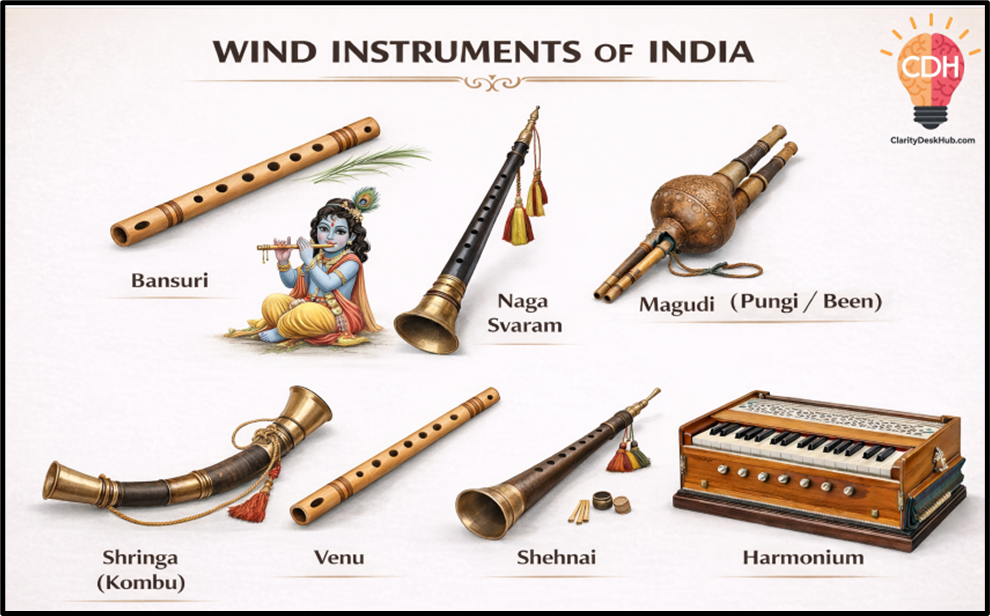
Wind Instruments (Sushir Vadyas)
Sound is produced by air vibration.
1. Bansuri / Venu
- Bamboo flute;
- Mentioned in Vedic texts | Found in sculptures of Sanchi & Amaravati | Seen in Ajanta paintings
Closely associated with Lord Krishna
Two main types:
- Bansuri (North, 6 holes)
- Venu (South, 8 holes)
2. Nadasvaram
- Ancient Tamil instrument; Longer than Shehnai
- Considered auspicious; Used in temples and weddings
3. Magudi (Pungi / Been)
- Traditionally played by snake charmers
- Also called Bhujanga Swaram
4. Shringa / Kombu
- Horn instrument
- Shringa (North); Kombu (South)
5. Shehnai
- Tube-like wind instrument; Played at weddings and religious events
Legendary exponent → Bismillah Khan
6. Harmonium
- Reed-based keyboard instrument
- Brought by Westerners; Hand-pumped version developed in India
Invented (foot-pumped version) in Paris in 1842.
Widely used in → Bhajans, Ghazals, Classical accompaniment
Western Instruments in Indian Music
Indian music incorporated Violin, Guitar, Clarinet, Mandolin
Violin is now indispensable in Carnatic concerts.
This topic is covered under the Art and Culture notes series designed for UPSC Prelims and Mains preparation.