
Hinduism in India
Hinduism is regarded as one of the oldest and most continuous religious traditions in the world. Its origins can be traced to the Vedic period (around 1500 BCE) when the earliest sacred hymns known as the Vedas were composed. Unlike many other religions that emerged through the teachings of a single prophet or founder, Hinduism developed gradually through the interaction of diverse philosophical ideas, rituals, and cultural traditions over thousands of years. It represents a broad and flexible spiritual tradition rather than a rigidly defined religious system.
The earliest foundations of Hindu thought are found in the Vedas (1500–600 BCE), which laid down ritual practices, cosmological ideas, and philosophical reflections. Over time, these ideas evolved through later texts such as the Upanishads, which emphasised spiritual knowledge, and the epics like the Mahabharata and Ramayana, which conveyed ethical and moral teachings through narrative traditions. Legal and social principles were articulated in texts such as the Manusmriti and other Dharmashastras. Together, these texts created a vast intellectual tradition that shaped Indian society, ethics, and worldview.
A central idea in Hindu philosophy is the pursuit of Purusharthas, the four fundamental aims of human life: Dharma (righteous duty), Artha (material prosperity), Kama (desire and enjoyment), and Moksha (liberation). These ideals guide individuals in balancing worldly responsibilities with spiritual aspirations. Hinduism also emphasises Karma (the law of cause and effect) and Samsara (the cycle of birth and rebirth), suggesting that an individual’s actions determine future lives until liberation (Moksha) is achieved.
Another characteristic feature of Hinduism is its pluralistic and inclusive nature. It recognises a vast pantheon of deities, such as Brahma (creator), Vishnu (preserver), and Shiva (destroyer), who symbolise different aspects of cosmic order. At the philosophical level, however, many traditions emphasise the unity of the ultimate reality (Brahman) and the individual soul (Atman). Hindu philosophy also developed multiple schools of thought, notably Vedanta and Yoga, which propose different paths—knowledge, devotion, or action—for spiritual liberation.
In contemporary India, Hinduism remains the largest religion, followed by nearly 79.8% of the population according to the 2011 Census. It continues to shape cultural practices, festivals, and social traditions across the country, with celebrations such as Diwali and Holi reflecting the enduring vitality of Hindu religious life.
Major Features of Hindu Religion
| Feature | Explanation |
| Polytheism | Hinduism recognises a large number of gods and goddesses. The Trimurti—Brahma (creator), Vishnu (preserver), and Shiva (destroyer)—symbolise different cosmic functions. |
| Purushartha (Four Goals of Life) | The guiding framework of human life: Dharma, Artha, Kama, and Moksha. |
| Dharma | Moral and ethical duties guiding an individual’s behaviour according to social and personal responsibilities. |
| Artha | Pursuit of material prosperity, career, and economic well-being necessary for a fulfilling life. |
| Kama | Desires, pleasures, emotional fulfilment, and appreciation of art and beauty. |
| Moksha | Liberation from the cycle of birth and rebirth (Samsara), considered the ultimate spiritual goal. |
| Karma and Reincarnation | The belief that actions (karma) influence future births, reinforcing moral responsibility. |
| Rituals and Festivals | Elaborate rituals and major festivals such as Diwali and Holi, which reinforce community bonds and religious traditions. |
| Philosophical Traditions | Includes major schools like Vedanta (focus on Brahman–Atman unity) and Yoga (spiritual discipline through paths like Bhakti, Karma, and Jnana). |
Major Hindu Pilgrimage Centres
Pilgrimage (Tirtha Yatra) holds a central place in Hindu religious life. The concept of tirtha literally means a sacred crossing place between the earthly and the divine, where devotees seek spiritual purification, blessings, and ultimately moksha (liberation).
Hindu pilgrimage centres are spread across the Indian subcontinent and are often associated with mythological events, sacred rivers, temples, or natural landscapes such as mountains and caves. These sites serve not only as religious destinations but also as cultural hubs that preserve traditions, rituals, festivals, and regional identities.
Many of these centres are connected with major Hindu traditions such as Shakti worship, Shaivism, and Vaishnavism, and some belong to important pilgrimage circuits like the Char Dham, Sapta Puri, Jyotirlingas, and Shakti Peethas.
Pilgrimages often involve specific rituals such as holy baths in sacred rivers, temple worship, ancestor rites (piṇḍadana), and participation in religious festivals. Over centuries, these sacred places have played a crucial role in strengthening cultural unity, religious devotion, and the transmission of spiritual knowledge across regions.
Major Hindu Pilgrimage Centres (State-wise)
| State/Region | Pilgrimage Centre | Key Features |
| Jammu & Kashmir | Vaishno Devi (Katra) | Temple in the Trikuta Mountains dedicated to Goddess Vaishno Devi; one of the most visited Hindu shrines. |
| Amarnath (Pahalgam) | Cave shrine dedicated to Lord Shiva; famous for the Amarnath Yatra and naturally formed ice Shiva Lingam. | |
| Himachal Pradesh | Jwala Devi (Kangra) | One of the 51 Shakti Peethas, known for the eternal flame burning without fuel. |
| Naina Devi (Bilaspur) | Another Shakti Peetha, believed to be the place where the eyes of Goddess Sati fell. | |
| Uttarakhand | Badrinath | One of the Char Dham; dedicated to Lord Vishnu, located along the Alaknanda River. |
| Kedarnath | One of the 12 Jyotirlingas of Lord Shiva, located in the Himalayas. | |
| Rishikesh | Spiritual hub on the Ganga River; known as the Yoga Capital of the World and host of the International Yoga Festival. | |
| Haridwar | One of the seven holy cities (Sapta Puri); site of the Kumbh Mela and famous Ganga Aarti. | |
| Uttar Pradesh | Varanasi (Kashi/Banaras) | One of the oldest continuously inhabited cities; spiritual capital dedicated to Lord Shiva; famous temples and ghats like Dashashwamedh and Manikarnika. |
| Prayagraj | Site of Triveni Sangam (Ganga, Yamuna, Saraswati); host of Kumbh and Maha Kumbh Mela. | |
| Ayodhya | Birthplace of Lord Rama; ancient capital of Kosala kingdom; located on the Sarayu River. | |
| Mathura | Birthplace of Lord Krishna; home to Krishna Janmabhoomi Temple; famous for Janmashtami celebrations. | |
| Vindhyachal (Mirzapur) | Shakti Peetha dedicated to Goddess Vindhyavasini. | |
| Bihar | Gaya | Sacred place for piṇḍadana rituals for ancestors, linked to the story of Rama offering rites for Dasharatha. |
| Jharkhand | Deoghar (Baidyanath Dham) | One of the 12 Jyotirlingas and also a Shakti Peetha, dedicated to Lord Shiva. |
| West Bengal | Kalighat (Kolkata) | One of the 51 Shakti Peethas, dedicated to Goddess Kali. |
| Odisha | Jagannath Puri | One of the Char Dham; famous for the Ratha Yatra of Jagannath, Balabhadra, and Subhadra. |
| Lingaraja Temple (Bhubaneswar) | Major Shiva temple, showcasing Kalinga architecture. | |
| Andhra Pradesh | Tirupati (Tirumala) | Temple of Lord Venkateswara on Tirumala Hills; one of the richest and most visited temples. |
| Srisailam | Home to Mallikarjuna Jyotirlinga and a Shakti Peetha. | |
| Tamil Nadu | Rameswaram | One of the Char Dham; associated with Lord Rama’s journey to Lanka; famous Ramanathaswamy Temple. |
| Madurai | Meenakshi Temple dedicated to Goddess Meenakshi and Lord Sundareshwarar. | |
| Kanchipuram | One of the Sapta Puri; known as the City of Thousand Temples and a historic learning centre (ghatikasthanam). | |
| Thanjavur | Site of Brihadeeswara Temple, part of the Great Living Chola Temples (UNESCO). | |
| Kerala | Sabarimala | Temple of Lord Ayyappa in the Periyar Tiger Reserve; one of the largest annual pilgrimages in the world. |
| Guruvayur | Famous temple dedicated to Lord Krishna (Guruvayurappan). | |
| Thiruvananthapuram | Padmanabhaswamy Temple, dedicated to Lord Vishnu, considered the richest temple in the world. | |
| Karnataka | Udupi | Krishna Temple associated with Dvaita philosophy of Madhvacharya. |
| Murudeshwar | Coastal Shiva temple known for its towering Shiva statue. | |
| Gokarna | Famous for Mahabaleshwar Temple, dedicated to Lord Shiva. | |
| Goa | Mangeshi Temple | Temple dedicated to Lord Mangesh, a form of Shiva. |
| Maharashtra | Shirdi | Associated with Sai Baba, attracting millions of devotees. |
| Pandharpur | Temple of Lord Vithoba (Krishna); centre of Bhakti movement saints like Tukaram and Namdev. | |
| Trimbakeshwar (Nashik) | One of the 12 Jyotirlingas; near the source of the Godavari River. | |
| Shani Shingnapur | Temple dedicated to Lord Shani (Saturn). | |
| Madhya Pradesh | Ujjain (Mahakaleshwar) | One of the 12 Jyotirlingas of Shiva. |
| Omkareshwar | Jyotirlinga shrine located on an island in the Narmada River. | |
| Chitrakoot | Associated with Lord Rama’s exile. | |
| Morena (Chausath Yogini Temple) | Circular temple dedicated to 64 Yoginis; inspiration for India’s old Parliament building design. | |
| Chhattisgarh | Dongargarh | Bamleshwari Temple dedicated to Goddess Bamleshwari. |
| Gujarat | Dwarka | One of the Char Dham, dedicated to Lord Krishna (Dwarkadhish). |
| Somnath | One of the 12 Jyotirlingas, located on the Arabian Sea coast. | |
| Rajasthan | Pushkar | Famous for the world’s only Brahma Temple and Pushkar Lake; site of the Pushkar Camel Fair. |
| Karni Mata Temple | Known as the Rat Temple, where rats are considered sacred. | |
| Mehandipur Balaji | Famous Hanuman temple, believed to cure evil spirits. | |
| Delhi | Akshardham Temple | Modern temple complex showcasing Indian culture and spirituality. |
| Haryana | Kurukshetra | Battlefield of the Mahabharata where the Bhagavad Gita was delivered; famous sites include Jyotisar and Brahma Sarovar. |
Important Pilgrimage Circuits in Hinduism
| Circuit | Description |
| Char Dham | Four sacred pilgrimage sites: Badrinath (Uttarakhand), Dwarka (Gujarat), Puri (Odisha), Rameswaram (Tamil Nadu). Each represents a yuga according to Adi Shankaracharya. |
| Sapta Puri | Seven sacred cities believed to grant moksha: Ayodhya, Mathura, Haridwar, Varanasi, Kanchipuram, Ujjain, Dwarka. |
| Jyotirlingas | Twelve sacred shrines of Lord Shiva, including Kedarnath, Somnath, Mahakaleshwar, Omkareshwar, Trimbakeshwar, Baidyanath, etc. |
| Shakti Peethas | Sacred shrines dedicated to Goddess Shakti, associated with body parts of Goddess Sati. |
The 12 Jyotirlingas of Hinduism
In Hindu religious tradition, the Jyotirlingas are among the most sacred shrines dedicated to Lord Shiva. The term Jyotirlinga is derived from two Sanskrit words — “Jyoti” (light) and “Linga” (symbol of Shiva) — signifying the manifestation of Shiva as an infinite pillar of divine light. According to Shaivite traditions and the Shiva Purana, these shrines represent places where Lord Shiva appeared as a radiant cosmic column, symbolising his limitless and eternal nature.
The Jyotirlingas are believed to be self-manifested (Swayambhu) and embody the divine presence of Shiva in the form of spiritual light. Pilgrimage to these twelve sacred temples is considered extremely auspicious, and completing the journey to all of them is regarded as a powerful spiritual undertaking that brings devotees closer to moksha (liberation). These shrines are spread across different regions of India, reflecting the pan-Indian nature of Shaivism and the cultural integration of sacred geography in Hinduism.
The 12 Jyotirlingas of Lord Shiva
| No. | Jyotirlinga | Location | Key Significance |
| 1 | Somnath Jyotirlinga | Prabhas Patan, Gujarat | Considered the first Jyotirlinga. The temple has been destroyed and rebuilt several times (traditionally said 16 times) in history. |
| 2 | Mallikarjuna Jyotirlinga | Srisailam, Andhra Pradesh (Nallamala Hills) | Symbolises the union of Lord Shiva and Goddess Parvati and their compassionate grace. |
| 3 | Mahakaleshwar Jyotirlinga | Ujjain, Madhya Pradesh | Famous for the Bhasma Aarti ritual. Believed to grant moksha and protection from untimely death. |
| 4 | Omkareshwar Jyotirlinga | Mandhata Island, Narmada River, Madhya Pradesh | Represents the cosmic sound “Om”, symbolising the origin of the universe. |
| 5 | Kedarnath Jyotirlinga | Kedarnath, Uttarakhand (Garhwal Himalayas) | One of the most revered Himalayan shrines; accessible only during certain months due to weather conditions. |
| 6 | Bhimashankar Jyotirlinga | Pune District, Maharashtra | Associated with the slaying of the demon Tripurasura by Lord Shiva. |
| 7 | Kashi Vishwanath Jyotirlinga | Varanasi, Uttar Pradesh | Considered one of the holiest Shiva temples, believed to grant liberation to the soul. |
| 8 | Trimbakeshwar Jyotirlinga | Nashik District, Maharashtra | Located near the source of the Godavari River, symbolising purification and sacred water. |
| 9 | Vaidyanath Jyotirlinga | Deoghar, Jharkhand | Also called Baba Baidyanath; associated with healing and divine grace. |
| 10 | Nageshwar Jyotirlinga | Near Dwarka, Gujarat | Symbolises protection from evil forces and Shiva’s omnipresence. |
| 11 | Rameshwaram Jyotirlinga | Rameswaram, Tamil Nadu | Associated with Lord Rama’s worship of Shiva before his journey to Lanka. |
| 12 | Grishneshwar Jyotirlinga | Ellora (near Aurangabad), Maharashtra | The last of the twelve Jyotirlingas, symbolising devotion, humility, and divine love. |
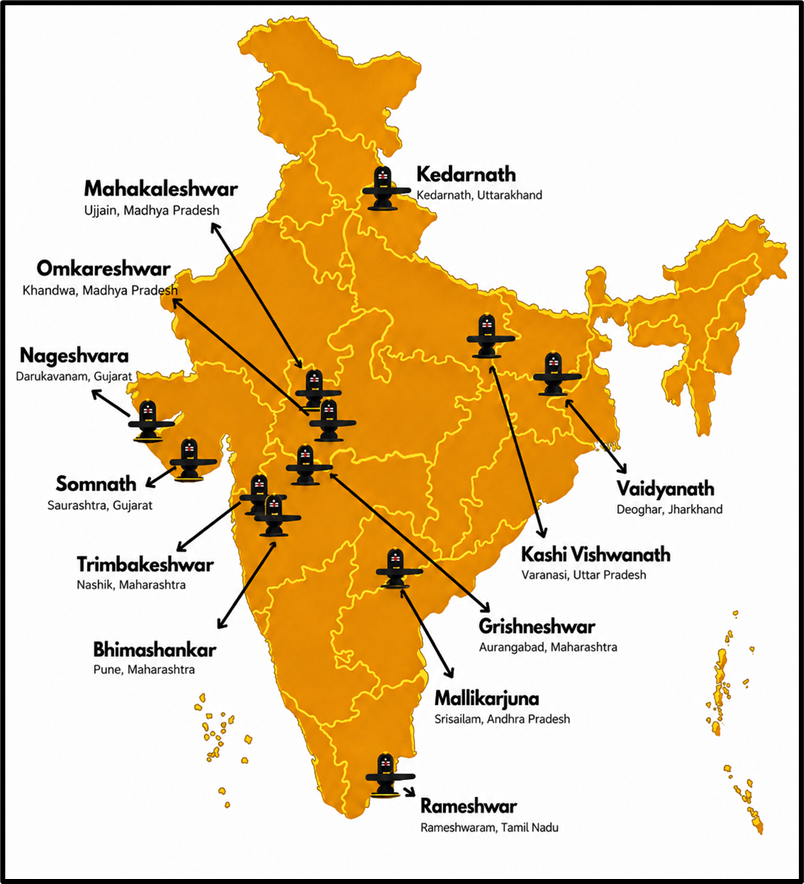
Distribution of Jyotirlingas in India
| State | Jyotirlingas |
| Maharashtra | Bhimashankar, Trimbakeshwar, Grishneshwar |
| Madhya Pradesh | Mahakaleshwar, Omkareshwar |
| Gujarat | Somnath, Nageshwar |
| Uttarakhand | Kedarnath |
| Uttar Pradesh | Kashi Vishwanath |
| Jharkhand | Vaidyanath |
| Tamil Nadu | Rameshwaram |
| Andhra Pradesh | Mallikarjuna (Srisailam) |
This topic is part of the complete Art and Culture Notes for UPSC. Explore the full subject coverage here.