
Business Cycle
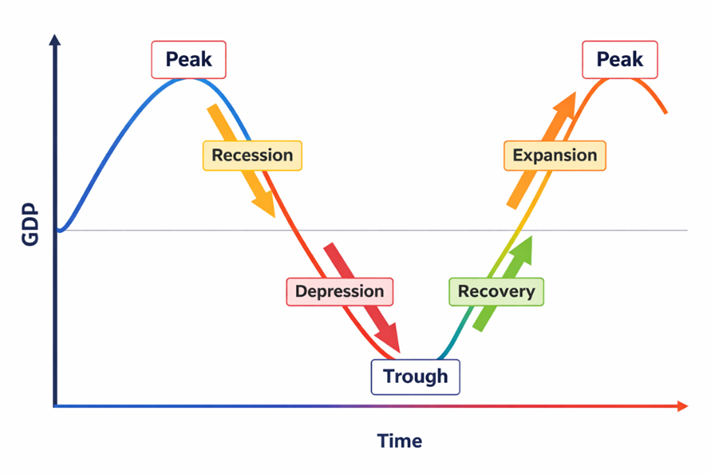
The business cycle refers to the regular and recurring fluctuations in the level of overall economic activity in an economy over time.
These fluctuations are reflected in:
- Gross Domestic Product (GDP)
- Employment
- Income
- Investment and production
👉 In simple words, the economy does not grow in a straight line. Instead, it moves in waves — sometimes expanding, sometimes slowing down.
Why Do Business Cycles Occur?
Business cycles arise mainly due to:
- Changes in aggregate demand (consumption, investment, government spending, exports)
- Changes in aggregate supply
- Shifts in consumer and business confidence
- Monetary and fiscal policy changes
- External shocks (oil prices, pandemics, global crises)
📌 Therefore, fluctuations in output and employment are natural features of a market economy.
Phases of the Business Cycle
The business cycle has four distinct phases, each representing a different economic condition.
1. Expansion
This is the growth phase of the economy.
Key characteristics:
- Rising GDP
- Increasing employment opportunities
- Higher income levels
- Rising investment and consumption
- High consumer and business confidence
👉 Businesses expand production, hire more workers, and invest in new capacity.
📌 Expansion reflects positive economic momentum.
2. Peak
The peak represents the highest point of economic activity.
Key characteristics:
- Economy operating at or near full capacity
- Demand may exceed supply
- Inflationary pressures start building
- Rising prices due to excess demand
👉 This phase signals that the economy cannot grow indefinitely at the same pace.
📌 Important UPSC insight:
Peaks often sow the seeds of the next slowdown.
3. Contraction
This phase marks the slowdown of economic activity.
Key characteristics:
- Decline in GDP
- Reduction in employment
- Fall in investment and consumption
- Low consumer and business confidence
👉 Firms cut production, postpone investments, and may lay off workers.
📌 If contraction becomes deep and prolonged, it may turn into a recession.
4. Trough
The trough is the lowest point of the business cycle.
Key characteristics:
- Economic activity at its minimum
- High unemployment
- Weak demand
- Business distress and closures
👉 However, the trough also marks the turning point.
📌 From here, the economy begins recovery and enters a new expansion phase.
Economic Recession
An economic recession refers to a significant and prolonged decline in overall economic activity.
A commonly used rule of thumb is → Two consecutive quarters of declining GDP
However, economists do not rely on GDP alone.
They also examine:
- Employment levels
- Consumer spending
- Business investment
- Industrial production
📌 Recession reflects a broad-based and sustained economic slowdown.
Government Measures to Overcome Economic Recession
When markets fail to revive the economy on their own, government intervention becomes crucial.
1. Fiscal Stimulus
The government increases → Public spending on infrastructure (roads, bridges, schools)
Impact:
- Creates jobs
- Boosts demand
- Multiplier effect on income and output
📌 This is a direct demand-side intervention.
2. Monetary Policy Measures
The central bank plays a key role.
Tools include:
- Lowering interest rates → cheaper loans → higher investment & consumption
- Quantitative easing → purchasing government bonds → increasing liquidity
📌 Objective: Ensure adequate money supply and revive credit flow.
3. Tax Cuts
Reducing taxes:
- Increases disposable income
- Encourages consumption
- Improves business profitability
Targeted tax relief can:
- Support stressed sectors
- Prevent large-scale closures
4. Support for Small Businesses
Small businesses are the most vulnerable during recessions.
Government support includes → Low-interest loans, Grants, Tax reliefs
📌 This helps preserve employment and entrepreneurial capacity.
5. Job Creation Programs
Government may:
- Launch public works programs
- Provide hiring subsidies
Impact → Reduces unemployment, Stabilizes income, Revives demand
📌 Employment is both an economic and social stabilizer.
6. Regulatory Reforms
By simplifying regulations, governments can:
- Reduce compliance burden
- Encourage entrepreneurship
- Improve ease of doing business
📌 This stimulates private investment and long-term growth.
7. International Cooperation
In a globalized world → Recessions often spread across countries
Cooperation helps through:
- Boosting global trade
- Restoring investor confidence
- Stabilizing international financial systems
📌 Global problems require coordinated global solutions.
Economic Recovery
Economic recovery refers to the process by which an economy returns to its pre-recession level of economic activity after a downturn.
In simple terms:
- Recession → fall in output, income, employment
- Recovery → revival of growth, jobs, confidence, and production
Recovery does not mean instant prosperity. It is a gradual process of regaining lost momentum.
Why Do Economists Classify Recoveries by Shape?
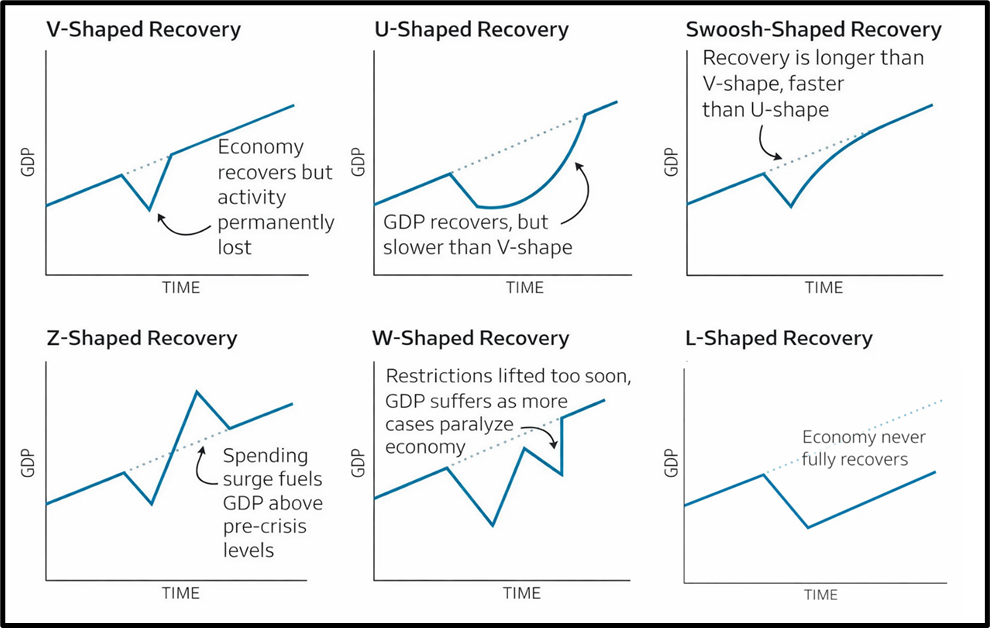
Economists use alphabet-shaped patterns to visually describe:
- Speed of recovery
- Strength of rebound
- Uniformity across sectors
Each shape reflects how quickly and evenly an economy heals after a shock.
Types of Economic Recovery
1. V-Shaped Recovery
This is the most desirable form of recovery.
Characteristics
- Sharp and steep economic decline
- Equally sharp and rapid rebound
- Economy returns quickly to pre-crisis levels (or higher)
Economic meaning
- Shock is temporary
- Fundamentals remain strong
- Policy response is effective
Example
During the COVID-19 pandemic, some sectors (such as manufacturing and digital services) witnessed a sharp fall due to lockdowns, but bounced back quickly once restrictions were lifted—showing a V-shaped recovery.
📌 UPSC keyword: Short recession, strong fundamentals
2. U-Shaped Recovery
Here, the economy stays at the bottom for some time before recovering.
Characteristics
- Prolonged slowdown
- Gradual revival
- Slower confidence restoration
Economic meaning
- Structural damage takes time to heal
- Demand and investment recover slowly
Example
After the 2008 global financial crisis, many economies experienced a U-shaped recovery, as banks, firms, and consumers took time to regain confidence.
📌 UPSC angle: Financial crises usually lead to U-shaped recoveries.
3. Swoosh-Shaped Recovery
This recovery resembles the Nike swoosh—a slow, stretched-out upward curve.
Characteristics
- Slow and uneven improvement
- Recovery takes longer than U-shape
- Some sectors remain weak for extended periods
Economic meaning
- Lingering uncertainty
- Partial reopening
- Incomplete demand revival
Example
Post-COVID, several countries saw a swoosh-shaped recovery, where overall growth improved slowly, but sectors like tourism and MSMEs continued to struggle.
📌 Reflects long-term scarring effects.
4. Z-Shaped Recovery
This is a volatile recovery path.
Characteristics
- Multiple ups and downs
- Frequent fluctuations
- Eventually stabilises
Economic meaning
- Policy uncertainty
- External shocks
- Unstable expectations
Example
Economies facing frequent policy reversals, geopolitical tensions, or trade disruptions may experience Z-shaped recovery before stabilising.
📌 Indicates macro-economic uncertainty.
5. W-Shaped Recovery (Double-Dip Recession)
This is also known as a double-dip recession.
Characteristics
- Initial recovery
- Followed by another downturn
- Final recovery thereafter
Economic meaning
- Premature withdrawal of policy support
- Second shock (e.g., new crisis or pandemic wave)
Example
During pandemics, a second wave of infections after an initial recovery can push the economy back into recession, creating a W-shaped pattern.
📌 Important for analysing policy timing mistakes.
6. L-Shaped Recovery
This is the worst-case scenario.
Characteristics
- Sharp decline
- No meaningful recovery for a long time
- Economy remains stagnant
Economic meaning
- Deep structural problems
- Policy failure
- Loss of productive capacity
Example
Economies suffering from prolonged conflicts, institutional breakdown, or chronic policy paralysis may face an L-shaped recovery.
📌 Indicates lost decades and permanent damage.
7. K-Shaped Recovery
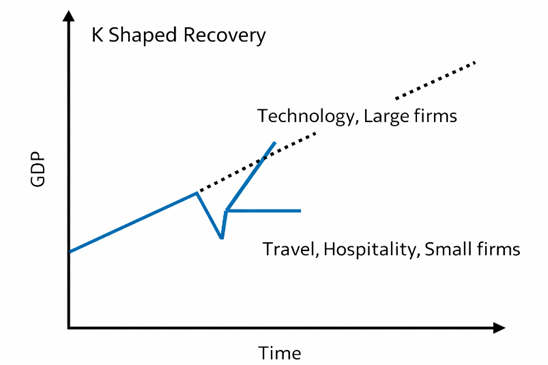
This recovery highlights unequal recovery across sectors and social groups.
Characteristics
- Some sectors grow rapidly
- Others continue to decline
- Inequality widens
Economic meaning
- Growth is uneven and non-inclusive
- Benefits accrue to capital-intensive and digital sectors
Example
During COVID-19:
- Technology firms, large corporates → strong recovery
- Travel, hospitality, MSMEs → continued distress
This divergence creates a K-shape when economic indicators are plotted.
Comparative Insight (Quick Recall)
- V → Fast fall, fast rise
- U → Slow recovery after stagnation
- Swoosh → Very gradual revival
- Z → Volatile recovery
- W → Recovery + relapse
- L → No recovery
- K → Unequal recovery
Jobless Growth
Jobless growth refers to a situation where an economy records economic growth—such as rising GDP or overall production—but fails to generate adequate employment opportunities for its growing workforce.
In simple words:
- Output increases
- Income may rise
- Jobs do not increase proportionately
👉 As a result, unemployment remains high or even rises, despite economic expansion.
📌 UPSC-ready definition:
Jobless growth is a form of economic growth that does not translate into sufficient employment generation.
Why is Jobless Growth a Serious Concern?
Because employment is the primary channel through which growth benefits reach the masses.
If growth is jobless:
- Poverty reduction slows
- Inequality increases
- Social dissatisfaction rises
- Demographic dividend turns into a liability
📌 This is why economists stress inclusive and employment-intensive growth, not just high GDP numbers.
Reasons for Jobless Growth
Let us examine the key structural and technological reasons behind this phenomenon.
1. Technological Advancements
With rapid technological progress → Automation, Artificial intelligence, Mechanisation many tasks earlier done by humans are now done by machines.
Impact
- Productivity increases
- Output rises
- Demand for labour falls
👉 Thus, technology-led growth may become capital-intensive rather than labour-intensive.
📌 Important insight:
Technology boosts growth, but without policy correction, it can reduce employment elasticity of growth.
2. Skill Mismatch
Jobless growth can occur due to a mismatch between:
- Skills demanded by employers
- Skills possessed by job seekers
Example
If the economy generates growth in → IT, Data analytics, Advanced manufacturing
but the workforce lacks → Digital skills, Technical training
then vacancies remain unfilled, while unemployment persists.
📌 This reflects qualitative unemployment, not lack of growth.
3. Structural Changes in the Economy
As economies develop, they undergo structural transformation, such as: Shift from agriculture → industry → services
During this transition:
- Traditional sectors may shrink
- New sectors may not absorb displaced workers immediately
Example
Farmers displaced from agriculture may find it difficult to get jobs in services due to → Low education, Lack of skills, Urban barriers
📌 Result: Growth occurs, but employment lags behind.
How Can Jobless Growth Be Addressed?
Jobless growth is not inevitable. It can be corrected through targeted policy interventions.
1. Enhancing Education and Skills Training
- Align education with labour market needs
- Focus on vocational training and reskilling
- Promote industry–academia linkage
👉 A skilled workforce improves employability and reduces mismatch.
📌 Human capital is the most sustainable solution to jobless growth.
2. Promoting Entrepreneurship
Entrepreneurship leads to → New enterprises, Innovation, Job creation
Government support can include:
- Startup incubators
- Access to credit
- Simplified compliance
📌 Small and medium enterprises are employment multipliers.
3. Revitalising Traditional Industries
While moving into new sectors is essential: Traditional sectors still employ large populations
Policies can:
- Modernise traditional industries
- Encourage innovation
- Provide targeted incentives
📌 This helps prevent large-scale displacement of workers.
4. Labour Market Reforms
Flexible labour markets can:
- Reduce hiring hesitation
- Encourage formal employment
- Improve labour mobility
Measures include:
- Simplifying labour laws
- Reducing bureaucratic hurdles
- Balancing worker protection with business flexibility
📌 Labour reforms convert growth into jobs.
5. Infrastructure Development
Infrastructure investment:
- Creates immediate jobs (construction, logistics)
- Boosts long-term productivity
- Attracts private investment
Examples → Roads, Railways, Urban infrastructure
📌 Infrastructure-led growth is highly employment-intensive.