
Carnatic Music
Carnatic Music is the classical music tradition of South India.
It is deeply devotional in character and historically associated with → Bhakti saints, Temple rituals; Compositions in praise of deities
Unlike Hindustani music, which absorbed strong Persian influence, Carnatic music remained more rooted in indigenous devotional tradition.
Origin of the Name
There are two major interpretations:
- It derives from theVijayanagara Empire (historically called the Karnataka Empire).
The British later anglicised “Karnataka music” into “Carnatic music.” - Another interpretation connects it to:
- Karna → ear
- Atakam → that which lingers
Meaning: Music that lingers in the ear.
Early Patrons
Carnatic music flourished under → Kingdom of Mysore; Kingdom of Travancore; Maratha rulers of Tanjore
Many rulers were themselves composers — showing that music in South India was not merely entertainment but a royal-cultural duty.
Significant Features of Carnatic Music
Now let us examine its structural characteristics.
1. Tempo and Structure
Carnatic music is → More structured; Faster in tempo (compared to Hindustani); Composition-oriented
Improvisation exists, but the composition (kriti) is central.
2. Gamakas
- Gamakas are complex melodic embellishments.
- They give Carnatic music its distinctive oscillatory texture Without gamakas, the raga loses its character.
- In fact, In Carnatic music, a raga lives through its gamakas.
3. Varnam – The Foundational Form
Varnam is a short, metrically structured composition.
It encapsulates:
- The essential features of a raga
- Its characteristic phrases
Features:
- Contains lyrics; Structurally complex; Practised at multiple speeds; Used as vocal exercise
- Often performed at the beginning of concerts
Varnam serves two purposes:
- Technical warm-up
- Raga introduction
4. Kriti – The Core of Carnatic Music
The Kriti is the central compositional form of Carnatic music. It generally consists of three parts:
(i) Pallavi
- Opening section | Repeated throughout | Introduces the main theme
(ii) Anu Pallavi
- Second section | Expands the raga | Acts as a bridge
(iii) Charanam
- Concluding section | Most elaborate | Contains detailed improvisational scope
Thus, Carnatic music is composition-driven rather than purely improvisation-driven.
Prominent Composers of Carnatic Music
Most Carnatic compositions are in → Telugu (predominant) and Sanskrit. Now let us study major composers.
Early Composers
1. Purandara Dasa (1484–1564)
Born in Thirthahalli (Karnataka).
Originally a wealthy merchant who renounced worldly life to become a Haridasa (servant of Vishnu).
Contributions:
- Structured Carnatic music pedagogy
- Formulated graded lessons:
- Swaravalis
- Alankaras
- Introduced Raga Mayamalavagowla as beginner scale
Because of his foundational contribution, he is called Pitamaha (Grandfather) of Carnatic Music.
He systematised teaching — just like Bhatkhande did later for Hindustani music.
2. Annamacharya (1408–1503)
Also known as Annamayya. Born in Tallapaka (Andhra Pradesh).
Major Contributions:
- Composed over 32,000 samkirtanas
- Dedicated mostly to Lord Venkateswara
- Classified compositions into:
- Adhyatma (spiritual)
- Sringara (romantic)
His compositions were rediscovered in 1922 engraved on copper plates in the Tirumala temple.
He is known as Andhra Pada Kavita Pitamaha (Grandfather of Telugu songwriting)
Importantly, he opposed untouchability through compositions like Brahmam Okkate (The divine is one)
The Carnatic Trinity (1700–1850 CE)
The golden period of Carnatic music is associated with three composers collectively known as the Trinity:
- Tyagaraja (1767–1847)
- Muthuswami Dikshitar (1776–1835)
- Syama Sastri (1762–1827)
All three were contemporaries and lived in Tamil Nadu, particularly around Tiruvarur–Thanjavur region.
Together, they defined → Structure of kriti, Raga expansion, Devotional intensity, Compositional grammar
Their compositions form the backbone of modern Carnatic repertoire.
1. Tyagaraja (1767–1847)
Also known as Kakarla Tyagabrahmam. Born in Tiruvarur (Tamil Nadu) to a Telugu Brahmin family.
Contributions:
- Composed thousands of kritis; Mostly in Telugu
- Primarily devoted to Lord Rama
His most famous works are Pancharatna Kritis (Five Gems)
These are monumental compositions that are still sung collectively during the Tyagaraja Aradhana festival.
Tyagaraja represents → Pure devotional surrender expressed through music.
2. Muthuswami Dikshitar (1776–1835)
Born in Tiruvarur near Thanjavur.
He was → A poet, A Veena player, A scholar
Contributions:
- Composed more than 500 compositions; Compositions predominantly in Sanskrit
- Highly poetic and descriptive
- Detailed depiction of temples and deities
Unlike Tyagaraja, whose compositions are emotionally devotional, Dikshitar’s compositions are → Scholarly, structured, and temple-centric.
Unique Feature:
He travelled widely in North India and was influenced by the Hindustani stream. Thus, he forms a subtle bridge between the two classical traditions.
3. Syama Sastri (1762–1827)
Original name: Venkata Subrahmanya. Oldest among the Trinity. Born in Tiruvarur (Tamil Nadu).
Contributions:
- Composed around 300 kritis; Fewer in number compared to others but musically and rhythmically complex
His compositions are known for → Rhythmic depth | Literary excellence | Technical sophistication
If Tyagaraja is devotion, and Dikshitar is scholarship, then Syama Sastri is rhythmic mastery.
Main Features of Carnatic Compositions
Now let us understand what makes Carnatic compositions unique.
1. Religious Inspiration
Almost all major composers were deeply devotional. Music was not entertainment — it was spiritual practice.
2. Linguistic Proficiency
Carnatic composers were scholars.
They composed in → Sanskrit, Telugu (most dominant), Kannada, Tamil, Malayalam
Telugu dominates Carnatic music repertoire.
3. Mudra (Signature)
A very important UPSC fact. Composers inserted their signature — called mudra — within their compositions.
Examples:
- Tyagaraja → “Tyagaraja”
- Muthuswami Dikshitar → “Guruguha”
- Syama Sastri → “Syama Krishna”
- Purandara Dasa → “Purandara Vitthala”
This helped identify authorship and lineage.
Prominent Exponents of Carnatic Music
Now let us move from composers to performers.
Some major exponents include:
- M. S. Subbulakshmi
- Ariyakudi Ramanuja Iyengar (Father of modern concert format)
- Balamuralikrishna
- Lalgudi Jayaraman
- T. M. Krishna
- K. J. Yesudas
These artists modernised performance while preserving tradition.
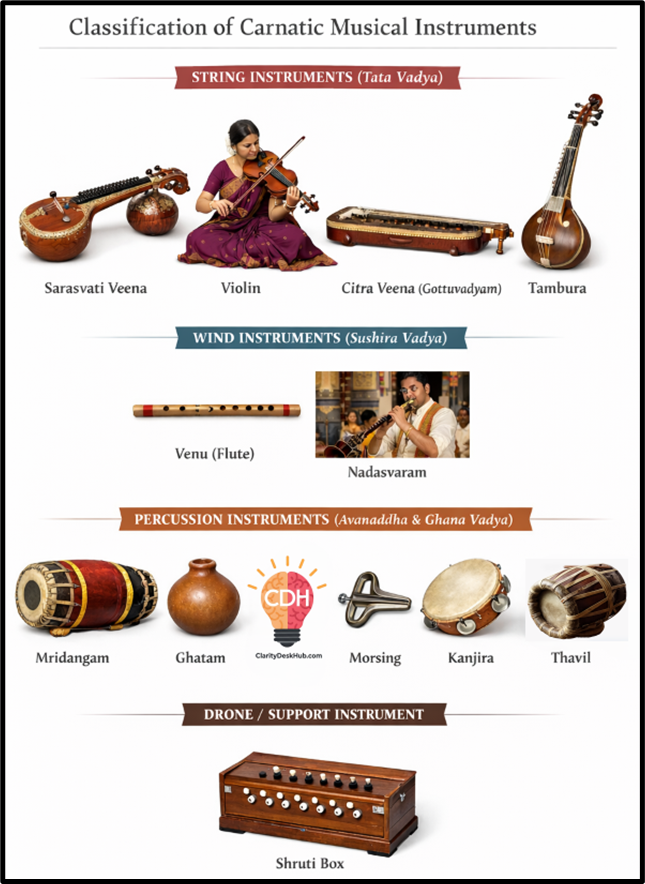
Instruments of Carnatic Music
String Instruments (Tata Vadya)
- Sarasvati Veena | Violin | Citra Veena (Gottuvadyam) | Tambura
Wind Instruments (Sushira Vadya)
- Venu (flute) | Nadasvaram
Percussion (Avanaddha & Ghana Vadya)
- Mridangam | Ghatam | Morsing | Kanjira | Thavil
Drone/ Support Instruments:
- Shruti Box
The Mridangam plays a central rhythmic role in Carnatic concerts.
Kriti and Varnam
These are two foundational compositional forms of Carnatic music, but their purpose and aesthetic orientation differ.
Think of it this way:
- Kriti → Devotional expression
- Varnam → Technical foundation
Kriti
A Kriti is the central and most expressive form of Carnatic composition.
Nature → Structured, Lyrical, Devotional, Emotion-driven
Structure:
- Pallavi – Main theme
- Anupallavi – Expansion and bridge
- Charanam – Culmination and elaboration
Focus → Melody, Bhakti, Emotional depth, Literary beautyKritis are most frequently performed in concerts and are the backbone of Carnatic repertoire.Most famous kritis were composed by the Trinity → Tyagaraja, Muthuswami Dikshitar, Syama Sastri
Varnam
A Varnam is primarily a pedagogical and technical composition.
Nature → Structured, Technically complex, Practice-oriented
Structure:
- Pallavi
- Charanam
- Multiple intricate swara patterns
Focus → Raga grammar; Swara precision; Rhythm control; Technical fluency
Varnams are often performed at the beginning of concerts → As warm-up ; to establish the raga’s technical foundation; to capture audience attention
Quick Comparison
| Aspect | Kriti | Varnam |
|---|---|---|
| Orientation | Devotional | Technical |
| Focus | Emotion & Lyrics | Swara & Rhythm |
| Structure | Pallavi–Anupallavi–Charanam | Pallavi–Charanam (with swaras) |
| Role in Concert | Main item | Opening item |
| Purpose | Expression | Foundation |
Martial Music
Now we move to a fascinating and often neglected area — Martial Music.
Music has never been limited to temples and courts. It has also marched on battlefields.
Historical Role
During military expeditions:
- Musicians accompanied armies.
- Music boosted morale.
- War rhythms energised soldiers.
In the Mughal period, two noted martial musicians were → Hapa Charan, Mian Lal Khan
Rajasthan Tradition
In Rajasthan, a professional community called Dadis → Accompanied rulers to battle, sang heroic songs, motivated soldiers
This connects to the larger tradition of Veer Rasa (heroic emotion) in Indian aesthetics.
Modern Military Bands
Today, the Indian Armed Forces → Army, Navy, Air Force, Paramilitary Forces maintain formal music bands.
They perform at:
- Republic Day Parade (Kartavya Path)
- Beating Retreat Ceremony
- Independence Day at Red Fort
- Changing of Guard at Rashtrapati Bhavan
- Passing Out Parades
Beating Retreat Ceremony
Held on 29 January (third day after Republic Day).
Location → Vijay Chowk, New Delhi. Started in 1955.
It marks the formal end of Republic Day celebrations.
“Qadam Qadam Badhaye Ja”
This famous quick march:
- Written by Vanshidhar Shukla
- Composed by Ram Singh Thakuri (1942)
- Originally regimental march of the INA
- Now official regimental march of the Indian Army
This is a very important factual detail for Prelims.
Carnatic and Hindustani – Similarities and Differences
This is a classic UPSC Mains question area. Let us break it into two parts.
Similarities Between Carnatic and Hindustani
1. Common Foundation
Both trace roots to → Vedic tradition, Natya Shastra, Sangita Ratnakara
2. Raga–Tala System
Both systems are built on → Raga (melody) and Tala (rhythm). These define structure and mood.
3. Improvisation
Both traditions allow improvisation within raga and tala grammar. Though style differs, creative freedom exists in both.
4. Spiritual Orientation
Both traditions:
- Emphasise devotion
- Explore spiritual themes
- Aim to evoke meditative experience
5. Shared Instruments
Some instruments, like the flute and violin, are used in both systems, though the playing style differs
The human voice remains supreme in both systems.
Differences Between Carnatic and Hindustani
Now the divergence.
1. Regional Influence
| Carnatic | Hindustani |
|---|---|
| South India | North India |
| Strong Hindu devotional focus | Hindu + Persian-Sufi influence |
Hindustani reflects Mughal-era cultural synthesis. Carnatic retained more indigenous temple tradition.
2. Structural Orientation
| Carnatic | Hindustani |
|---|---|
| Composition-centric | Improvisation-centric |
| Kriti dominant | Alap dominant |
| Structured concert format | More fluid unfolding |
3. Ragas and Talas
Though concept is common:
- Specific ragas differ
- Specific talas differ
Hindustani places stronger emphasis on Time theory of ragas (morning, evening, seasons)
Carnatic does not emphasise time theory as strongly.
4. Instruments
| Carnatic | Hindustani |
|---|---|
| Mridangam | Tabla |
| Veena | Sitar |
| Ghatam | Sarod |
| Nadasvaram | Shehnai |
5. Language of Composition
| Carnatic | Hindustani |
| Telugu, Sanskrit, Tamil, Kannada | Hindi, Urdu, Braj |
| Strong devotional themes | Wider emotional range (nature, romance, mysticism) |
Final Conceptual Insight
Both traditions:
- Share the same ancient roots
- Use raga and tala grammar
- Aim for spiritual elevation
But:
- Hindustani evolved through cultural synthesis and court influence.
- Carnatic evolved through Bhakti and temple tradition.
They are not opposites.
They are two branches of the same civilisational tree.