
Classical Dances of India
When we say Indian Classical Dance, we are not referring merely to stage performance. We are referring to a codified, disciplined, philosophical system of expression, whose grammar is rooted in ancient Sanskrit treatises.
It is called Shastriya Nritya — meaning dance governed by Shastra (scriptural rules).
Let us understand this.
Meaning and Foundation
Indian classical dance traditions trace their theoretical roots to the Natya Shastra, composed between 200 BCE and 200 CE and attributed to Sage Bharata.
The word itself is revealing:
- Natya → Act, performance
- Shastra → Rule book or manual
So, classical dance in India is not random movement — it is rule-bound, structured, and spiritually purposeful.
The apex body recognising classical dances today is the Sangeet Natak Akademi.
It recognises eight classical dances.
The Eight Classical Dances of India
These eight forms are:
- Bharatanatyam – Tamil Nadu
- Kathak – Uttar Pradesh
- Kuchipudi – Andhra Pradesh
- Odissi – Odisha
- Kathakali – Kerala
- Sattriya – Assam
- Manipuri – Manipur
- Mohiniyattam – Kerala
Each emerged in a different region, yet all share a common philosophical foundation.
This is Unity in Diversity — a core UPSC theme.
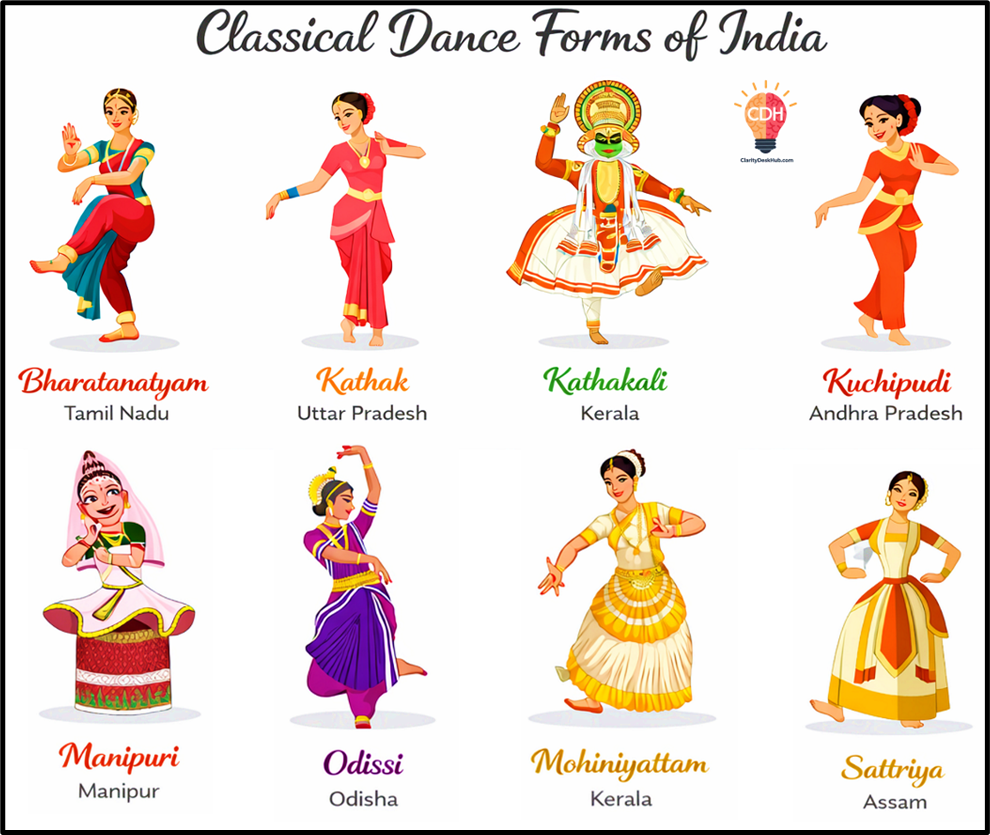
Overview of 8 Classical Dances
| Dance Form | State | Core Origin/Tradition | Signature Movement Feature | Music System | Unique Identifier |
| Bharatanatyam | Tamil Nadu | Devadasi (Sadir) temple tradition | Linear geometry, Araimandi posture | Carnatic | Structured Margam format |
| Kathak | Uttar Pradesh | Kathakars + Mughal court influence | Tatkar (footwork) & Chakkars (spins) | Hindustani | Persian/Sufi influence |
| Odissi | Odisha | Mahari & Gotipua temple tradition | Tribhanga (triple bend) | Odissi music (blend) | Sculptural poses |
| Kathakali | Kerala | Ramanattam/ Krishnanattam court tradition | Dramatic facial abhinaya | Sopanam (Kerala style) | Elaborate Vesham (make-up) |
| Kuchipudi | Andhra Pradesh | Bhagavata Mela dance-drama | Graceful theatrical style | Carnatic | Tarangam (brass plate dance) |
| Manipuri | Manipur | Vaishnavite Raas Leela | Soft, circular, gliding movements | Manipuri classical | No ghungroos |
| Mohiniyattam | Kerala | Temple & royal court (Lasya tradition) | Gentle swaying (Ati Bhanga) | Carnatic (Sopana influence) | White kasavu costume |
| Sattriya | Assam | Vaishnavite Sattras (monasteries) | Mati-Akhora structured movements | Assamese devotional (Borgeet) | Origin in Ankiya Nat |
Core Features of Classical Dances
Let us break down their essential characteristics.
1. Unity in Diversity
All follow → Rasa theory, Mudras, Codified technique, Guru–Shishya tradition
Yet they differ in → Costume, Music, Language, Movement vocabulary
2. Storytelling Through Dance
Classical dances are narrative in nature.
They enact → Mythological stories, Devotional themes, Philosophical ideas, Poetry
This is not dance for dance’s sake — it is embodied literature.
3. Precision and Technique
Accuracy of Hand gestures (Mudras/Hastas), Footwork, Postures, Eye movements
Every movement is intentional. Nothing is accidental.
4. Gender Representation
Traditionally:
- Many forms were performed by women
- But several traditions (e.g., Kathakali, Sattriya) were historically male-dominated
Thus, classical dance is not gender-exclusive.
5. Costume and Aesthetic
- Elaborate costumes | Jewellery | Ghungroo (anklets) | Expressive make-up
In forms like Kathakali, makeup itself becomes symbolic language.
6. Expression of Navarasas
The soul of classical dance lies in Navarasas (Nine Aesthetic Emotions):
| Rasa | Meaning |
|---|---|
| Shringara | Love |
| Hasya | Laughter |
| Karuna | Compassion |
| Raudra | Anger |
| Vira | Heroism |
| Bhayanaka | Fear |
| Bibhatsa | Disgust |
| Adbhuta | Wonder |
| Shanta | Peace |
The ultimate aim is to create Rasanubhava — aesthetic experience in the audience.
Repertoire: Natanabheda
According to Natya Shastra, classical dance consists of three components:
1️⃣ Nritta
- Pure dance | No emotions | No storytelling | Rhythmic patterns | Fast tempo
This engages the senses (Prakriti).
2️⃣ Nritya
- Expressional dance | Facial expressions | Mudras | Emotional interpretation
This engages the mind and emotions.
3️⃣ Natya
- Dramatic representation | Imitation of characters | Full storytelling
This integrates theatre into dance.
👉 Thus, Indian classical dance is a synthesis of rhythm, emotion, and drama.
Abhinaya – The Science of Expression
The word Abhinaya means “To carry the spectator towards the meaning.”
It has four types:
1️⃣ Angika Abhinaya
- Body movements | Gestures | Facial expressions
2️⃣ Vachika Abhinaya
- Music | Recitation | Dialogue | Rhythm
3️⃣ Aharya Abhinaya
- Costume | Jewellery | Stage design | Make-up
4️⃣ Sattvika Abhinaya
- Inner emotional state | Psychological authenticity | Spiritual connection
Sattvika is the highest level — when the artist truly becomes the character.
Foundational Texts of Classical Dance
📖 Natya Shastra
Authored by Sage Bharata.
Key Features:
- 6,000 verses; Covers stage design, acting, costume, music
- Introduces Rasa theory
- Describes four regional traditions → Avanti (Central India), Dakshinatya (South India), Panchali (North-west), Odra-Magadhi (East)
Its goal was not entertainment — but spiritual elevation.
Later commentary → Abhinavabharati by Abhinavagupta.
📖 Abhinaya Darpanam
Authored by Nandikeshwara (~1000 CE).
- Written in poetic form (Padya)
- Focused specifically on gestures and expression
- Acts as a practical manual for dancers
📖 Sangita Ratnakara
Authored by Sarangadeva (13th century).
Patron → King Simhana of Yadava dynasty (Devagiri)
Key Features:
- 7 chapters (Saptadhyayi) → 6 on music, 1 on dance
- Authoritative for both Carnatic and Hindustani traditions
Important commentaries → Sangitasudhakara, Kalanidhi
This text bridges ancient and medieval performance traditions.
Language and Music
Classical dance compositions use → Tamil, Sanskrit, Hindi, Malayalam, Meitei, Odia, Telugu
Thus, classical dance is multilingual yet unified in philosophy.
Philosophical Objective
The purpose of classical dance is → Not merely performance, not merely storytelling.
But the creation of Rasa — An elevated, almost spiritual aesthetic experience.
It transforms → Movement into meditation, Gesture into scripture, Performance into devotion