
Coastal Regulation Zone
🗂️ Background
Think of India’s coastline as a highly sensitive boundary—where land meets sea, and where human activity directly impacts fragile ecosystems like mangroves, coral reefs, estuaries, and fishing livelihoods.
To regulate this delicate interface, India introduced the concept of the Coastal Regulation Zone (CRZ).
📜 Origin of CRZ Rules (1991)
In 1991, coastal areas influenced by tidal action—including seas, bays, estuaries, creeks, rivers, and backwaters—were officially declared as Coastal Regulation Zone (CRZ).
What exactly is CRZ?
- It is an area up to 500 metres from the High Tide Line (HTL) on the landward side.
- HTL is the line on the coast up to which the highest tide reaches during spring tide.
The rules were notified by Ministry of Environment, Forest and Climate Change under the Environment (Protection) Act, 1986.
🏛️ Institutional Framework for CRZ Implementation
To ensure enforcement:
- National Coastal Zone Management Authority (NCZMA)
- State Coastal Zone Management Authorities (SCZMA)
Their role:
- Monitoring CRZ compliance
- Granting clearances
- Preparing Coastal Zone Management Plans (CZMPs) at the state level, strictly as per central guidelines
📌 Key idea: Centre frames the rules, States implement them.
⚠️ Why Were CRZ Rules Amended in 2011?
Although the 1991 CRZ Rules were well-intentioned, over time they were seen as:
→ Too restrictive
→ Obstacles to infrastructure development, especially in coastal states
📍 Example:
- Projects like Navi Mumbai Airport were delayed due to CRZ restrictions.
👉 To address these concerns, CRZ Rules, 2011 were introduced, allowing select exemptions while still protecting ecological interests.
🗂️ CRZ Classification (as per CRZ Rules, 2011)
The entire CRZ area is divided into four categories, based on ecological sensitivity and level of development.
🌿 CRZ-I: Ecologically Most Sensitive Areas
Includes:
A. Ecologically Sensitive Areas, such as:
- National parks, sanctuaries, marine parks
- Mangroves, coral reefs
- Breeding grounds of marine life
- Areas rich in genetic biodiversity
- Regions vulnerable to sea-level rise
- Historical and heritage sites
B. Area between HTL and LTL (Low Tide Line)
Regulation:
- No new construction permitted within 500 m of HTL
Exceptions (important for Prelims):
- Department of Atomic Energy projects
- Pipelines and transmission lines
- Weather radar installations (IMD)
- Trans-harbour sea link (without affecting tidal flow)
- Greenfield airport only at Navi Mumbai
- Exploration and extraction of natural gas
- Salt harvesting, desalination plants
- Storage of non-hazardous cargo (food grain, fertilisers, edible oil)
- Amenities for traditional inhabitants (with CZMA approval)
📌 Conceptual takeaway: Maximum protection, minimum construction.
🏙️ CRZ-II: Already Developed Coastal Areas
What does “developed” mean?
- Urban areas with existing infrastructure → Roads, Drainage, Water supply, Sewerage
Permitted activities:
- Construction only on the landward side of existing roads or authorised structures
- Reconstruction allowed:
- No change in land use
- Must follow existing FSI/FAR norms
- LNG facilities and regasification units
- Desalination plants
- Storage of non-hazardous cargo
- Power generation from non-conventional sources
📌 Key idea: Controlled development, not fresh expansion seaward.
🌾 CRZ-III: Relatively Undisturbed Areas
Includes:
- Rural coastal areas
- Undeveloped or partially developed zones
- Urban areas not substantially built-up
🚫 No Development Zone (NDZ)
- 0–200 m from HTL (seafront)
- 0–100 m along tidal-influenced water bodies
- No construction allowed, except repairs
❗ NDZ does not apply within notified port limits.
Activities permitted even in NDZ:
- Agriculture, horticulture, forestry
- Atomic Energy projects
- Rare mineral mining
- Salt manufacturing
- LNG facilities and regasification
- Desalination plants
- Non-conventional energy projects
- Weather radars
- Fishing community infrastructure
- Sewage treatment units (with PCB approval)
- Greenfield airport only at Navi Mumbai
🏗️ Area between 200 m and 500 m from HTL
Permitted:
- Hotels and beach resorts (with conditions)
- LNG and storage facilities
- Non-hazardous cargo storage in ports
- Desalination plants
- Renewable energy facilities
- Housing for traditional communities:
- Max height: 9 m
- Ground + one floor
- Schools, dispensaries if no alternative land exists
- Navi Mumbai airport (again, a special case)
📌 UPSC insight: CRZ-III shows the development–conservation compromise most clearly.
🌊 CRZ-IV: Aquatic and Marine Areas
Includes:
- Water area from LTL to 12 nautical miles seaward
- Tidal-influenced water bodies up to salinity of 5 ppt during driest season
Permitted:
- Traditional fishing and allied activities — no restriction
Strict Prohibition:
- No discharge of → Untreated sewage, Industrial effluents, Ballast water, Fly ash, Solid waste
📌 Core idea: Livelihoods protected, pollution prohibited.
Guys before proceeding further, keep one idea in mind:
CRZ is not about stopping development; it is about preventing irreversible ecological damage in fragile coastal zones.
🚫 Prohibited Activities within the Coastal Regulation Zone (CRZ)
Certain activities are considered inherently destructive for coastal ecology. Therefore, the CRZ framework prohibits them across all CRZ categories—unless specific exemptions are provided under CRZ-I, II, III or IV.
🔴 Activities prohibited in general within CRZ:
- Setting up new industries or expansion of existing industries
- Manufacture, handling, storage or disposal of hazardous substances
- Establishment of new fish processing units
- Land reclamation, bunding, or altering the natural flow of seawater
- Discharge of untreated sewage or industrial effluents
- Dumping of municipal waste, construction debris, fly ash, or industrial solid waste
- Port and harbour projects in high-erosion coastal stretches
- Mining of sand, rocks, or sub-strata materials
- Alteration or dressing of active sand dunes
- Disposal of plastic waste into coastal waters
- Drawal of groundwater in coastal stretches
📌 UPSC insight:
These prohibitions reflect the precautionary principle—prevent damage rather than repair it later.
🌿 Critical Vulnerable Coastal Areas (CVCA)
Some coastal regions are so ecologically fragile that even normal CRZ safeguards are not sufficient. These are classified as Critical Vulnerable Coastal Areas (CVCA) under the Environment (Protection) Act, 1986.
📍 Examples of CVCA:
- Sundarban region (West Bengal)
- Gulf of Khambat & Gulf of Kutchh (Gujarat)
- Malvan, Achra–Ratnagiri (Maharashtra)
- Karwar & Coondapur (Karnataka)
- Vembanad (Kerala)
- Gulf of Mannar (Tamil Nadu)
- Bhitarkanika (Odisha)
- Coringa, East Godavari & Krishna (Andhra Pradesh)
🧑🌾 Governance approach in CVCA:
- Managed with active participation of coastal communities
- Especially fisherfolk and traditional livelihood groups
- Focus on sustainable livelihood + conservation, not exclusion
📌 Conceptual clarity:
CVCA management shifts from regulatory control to community-based conservation.
📜 Coastal Regulation Zone (CRZ) Rules, 2019
To address long-standing concerns of coastal states—especially regarding housing, tourism and infrastructure—the Government of India notified CRZ Rules, 2019.
🎯 Objective:
- Balance coastal protection with developmental needs
- Simplify procedures without dismantling safeguards
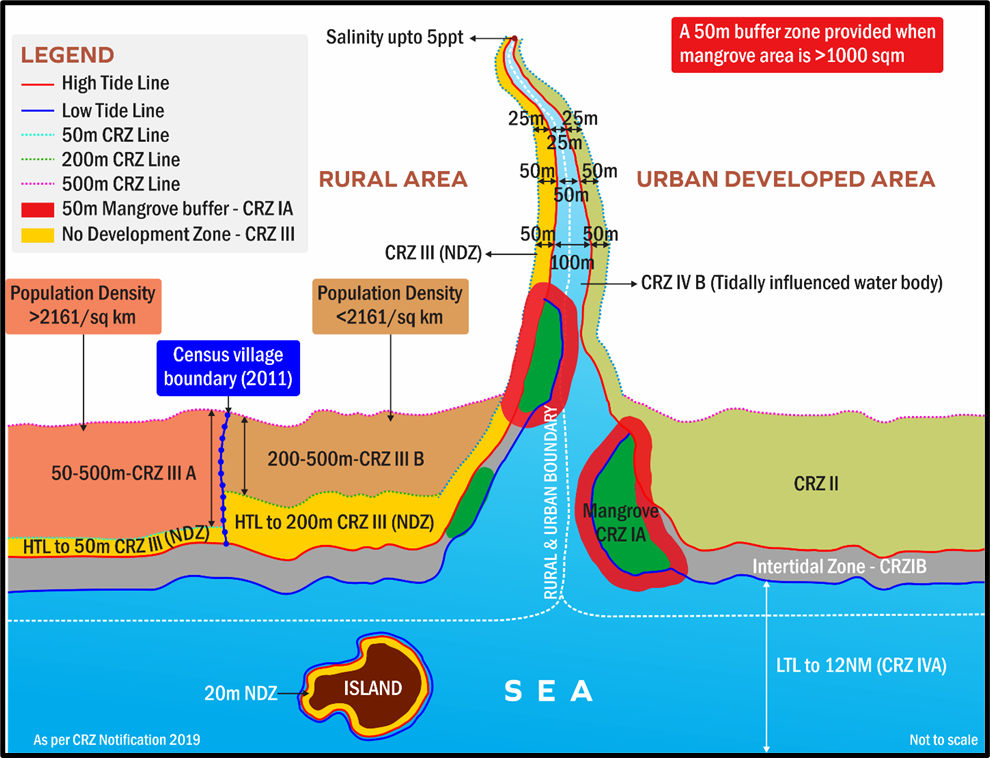
🗂️ New Sub-Categories under CRZ-III (Major Reform)
CRZ-III areas were further divided based on population density (Census 2011).
🏘️ CRZ-III A
- Population density > 2161 persons/sq km
- No Development Zone (NDZ): 50 metres from HTL
(Earlier: 200 m)
🌾 CRZ-III B
- Population density < 2161 persons/sq km
- NDZ remains 200 metres from HTL
📌 Why this change matters:
Densely populated coastal villages needed housing space, while sparsely populated areas retained stronger buffers.
🚫 Revised No Development Zone for Islands
- 20-metre NDZ introduced for:
- Islands close to the mainland
- Backwater islands on the mainland
This recognises space constraints unique to island geographies.
⚙️ Streamlining of CRZ Clearance Process
- Multiple levels of delegation introduced
- Faster recommendations and approvals
- Reduced bureaucratic delays
📌 Exam phrase: Ease of compliance without dilution of standards
🏗️ Easing of Floor Space Index (FSI) Norms
- CRZ 2019 de-freezes FSI
- Allows vertical construction instead of horizontal sprawl
- Reduces pressure on coastal land
🏖️ Tourism Infrastructure Permitted
Temporary tourism facilities are now allowed, such as:
- Beach shacks
- Toilets and change rooms
- Drinking water facilities
📌 Balance achieved: Tourism promotion + minimal permanent ecological footprint.
🌐 Integrated Coastal Zone Management Plan (ICZMP)
CRZ regulation alone is reactive. ICZMP is proactive and holistic.
🔍 What is ICZMP?
- An integrated approach considering → Ecology, Livelihoods, Climate risks, Governance
🇮🇳 ICZMP in India
- Launched by Ministry of Environment, Forest and Climate Change
- World Bank–assisted programme
- Implemented through Society of Integrated Coastal Management (SICOM)
🧪 Scientific Support
- National Centre for Sustainable Coastal Management (NCSCM), Chennai
- Located within Anna University campus
- Provides technical and scientific inputs
🗺️ States Covered under ICZMP
- Gujarat
- Odisha
- West Bengal
Four Components:
- National Coastal Management Programme
- ICZM – West Bengal
- ICZM – Odisha
- ICZM – Gujarat
🧩 National Component of ICZMP
Includes:
- Demarcation of Hazard Line along entire mainland coastline
- Establishment of NCSCM and regional centres
- Promotion of R&D and coastal community resilience
📘 Draft Integrated Coastal Zone Management Framework
Prepared by SICOM, this framework:
- Integrates environmental and social safeguards
- Guides coastal states while approving projects
- Emphasises sustainability at planning, design and implementation stages
Key Activities:
- Mangrove afforestation
- Seagrass meadow restoration
- Habitat conservation
- Beach cleaning
- Eco-restoration of sacred groves
Livelihood Focus:
- Climate-resilient agriculture
- Water harvesting
- Eco-tourism
- Community-based mariculture
- Seaweed cultivation
- Aquaponics
- Value addition to coastal livelihoods
🌊 ENCORE Programme
Enhancing Coastal and Ocean Resource Efficiency
- World Bank-funded
- Objectives:
- Protect coastal populations from pollution, erosion & sea-level rise
- Enhance coastal and marine resource efficiency
- Improve livelihood opportunities for coastal communities
🟦 Blue Flag Beaches
The ‘Blue Flag’ certification is an international eco-label awarded to beaches, marinas, and sustainable boating tourism operators that meet high environmental and safety standards.
📜 Background
- Started in France in 1985
- Expanded beyond Europe in 2001
- Awarded by the Denmark-based Foundation for Environmental Education (FEE)
📌 Important clarification:
The certification is annual, meaning a beach must maintain standards continuously, not just once.
📊 Criteria for Blue Flag Certification
Blue Flag beaches are evaluated on 33 parameters, grouped under four major heads:
- Water Quality – Clean, pollution-free bathing water
- Environmental Management – Waste management, sanitation, ecosystem protection
- Environmental Education – Awareness boards, public information, eco-sensitivity
- Safety – Lifeguards, first-aid, emergency response, safe access
🏛️ International Jury Members
The selection jury includes representatives from:
- United Nations Environment Programme (UNEP)
- UN World Tourism Organization (UNWTO)
- Foundation for Environmental Education (FEE)
- International Union for Conservation of Nature (IUCN)
📌 Prelims fact:
Spain has the highest number of Blue Flag beaches (729).
🇮🇳 Blue Flag Beaches in India
- India currently has 10 Blue Flag certified beaches
- Chandrabhaga Beach (Golden Beach), Odisha
→ First in India and Asia to receive the Blue Flag - Minicoy Thundi Beach and Kadmat Beach (Lakshadweep)
→ Recent additions
📌 Conceptual takeaway:
India is using Blue Flag certification as a tool for coastal tourism + environmental branding.
🏖️ BEAMS Programme
To support Blue Flag standards domestically, the Ministry of Environment, Forest and Climate Change launched BEAMS (Beach Environment and Aesthetics Management Services) under the ICZMP framework.
🎯 Objectives of BEAMS:
- Abate pollution in coastal waters
- Promote sustainable beach infrastructure
- Protect coastal ecosystems and natural resources
- Enable local authorities and stakeholders to maintain → Cleanliness, Hygiene, Safety
- Promote beach recreation in harmony with nature
📌 UPSC framing:
BEAMS is India’s institutional bridge between CRZ rules and Blue Flag certification.
🏗️ Relaxation of CRZ Rules for Blue Flag Beaches
To help states achieve Blue Flag certification, the MoEFCC has selectively relaxed CRZ norms.
✅ Permitted Activities (subject to conditions):
Allowed within CRZ of beaches and islands, maintaining minimum 10 m distance from HTL:
- Portable toilets
- Change rooms and shower panels
- Grey water treatment plants
- Solid waste management plants
- Purified drinking water facilities
- Other infrastructure required for Blue Flag standards
📌 Key balance:
Temporary, eco-friendly infrastructure is allowed—not permanent urbanisation.
⚠️ Issues in Execution of CRZ Rules
Despite robust rules, implementation remains weak.
Key Problems:
- State governments and local bodies often ignore CRZ norms to facilitate construction
- Coastal Zone Management Authorities (CZMAs):
- Cannot take direct action
- Can only file cases
- Enforcement powers lie with:
- Principal Secretary / Additional Chief Secretary (Environment)
- Chairman / Member Secretary of Pollution Control Board
- District Collector
📌 Governance issue:
Regulatory authority without enforcement teeth.
🏢 Maradu Apartments Case: A Landmark CRZ Failure
This case highlights how administrative negligence, judicial ambiguity, and market pressures collide.
🔍 Timeline of Events:
- 2007: Maradu Panchayat issues show-cause notice for CRZ violations near Vembanad Lake
- Local Self Government Department directs revocation of permits—but only show-cause issued
- Kerala High Court grants stay, allowing construction
- Builders lacked mandatory KCZMA clearance
- KCZMA approaches the Supreme Court
- At the time of construction, area fell under CRZ-III (1991 notification)
- Maradu became municipality in 2010, reclassified as CRZ-II (2011 rules)
- MoEFCC approved CZMP only in 2019
- Supreme Court ordered demolition, holding CRZ-III status at construction time decisive
- Apartments demolished by Kerala government in 2021
📌 Legal principle:
CRZ status at the time of construction is decisive, not later reclassification.
🌍 Implications of the Maradu Demolition
🌱 Ecological
- Lake contamination from debris
- Air pollution affecting nearby residents
💰 Economic
- Shockwaves to surrounding buildings
- Poor and middle-class families suffer most
⚖️ Moral Responsibility
- Municipal authorities: Ignored KCZMA reminders
- Builders: Never applied for CRZ clearance; colluded with officials
- Buyers: Took calculated risks in a land-scarce housing market
- Judiciary:
- HC allowed construction
- SC ignored local permissions and ordered demolition
- Liability effectively fell on apartment owners
📜 Legal Paradox
- Demolition ordered due to CRZ-III status during construction
- New buildings can now legally come up under CRZ-II rules
📌 Mains-ready critique:
This exposes the human cost of regulatory ambiguity and delayed governance.