Epigraphic Sources of Indian Art and Culture
Introduction
When there were no newspapers, no printed books, and no digital records, rulers and communities communicated permanence through stone and metal. That permanence is what makes inscriptions one of the most reliable sources for ancient Indian history.
What Are Inscriptions?
- Inscriptions are permanent writings engraved on durable materials such as → Stone, Metal (especially copper plates), Terracotta, Pillars, Temple walls, Sculptures
- Unlike manuscripts written on palm leaves or paper — which decay — inscriptions survive centuries.
- They generally record → Achievements of kings, Royal orders, Donations, Religious ideas, Administrative decisions, Economic transactions
- In short, inscriptions are primary historical evidence for political, social, religious, and economic history.
Epigraphy and Palaeography – Two Important Disciplines
Now we must understand two technical terms very clearly.
1️⃣ Epigraphy
- The study of inscriptions is called epigraphy.
- An epigraphist → Reads inscriptions, Deciphers scripts, Interprets content, Dates them, Analyses historical context
- Without epigraphy, much of ancient Indian history would remain unknown.
2️⃣ Palaeography
Palaeography is the study of the style and evolution of writing.
It helps us answer:
- How did Brahmi evolve?
- When did a script change its shape?
- How can we date inscriptions based on writing style?
So, remember:
- Epigraphy = study of inscriptions
- Palaeography = study of writing style
Types of Inscriptions
Indian inscriptions were not random. They had clear categories. Let us classify them:
(A) Based on Purpose
1. Prashastis (Eulogies)
- These were inscriptions composed by poets praising kings and patrons.
- They exaggerate victories and virtues. Hence, while useful, they must be read critically.
- They reflect → Political propaganda, Royal ideology, Concepts of kingship
2. Raja-shasanas
- These were royal orders issued by kings.
- They deal with → Administrative instructions, Tax policies, Grants, Governance matters
- These are extremely reliable for understanding political structure.
3. Dana-shasanas
- These record gifts or donations, usually for → Temples, Brahmins, Monasteries, Religious institutions
- They show → Religious patronage, Land grant system, Economic redistribution
4. Tamra-shasanas
- These are copper-plate inscriptions. Copper plates were durable and portable.
Most land grants were recorded on copper plates.
Why copper? Because:
- It lasts long
- It carries legal authority
- It could be stored by the donee
5. Kraya-shasanas
These record sale and purchase of land. This is very important.
They prove:
- Private property existed
- Land transactions were formalized
- Economic life was legally regulated
(B) Hero Stones and Memorial Inscriptions
Indian society also commemorated bravery and sacrifice.
These are called Hero Stones, and they had different names:
- Vijaya-shasanas – Victory stones
- Viragals – Gravestones for heroes
- Yupa-shasanas – Sacrificial posts
- Commemorations of martyrs or even sati
These inscriptions tell us → Social values, Warrior culture, Ritual practices
(C) Pratima-shasanas
- These are inscriptions found on sculptures or idols.
- They usually record → Donor’s name, Date of installation, Religious purpose
- They help date sculptures and trace artistic evolution.
Language and Script of Early Inscriptions
Now comes a very important historical transition.
Earliest inscriptions were written in Prakrit
Why Prakrit?
Because:
- It was the language of the common people.
- It was not elitist like Sanskrit.
- It ensured wider communication.
Ashoka and the Beginning of Indian Epigraphy
The turning point in Indian inscriptional history is:
Ashoka
He was the first ruler in India to systematically issue inscriptions across his empire.
Most of his inscriptions were:
- Written in Prakrit
- In the Brahmi script
- Engraved on rocks and pillars
These inscriptions are called → Rock Edicts, Pillar Edicts
Why are they revolutionary?
Because for the first time:
- A ruler communicated directly with subjects.
- Moral ideas (Dhamma) were publicly declared.
- Governance became ethically articulated.
Ashoka transformed inscriptions from mere royal records into moral-political documents.
Beginning of Land Grant Inscriptions
From the 1st century BCE, inscriptions related to land grants for religious purposes begin to appear. The first rulers to issue such grants were → Satavahana kings of the Deccan
This marks a crucial development → Rise of temple economy; Agrarian expansion; Religious patronage as state policy
Land grants would later become central in → Gupta period; Early medieval IndiaFeudal structures
So inscriptions are not just texts — they show structural economic change.
Harappan Script (2500 BCE – 1500 BCE)
Now we move further back in time.
Before Ashoka, before Brahmi — we encounter something mysterious → The Harappan Script
Key Features:
- Found on → Seals, Pottery, Tablets, Amulets
- Consists of → Pictorial signs, Symbolic characters
- It remains undeciphered
This is crucial.
Despite decades of research, no one has conclusively decoded it.
Why?
Because → There is no bilingual inscription to compare.
The Rosetta Stone Analogy
To understand this difficulty, consider → Rosetta Stone
The Rosetta Stone was discovered in Egypt.
It contained → The same text; In two languages (Egyptian & Greek); Written in three scripts
Since scholars already knew Greek, they could decode Egyptian hieroglyphics.
But the Harappan script has no such bilingual key. That is why it remains undeciphered.
Possible Uses
Scholars believe it may have been used for → Administrative purposes; Trade identification; Religious symbols
It shows that the Indian subcontinent had one of the earliest writing traditions in the world.
Contemporary Relevance
Recently, the Tamil Nadu Chief Minister, M. K. Stalin announced a reward of $1 million for anyone who can successfully decipher the Harappan script.
This shows:
- The script remains one of the greatest historical puzzles.
- It continues to inspire academic interest.
Mauryan Edicts (322 BCE – 185 BCE)
The Mauryan period marks a decisive turning point in Indian epigraphic history.
For the first time, inscriptions are used systematically by the state to communicate policy, ethics, and administrative intent.
Two major components must be understood here:
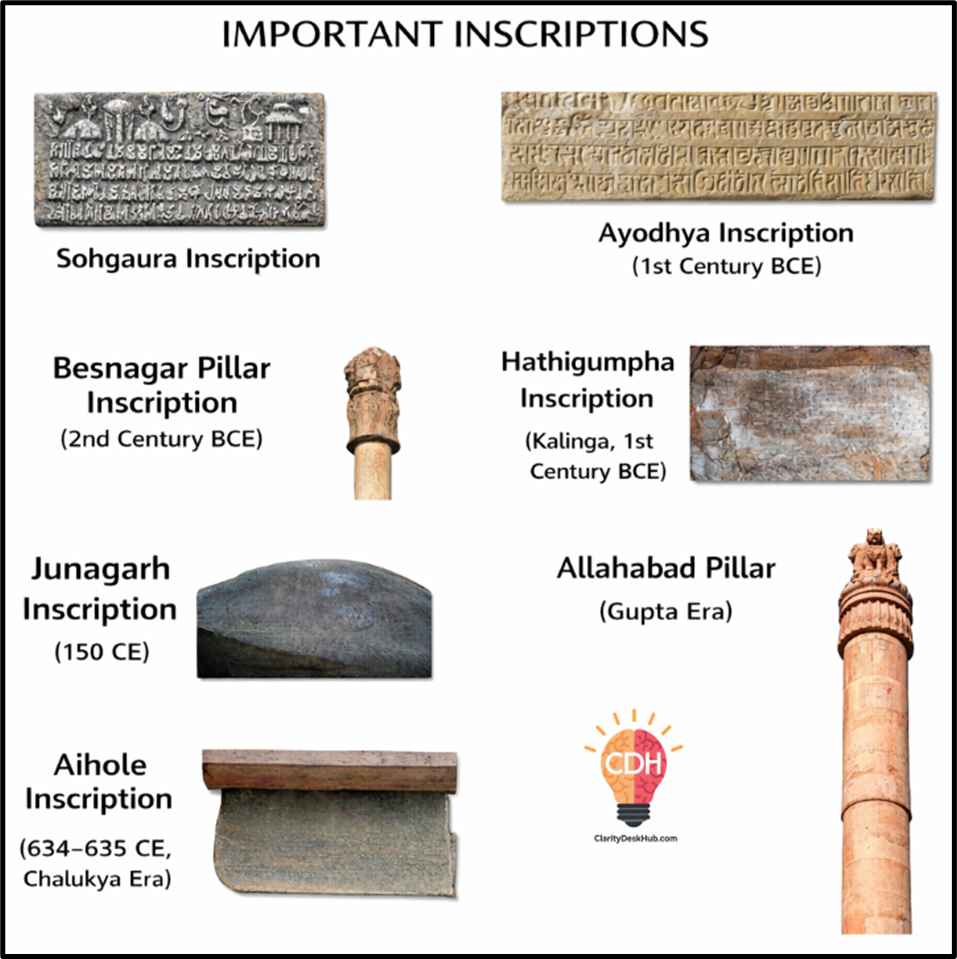
- The Sohgaura Inscription
- Inscriptions of Ashoka
The Sohgaura Inscription
This inscription belongs to the early Mauryan phase and is associated with → Chandragupta Maurya
Key Features
- It is a copper plate inscription
- Written in Prakrit; In Brahmi script
- Discovered at Sohgaura in present-day Uttar Pradesh (Gorakhpur district)
- Considered the oldest copper plate inscription in India
Now pause here.
Why is this important?
Because later land grants are mostly recorded on copper plates.
But this is the earliest known example — and it predates Ashoka’s famous inscriptions.
What Does It Record?
It mentions → Establishment of three granaries; Public distribution of food; Famine relief measures
This reveals something crucial:
The Mauryan state was already concerned with public welfare and food security, even before Ashoka.
This is administrative sophistication — not mere kingship.
Symbols on the Inscription
The Sohgaura plate also contains symbols similar to those found on Punch-Marked Coins, including → A three-arched crescent symbol known as the Rajanka or Meru symbol
This suggests:
- Standardised symbolic vocabulary
- State legitimacy markers
- Economic and administrative continuity
Thus, Sohgaura represents the beginning of inscriptional governance in India.
Inscriptions of Ashoka
Read in Details here.
Post-Mauryan period
Under the Mauryas, inscriptions were instruments of moral governance.
After them, inscriptions become:
- Vehicles of royal glory
- Records of military achievements
- Instruments of religious assertion
- Documents of administrative activity
And most importantly — Sanskrit gradually replaces Prakrit, marking a cultural shift.
Let us examine each major inscription carefully.
Ayodhya Inscription
This inscription:
- Found in a monastery at Ayodhya (Uttar Pradesh)
- Written in Sanskrit, in Brahmi script, dated to the 1st century BCE
It records:
- The performance of Ashvamedha sacrifice
- Conducted by the Sunga ruler → Pushyamitra Sunga
Why is this important?
The Ashvamedha is a Vedic royal sacrifice symbolising sovereignty.
This inscription reveals:
- Revival of Brahmanical rituals after the Mauryan period
- Assertion of political authority through Vedic tradition
- Increasing use of Sanskrit in inscriptions
We see here a shift from Ashoka’s ethical universalism to ritual-based kingship.
Besnagar Pillar Inscription (Heliodorus Pillar)
Located at Besnagar (Vidisha, Madhya Pradesh).
Also known as the Garuda Dhvaja or Heliodorus Pillar.
- 2nd century BCE
- Language: Prakrit
- Script: Brahmi
This inscription venerates Vasudeva Krishna.
Now comes the most fascinating part.
The pillar was dedicated by → Heliodorus, Ambassador of Indo-Greek king Antialcidas, sent to the court of Sunga king Bhagabhadra
This is the earliest surviving record of a foreign convert to Vaishnavism.
And it is the first inscription explicitly connected to Vaishnavism.
What does this show?
- Early development of Bhagavata/Vaishnava tradition
- Religious permeability
- Cultural assimilation of foreigners
This inscription is civilizationally significant.
Hathigumpha Inscription
Located in the Udayagiri Hills, Odisha.
Belongs to → Kharavela (1st century BCE)
Language: Prakrit; Script: Brahmi
It records:
- Victories over Pandyan rulers
- Conflict with Sunga rulers
- War against Satavahana king Satakarni
- Patronage of Jainism
- Construction of tanks and canals
Important observations:
- It reflects aggressive regional power politics.
- It shows state-sponsored irrigation.
- It demonstrates religious tolerance.
Thus, inscriptions now combine military record and public works.
Junagarh (Girnar) Inscription
This is a turning point. It belongs to → Rudradaman I (Dated 150 CE)
Location: Junagadh, Gujarat
Features:
- Written in Classical Sanskrit; In prose form
- First major inscription in Classical Sanskrit
This marks a cultural milestone.
Until now, most inscriptions were in Prakrit. With Rudradaman, Sanskrit enters royal epigraphy formally.
What does it record?
- Repair of Sudarshana Lake
- Originally built under Chandragupta Maurya by Pushyagupta
- Repaired by Rudradaman’s governor Suvishakha
- Later repaired again under Skandagupta
Thus, this single rock carries inscriptions of → Ashoka, Rudradaman, Skandagupta
It becomes a layered historical archive.
Allahabad Pillar
Originally erected by Ashoka at Kaushambi. Later shifted to Allahabad Fort.
It contains inscriptions from:
- Ashoka (Prakrit, Brahmi)
- Gupta emperor Samudragupta
- Mughal emperor Jahangir (Persian)
Thus, One pillar, three millennia, three languages.
This is extraordinary continuity.
Prayaga Prashasti
The inscription of Samudragupta
Known as the Prayaga Prashasti.
- Composed by court poet Harisena
- Written in Sanskrit, in prose and verse
- A classical example of Prashasti (eulogy)
Harisena compares Samudragupta to → Brihaspati (intellect); Tumburu and Narada (music)
He calls him Kaviraja.
This is the golden age of royal glorification through literature.
Aihole Inscription
Also called the Aihole Prashasti. Dated 634–635 CE.
Composed by Jain poet Ravikirti in honour of → Pulakeshin II
Location → Meguti Jain Temple, Aihole, Karnataka
Written in Sanskrit.
It records:
- Pulakeshin II’s victories
- Defeat of Emperor Harshavardhana
Ravikirti even compares himself to Kalidasa and Bharavi.
Notice the cultural shift → The poet now glorifies both himself and the king.
Eran Inscription
Belongs to Bhanu Gupta (510 CE)
It records:
- Conflict with Huna ruler Toramana
- Death of feudatory Goparaja
- Performance of Sati by Goparaja’s wife
This is the first epigraphic reference to Sati. Thus, inscriptions now also document social practices.
Mehrauli Iron Pillar Inscription
Located in the Qutb complex, Delhi. Constructed by → Chandragupta II
Written in Sanskrit.
It describes:
- King as devotee of Vishnu
- Erection of a Vishnu dhvaja
But beyond content, the pillar is famous for:
- Resistance to corrosion
- Advanced metallurgical knowledge
It is testimony to the high level of iron extraction and processing in ancient India.