
Ethical Reasoning and Moral Dilemmas
What is an Ethical Situation?
Imagine you are a district collector. Every day you sign dozens of files — approving tenders, disbursing salaries, ordering stationery. None of these decisions trouble your conscience because they follow routine procedures.
But one morning, a file lands on your desk with no easy answer. You must decide whether to allot land to a company that will create 5,000 jobs but displace 500 tribal families. Suddenly you feel a deep inner tension. That tension is the hallmark of an Ethical Dilemma — the central concept of this section.
Routine Decisions vs. Ethical Situations
Most decisions in personal, official, and social life are straightforward. They rest on routine and habitual procedures. Even when they touch morality, the applicable criteria are simple and clear.
An Ethical Dilemma, by contrast, is a situation in which a decision involves conflict between two or more moral principles of equal standing. The decision-maker (the Moral Agent) must choose between Norm N1 and Norm N2, knowing that selecting one means sacrificing the other.
This is a trade-off between moral criteria — not between good and bad, but between good and good!
💡Key Insight: “Ethical Dilemma is NOT a choice between RIGHT and WRONG. It is a choice between TWO RIGHTS that cannot both be honoured simultaneously.”
What Makes a Situation “Ethical”?
Not every situation carries a moral dimension. Ordering office stationery or designing a bridge are purely technical decisions. So, what injects ethics into a situation? Three ingredients are needed:
- The decision is based on the Moral Agent’s choice and volition (free will).
- The decision significantly affects other individuals.
- The decision is guided by moral norms such as fairness, honesty, justice, integrity, truthfulness, or generosity.
Two scholars have defined this elegantly:
| Scholar | Definition of Ethical Situation |
| Dennis P. Wittmer | A situation in which ethical dimensions are relevant and deserve consideration in making a choice that will have significant impact on others. |
| James Rest | Ethical dimensions are those norms and principles that “provide the basic guidelines for determining how conflicts in human interests are to be settled and for optimizing mutual benefit of people living together in groups.” |
Ethical vs. Non-Ethical Situations — A Quick Comparison
| Aspect | Non-Ethical Situation | Ethical Situation |
| Nature of decision | Routine / Technical | Involves moral judgment |
| Criteria used | Budget, specifications, rules | Fairness, honesty, justice, rights |
| Affects others? | Minimally or indirectly | Directly and significantly |
| Volition involved? | Procedure-driven | Agent’s free choice required |
| Example | Ordering office stationery | Deciding whether to report a senior’s corruption |
How Do We Make Moral Decisions? Two Powerful Models
Once we recognise that a situation has ethical dimensions, the next challenge is: how do we decide? Administrators cannot rely on gut feeling alone — they are accountable to the political executive and the public. Their decisions must be grounded in reasons and principles.
Decisions without the guidance of standards will be arbitrary, capricious, and unpredictable. Two important models guide ethical decision-making in public administration.
⚠ Golden Rule “An administrator can defend using the wrong principle. But an administrator can NEVER defend a decision that is not grounded in ANY principle.”
Model I — Terry Cooper’s Step-by-Step Framework
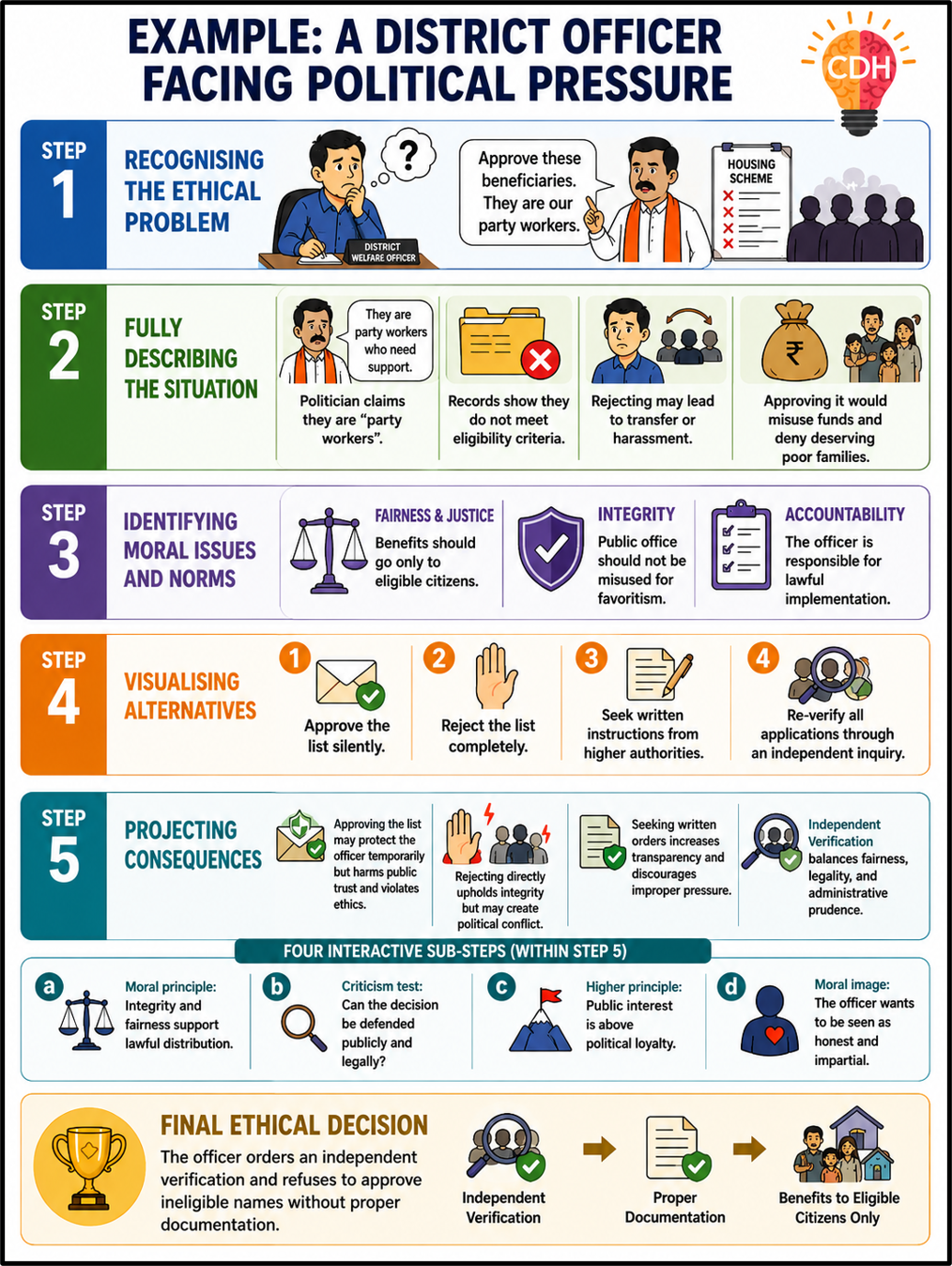
Terry Cooper, a leading scholar in administrative ethics, reduced moral decision-making to a logical series of steps. Think of it as a GPS for ethical navigation — it tells you where you are, what options exist, and which route is morally justified. The procedure presupposes no fixed moral norms — the decision-maker is free to select the appropriate moral standard at each stage.
Terry Cooper’s Ethical Decision-Making Model — Flowchart
| STEP 1 ▶ Perception / Recognition of the Ethical Problem |
| Administrators can be morally blind. The first step is simply SEEING the moral dimension. Failure to notice arises from personality, inadequate moral development, or a feeling of helplessness. |
| STEP 2 ▶ Fully Describing the Situation |
| This is NOT literary description — it is a full, objective recitation of facts. Facts may be incomplete and seen from multiple perspectives. |
| STEP 3 ▶ Spelling Out the Moral Issues and Moral Norms |
| Identify which moral principles are at stake. Officials tend to view problems through administrative or legal lenses; the moral lens must also be applied. |
| STEP 4 ▶ Visualising All Possible Alternatives |
| Do NOT reduce the problem to a simple either/or. All possibilities must be explored — no option should be rejected outright at this stage. |
| STEP 5 ▶ Projecting Consequences of Each Alternative |
| Like a “dramatic rehearsal” — list each option and weigh its merits and demerits. Use a pros/cons table to make thinking visible. |
| FOUR INTERACTIVE SUB-STEPS (within Step 5) |
| a) Identify the moral principle behind each alternative. b) Analyse how well each alternative can withstand criticism. c) Consider whether higher moral principles apply to the situation. d) Examine how each alternative reflects on the decision-maker’s moral image. |
📖 Important Note: In real life, following these steps in exact sequence is not always possible. But the framework helps public administrators make the moral dimensions of policy alternatives EXPLICIT — rather than hiding them behind legal or administrative jargon. Remember: In a democratic setup, the political executive takes the FINAL call.
The solution reached by this process is rarely perfect. It will not represent a fine balance between duties and rights. In technical terms, such solutions are not “optimising” but “satisficing” — satisfactory overall, and more desirable than undesirable.
CASE STUDY 1 | The Vidyasahayaks Problem
A District Development Officer (DDO) discovers that many part-time education assistants (Vidyasahayaks) are not teaching for their prescribed hours. The moral dimensions are two-fold:
(1) breach of promise/obligation by the Vidyasahayaks, and
(2) deprivation of rural children’s right to education.
| Cooper’s Step | Applied to This Case |
| Step 1: Recognise | Moral dimensions — breach of duty + children’s right to education |
| Step 2: Describe | Teaching norms, number of defaulters, availability of replacements, Tehsil-level awareness |
| Step 3: Identify Norms | Obligation to meet duties, fairness to children, honesty |
| Step 4: Alternatives | Discharge them OR ignore OR alter schedules OR run improvement programmes OR hold a meeting |
| Step 5: Consequences | Discharge → no teacher for children; Ignore → slow decay of education quality |
| Step 6: Resolution | A combination of counselling, schedule changes, and quality programmes is most “satisficing” |
Model II — Pops & Pavlak: The Justice-Based Approach
Gerald Pops and Thomas Pavlak, in their seminal work “The Case for Justice: Strengthening Decision Making in Public Administration,” proposed a method rooted in justice as an integrative normative principle.
Justice, they argue, subsumes values like public interest, social equity, and efficiency. They propose two types of justice that every administrator must honour:
| Type of Justice | Focus | Key Question |
| Outcome Justice (Distributive Justice) | WHAT is decided — the substance of the decision | Is the result fair and equitable? |
| Process Justice (Procedural Justice) | HOW it is decided — the manner of decision-making | Was the procedure fair and open? |
Conditions for Outcome Justice
For a decision to satisfy Outcome Justice, it must meet these six conditions:
| Condition | Explanation | Example |
| i. Fact-based | Decisions must rest on the actual facts of the case. | In an evacuation, prioritise women, children, and the aged based on vulnerability facts. |
| ii. Policy-aligned | Decisions must follow and advance public policy goals set by the duly constituted political authority. | A welfare scheme must target the intended beneficiaries. |
| iii. Canons of Justice | No penalty without opportunity to be heard (Audi Alteram Partem). | Show-cause notice before dismissal. |
| iv. Rules + Discretion Balance | Rules ensure objectivity; discretion covers contingencies rules cannot anticipate. | Act of God exemption in contracts (e.g., floods delaying construction). |
| v. Service to People | Decisions must serve the “clients” (citizens), not the agency itself. | Gram Panchayat prioritises villagers’ needs, not bureaucratic convenience. |
| vi. Individual vs. Society Balance | Individual care must not waste public resources. | Welfare benefits must be targeted, not dissipated. |
CASE STUDY 2 | Suman’s Dilemma — Democratic Accountability vs. Development Priority
Suman, a young idealistic development officer, finds that the elected Panchayat has allocated 40% of its budget to minor irrigation — a scheme that benefits landowning farmers. But Suman’s analysis shows the district urgently needs investment in social sectors (high infant mortality, maternal mortality, low female literacy). What should Suman do?
| Option | Analysis | Verdict |
| Surreptitiously divert funds | Violates truthfulness and transparency. Cannot give wrong instructions to subordinates. | ❌ Wrong |
| Simply follow Panchayat’s decision | Correct, but incomplete. As an officer with deep knowledge, he owes more. | ⚠ Partially Right |
| Discuss and persuade elected officials | Correct! Use skills of communication, persuasion, and negotiation. Democratic method. | ✅ BEST Option |
| Resign himself to the power structure | Fatalistic/passive behaviour. Undermines initiative. Avoid abstract excuses for inaction. | ❌ Wrong |
🎓 Key Takeaway Lesson: Young officers must not give up WITHOUT trying. In a democratic setup, policy power rests with elected representatives. An officer’s duty is to advise, persuade, and negotiate — not to defy or bypass.
Conditions for Process Justice
For a decision to satisfy Process Justice, the following six requirements must be met:
| Requirement | What It Means | Real-World Example |
| Equality of Access | All concerned parties must have equal access to decision-makers, information, and processes. | RTI (Right to Information) Act ensures this in India. |
| Impartiality | Public administrators must not be biased by extraneous considerations. | A DM must not favour a contractor just because he is from the same community. |
| Transparency | Decisions must be taken openly, with inputs from all stakeholders sought. | Planning Commission placing Draft Plan on its website for public comment. |
| Efficiency | The process must result in timely decisions. Undue delay negates justice. | Pendency in land acquisition proceedings harms all parties. |
| Participation & Humaneness | All participants must be treated with dignity and courtesy. | Tribal hearings in environment clearance processes. |
| Right to Appeal | Affected persons must have avenues to challenge decisions at higher levels. | Appellate Authority under RTI Act; Central Administrative Tribunal (CAT). |
📌 Note for UPSC Important: Both Cooper’s Model and Pops & Pavlak’s Model are PROCEDURAL frameworks. They tell you HOW to decide, not WHICH moral criterion to apply. It is for the decision-maker to choose the relevant moral standard (fairness, honesty, justice, etc.) in any given case.
Ethical Dilemmas and Prima Facie Principles (W.D. Ross)
Now we come to the philosophical heart of this scetion. We know that ethical dilemmas arise when two moral standards collide. But what are these standards? The 20th-century moral philosopher W.D. Ross gave us a brilliant framework: Prima Facie Duties.
What are Prima Facie Duties?
“Prima Facie” is a Latin expression meaning “on first view” or “at first glance.” These are commonly accepted moral principles — the presumptions with which moral agents approach any situation. Think of them as your default moral settings.
A moral presumption operates like a legal presumption: it is treated as TRUE unless there is sufficient evidence or special justification to override it. Ethical dilemmas arise precisely when two prima facie presumptions point in conflicting directions.
🧲 Analogy: Imagine two strong magnets pulling a metal ball in opposite directions with equal force. That tug-of-war IS the ethical dilemma. Prima Facie principles are the magnets.
The Six Prima Facie Principles (W.D. Ross)
W.D. Ross identified six prima facie moral principles that most moral philosophers accept:
| # | Principle | Core Idea | Exception / Limit | UPSC Relevance |
| 1 | Honesty | Tell the truth. Truth-telling has both intrinsic value and utilitarian value — collective action is impossible if everyone lies. | Can be overridden by Beneficence (e.g., lie to thugs to save an innocent life). | Truthfulness as a civil service value; RTI; Whistleblowing |
| 2 | Promise-Keeping (Fidelity) | Keep your promises in official, social, and family life. Contracts embody promises. The legal doctrine of Estoppel enforces this. | “Acts of God” may excuse non-fulfilment (e.g., floods delay a contractor). | Contractual obligations; Policy commitments; Service rules |
| 3 | Non-Maleficence (Not Harming Others) | At minimum, do NOT harm others. Harm includes both physical pain and mental trauma. | Harming others is permissible in self-defence. | Avoiding collateral damage in policy; Police use of force |
| 4 | Beneficence (Doing Good) | Actively help others (altruism). Good has physical dimensions (food, health) and psychological ones (security, happiness). | Preventing harm (a form of beneficence) is distinct from the duty to not harm. | Public welfare; CSR; Officer’s duty to citizens |
| 5 | Autonomy | Respect individual freedom. People can live as they wish provided, they do not violate others’ rights. Two sides: right of non-interference + right to control actions others take for your benefit. | Cannot claim autonomy to harm others. | Individual liberty; Patient rights; Freedom of speech |
| 6 | Equality / Justice | All similarly placed individuals must be treated by the same legal standards. Not equal treatment in all respects — but equal application of law. | Different roles warrant different treatment (parents vs. strangers). | Article 14; Non-discrimination; Equal opportunity |
How Prima Facie Principles Create Ethical Dilemmas
Since these six principles represent equally valid moral duties, situations often arise where two or more of them pull in opposite directions. The moral agent must then decide which principle takes priority — which one becomes the “actual duty” in that specific context.
| Conflicting Principles | Dilemma Scenario | Resolution by W.D. Ross |
| Honesty vs. Beneficence | A bystander is asked by thugs for the whereabouts of an innocent man fleeing them. | Beneficence (saving life) TRUMPS Honesty. The lie is morally justified. |
| Promise-Keeping vs. Beneficence | Maria learns of financial fraud from her friend Julie (in confidence). | Beneficence (preventing harm to many) OVERRIDES keeping Julie’s secret. |
| Non-Maleficence vs. Non-Maleficence | Vanajakshi can save only ONE of two accident victims. | Triage logic: Save the one more likely to survive (maximise lives saved). |
| Autonomy vs. Equality | Affirmative action for backward communities restricts “open competition.” | Equality (substantive) OVERRIDES formal autonomy to ensure level playing field. |
📑 How to Resolve: Ross’s Rule W.D. Ross’s method: Look at the morally relevant facts of the situation. Decide which conflicting prima facie duty deserves priority in THAT context. The one accorded priority becomes the “Actual Duty” of the moral agent.
Case Studies in Ethical Reasoning
The best way to understand ethical principles is through real-life scenarios. Let us examine five case studies that illustrate how prima facie principles work in practice.
CASE STUDY 3 | Chandan’s Rash Promise — Honesty & Promise-Keeping
Kailash needs a financial partner for his retail garment venture. His friend Chandan, swept up in excitement, rashly promises to contribute the needed capital — despite having no resources and no realistic means to raise funds. Kailash structures his entire financial plan around this promise. Chandan fails to deliver, causing Kailash great hardship.
- Principle at stake: Promise-Keeping (Fidelity)
- What should Chandan have done?
The best option was Option 1: He should NOT have joined the venture.
In the absence of any realistic means to raise funds, a promise was not genuine. Holding out even vague hope is dishonest. True opportunity only exists when resources back it. Chandan’s behaviour is the classic “Micawber Syndrome” (from Charles Dickens) — hoping things will work out without any plan. Moral lesson: Be realistic. Do not make promises you cannot keep.
CASE STUDY 4 | Y’s Excuse — The Price of Convenient Lies
X invites Y to a function at his far-away home. Y is simply too tired to drive through traffic. Should Y pretend to be unwell? Agree to come but cancel last minute? Or attend if the function is important?
- Best option: Option 3 — Attend if the function is important; else politely state the real reason.
- Why not Option 1? Pretending to be unwell is a white lie. Rigorous moralists argue it is habit-forming.
- Why not Option 2? Worse — X has already prepared and spent money in anticipation.
- Why not Option 4? Transferring the problem to another guest shows a lack of self-reliance.
💡Key Quote “Convenient lies are habit-forming and stepping stones to more serious moral transgressions.” Professional ethics treat truth-telling as an INVARIANT norm.
CASE STUDY 5 | The Bystander’s Lie — Beneficence vs. Honesty
A bystander watches an innocent man fleeing thugs who intend to kill him. When the thugs ask which way he ran, the bystander deliberately misleads them.
| Perspective | Position | Verdict |
| Kantianism | Lying is always wrong, regardless of consequences. Kant would convict the bystander. | ❌ Rejected by most thinkers |
| W.D. Ross | Beneficence (saving life) trumps Honesty here. The bystander acted correctly. | ✅ Accepted |
| Common Sense | The bystander’s action aligns with the “commonsense of humanity.” | ✅ Accepted |
| Dismissive | “This is a mere moral quibble not worth troubling about.” | ❌ Wrong: Even eccentric problems must be logically examined. |
CASE STUDY 6 | Maria’s Dilemma — Promise-Keeping vs. Beneficence
Julie tells Maria (in confidence) that their boss Arunachalam plans to commit financial fraud, endangering depositors and employees. Maria tips off the CFO, who foils the fraud. Was Maria right?
The dilemma: Maria’s implicit promise to keep Julie’s confidences (Promise-Keeping) vs. her obligation to prevent harm to many people (Beneficence).
- Resolution: Beneficence (preventing large-scale harm) OVERRIDES promise-keeping.
- Maria’s action is fully justified. Once she became aware of the risk, she had a responsibility to act — irrespective of what Julie chose to do.
📌 UPSC Connection: Whistleblowing This case illustrates how WHISTLEBLOWING finds its ethical foundation in the Principle of Beneficence.
CASE STUDY 7 | Vanajakshi’s Triage — Who to Save First?
Police officer Vanajakshi, trained in paramedical skills, arrives at an accident scene. A boy and a girl are critically injured. She can singlehandedly save only one. The girl’s condition makes survival with solo effort highly unlikely.
| Option | Reasoning | Correct? |
| Toss a coin | No moral principle applied. Arbitrary decision. | ❌ Wrong |
| Help the boy first (because higher survival odds) | Maximises the number of lives saved. This is TRIAGE logic. | ✅ Correct |
| Help the boy (because “boys always have priority”) | Perverse sex-based criterion. This attitude causes sex-ratio distortion. | ❌ Wrong |
| “No acceptable solution” | Fatalistic. Every dilemma has a solution based on morally relevant facts. | ❌ Wrong |
“Triage” — originally a battlefield concept — means allocating scarce resources on the basis of the productivity of those resources. When two moral duties clash (both deserve equal care), the relevant fact is survival probability, not gender, caste, or religion.
Harold Gortner’s Framework for Analysing Ethical Dilemmas
Harold Gortner, in “Ethics for Public Managers,” provides a practical analytical framework for public servants. Before trying to resolve a dilemma, one must first confirm it IS a dilemma — and then examine it through multiple lenses.
Step 1 — Is it really an Ethical Dilemma?
Answer these three diagnostic questions:
| Diagnostic Question | Why It Matters |
| Is there a CONFLICT between important moral standards in this case? | No conflict = no dilemma. Perhaps it is simply a legal or procedural problem. |
| Can the conflicting values be IDENTIFIED straightaway, or does deeper analysis help? | Some dilemmas are obvious; others require careful unpacking of hidden values. |
| Is a QUANTITATIVE study needed to determine which value needs priority? | Some dilemmas require empirical data (e.g., cost-benefit analysis of a policy). |
Step 2 — Five Lenses for a Morally Sound Decision
Once the dilemma is confirmed, examine it through five perspectives:
| Lens | Key Question to Ask | Illustration |
| i. The Law | What direction do the relevant laws indicate? | Prevention of Corruption Act; Whistle Blowers Protection Act; RTI Act. |
| ii. Philosophical & Cultural Background | What light do philosophical and cultural ideas throw on this case? | Indian constitutional values of justice, equality, fraternity. Gandhian trusteeship. |
| iii. Professionalism | What expert inputs are needed from specialists and generalists? | Medical officer’s advice in a health policy; Engineer’s input in infrastructure. |
| iv. Organisational Dynamics | Is the problem rooted in the organisation’s culture or personnel mindset? | “Mindset” of Police SHOs, Village Revenue Officials, field-level engineers often creates problems for citizens |
| v. Personal Aspects | “What do I need to know about MYSELF to handle this dilemma properly?” | Self-awareness, emotional intelligence, integrity of the decision-maker himself. |
Connecting to Normative Theories
When prima facie principles clash and no simple intuitive judgment helps, two grand normative theories assist in breaking the deadlock:
| Theory | Core Recommendation | Form Preferred | Limitation |
| Utilitarianism | Choose the course that MAXIMISES social welfare or happiness. | Rule Utilitarianism (preferred form) | May justify harming a minority to benefit a majority. |
| Deontology (Kant) | Follow moral rules that can be applied universally WITHOUT exceptions. | Categorical Imperative | Too rigid — does not account for context and consequences. |
Key Terms Glossary
| Term | Meaning |
| Moral Agent | An individual who has the capacity and freedom to make moral choices. |
| Ethical Dilemma | A situation involving conflict between two equally valid moral norms (N1 vs N2). |
| Prima Facie Duty | A presumptive moral obligation that holds unless overridden by a stronger duty. |
| Normative Theory | A prescriptive ethical theory that tells us what we OUGHT to do (e.g., Utilitarianism, Deontology). |
| Satisficing | A decision that is not optimal but is satisfactory and more desirable than undesirable. |
| Optimising | A perfect decision that fully satisfies all moral criteria (rare in real life). |
| Triage | Allocating scarce resources to those most likely to benefit, in order to maximise positive outcomes. |
| Outcome Justice | Justice in the SUBSTANCE of a decision (what was decided). |
| Process Justice | Justice in the MANNER of a decision (how it was made). |
| Estoppel | A legal doctrine that prevents a person from acting contrary to a position they have previously represented. |
| Beneficence | The moral duty to actively do good / prevent harm to others (altruism). |
| Autonomy | The freedom of an individual to make their own choices without interference, as long as they respect others’ rights. |
Comparison: Outcome Justice vs. Process Justice
| Parameter | Outcome Justice (Distributive) | Process Justice (Procedural) |
| Focus | Result / substance of the decision | Method / procedure of decision-making |
| Key Question | Was the outcome fair? | Was the process fair? |
| Components | 6 conditions (fact-based, policy-aligned, canons of justice, rules+discretion, people-service, individual-society balance) | 6 requirements (equality of access, impartiality, transparency, efficiency, participation, right to appeal) |
| Indian Parallel | Substantive justice; socio-economic rights | Natural justice; procedural rights (Art. 21) |
| Analogy | Did everyone get the right share of the pie? | Was the pie-cutting process transparent and fair? |