
Ethical Qualities Through the Lenses of Sages and Great Thinkers
“The measure of a man is what he does with power.” — Plato
Before we begin, let me tell you something important. Ethics is not a subject you study — it is a subject you live. Most students make the mistake of treating this section as a list of definitions to be mugged up. But think about it: when a senior IAS officer refuses a bribe at great personal cost, what is happening inside him? That, dear student, is Ethics in action.
This section, presents the great virtues and vices of humanity through the words of the world’s greatest thinkers — from Aristotle to Gandhi, from Buddha to George Orwell. Every quotation is a compressed wisdom-bomb. Once you understand what each thinker is actually saying, it will transform not just your UPSC answer but your worldview.
| 🎯 How to Use This section Read each virtue/vice in order. For each one: (1) First understand the DEFINITION with a relatable analogy. (2) Then grasp the PHILOSOPHICAL perspective. (3) Then note the UPSC/administrative relevance. (4) Finally, remember 2-3 key quotes. You don’t need all quotes — pick the most powerful ones. |
INTRODUCTION: The Two Faces of Human Nature
Imagine two children growing up in the same family, in the same city. One grows up to become a kind, honest, courageous public servant who transforms his district. The other grows up to become corrupt, cowardly, and envious. What made the difference? The answer, according to every great moral thinker in history, comes down to one thing: the cultivation of VIRTUES and the avoidance of VICES.
This is the central theme of Ethics — the oldest and most important question in human civilization: How should one live? What kind of person should one be?
What is a Virtue?
A Virtue is any excellence of character. More precisely, it is an acquired power or capacity for moral action. Notice the word ‘acquired’ — virtue is not something you are born with. It is cultivated through moral effort, through practice, through conscious choice.
Aristotle brilliantly said that we become just by doing just acts, brave by doing brave acts. Virtue is a habit, not a one-time event.
| VIRTUE | VICE |
| An excellence of character | A defect or fault of character |
| Cultivated through moral effort | Acquired through moral laziness or indulgence |
| Examples: Courage, Kindness, Honesty | Examples: Anger, Envy, Sloth, Lust |
| Beneficial to self and society | Harmful to self and society |
| Virtues are permanent attributes of a moral agent | Vices become habitual and hard to escape |
Plato’s Four Cardinal Virtues
After centuries of philosophical analysis, the ancient Greek philosopher Plato distilled all virtues into just FOUR cardinal (foundational) ones. Every other virtue can be traced back to these four. Understanding them is crucial for UPSC Ethics answers.
| Cardinal Virtue | Aspect of Human Nature | What it Governs |
| Wisdom (Prudence) | Cognitive / Intellectual | Right thinking and decision-making |
| Fortitude (Courage) | Active Power / Will | Action in the face of danger and difficulty |
| Temperance (Self-Control) | Appetitive / Desires | Control over pleasures and impulses |
| Justice | Social Being | Our interactions and duties towards others |
The Seven Deadly Sins (Major Vices)
Moral philosophers, particularly in the religious tradition, identified the most dangerous vices as ‘deadly sins’ because they corrupt the soul from within and give birth to all other vices. Here they are:
| Deadly Sin | Core Description | Opposite Virtue |
| Pride (Vanity) | Excessive love of self; contempt for others | Humility |
| Greed (Avarice) | Excessive desire for wealth and power | Generosity / Liberality |
| Lust | Excessive sexual desire; violation of moral boundaries | Chastity / Temperance |
| Anger (Wrath) | Uncontrolled rage; revenge | Self-Control / Good Temper |
| Gluttony | Overindulgence in food and pleasure | Temperance / Moderation |
| Envy | Resentment of others’ success and happiness | Kindness / Fraternity |
| Sloth (Laziness) | Aversion to work and moral effort | Diligence / Industry |
KINDNESS
| “Be kind, for everyone you meet is fighting a harder battle.” — Plato |
| “My religion is very simple. My religion is kindness.” — Dalai Lama |
| “Kindness is a language which the deaf can hear and the blind can see.” — Mark Twain |
| “Real kindness seeks no return; what return can the world make to rain clouds?” — Tiruvalluvar |
💡 Understanding Kindness
Let’s start with Aristotle’s definition:
Kindness is helpfulness towards someone in need — not in return for anything, nor for the advantage of the helper, but for the person being helped. This is a profound definition.
Think about it carefully. A shopkeeper who gives you an extra sweet because he wants your repeat business — is that kindness? No! That is strategic generosity. True kindness has no hidden agenda.
The simplest way to understand kindness: it is being FRIENDLY, GENEROUS, and CONSIDERATE towards others. It is the bedrock of both humanist and religious ethics. In fact, Dalai Lama goes so far as to call kindness his religion — implying that all of religion, at its core, is about how we treat other beings.
Key Elements of Kindness
- Empathy: The ability to feel what others feel — to ‘weep with those that weep, and rejoice with those that rejoice.’
- Practical Beneficence: Kindness cannot remain as an inactive sentiment. It must translate into action — deeds that help those in distress.
- Forgiveness and Forbearance: Most religions regard these as special forms of kindness — not speaking evil of others, being gentle and humble.
- Non-Violence (Ahimsa): Mahavira defines kindness in negative terms — ‘Do not injure, abuse, oppress, enslave, insult, torment, torture, or kill any creature.’
- Social Conscience: Kindness arises from our capacity for fellow-feeling, our common humanity.
Kindness in World Religions
| Religion / Tradition | Concept | Essence |
| Hinduism | Daya / Anukampa | Compassion and mercy towards all beings |
| Buddhism | Karuna | Compassion as a central spiritual practice |
| Islam | Reham (Rahm) | Mercy and compassion; Allah’s primary attribute |
| Christianity | Charity / Agape | Love towards fellow human beings as core virtue |
| Jainism | Ahimsa + Kindness | Non-violence as the chief form of kindness |
| Sikhism | Daya | Compassion as one of five virtues (Panj Guna) |
| Tamil Tradition | Anbum Arulum | Love and grace; Tiruvalluvar’s Thirukkural |
Decoding the Quotes
Plato says: ‘Be kind, for everyone you meet is fighting a harder battle.’ This is remarkable! Plato, arguably the greatest philosopher in history, is asking us to ASSUME that the person in front of us is struggling more than us — even if we don’t know for sure. Why? Because this assumption will make us permanently kind.
A civil servant who assumes that every citizen standing before him is going through hardship will treat them with dignity and compassion. This assumption becomes a virtue.
Mark Twain’s quote is one of the most beautiful in Ethics. Kindness transcends language, education, and ability. You don’t need a PhD to be kind. Even a child, even an illiterate person, can be kind. It is part of our natural emotional make-up. Kindness is the most democratic of all virtues.
Mother Teresa’s observation is about the RISK of kindness. She says: even if my kindness leads to mistakes — if I am overindulgent towards some undeserving person — I will at least not harm anyone.
Versus those who ‘work miracles in unkindness’ — like totalitarian regimes (Nazi Germany, Stalinist Russia) that tried to ‘improve society’ through violence and ended up causing unimaginable suffering. The lesson: kindness must be the non-negotiable floor of all human interaction.
| 🏛️ UPSC Relevance In public administration, kindness manifests as empathy with citizens, sensitivity to vulnerable populations, and humane implementation of policies. A DM who is ‘kind’ in the Platonic sense will listen to every petitioner, remember that they are fighting their own battles, and treat them with dignity. Kindness is the foundation of citizen-centric governance. |
FORGIVENESS
| “Forgiveness is the fragrance that the violet sheds on the heel that has crushed it.” — Mark Twain |
| “He who is devoid of the power to forgive, is devoid of the power to love.” — Martin Luther King Jr. |
| “To forgive all is as inhuman as to forgive none.” — Seneca |
💡 Understanding Forgiveness
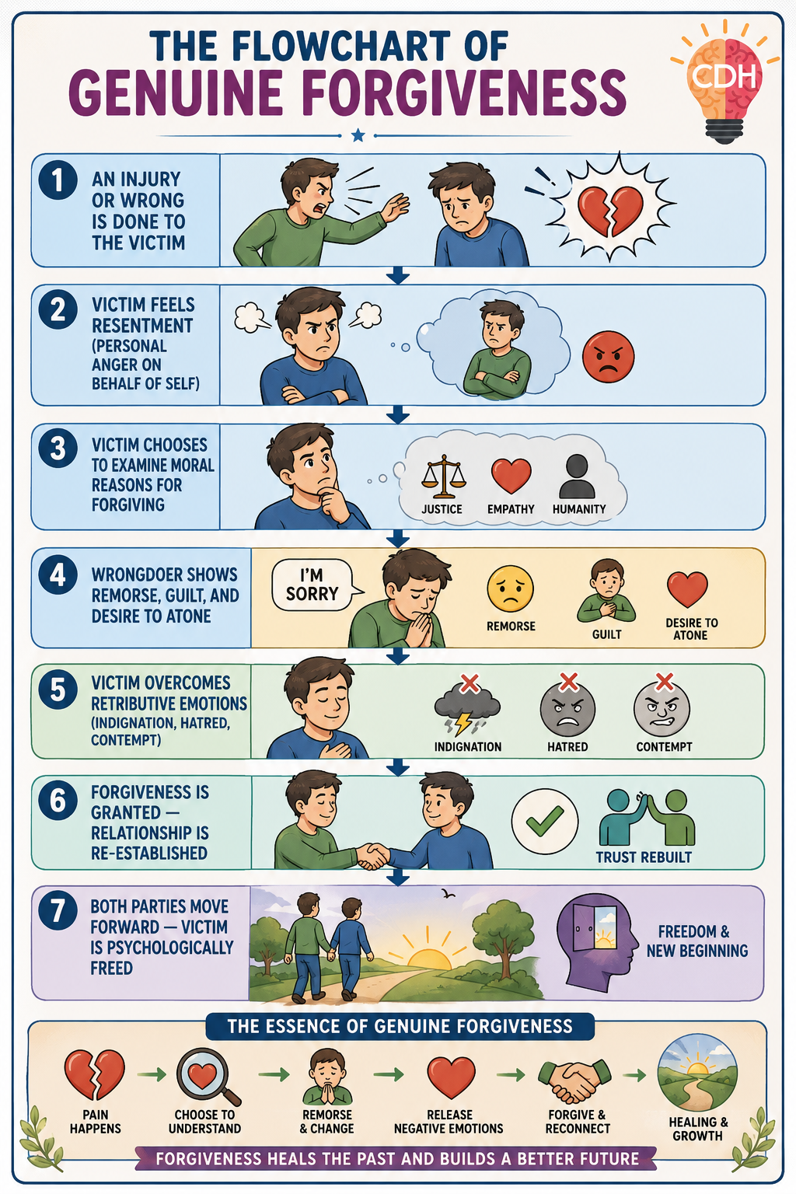
Mark Twain’s quote is perhaps the most poetic definition of forgiveness ever written. A violet crushed underfoot — instead of dying bitterly, it releases its fragrance. Forgiveness is that fragrance: beauty arising from injury. This is the essence of what forgiveness means — the victim, despite being wronged, chooses to release rather than retain bitterness.
Technically, Forgiveness means the pardoning of an offence, wrongdoing, or obligation. The victim pardons the wrongdoer. The classic phrase ‘forgive and forget’ captures the idea. But forgiveness is more complex than it sounds. It is not weakness. It is not blind. It requires moral courage.
Benefits of Forgiveness
- Continuing personal relationships — preserved through forgiveness rather than broken by resentment.
- Personal mental health — releasing persistent negative emotions that harm the wronged individual.
- Helping wrongdoers — releasing them from blame and enabling them to turn a new leaf.
- Social harmony — at a collective level, Truth and Reconciliation Commissions worldwide use forgiveness to heal historical wrongs.
When Forgiveness Can Be Wrong (The Critical Analysis)
Here is where it gets interesting — and this is where students often miss the depth. Aristotle, Kant, and Hume all warn that forgiveness can be MISDIRECTED. It can reflect weakness of character, not strength!
Consider: a woman in an abusive relationship who repeatedly forgives her abuser ‘because she loves him’ — is that noble? No, it is servility. It enables wrongdoing.
| Philosopher | View on Forgiveness |
| Aristotle | A person who lacks appropriate anger is a ‘fool’. Appropriate anger defends dignity. Forgiveness must be earned. |
| Kant | Failing to become angry at injustice done to you = lack of dignity and self-respect. |
| Hume | Anger and hatred are inherent in human nature; total absence of these feelings = weakness and imbecility. |
| Christianity (Gospels) | Forgiveness should be unconditional, extending even to enemies. God’s forgiveness of us depends on our forgiving others. |
| Seneca | ‘To forgive all is as inhuman as to forgive none.’ Balance is required. |
The Flowchart of Genuine Forgiveness
| 🏛️ UPSC Relevance Forgiveness is not just personal. In public life, it manifests as ‘reformative justice’ — the idea that punishment should rehabilitate, not just punish. India’s constitution leans toward humane treatment of offenders. A good civil servant does not carry personal grudges against complainants or opponents. The ability to ‘forgive and move on’ is essential for impartial functioning. |
SELF-CONTROL AND GOOD TEMPER (ANGER)
| “Holding on to anger is like grasping a hot coal with the intent of throwing it at someone else; you are the one who gets burned.” — Buddha |
| “Anyone can become angry — that is easy, but to be angry with the right person at the right time, and for the right purpose and in the right way — that is not within everyone’s power and that is not easy.” — Aristotle |
| “Anger is the enemy of Ahimsa, and pride is a monster that swallows it up.” — Gandhi |
💡 Understanding Anger and Self-Control
Buddha’s image is perfect. When you hold on to anger against someone, you are holding a hot coal. YOU are being burned, not them. This is scientifically verifiable: pent-up anger produces adverse biochemical effects in the body — elevated cortisol, hypertension, weakened immunity. The person you are angry at is probably sleeping peacefully. You are suffering.
But wait — does this mean we should NEVER get angry? Here is where Aristotle shows his genius. He says: anyone can get angry. That requires no skill.
The VIRTUE is to be angry with the RIGHT person, at the RIGHT time, for the RIGHT purpose, in the RIGHT way.
This is one of the most sophisticated statements in all of ethical philosophy.
Aristotle’s Doctrine of the Golden Mean
Aristotle’s concept of virtue as a golden mean between extremes is best illustrated through anger:
| Too Little (Deficiency) | Golden Mean (Virtue) | Too Much (Excess) |
| Inirascibility | Good Temper | Irascibility (Quick Temper) |
| Total placidity; cannot defend oneself | Appropriately controlled anger; forgiving | Road rage; abusive to subordinates |
| Aristotle: ‘A fool who endures insults’ | Anger governed by reason = VIRTUE | Anger ungoverned by reason = VICE |
Two Great Views on Anger
| Greek View (Plato & Aristotle) | Christian View |
| Anger controlled by reason is a virtue | Anger should be subordinated to forgiveness and love |
| Appropriate anger defends dignity and rights | Turn the other cheek; re-embrace the offender |
| Good-tempered person is not revengeful but forgiving | Biblical: Let all bitterness and wrath be put away |
Psychological Perspective
Modern psychologists add a nuance: pent-up anger should ideally be released into HARMLESS channels. Catharsis — the release of emotional tension — is healthy. The word ‘catharsis’ comes from Greek: it means ‘cleansing,’ like lancing a wound.
But this does NOT mean indiscriminate venting. Uncontrolled rage — road rage, domestic violence, teacher beating students, bosses harassing subordinates — is clearly a vice and a social evil.
The Stoic philosopher Seneca goes furthest: ALL forms of anger are inconsistent with moral life because they dispose us to cruelty and vengeance. Gandhi was deeply influenced by this view.
| 🏛️ UPSC Relevance Civil servants encounter frustration daily — uncooperative colleagues, corrupt superiors, political pressure, citizen complaints. The virtue of self-control is what separates an effective administrator from an ineffective one. An officer who ‘flies into a rage’ (Will Rogers: ‘always makes a bad landing’) loses credibility, respect, and effectiveness. Self-control also connects to Emotional Intelligence (EI) — a key topic in GS Paper 4. |
FORTITUDE (COURAGE)
| “Fortitude is the guard and support of the other virtues.” — John Locke |
| “Fortitude is the marshal of thought, the armour of the will, and the fort of reason.” — Francis Bacon |
| “In struggling with misfortunes lies the true proof of virtue.” — Shakespeare |
| “The gem cannot be polished without friction, nor man perfected without trials.” — Confucius |
💡 Understanding Fortitude
Locke’s quote is the most important one here: Fortitude is the GUARD of all other virtues. Think about this with an example:
A passenger on an Indian train sees a woman being harassed. He feels kindness — he wants to help. He knows justice demands intervention. But then cowardice whispers: ‘Don’t get involved. They might hurt you.’ The kindly sentiment is STRANGLED by cowardice. Without fortitude, every other virtue collapses. This is why Locke says fortitude guards the other virtues.
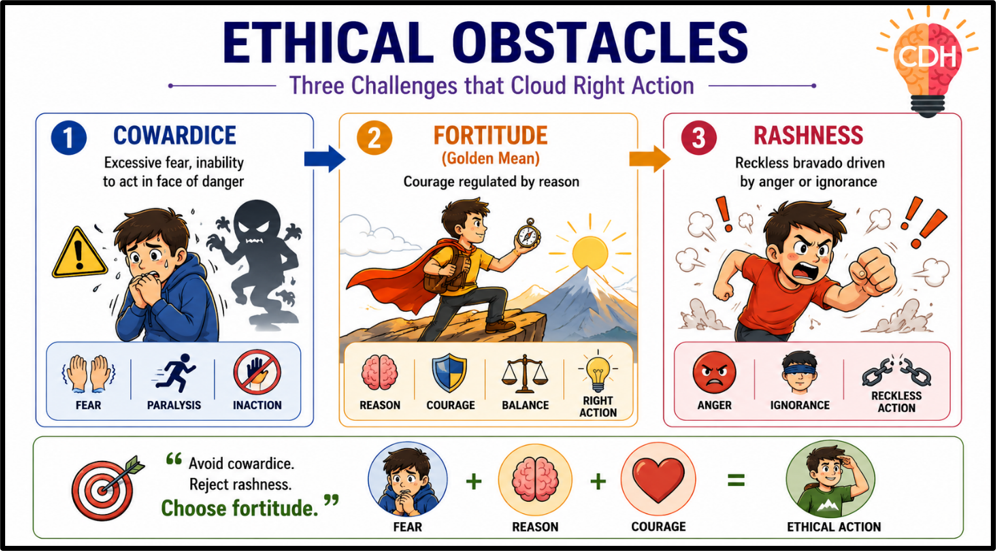
Fortitude is also called courage, bravery, or endurance. Aristotle defines it as the golden mean between cowardice (too little courage) and rashness (too much recklessness):
What Fortitude Is NOT
- It is NOT absence of fear — the brave man DOES feel fear, but controls it through reason.
- It is NOT recklessness — risking life for trivial or ignoble causes is not bravery, it is foolishness.
- It is NOT bravery from ignorance — a soldier who charges because he doesn’t know the danger is not courageous.
- It IS facing real danger with full awareness of its gravity, while pursuing duty or a noble cause.
Plato’s Framework: Cardinal Virtues and Human Nature
| Aspect of Human Nature | Corresponding Cardinal Virtue |
| Cognitive / Intellectual | Wisdom (Prudence) |
| Active Power (Will) | Fortitude (Courage) |
| Appetitive (Desires / Impulses) | Temperance (Self-Control) |
| Social Being (Interactions with others) | Justice |
Fortitude in Administrative Context
This is absolutely critical for UPSC. Civil servants need MORAL COURAGE — the courage of conviction. In practice this means: adhering to rules even under illegal pressure, refusing inducements, not yielding to subtle threats or intimidation, speaking truth to power, whistleblowing when necessary.
Unfortunately, many ‘guardians of public welfare have decided to close their eyes to obvious wrongdoing.’ This is the failure of fortitude in public life.
| 🏛️ UPSC Relevance Questions on ‘moral courage’, ‘courage of conviction’, and ‘probity in public life’ are directly linked to fortitude. Examples: an IAS officer refusing a transfer requested by a powerful minister; a doctor refusing to issue a false certificate; a teacher reporting corruption to superiors. Remember: fortitude = courage + reason. Rashness alone is not a virtue. |
EMPATHY
| “You can only understand people if you feel them in yourself.” — John Steinbeck |
| “Seeing with the eyes of another, listening with the ears of another, and feeling with the heart of another.” — Alfred Adler |
| “I call him religious who understands the sufferings of others.” — Mahatma Gandhi |
| “I do not ask the wounded person how he feels, I myself become the wounded person.” — Walt Whitman |
💡 Understanding Empathy
Here is the single most important distinction in this topic: SYMPATHY vs EMPATHY. These two words are often confused — and in UPSC answers, confusing them can cost you marks.
| SYMPATHY | EMPATHY |
| I feel FOR you | I feel WITH you |
| Emotional distance — I feel sorry for your pain | Emotional immersion — I share your pain |
| Observer position | Participant position |
| Example: ‘I’m so sorry your dog died.’ | Example: ‘My heart breaks as if I lost my own dog.’ |
| Less motivating for action | Powerful motivational driver for action |
The Science of Empathy
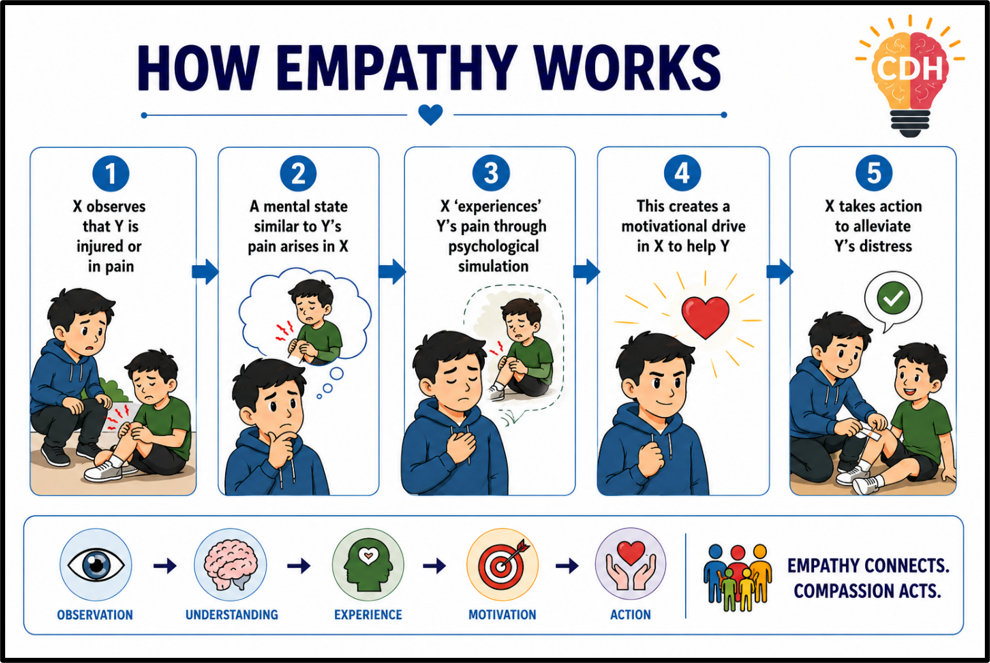
Adam Smith (yes, the same Adam Smith of ‘Wealth of Nations’!) gave the best psychological explanation of empathy: it works through imaginatively placing oneself in another’s position — what we today call ‘simulation.’ Not through mere emotional contagion, but through active imagination.
Alfred Adler (co-founder of psychoanalysis with Freud and Jung) gave the most concise definition:
Seeing with the eyes of another, listening with the ears of another, feeling with the heart of another.
Daniel Goleman adds: when we obsess over our own problems, they become huge and consume our mental space. But when we focus on others, our own problems drift to the periphery — and we grow in wisdom and connection. This is the paradox of empathy: by feeling others’ pain, you reduce your own.
Annie Lennox makes a chilling observation: when empathy ‘atrophies’ in human beings — driven by ideological fanaticism, xenophobia, or hatred — they turn against each other with ferocity. This explains the Holocaust, the Rwandan genocide, the pogroms. The moment you stop seeing ‘the other’ as fully human, the door to atrocity opens.
Developing Empathy
- Listen actively and attentively — resist the urge to give advice prematurely.
- Read literature, humanities — they are empathy machines, forcing you into others’ perspectives.
- Widen your circle of concern beyond yourself and your immediate family.
- Silence the restless ego — minimize self-preoccupation.
- Take genuine interest in others’ problems without being intrusive.
| 🏛️ UPSC Relevance Empathy is the foundation of Emotional Intelligence (EI), a key topic in GS-4. In administration, empathy allows officers to understand citizens’ ground-level realities, design citizen-friendly policies, handle grievances sensitively, and manage diverse teams effectively. Without empathy, an administrator becomes a ‘file-pushing machine.’ With empathy, he becomes a ‘public servant’ in the truest sense. |
ALTRUISM
💡 Understanding Altruism
Altruism or selflessness is the concern for the welfare of others. The word was coined by Auguste Comte, the French philosopher, from the Italian ‘altrui’ (others). Altruism is the OPPOSITE of selfishness.
The altruist moral principle:
‘An action is morally right if the consequences of that action are more favourable than unfavourable to everyone EXCEPT the agent.’
This is beautiful — the altruist explicitly excludes himself from the calculation! Auguste Comte’s version goes even further: ‘Live for others.’
Key Definitions of Altruism
| Thinker | Definition |
| Auguste Comte | ‘Live for others.’ Moral obligation to renounce self-interest. Social sympathy must dominate self-regarding instincts. |
| C.D. Broad | ‘The doctrine that each of us has a special obligation to benefit others.’ |
| W.G. Maclagan | ‘A duty to relieve the distress and promote the happiness of our fellows; a man may and should discount his own pleasure when deciding what to do.’ |
| Utilitarian View | Acts that maximise social good will naturally require altruism, since society always outnumbers the individual. |
Criticisms of Altruism
- Friedrich Nietzsche: treating others as more important than oneself is degrading to the self; it hinders self-development, excellence, and creativity.
- Psychological Egoism: the thesis that ALL human acts are ultimately self-interested; ‘true’ altruism is impossible because even helping others gives the helper psychological satisfaction.
- Rational Egoism: rationality means acting in self-interest; pure self-sacrifice may be irrational.
- Classical Economics (Adam Smith’s market theory): if every agent pursues self-interest, social welfare is maximised — this works AGAINST altruism.
However, the philosophical egoism argument has a flaw: consider a soldier who sacrifices his life for his country. He receives no psychological gratification because he is dead. Calling this ‘self-interest’ is stretching the concept of gratification beyond recognition.
| 🏛️ UPSC Relevance Altruism is central to ‘public service motivation’ — why do people choose low-paying government jobs over high-paying private sector jobs? Altruism explains it. Great public servants — IAS officers who work in disaster zones, doctors in tribal areas, teachers in Naxal-affected regions — embody altruism. It is the opposite of corruption, which is extreme selfishness at the expense of the public good. |
TRUTHFULNESS
| “Even if you are in a minority of one, the truth is truth.” — Mahatma Gandhi |
| “Without truth, social intercourse and conversation become valueless.” — Immanuel Kant |
| “If you shut up truth and bury it under the ground, it will but grow, and gather to itself such explosive power that the day it bursts through it will blow up everything in its way.” — Emile Zola |
| “Man has always sacrificed truth to his vanity, comfort and advantage. He lives by make-believe.” — W. Somerset Maugham |
💡 Understanding Truthfulness
Gandhi famously declared:
‘There is no god higher than truth.’
He called it ‘Satya’ — and for him, it was not just a virtue but a spiritual path. But truthfulness as a moral concept is vast and multi-dimensional. Let’s break it down systematically.
Three Theories of Truth in Philosophy
| Theory | Core Idea | Thinker |
| Correspondence Theory | A belief is true if it corresponds to facts/reality. ‘To say of what is, that it is, is true.’ — Aristotle | Aristotle, Objectivism |
| Coherence Theory | A belief is true if it is part of a coherent system of beliefs. Truth is systematic, not isolated. | Philosophical Idealists |
| Pragmatic Theory | Truth is what is useful and satisfactory to believe. It is borne out by experience and guides action. | William James, Pragmatists |
Why Truthfulness is a Social Necessity
Kant’s quote captures this brilliantly. Social life PRESUPPOSES truth-telling as a norm. Consider what happens without it:
- If accounts of history are all lies: history becomes fiction.
- If witnesses habitually lie: judicial proceedings become a mockery.
- If people cannot trust each other: commerce collapses.
- If officials lie to citizens: governance breaks down.
This is why truth is not just a private virtue — it is the foundation of social order.
Forms of Deception (Going Beyond Outright Lying)
| Form | Description | Example |
| Suppressio Veri | Suppressing truth (deliberate omission) | A minister giving a half-truth statement to Parliament |
| Suggestio Falsi | Suggesting falsehood through implication | Misleading statistics or selective data presentation |
| Half-Truth | Only part of the truth told to misguide | Quoting a scientist out of context |
| Equivocation | Double-meaning statements that mislead | ‘I did not have monetary dealings’ (hiding favours) |
| Silence as Complicity | Remaining silent while lies are told | Not rebutting false propaganda |
Can Lies Ever Be Justified?
This is one of Ethics’ greatest debates.
- Kant said NO — truth is a Categorical Imperative (absolute duty) with NO exceptions.
- St. Augustine agreed: no lie is ever just.
But Dr. Johnson gave a more practical view: lying to protect an innocent man from a murderer IS justified. But lying to spare a patient’s feelings about his terminal illness is NOT.
| Philosopher | View on Lying |
| Kant | Never justified. Truth is an absolute categorical imperative. |
| St. Augustine | No lie is ever just — it is against divine dispensation. |
| Socrates | Lies can be told to guard against enemies or prevent harm. |
| Dr. Johnson | Lying to save an innocent life is justified. Lying for comfort is not. |
| St. Thomas Aquinas | Even if no one is harmed, lying is intrinsically wrong. |
The Sub-Virtues of Truthfulness
- Keeping Promises: Gandhi equates breaking a promise with abandoning truth. A promise is a ‘truthful intent of performing a stated act.’ After making a promise, one must take all possible steps to deliver on it.
- Honesty: Truthfulness in financial matters. Those who handle others’ money (accountants, trustees, treasury officers, civil servants) must be scrupulously honest. Corporate governance is essentially institutionalised honesty.
- Integrity: Acting according to inner convictions; conduct free from hypocrisy. The distinction between ‘ethics of compliance’ (following externally imposed rules) and ‘ethics of integrity’ (internalised moral autonomy) is crucial for UPSC.
- Avoiding Breach of Trust: Never betraying trust placed in you — whether in personal relationships, friendship, or official duties.
Ethics of Compliance vs Ethics of Integrity
| Ethics of Compliance | Ethics of Integrity |
| Based on externally imposed rules and regulations | Based on internalised moral character |
| Civil servants memorise rules and follow them mechanically | Civil servants think independently about ethical problems |
| Obeys when supervised; may not when unsupervised | Behaves ethically even without supervision |
| Risk: may follow bad rules without questioning | Strength: moral autonomy and self-responsibility |
| ‘I didn’t break any rules’ | ‘I did what was right’ |
| 🏛️ UPSC Relevance Truthfulness, honesty, and integrity are the three pillars of probity in public life. The Second Administrative Reforms Commission (2ARC) and various codes of conduct for civil servants emphasise these values. ‘Ethics of integrity’ is the goal of training programmes at LBSNAA. The Right to Information (RTI) Act is essentially a legal instrument for enforcing governmental truth-telling. |
POWER AND MORALITY
| “Power tends to corrupt, and absolute power corrupts absolutely. Great men are almost always bad men.” — Lord Acton |
| “Power gradually extirpates from the mind every humane and gentle virtue.” — Edmund Burke |
| “The measure of a man is what he does with power.” — Plato |
| “Power is of two kinds. One is obtained by the fear of punishment and the other by acts of love. Power based on love is a thousand times more effective and permanent than the one derived from fear of punishment.” — Mahatma Gandhi |
💡 Key Definitions
| Term | Definition |
| Power | The ability to get others to do what you want — ranging from brute force to subtle persuasion. |
| Authority | The ability to exercise power WITHOUT resorting to violence (based on acceptance). |
| Legitimacy | Citizens’ belief that the government has the right to hold power. Lost legitimacy = weakened government. |
| Regime | Any government or ruling system. |
The Corruption Problem
Lord Acton’s statement is the most famous in political philosophy. Why does power corrupt? Because unregulated power gives an individual opportunity for: personal enrichment, abuse of others, subversion of public interest, and insulation from accountability.
Like alcohol, power ‘goes to one’s head.’ The Greek story of Circe is apt: ‘Those who drink of my cup become swine.’
Historical Approaches: Idealism vs Realism
| Political Idealism | Political Realism (Machiavelli) |
| Plato, Aristotle, Cicero, Gandhi, Lincoln, Mandela | Machiavelli, Bismarck, Kautilya (Arthashastra) |
| Politics SHOULD be grounded in universal moral values | Politics IS and MUST BE grounded in power and self-interest |
| Good ends require good means | The end justifies the means |
| Rulers should be virtuous, kind, and just | ‘If you are out to rule, you must be ready to be cruel’ |
| Power should be exercised morally | Morality is a luxury of the powerless |
Important nuance about Machiavelli:
He is often misrepresented as a pure cynic. But he also said: ‘It cannot be called virtue to kill one’s fellow citizens, betray one’s friends, be without faith, without pity; by these methods one may gain power, but not GLORY.’ He distinguished between power and moral legitimacy.
Mechanisms to Control Power
- Social Contract Theory (Hobbes, Rousseau, Locke): People gave up some natural rights to form government — so government derives its power FROM the people, not above them.
- Natural Rights (Locke, Thomas Paine): Right to life, liberty, property are inalienable — government cannot take them away.
- Constitutional Rights: France’s Declaration of Rights of Man; American Constitution; India’s Fundamental Rights.
- Democracy: Periodic elections, separation of powers (legislature, executive, judiciary), independent judiciary, free press.
- Accountability Mechanisms: RTI, Citizens’ Charters, anti-corruption bodies, whistleblower protection.
Gandhi’s View on Power
Gandhi represents one extreme of the spectrum: power without morality is no power at all. He identified two kinds of power — power based on fear and power based on love. He believed the latter is ‘a thousand times more effective and permanent.’
This is not just idealism — it is strategic insight. A government that rules by fear collapses when fear no longer works. A government that rules by love creates citizens who defend it voluntarily.
| 🏛️ UPSC Relevance Power and morality is a perennial UPSC essay and GS-4 topic. Key connections: (1) Lord Acton’s quote on corruption; (2) Gandhi’s view on non-violence in power; (3) Machiavelli vs Kautilya; (4) Totalitarianism and the dangers of unchecked power; (5) Democratic checks through institutions. Civil servants are entrusted with public power — probity demands they use it for citizens, not themselves. |
PRUDENCE
| “The golden mean is God’s delight; Extremes are hateful to his sight.” — Aeschylus |
💡 Understanding Prudence
The common usage of ‘prudence’ is fairly limited — careful, cautious, wary of risks. But in Aristotle’s philosophy, prudence (Greek: phronesis) is elevated to something magnificent: it is Practical Wisdom — the ability to discern the right course of action in any situation.
For Aristotle, prudence is THE master virtue that ENABLES all other virtues. Here is why: Aristotle believed virtue is always a golden mean between two extremes. But how do you FIND that mean in a specific situation? Through prudence! Without prudence, all other virtues go wrong:
| Virtue without Prudence | Goes Wrong As |
| Fortitude (Courage) | Becomes Rashness (reckless bravado) |
| Justice | Becomes Vindictiveness (harsh revenge) |
| Clemency (Mercy) | Becomes Weakness (enabling wrongdoing) |
| Religion / Piety | Becomes Superstition (blind fanaticism) |
| Generosity | Becomes Prodigality (wasteful extravagance) |
Prudence guides the will toward virtuous ends. But crucially — prudence operates only in the service of virtuous ends. It will not help a corrupt official pursue corruption more efficiently. For that, he uses shrewdness, cunning, or sagacity. Prudence is reserved for moral purposes.
| 🏛️ UPSC Relevance In administrative contexts, prudence means avoiding extreme positions and choosing moderate, consensus-based courses of action. A prudent administrator neither overreacts nor under-reacts. Prudence is also the basis of ‘calibrated response’ in security situations and ‘consultative governance’ in policy-making. |
TEMPERANCE
💡 Understanding Temperance
Temperance is the virtue of moderation. It applies reason’s judgment to human cravings — especially for food, drink, and sexual desire. It is made up of three components: abstinence (from excessive indulgence), chastity (purity in sexual conduct), and sobriety (freedom from excess in drink and substance).
Note: temperance is relative. The right diet for an ascetic saint is different from that of an Olympic athlete. Temperance does not mean having the same standard for everyone — it means having the APPROPRIATE level of moderation for your situation and role.
Modesty is temperance’s outward expression — it is visible in a person’s demeanor, dress, and manner of carrying oneself. In Plato’s phrase, modesty indicates temperance ‘set up on holy pedestal’ within one’s heart.
HUMILITY
| “It was pride that changed angels into devils; it is humility that makes men as angels.” — St. Augustine |
| “We come nearest to the great when we are great in humility.” — Rabindranath Tagore |
| “The first condition of humaneness is a little humility and a little diffidence about the correctness of one’s conduct and a little receptiveness.” — Gandhi |
💡 Understanding Humility
Humility is universally recognised as a virtue in all religions — it is, in fact, the foundational virtue of Christianity, Buddhism, and Sufism. But humility is frequently misunderstood. Let us be clear:
| What Humility IS | What Humility is NOT |
| Recognising your abilities without exaggerating them | Self-debasement or denying your talents |
| Not placing yourself on a higher pedestal than others | Being servile or doormat-like |
| Feeling equally responsible BECAUSE you have more talent | Pretending not to have skills or knowledge |
| Being open to others’ viewpoints and correction | False modesty (performing humility for show) |
Tagore’s observation is perhaps the most elegant: ‘We come nearest to the great when we are great in humility.’ Think of the greatest leaders in history — Gandhi, Lincoln, Mandela, Nehru. None of them were arrogant. Power, as St. Augustine noted, destroyed angels by converting them to pride. Humility keeps one grounded.
The vices opposed to humility are vanity, pride, and arrogance. Vanity leads to ostentation — ‘showing off,’ putting on airs, looking down on others. This creates a superiority complex that others find insufferable, especially in public servants.
| 🏛️ UPSC Relevance Humility is essential in public service for a simple reason: citizens interact with civil servants from a position of vulnerability. An arrogant bureaucrat is a nightmare for common people. Gandhi’s statement captures it perfectly: the first condition of being humane as a public servant is a LITTLE humility about whether you are right, and a little RECEPTIVENESS to others’ perspectives. This is what ‘participatory governance’ and ‘citizen-centric administration’ fundamentally require. |
THE GOLDEN RULE
| “That which is hateful to you, do not do to your fellow. That is the whole Torah.” — Rabbi Hillel the Elder |
| “Never impose on others what you would not choose for yourself.” — Confucius |
| “Do to others what you want them to do to you.” — Matthew (The Bible) |
| “One should never do that to another which one regards as injurious to one’s own self. This, in brief, is the rule of dharma.” — Brihaspati, Mahabharata |
💡 Understanding the Golden Rule
The Golden Rule is extraordinary because it appears, independently and almost identically, in virtually every major religion and philosophical tradition in human history. This is not a coincidence — it reflects a deep moral insight that human societies across cultures converge on.
| Source / Tradition | Formulation of the Golden Rule |
| Judaism (Torah) | What is hateful to you, do not do to others. |
| Christianity (Bible) | Do unto others as you would have them do unto you. |
| Islam (Hadith) | None of you truly believes until he wishes for his brother what he wishes for himself. |
| Hinduism (Mahabharata) | Never do to another what you regard as injurious to yourself. |
| Buddhism (Udanavarga) | Hurt not others in ways that you yourself would find hurtful. |
| Confucianism | Never impose on others what you would not choose for yourself. |
| Greek Philosophy (Socrates) | Do not do to others what would anger you if done to you. |
The Golden Rule as a Foundation of Morality
Many thinkers argue that the Golden Rule is THE essence of all morality. If every person followed it, no other moral code would be necessary. It is an ethic of equity — it requires you to treat others exactly as you wish to be treated, creating a symmetry of moral obligations.
Limitations of the Golden Rule (Critical Analysis)
- Bernard Shaw’s objection: ‘Do not do unto others as you would that they should do unto you — their tastes may not be the same.’ Different people have different needs. What I want may not be what you want.
- Karl Popper’s refinement: ‘The golden rule is improved by doing unto others, wherever reasonable, as they want to be done by.’ Act according to their preferences, not yours.
- Kant’s objection: A convicted criminal cannot invoke the golden rule to ask a judge to release him (since the judge would not want to be imprisoned). The rule breaks down in cases involving justice and law.
Despite limitations, the Golden Rule covers the vast majority of ordinary human interactions and remains the most practical, universally accepted moral principle ever articulated.
| 🏛️ UPSC Relevance The Golden Rule is the bedrock of ‘service orientation’ in public administration. If every civil servant asked: ‘How would I want to be treated if I were a citizen filing a complaint, waiting for a permit, or seeking help during a flood?’ — and acted accordingly — the quality of governance would transform overnight. It is also the basis of India’s constitutional morality: equal treatment for all. |
❌ THE VICES
We have so far examined the great virtues. Now we turn to their opposites — the Vices. Vices are the negative qualities that corrupt character, harm society, and destroy human potential. The good news is: unlike virtues (which must be cultivated), vices can be overcome — but it requires significant will-power and self-awareness.
Once you get into the grip of a vice, it is hard to escape. It becomes a settled habit. Hence, it is best to watch your responses and nip any bad thoughts ‘in the bud’ before they take root.
The Complete List of Vices
| Vice | Core Description |
| Anger | Strong passion of displeasure or antagonism, excited by real or supposed injury to oneself or others. |
| Arrogance | Making undue claims in an overbearing manner; excessive pride with contempt for others. |
| Bragging | Exhibiting self-importance; boastful talk. |
| Cowardice | Lack of courage to face danger; extreme timidity; base fear of danger. |
| Disloyalty | Lack of loyalty; violation of allegiance. |
| Doubt | Lack of trust and confidence; excessive suspicion. |
| Envy | Discontent and resentment at others’ possessions or qualities. |
| Greed (Avarice) | Excessive desire to acquire or possess more than what one needs. |
| Injustice | The practice of being unjust or unfair. |
| Impatience | Want of endurance; excessive eagerness; restlessness. |
| Jealousy | Painful apprehension of rivalry; suspicion of faithfulness of loved ones. |
| Recklessness | Wild carelessness and disregard for consequences. |
| Sloth | Aversion to work or exertion; laziness; indolence. |
| Untrustworthiness | The trait of not deserving trust or confidence. |
| Vanity | Inflated pride in oneself or one’s appearance. |
| Weakness | Want of strength or firmness; lack of moral strength. |
| Wrath | Forceful, often vindictive anger. |
ENVY
| “Resentment is like drinking poison and waiting for the other person to die.” — Carrie Fisher |
| “As rust corrupts iron, so envy corrupts man.” — Antisthenes |
| “Envy is the daughter of pride, the author of murder and revenge, the beginner of secret sedition and the perpetual tormentor of virtue.” — Socrates |
💡 Understanding Envy
Carrie Fisher’s quote is perfect. Resentment/envy is like swallowing poison hoping it will kill the other person. But the only person it kills is YOU. This is the defining characteristic of envy — it is a wholly negative emotion that yields no advantage whatsoever to the one who harbours it.
Envy is the resentment of others for their wealth, success, or happiness. More precisely, it is a perversion where the desire for one’s own good transforms into a desire to deprive others of their good. The envious person doesn’t just want success — he wants the OTHER person to FAIL.
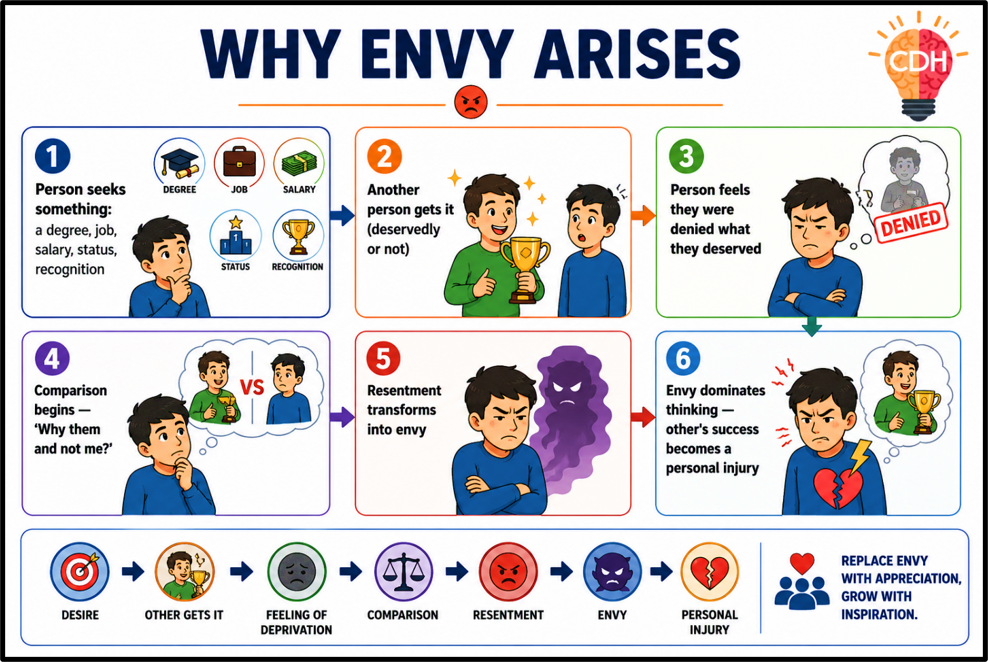
Envy is especially high within peer groups — among people of similar backgrounds competing for similar things. The Titus Livy quote captures this: ‘No man likes to be surpassed by those of his own level.’ We don’t usually envy people far above us (a poor farmer doesn’t envy a billionaire as much as he envies the slightly richer farmer next door).
Why Envy is Irrational
Envy is fundamentally irrational because: the riches or poverty of another make NO difference to our condition. Whether your neighbour gets a promotion or not literally does not change your salary, your skills, or your prospects.
Yet envy makes you miserable about something completely outside your control and irrelevant to your wellbeing. This is why Religions preach that we should love even our enemies — envy is the antithesis of this.
| 🏛️ UPSC Relevance In administration, envy manifests as jealousy between colleagues, sabotaging fellow officers’ careers, spreading false rumours about competitors, and a ‘crab mentality’ that prevents teams from functioning. Recognising envy in oneself and consciously combating it is a mark of emotional maturity and a requirement for effective leadership. |
SLOTH (LAZINESS)
💡 Understanding Sloth
Sloth is aversion to work or exertion — laziness and indolence. It is often an adult-acquired vice. Children are naturally energetic and curious. It is adults who, after securing a ‘safe’ job, gradually lose their drive and fall into comfortable inactivity.
The famous German sociologist Max Weber traced the origins of capitalism to the Protestant Work Ethic — the belief that hard work, punctuality, frugality, and honesty are sacred duties.
This work ethic created the institutional and attitudinal framework for economic progress. The opposite — sloth — leads to individual stagnation and national economic decline.
- Laziness reduces mental sharpness — the ability to analyse and synthesise information atrophies with disuse.
- ‘An idle mind is the devil’s workshop’ — sloth creates space for vices.
- In organisations, slothful employees become ‘parasites’ — they get marginalised and demoralised.
- Sloth is especially dangerous in public service where accountability is often weak — civil servants can coast for years on seniority.
AVARICE (GREED)
💡 Understanding Avarice
Avarice is the morbid, excessive love of money and material possessions. A key distinction: desiring enough money for comfortable living and family security is NOT a vice — it is a natural and even morally obligatory goal (in Hindu philosophy, ‘Artha’ is a legitimate dharma for a householder). Avarice begins when money-making becomes an obsession detached from any human purpose.
The psychology of avarice: money begins as a means to satisfy needs. Over time, the habit of money-making gets detached from its original purpose and becomes an end in itself. This is the classic psychology of the miser — Shylock in Shakespeare, Père Grandet in Balzac — for whom money-making becomes a compulsive addiction.
| Normal desire for wealth (NOT avarice) | Avarice |
| To meet family’s physiological and cultural needs | To hoard beyond any rational need |
| To have security in old age | Money-making as an end in itself |
| To be in a position to help others | Miserliness — refusing to help even when possible |
| Earned through legitimate means | Resorting to fraud, extortion, scams |
Gandhi’s view on wealth is instructive: ‘wealth is trust which the rich hold on behalf of the poor.’ The rich are under a moral obligation to share. The antidotes to avarice are charity, liberality, and philanthropy — as exemplified by Karna and King Bali in Indian mythology.
LUST
💡 Understanding Lust
Lust refers to excessive sexual desire. All religions condemn adultery and sexual exploitation. Adultery involves disloyalty to one’s spouse, violation of marital vows, and harm to children and family bonds — making it a form of untruthfulness and breach of trust.
The section particularly addresses sexual harassment in workplaces. Key points:
- Men in positions of power sometimes treat exploitation of subordinates as an extension of authority — this is an abuse of power.
- No one, however talented or exalted (artistic genius, political power, etc.) is exempt from common morality. George Orwell demolished the ‘Benefit of Clergy’ argument in a famous essay.
- Changing social situations — more women in workplaces, influence of permissive media cultures — require both institutional protections (POSH Act) and individual moral accountability.
| 🏛️ UPSC Relevance Sexual harassment at the workplace is a critical administrative ethics issue. The Prevention of Sexual Harassment (POSH) Act, 2013 and the Vishaka Guidelines lay down the legal framework. Civil servants must understand: power imbalances create vulnerability; victims face social stigma; perpetrators often use power connections to escape accountability. Creating safe workplaces is a fundamental administrative responsibility. |
MASTER SUMMARY: Virtues, Vices & Key Thinkers
| Concept | Category | Key Thinker(s) | Core Idea for UPSC |
| Kindness | Virtue | Aristotle, Dalai Lama, Tiruvalluvar | Helpfulness with no return; foundation of humanist and religious ethics. |
| Forgiveness | Virtue | Plato, MLK Jr., Seneca | Overcoming resentment through moral reason; not weakness, but a virtue with conditions. |
| Self-Control (Anger) | Virtue | Aristotle, Buddha, Gandhi, Seneca | Golden mean between total placidity and irascibility; anger controlled by reason is virtue. |
| Fortitude | Virtue | Locke, Bacon, Confucius, Plato | Guard of all other virtues; courage + reason; essential for moral courage in civil service. |
| Empathy | Virtue | Adam Smith, Alfred Adler, Goleman | Feeling WITH (not just for) others; foundation of emotional intelligence and citizen-centric service. |
| Altruism | Virtue | Auguste Comte, C.D. Broad | Living for others; opposite of selfishness; explains public service motivation. |
| Truthfulness | Virtue | Gandhi, Kant, St. Augustine | Foundation of social order; includes honesty, integrity, promise-keeping, avoiding breach of trust. |
| Power & Morality | Virtue-Vice Boundary | Lord Acton, Burke, Gandhi, Machiavelli | Power corrupts; must be checked by morality, institutions, and democratic mechanisms. |
| Prudence | Virtue | Aristotle, Aeschylus | Practical wisdom; finds the golden mean; enables all other virtues to function correctly. |
| Temperance | Virtue | Plato, Aristotle | Moderation in desires; foundation of self-discipline. |
| Humility | Virtue | Gandhi, Tagore, St. Augustine, Burke | Not self-debasement; recognising abilities without arrogance; foundation of compassionate service. |
| Golden Rule | Virtue / Moral Principle | Confucius, Bible, Mahabharata (Brihaspati) | Do unto others as you would have done to you; universal across all traditions. |
| Envy | Vice | Socrates, Antisthenes, Balzac | Resentment of others’ success; yields no benefit; destroys inner peace. |
| Sloth | Vice | Max Weber (counter-example) | Aversion to work; destroys productivity and character; idle mind is devil’s workshop. |
| Avarice | Vice | Gandhi, Aristotle | Morbid obsession with wealth; money as end not means; antidote is charity and liberality. |
| Lust | Vice | All religions | Excessive sexual desire; violations of dignity, trust, and marital bonds. |
| Pride / Vanity | Vice (Deadly Sin) | St. Augustine, Tagore | Excessive love of self; contempt for others; antidote is humility. |
CASE STUDIES
Case Study 1: The Intemperate Officer
Setting the Stage
Meet Rajveer Anand — tall, charming, born into an affluent landlord family, educated at a premier Delhi college, and now an Income Tax Officer in the Indian Revenue Service. On paper, he is the complete package. But scratch the surface, and you find a young man who never quite made the transition from carefree student to responsible public servant.
Rajveer’s weekends begin on Thursday night — discotheques, nightclubs, late-night parties with friends. By Monday morning, he stumbles into office long after the Income Tax Commissioner has already begun the weekly review meeting. And when questioned? He fabricates convincing stories. His subordinates, who know the truth, exchange knowing smiles.
| Key Concept | Aristotle’s Golden Mean: Every virtue lies between two extremes (vices). Temperance lies between indulgence and insensibility. Rajveer has clearly fallen into the vice of excess — indulgence. |
The Four Options — Let’s Examine Each
| Option 1 | Whatever Rajveer does outside office hours is his personal life and has no bearing on his official conduct. |
| Option 2 | His lifestyle is starting to undermine official discipline, involves dishonesty, and may violate the code of conduct for public servants. |
| Option 3 | It is the Commissioner’s responsibility to enforce discipline and ensure punctuality. |
| Option 4 | The fact that he fabricates convincing stories shows he is smart. |
The Deep Dive — Why Option 2 is Correct
Option 1 sounds liberal and modern, but it rests on a flawed premise. When Rajveer was a student, his late nights affected nobody else. But a public servant’s personal conduct is never entirely ‘personal’ — it bleeds into the official domain. His tardiness on Monday mornings is direct evidence of this spillover.
Option 2 captures the full ethical picture. Notice three distinct problems stacking up:
- Failure of temperance: He indulges excessively, lacking prudence. Aristotle would say he has no ‘golden mean’ in his lifestyle.
- Erosion of discipline: Being late at a critical weekly review meeting is not a minor infraction — it disrupts planning and signals disrespect for institutional processes.
- Moral turpitude through lying: Instead of correcting the root cause — his behaviour — he invents stories. Each lie compounds the problem. The moment his subordinates stop smiling and start talking, his credibility collapses permanently.
| Philosophical Anchor | Immanuel Kant’s Categorical Imperative: Act only according to maxims that you would want to be universalised. Can Rajveer universalise ‘All officers may lie about their tardiness’? Clearly not. |
Option 3 has a kernel of truth — yes, the Commissioner must enforce discipline. But Rajveer is a senior officer. Discipline at that level must be self-imposed, not externally coerced. Civil servants are expected to be leaders, and leaders do not wait to be policed.
Option 4 is perhaps the most dangerous response. It glorifies lying as a skill. A morally wrong act does not become acceptable simply because it is executed with confidence. Smartness must be judged by its moral direction — not its technical execution.
Key Ethical Concepts Illustrated
| Concept | Application to this Case |
| Aristotle’s Golden Mean | Rajveer lacks temperance — he indulges excessively in personal pleasures at the cost of official responsibilities. |
| Prudence | He fails to foresee how his habits will eventually destroy his credibility and career. |
| Moral Turpitude | Habitual lying is moral degradation. It corrodes the character of a public servant. |
| Hippocratic Parallel | Just as a doctor cannot abandon duty, a civil servant cannot abandon institutional responsibility for personal pleasure. |
| Trustworthiness | A public servant who cannot be trusted by subordinates has already lost half the battle of leadership. |
Case Study 2: Deviant Childhood Behaviour
Setting the Stage
Arvind Khanna is a senior executive at a multinational IT firm — cultured, successful, happily married. But something deeply unsettling is unfolding in his home. His 7-year-old son Chetan has, over the past two years, developed a disturbing pattern of torturing and killing small creatures.
It began with insects — cockroaches, worms — cut to pieces with a blade. But recently, Arvind discovered Chetan in a corner of their garden, vivisecting the family’s pet rabbit. By the time he intervened, it was too late. Chetan stood there, hands bloody, almost savouring the sight. The parents are alarmed and confused about what to do.
| UPSC Relevance | This case tests your understanding of child psychology, parental responsibility, and the ethical obligation to seek professional help when a situation exceeds personal competence. |
The Four Options — Analysed
| Option 1 | Ignore the incidents as childish pranks. |
| Option 2 | Explain to Chetan the importance of kindness towards animals and non-violence. |
| Option 3 | Take Chetan to a psychiatrist for professional counselling and treatment. |
| Option 4 | Do not let Chetan out of sight when he is alone. |
Understanding the Right Response
Option 1 — Ignoring the behaviour — is not just unwise, it is negligent. Vivisecting a pet rabbit is not a prank. Normal children, even mischievous ones, are naturally drawn to pets and enjoy their company. Chetan’s behaviour is the opposite of natural. Leaving it unaddressed allows the tendency to harden into something far more dangerous.
Option 2 — Moral counselling by parents — is well-intentioned but inadequate. Yes, parents shape values. But at age 7, with what appears to be a deeper psychological disturbance, verbal advice about kindness to animals will not reach the root of the problem. A child showing pathological behaviour needs medical diagnosis, not just moral lectures.
Option 3 is the correct response. Think of it this way — if a child had a persistent physical symptom, you would not simply advise them to ‘feel better.’ You would take them to a doctor. Mental and psychological symptoms deserve the same seriousness.
- Pathological behaviour often has identifiable root causes: trauma, neurological issues, emotional disturbance.
- A child psychologist or psychiatrist can diagnose the underlying condition.
- Early intervention dramatically improves outcomes. Left untreated, such behaviour can escalate to violence against people.
- Outbursts of cruelty often originate from frustration, unresolved trauma, or neurological differences — only professional assessment can determine which
| Remember | Seeking professional help is not a failure of parenting. It is, in fact, an act of the highest parental responsibility — acknowledging the limits of what love alone can fix. |
Option 4 — constant surveillance — is impractical. Parents cannot watch a child every moment. More importantly, it treats the symptom (opportunity) rather than the cause (behaviour). The child needs healing, not just containment.
| Option | Verdict | Ethical Reasoning |
| Option 1 | WRONG | Dangerous neglect — abnormal behaviour hardens when ignored. |
| Option 2 | PARTIALLY RIGHT | Moral guidance helps but is insufficient for a pathological condition. |
| Option 3 | CORRECT | Professional diagnosis and treatment is the ethical and responsible choice. |
| Option 4 | WRONG | Impractical and treats only symptoms, not the root cause. |
Case Study 3: Duty vs. Personal Grievance
Setting the Stage
Dr. Neeraj Verma is the sole MBBS doctor at Rampur Primary Health Centre (PHC) — an isolated facility in a tribal block headquarters. A year ago, the Sarpanch of Rampur village had asked him to issue a false medical certificate for someone who was perfectly healthy. Dr. Verma refused, as any honest officer should.
Since then, the Sarpanch has been blocking Dr. Verma’s application for a residential construction permit through the village panchayat — neither approving nor rejecting it. Classic administrative obstruction as revenge.
One early morning, with only a cleaner and a staff nurse present, news arrives: the Sarpanch’s son Bhavesh and his friend have met with a serious road accident and are being rushed to the PHC.
| Core Ethical Tension | Public duty vs. personal grievance. Dr. Verma has been wronged. The wrongdoer’s family now needs his help. What should he do? |
The Four Options — Dissected
| Option 1 | Ask the nurse to give primary care, claim to be unwell, and slip out through the back door. |
| Option 2 | Tell the nurse to call the accident victims and divert them, claiming the PHC lacks medicines and equipment. |
| Option 3 | Forget the personal grievance and give the accident victims the best possible medical care. |
| Option 4 | Inform the Sarpanch that because of how he handled the permit, Dr. Verma finds it psychologically difficult to treat his son. |
Why the Answer is Obvious — and Yet Worth Explaining
Options 1 and 2 both involve abandoning patients who need emergency care. Option 1 is cowardice dressed as illness. Option 2 is worse — it instructs the nurse to lie and divert patients. In both cases, the accident victims — who bear no personal responsibility for the Sarpanch’s misconduct — could die because of a doctor’s dereliction of duty.
Option 4 may seem refreshingly honest, but it is profoundly unethical. A doctor cannot make their psychological comfort a condition for treating a patient. Medical duty does not have an ‘opt-out’ clause for personal feelings.
Option 3 is the only correct answer, and for multiple, interlocking reasons:
- The Hippocratic Oath: Doctors are bound to ‘first, do no harm.’ This is not merely a ceremonial oath — it is the bedrock of medical ethics.
- The sins of the father: Bhavesh did not block the construction permit. He is an innocent victim. Punishing him for his father’s wrongs is morally indefensible.
- Public servant’s duty: A civil servant must discharge duties faithfully, even towards those who have wronged them. Personal grievances do not suspend public obligation.
- Justice through proper channels: If the Sarpanch has behaved improperly, Dr. Verma has recourse through official mechanisms — not by withholding emergency care.
| Philosophical Anchor | Mahatma Gandhi: ‘An eye for an eye makes the whole world blind.‘ Retaliation through dereliction of duty does not correct injustice — it creates new injustice. |
The Bigger Picture
This case illustrates a fundamental principle of public service ethics: the personal and the professional must remain separate. Dr. Verma’s grievance is legitimate. The Sarpanch’s obstruction was wrong and should be addressed — but through appropriate grievance mechanisms, not by endangering lives.
In fact, by treating Bhavesh with full dedication, Dr. Verma demonstrates the highest form of moral strength: the ability to rise above personal hurt and serve humanity without condition. That is precisely the character that civil services demand.
| Option | Verdict | Ethical Reasoning |
| Option 1 | WRONG | Abandons duty through deception; puts lives at risk. |
| Option 2 | WRONG | Instructs nurse to lie and diverts patients — double ethical violation. |
| Option 3 | CORRECT | Upholds the Hippocratic Oath, duty as a public servant, and moral courage. |
| Option 4 | WRONG | Makes psychological comfort a condition for duty — unacceptable in medicine. |
Case Study 4: Ego, Arrogance, and the Erosion of Bonds
Setting the Stage
Aditya Sharma and Vikram Malhotra became close friends at LBSNAA (the IAS training academy). Despite vastly different backgrounds — Aditya from a humble background, formerly a railway clerk who cracked the IAS through sheer hard work; Vikram from an elite family, schooled at a prestigious boarding school — their friendship flourished.
Aditya’s wife Kamla was equally warm towards Vikram. On holidays, Vikram would visit their home for meals and conversation. Then Vikram married Priyanka — a former beauty queen from an affluent family.
Slowly, things began to sour. Priyanka would make subtle remarks about her family’s superior status. She once speculated that Vikram would become the Chief Secretary of the state, if not the Cabinet Secretary to the Government of India. Vikram said nothing. And gradually, Aditya and Kamla’s warmth began to cool — fewer invitations, polite excuses, distance. Vikram is now wondering what went wrong.
The Four Options
| Option 1 | Aditya and Kamla may have grown jealous of Vikram and Priyanka’s success. |
| Option 2 | As careers diverge, people naturally drift apart — this is just life. |
| Option 3 | Workplace competition and rivalry have created this rift. |
| Option 4 | The root cause is Priyanka’s arrogant behaviour. Vikram must address this and encourage her to show humility. |
Peeling Back the Layers
Option 1 — jealousy — does not hold up. Aditya and Kamla were warm and affectionate towards Vikram for years, even knowing the differences in their backgrounds. They are not people who suddenly become jealous; they are people who have been made to feel inferior, repeatedly.
Option 2 — natural drift — doesn’t apply here either. The two friends are in close proximity. Physical distance is not the issue. Something specific triggered the withdrawal.
Option 3 — professional rivalry — is also not convincing. At this early stage of their careers, the two are not in direct competition for the same posts.
Option 4 correctly identifies the root cause. Priyanka’s comments — about her family’s status, Vikram’s predicted career highs, the implied hierarchy between them — have created an uncomfortable dynamic. Every time she spoke this way, she was (perhaps unknowingly) sending Aditya and Kamla a message: ‘We are above you.’
| Psychology Insight | Avoidance is a common response to feeling diminished. When people repeatedly feel inferior in someone’s presence, they withdraw — not out of jealousy, but out of self-preservation. |
What Should Vikram Do?
- Have an honest, gentle conversation with Priyanka about the impact of her remarks on others.
- Reinforce the shared memories and common experiences that originally built the friendship.
- Avoid conversations about money, career achievements, or social status when with Aditya’s family.
- Make a deliberate, warm gesture — invite them, show that the friendship still matters.
| Confucius Said | If I am walking with two other men, each of them will serve as my teacher. I will pick out the good points of one and imitate them, and the bad points of the other and correct them in myself. |
Case Study 5: Secularism, Equity, and Administrative Wisdom
Setting the Stage
Meenakshi Iyer, IAS, is the District Magistrate of a district with a predominantly Hindu population but a substantial Christian community. She herself comes from a family with strong religious inclinations.
The district has only one good town hall, controlled by the estate department under the DM. Every year, the Christian community uses this hall to celebrate Easter. This year, Easter coincides with a major Hindu festival — and both communities have applied for the same hall. To complicate matters, the institution where Hindus usually celebrate is under renovation.
| Constitutional Principle | Article 15 of the Indian Constitution prohibits discrimination on grounds of religion. A secular administrator must ensure equal treatment of all religious communities. |
The Four Options
| Option 1 | Deny the hall to both groups. |
| Option 2 | Pass a policy banning future allotment of the hall to any religious group. |
| Option 3 | Give the hall to Hindus as they represent the majority of the population. |
| Option 4 | Give the hall to the Christians for Easter, as has been the established precedent. |
The Administrative Logic
Options 1 and 2 are overreactions. Because two festivals coincide on one rare occasion, we need not create a blanket ban on religious events. That would punish all communities for a one-time scheduling conflict. Good administration does not over-legislate in response to exceptional circumstances.
Option 3 is the most dangerous option, because it invokes majority arithmetic to justify differential treatment of minorities. This directly violates the principle of equity and the constitutional guarantee of equal treatment. Meenakshi, as a secular officer, cannot let the size of a community determine its access to public facilities.
| Key Principle | Equity does not mean giving more to the majority. It means giving everyone their fair share based on established rights and precedent — not head counts. |
Option 4 is correct, and the reasoning is elegant in its simplicity: precedent. The Christian community has used this hall for Easter every year. That is an established, reasonable expectation. The demand from the Hindu community has arisen due to a temporary, exceptional circumstance (their usual venue being under renovation).
The DM should honour the precedent, explain the reasoning to the Hindu community with sensitivity, and use her administrative initiative to find an alternative venue for the Hindu festival. That is proactive, equitable governance.
Core Values Demonstrated
- Secularism: Equal treatment regardless of religious community’s size.
- Equity and Fairness: Established rights and precedents must be respected.
- Administrative Wisdom: Solving problems proactively rather than creating blanket restrictions.
- Sensitivity: Communicating decisions with empathy and explaining reasoning to all parties.
Case Study 6: Conscience, Honesty, and Consumer Ethics
Setting the Stage
Ramachandra Pillai orders an expensive wristwatch online. He is supposed to send a cheque, but genuinely forgets. The watch arrives by courier — and it comes with a ‘Paid’ sticker on the package, clearly an error by the company.
Now Ramachandra has the watch, has not paid, and the company has no idea there has been a mistake. What should he do?
| Option 1 | Make the payment immediately, without waiting to be asked. |
| Option 2 | Write to the company, alert them to the error, and confirm his obligation to pay. |
| Option 3 | Ignore the matter — there is no demand pending from the company. |
| Option 4 | Keep the ‘Paid’ sticker and use it to dispute payment if the company ever asks. |
Breaking It Down
Option 1 — paying immediately — seems like the most upright choice at first glance, and it is certainly not wrong. But here is the nuance: the sticker says ‘Paid.’ Ramachandra does not know with certainty whether the company ran a promotion, made a data entry error, or applied a discount automatically. Paying without clarification might lead to confusion or double-payment.
Option 2 is the most appropriate response. By writing to the company, Ramachandra does two things simultaneously: he confirms his knowledge of the obligation to pay, and he alerts the company to their error. This is both honest and prudent. It gives the company a chance to correct their records and tell him exactly how to make payment.
| Kant’s Moral Law | Act as if your action were to become a universal law. If everyone who received goods by mistake kept silent, the commercial ecosystem would collapse. Transparency is a civic and moral duty. |
Option 3 — ignoring the matter — is intellectually dishonest. Ramachandra knows he owes money. The absence of a demand does not extinguish the obligation. Conscience does not wait for an invoice.
Option 4 is outright fraud — attempting to exploit a company’s clerical error to avoid a legitimate payment. Even if legally disputable, it is morally unacceptable. It transforms an accidental beneficiary into a deliberate fraudster.
| Option | Verdict | Ethical Reasoning |
| Option 1 | ACCEPTABLE | Honest, though it bypasses clarification of the company’s error. |
| Option 2 | BEST | Combines honesty, transparency, and practical wisdom. |
| Option 3 | WRONG | Silent beneficiary; ignores a known moral obligation. |
| Option 4 | VERY WRONG | Deliberate exploitation of an error — moral and legal fraud. |
Case Study 7: Forgiveness, Proportionality, and Moral Maturity
Setting the Stage
You are at a crowded Mumbai suburban railway station. You have just come from the ticket counter, rushing to the platform. A stranger standing in line at another counter accidentally spits on your feet. There was no malice. When confronted, he immediately folds his hands and sincerely apologises.
What do you do?
| Option 1 | Take him to the Railway Police and file a formal complaint. |
| Option 2 | Rush to the platform — you need to catch your train. |
| Option 3 | Spit back at him. |
| Option 4 | Forgive him and caution him to be more careful in future. |
The Analysis
Option 2 — running away — is not cowardice exactly, but it is avoidance. It tells us nothing about your moral character. It is neither right nor wrong; it is simply irrelevant to the ethical dimension of the question. The examiner is testing your moral response, not your punctuality.
Option 3 — retaliating — is both foolish and ethically indefensible. The person did not spit at you deliberately. He was careless, not malicious. Retaliating with equivalent or greater force in response to accidental harm is a violation of proportionality.
| Gandhi Said | ‘An eye for an eye makes the whole world blind.’ Retaliation does not restore dignity — it merely transfers injury and multiplies social harm. |
| ‘Before you embark on a journey of revenge, dig two graves.’ Vengeance harms the revenger as much as the target — often more. |
Option 1 — filing a formal complaint — is disproportionate. The act was accidental, the apology was sincere, and there was no intent to harm. Using the formal justice apparatus for such an incident would waste public resources and punish a man who has already acknowledged his mistake.
Option 4 is the correct response. Forgiveness here is not weakness — it is wisdom. It serves multiple purposes:
- It acknowledges the offence without escalating it.
- The caution given to the person nudges him towards better public behaviour in future.
- It reduces the total social cost of the incident — no police complaint, no wasted time, no lingering bitterness.
- It models the kind of civil, mature behaviour that holds communities together.
| The Deeper Lesson | Forgiveness is a virtue because it breaks the cycle of harm. It frees both parties — the forgiver from the burden of grudge, and the forgiven from the stigma of guilt. |
Case Study 8: Conscience, Bandwagon Ethics, and Civic Responsibility
Setting the Stage
Suresh Yadav is your friend from a village whose surroundings were devastated by monsoon floods last year. The government provided cash relief for household losses, seeds for crop replanting, and compensation for standing crop damage.
Here is the twist: Suresh’s house is on high ground — he lost nothing. His agricultural land, being far from the flooded river, was also spared. But when it came time to file claims, he filed false ones anyway — just like everyone else in the village.
| The Ethical Question | Suresh knew he had not suffered any loss. He filed a false claim. Does the fact that ‘everyone was doing it’ make his act ethically acceptable? |
| Option 1 | Suresh should have made only genuine claims based on actual losses. |
| Option 2 | It is the government’s responsibility to verify claims — if they failed, it is their problem. |
| Option 3 | When everyone is cheating, one person cannot do anything differently — so joining the crowd is acceptable. |
| Option 4 | Governments give flood relief for political popularity anyway — benefits should be scaled down. |
The Conscience Argument
Option 1 is the correct answer, and its justification reaches deep into moral philosophy. Immanuel Kant wrote: ‘Two things fill me with ever-increasing awe: the starry sky above me and the moral law within me.’ The moral law is internal. It does not require external enforcement. Suresh knew he suffered no loss. His conscience told him the claim was false. He filed it anyway.
| Kant’s Insight | An act is wrong not because someone caught you, but because it fails the internal test of morality. The absence of verification does not create a moral permission. |
Option 2 — blaming government negligence — has a dangerous flaw. Yes, governments must verify claims. But that institutional failure does not transfer the moral responsibility away from Suresh. His obligation to be honest exists independently of whether the system catches him or not.
Option 3 — the bandwagon fallacy — is perhaps the most seductive and the most dangerous. ‘Everyone is doing it’ is one of the oldest excuses in human history for moral abdication. Let us be clear:
- If everyone is jumping off a cliff, does that make jumping moral? No.
- The popularity of an unethical act does not change its ethical status.
- Moral responsibility is individual, not collective. You are not absolved because others are equally guilty.
| Confucius Said | ‘I will pick out the good points of others and imitate them — and the bad points and correct them in myself.’ Others’ misconduct is a lesson in what NOT to do, never a licence. |
Option 4 misses the point entirely. The scale or motivation of government relief is irrelevant to the individual’s ethical obligation. Even if the government distributes relief liberally, Suresh has no right to a share he did not earn. The government’s potential mistakes do not create entitlements.
Summary of Ethical Principles — Case 8
| Ethical Principle | Lesson |
| Internal Moral Law (Kant) | Right and wrong are not determined by whether you get caught — they are determined by an inner moral compass. |
| Bandwagon Fallacy | The popularity of an unethical act never legitimises it. Moral responsibility is always individual. |
| Civic Virtue | Citizens have an obligation to use public resources only to the extent of genuine need — dishonest claims deprive truly needy people. |
| Conscience as First Auditor | Before any external audit, your own conscience evaluates your actions. Suresh had already failed this test. |
One Comment