
Evolution of International Trade
Let us understand this as a chronological journey—from ancient civilizations to the modern global economy. Imagine we are unfolding a story across centuries, where trade evolves not just as an economic activity, but also as a political, cultural, and strategic tool.
Ancient Beginnings: The Silk Route
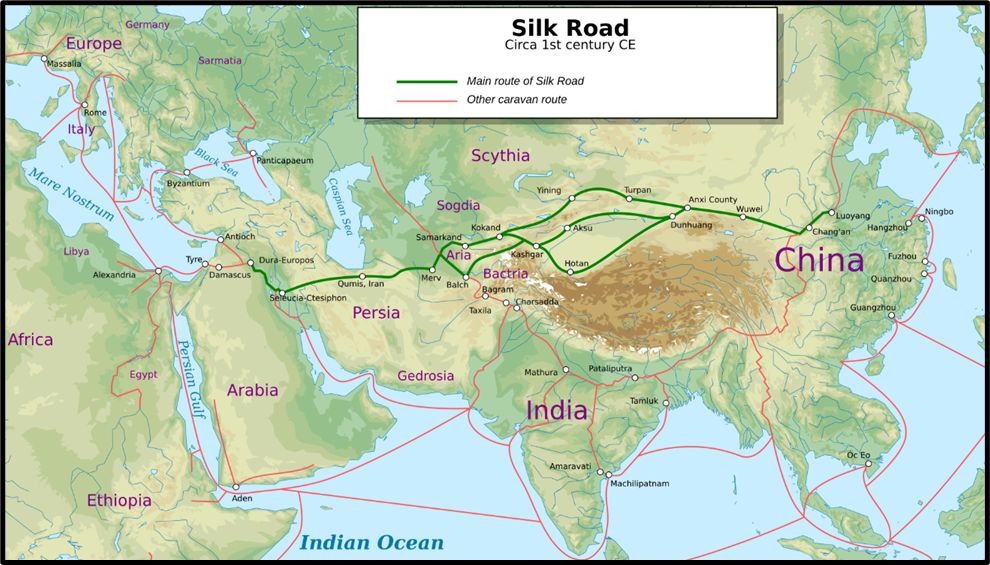
- The Silk Route is one of the earliest examples of long-distance trade. It stretched approximately 6,000 kilometers, connecting Rome in the West to China in the East.
- Now, don’t get misled by the word “silk” alone—it was much more than that. Spices, precious stones, ceramics, and even ideas and religions travelled along this route.
- Think of it as the ancient world’s version of globalization—where distant empires exchanged goods, culture, and even diplomacy.
The following figure shows an illustration of Silk Road in the 1st century:
Medieval Revival of Trade
- After the disintegration of the Roman Empire, Europe experienced a period of stagnation. But by the 12th and 13th centuries, commerce began to revive.
- What played a critical role? The development of shipping.
- This allowed trade between Europe and Asia to flourish again. Ports like Venice and Genoa in Italy became major hubs.
- Trade shifted from being just overland (like the Silk Route) to also being maritime—faster and capable of carrying bulk goods.
Age of Colonialism and Emergence of Slave Trade
- From the 15th century onwards, we see the dawn of European Colonialism.
- European powers—Portuguese, Dutch, Spanish, and British—ventured into Asia, Africa, and the Americas, seeking spices, gold, and territory.
- A dark chapter begins here: the Slave Trade.
- These European powers captured African natives and transported them forcefully across the Atlantic.
- The goal: to make them work on plantations in the newly “discovered” Americas (a euphemism for colonization).
- Slave trade became a lucrative economic system for more than 200 years.
- But gradually, abolition movements gained momentum:
- Denmark abolished it in 1792,
- Great Britain in 1807, and
- The United States in 1808.
- But gradually, abolition movements gained momentum:
Industrial Revolution and Trade Transformation
- The Industrial Revolution was a turning point. It altered the nature of trade fundamentally.
- Industrialised nations needed raw materials like:
- Grains, meat, wool, etc.
- However, here’s the twist: even as demand increased, the monetary value of these raw materials declined compared to manufactured goods.
- This is key. Think of a cotton farmer in India getting pennies, while a British textile mill selling shirts for pounds.
- Hence, the core-periphery dynamic evolved:
- Core (Industrialised Nations): Export value-added finished goods.
- Periphery (Colonial/Non-industrialised Regions): Export primary products or raw materials.
Shifting Trade Patterns in the 19th Century
- By the late 19th century, the importance of raw-material-producing regions started to decline.
- Why? Because now, industrial nations began trading more among themselves.
- Example: Britain trading with Germany, or France with the US.
- This marks a shift from vertical trade (between developed and developing regions) to horizontal trade (between developed countries).
Impact of the World Wars
- World War I and II disrupted this global trade network.
- For the first time, countries started using tools like:
- Trade taxes (Tariffs)
- Quantitative restrictions (Quotas)
- These were done for economic protectionism and strategic autonomy during wartime.
Post-War Liberalization of Trade
- After World War II, there was a recognition that restrictive trade damages global economic health.
- So, institutions were formed to liberalize trade and promote cooperation.
- The most important one: GATT (General Agreement on Tariffs and Trade).
- Later evolved into the World Trade Organization (WTO).
- Purpose: to reduce tariffs, remove trade barriers, and ensure a rules-based global trade system.