
Fa-Hien’s Visit to India
Who Was Fa-Hien? The Man Before the Journey
Let’s start with a key question: why did someone leave China in 399 CE to walk to India?
Fa-Hien (also written Faxian) was born in 337 CE in Pingyang Wuyang — today’s Linfen City in Shanxi province. He was orphaned early and spent his formative years in Buddhist monasteries. Now here is the trigger moment: during a visit to Chang’an (present-day Xi’an), he saw the Vinaya Pitaka — the code of conduct for Buddhist monks and nuns — in a torn, incomplete, and weathered state. This disturbed him deeply. He thought: if the text has deteriorated this badly in China, perhaps the original, complete versions still exist in the land where the Buddha walked.
That personal conviction became a historic journey. At the age of 62, accompanied by 4 others, he set out westward from Chang’an. He was not a king’s ambassador. He was not a diplomat. He was a determined monk on a religious quest.
The Route: A Walking Map of the Ancient World
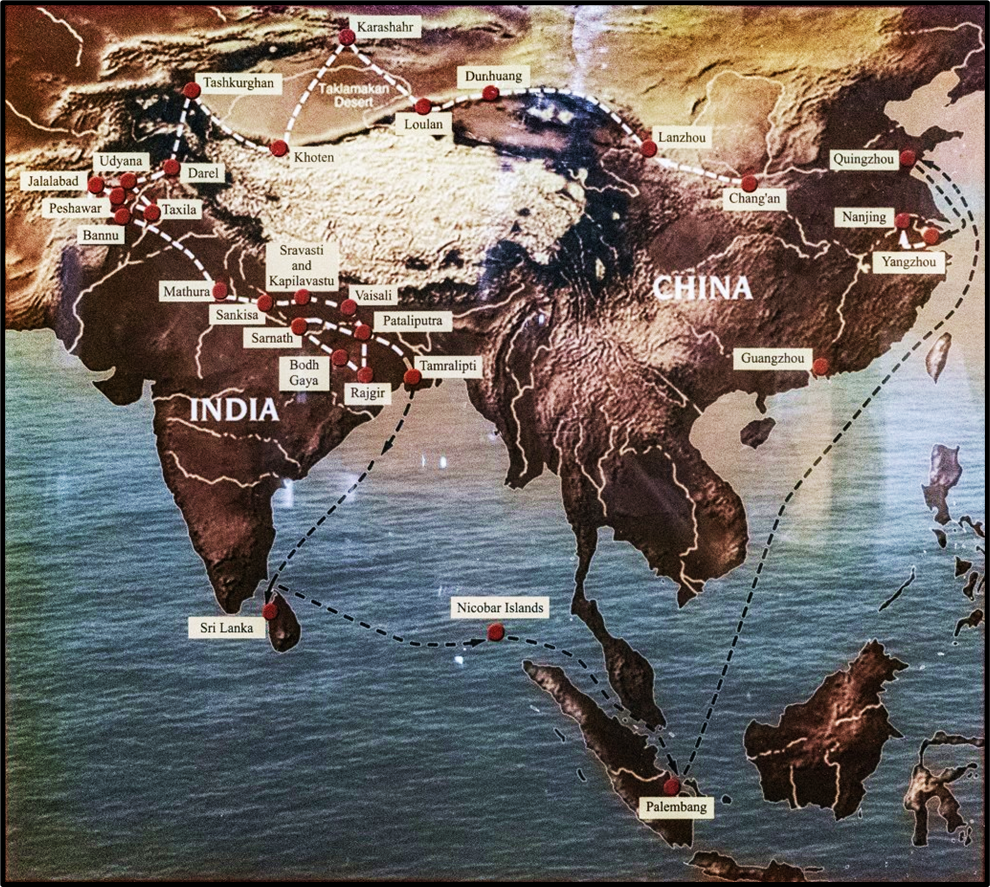
Let’s trace the journey geographically — this is very useful for map-based questions in Prelims.
He crossed Central Asia, passed through Purushapura (modern Peshawar), where he recalled the Buddhist legend that the Buddha had prophesied the rise of King Kanishka who would build a magnificent stupa there. He then entered the Indian subcontinent from the northwest — the classic entry point for foreign travelers in ancient India.
He traveled through Northern India, noted the unfamiliar vegetation (he only recognized bamboo, pomegranate, and sugarcane from China), and made his way to several cities of great Buddhist significance: Taxila, Mathura, Sravasti, Sarnath, Bodh Gaya, Vaishali, Rajgir, Kannauj, and finally Pataliputra.
From Pataliputra, he followed the Ganga eastward to Champa, and then reached Tamralipti (in present-day West Bengal) — an important port city. From Tamralipti, he sailed to Sri Lanka, where he spent two years. He even visited Lumbini, the birthplace of the Buddha, and there is a cave in the Kalutara district of Sri Lanka named after him — suggesting he resided there.
His return journey was by sea — a dangerous route — back to China.
Source – https://www.wisdomlib.org/gallery/galle-national-museum/7789
The Context: Which King’s India Did He See?
Fa-Hien visited India during the reign of Chandragupta II (Vikramaditya) — the golden age of the Gupta Empire. But here is the remarkable thing: he never once mentions Chandragupta II by name. He simply inferred the quality of governance from what he observed around him.
His travelogue was not a political document. It was a pilgrim’s diary.
What Did He Find? His Four Key Observations
1. Political & Administrative Conditions
Fa-Hien’s political observations are inferential, not direct. He noticed:
- Administration was liberal and benevolent
- Taxes were light — land revenue was the primary source
- Corporal punishment was rare, and the death penalty appears to have been absent
- Fines were preferred over physical punishment
- People could move freely from one region to another
- Monasteries, temples, and religious endowments were exempt from taxes — a detail of huge significance for understanding Gupta-era state-religion relations
- Rest houses (dharmashalas) and hospitals were built by kings and wealthy citizens — free medicine for the poor
Think about what this tells you: a state where taxes are low, movement is free, punishment is humane, and religion is state-supported — that is the hallmark of a mature, confident imperial administration.
2. Religious Conditions
Fa-Hien observed religious tolerance as the defining feature:
- Buddhism and Hinduism flourished side by side
- Buddhism was stronger in Punjab, Bengal, and the region around Mathura
- Hinduism dominated the ‘middle kingdom’ — essentially Uttar Pradesh, Bihar, and parts of Bengal — the Gupta heartland
Notice the geographical distribution: Buddhism thriving on the periphery, Hinduism strong at the centre of Gupta power. This is not coincidence — it reflects the Gupta kings’ own Brahmanical orientation while allowing Buddhism to flourish.
3. Social Conditions
This is the most vivid section of his account:
- People were largely vegetarian — avoided meat, onions, and alcohol
- Public morality was high and people were content
- The rich competed in acts of charity and benevolence — funding hospitals, temples, and monasteries
- Society was peaceful and prosperous
He was particularly impressed by Mathura — describing it as prosperous and peaceful, with most people being teetotalers and vegetarians. He found Malwa’s climate praiseworthy as well.
4. Economy & Trade
Fa-Hien gives us valuable economic data:
- Both internal and external trade were in a progressive state
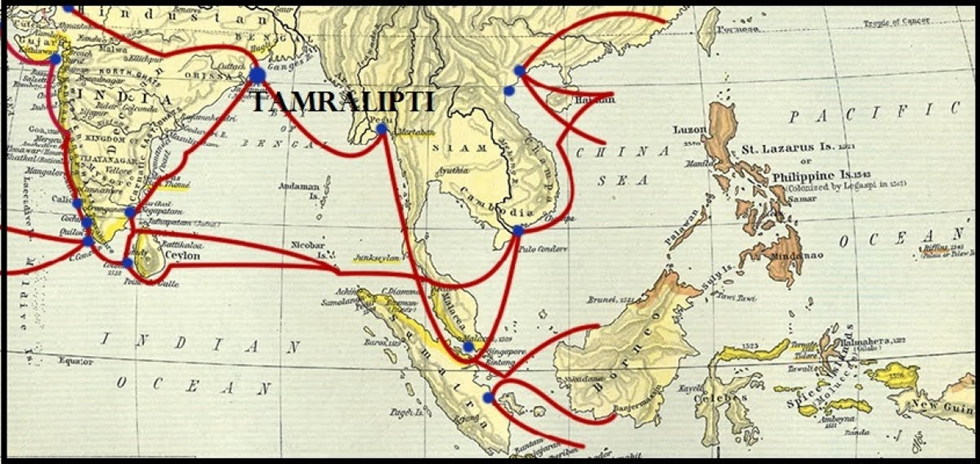
- Sea voyages were conducted by Indians — important evidence of maritime activity
- Western coast ports: Cambay, Sopara, Baroach (Bharuch)
- Eastern coast: Tamralipti1 (in Bengal) — it was from here he sailed to Sri Lanka on an Indian ship (not a Chinese one — note this!)
The Travelogue: Fo-Kwo-Ki
He compiled all his observations into a text called Fo-Kwo-Ki — also translated as A Record of Buddhistic Kingdoms or Faxian’s Account. After returning to China at age 77, he spent his remaining years translating Buddhist texts alongside the Indian monk Buddha-Bhadra. He died at 88 in Jingzhou.
Here are the analytical connections:
Why does Fa-Hien matter beyond his pilgrimage? Because he is one of the very few contemporary witnesses to the Gupta golden age. Inscriptions tell us what kings claimed about themselves. Fa-Hien tells us what an independent observer from another civilization actually experienced on the ground. That is an entirely different category of evidence.
Why did he not mention Chandragupta II? Because his purpose was religious, not courtly. He was documenting monasteries, Buddhist viharas, the state of the Dhamma — not the political calendar of a dynasty. This is important: absence of a name is not absence of a king.
What does his account NOT tell us? His silence on political matters is itself a source. It suggests either that the administration was so smooth it was invisible to a traveler — which is actually a great sign of good governance — or that his interests simply lay elsewhere.
The Chariot Procession detail: He was deeply moved by the annual procession on the eighth day of the second month where images of the Buddha and Bodhisattvas were carried on chariots. This tells us that by the 5th century CE, Buddhist traditions had incorporated elaborate public ritual — a fusion with the popular religious culture of India.
Ashoka’s Palace: His famous remark that it seemed “built not by men but by gods” is a literary flourish — but it also confirms that Mauryan structures were still standing and still awe-inspiring 600 years after Ashoka. That is extraordinary information for architectural and historical continuity.
- UPSC Prelims 1999 ↩︎
One Comment